

Why peace in the Middle East benefits me and my horse

Trucks ad trailers at a recent horse show
Kathy Lundberg | Contributor
The price of fuel depends on supply and demand, as well as expectations about what future supply and demand might be. Of the 80-90 million barrels of oil produced each day in the world, the U.S. accounts for about 10 percent, and the Middle East region for about 30 percent.
It may take up to 30 days for oil to be lifted from the ground and delivered to the refinery, and another two weeks to be refined. Shipping refined oil products to the site of retail may take several more weeks, until it arrives as fuel in our cars' and tractors’ tanks.
Disruption in the supply of crude oil, as may be caused by political instability, has price implications for months down the line. The U.S. disproportionately consumes about 25 percent of oil produced, and the emergence of a middle class in developing countries means increase in worldwide demand for energy.
Since the invention of the internal combustion engine in 1895, human dependence on horse power dramatically declined as fossil fuel use soared. Paradoxically, the U.S. horse industry is now largely dependent on oil.
Instead of using horses to transport ourselves, we now transport them. The cost of maintaining a horse, feeding and dealing with waste is heavily influenced by the price of oil.
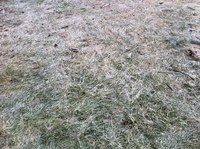
Dormant hay field: Energy is used to produce quality forage.
Kathy Lundberg | Contributor
The saying to “eat like a horse” has a basis in fact: they eat about 2 percent of their body weight each day. The foundation of the horse’s diet is forage: grass or its dry-preserved form, hay.
To prepare a field for hay or pasture, ground is tilled, sometimes several times over to ensure a relatively smooth surface. Weed killer is applied, or the “hay” will be inedible, occasionally poisonous weeds. Fertilizer may need to be applied.
The tractor cuts the ripe hay, goes over it the next day with a hay tedder to facilitate even drying and, on the third day, bales it into the square or round shapes we know. Bales (50-70 pounds for small square ones, up to a ton for large round ones) are then trucked around the country.
The price of hay varies widely. In summer, hay is generally cheaper (demand is lower due to grass availability, and supply is greater as hay is in season). In our area, prices rise to $7 per small square bale — in the south and west you may pay much more. In the winter, horses with high metabolisms may eat a square bale of hay per day; a Shetland pony may eat one per week.
In addition to hay, horses are often given concentrated feed such as grains and pelleted feed to add calories, amend nutrition when quality forage is not available or simply due to human preference.
These materials are also planted, harvested, processed to varying degrees, packaged and shipped — all energy dependent processes. Prices vary widely according to content, but generally range from $10-25 per 50 pound bag. A horse may eat no concentrated feed, or may eat a bag or more per week.
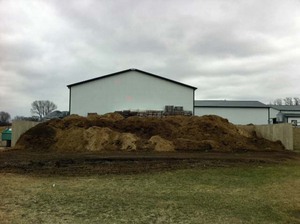
Manure in storage, to be spread on fields
Kathy Lundberg | Contributor
We have talked about what goes in, but processing waste is also energy dependent. Stalled horses use bedding. Historically this was straw ( the stems of harvested grains such as oats or wheat).
Most commonly some form of wood shaving is used. Today’s premium shavings are kiln-dried, screened, pine. It is purchased loosely by the truckload and stored to protect from moisture, or compacted in plastic bags that are easier to store and handle but that require further processing and packaging.
According to bedding style, each horse may use up to a bag of shavings per day, at up to $7 per bag in our area. After use, the soiled bedding and manure (yesterday’s choice hay and feed) are collected and usually stored in a pile outside, which begins to compost. Composted soiled bedding can be loaded into a manure spreader, hauled to the field via diesel powered tractor, and spread in lieu of commercial fertilizer to replenish the soil.
In some ways, caring for and working with horses is a refuge from common day-to-day concerns. Even then, we cannot escape the implications of bigger geopolitical issues.
Kathy Lundberg is a regular contributor on AnnArbor.com's pet section where she addresses topics regarding horses. She is owner of Scio Church Stables. She welcomes your contact via email.
Comments
Trumpet
Thu, Mar 17, 2011 : 1:16 p.m.
Thank you Kathy, this is an informative article and, oh so true. Horsepeople work hard to maintain their ability to participate in their sport, and this is one large aspect of it all. I think often wonder if people realize the many layers of responsibilities, and the physical work that is involved in keeping healthy horses. I always enjoy your sharing with us all.