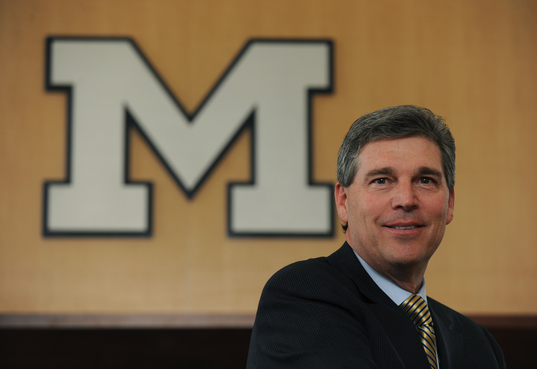
David Brandon, CEO of Domino's Pizza, was named the new Athletic Director at the University of Michigan on Tuesday.
Lon Horwedel | AnnArbor.com
As David Brandon begins his transition from CEO of Dominos to Michigan’s next athletic director, there is a group of people who understand that process.
Fred Glass and Morgan Burke made the transition from the law and business worlds to athletic directors at Indiana and Purdue. The first year, they said, brought more challenges than anticipated.
“I got to say the first year felt like driving too fast on the interstate with the headlights off,” said Glass, who recently completed his first year at Indiana. “I didn’t know what was coming next. Everything was new, every season was new, every Big Ten meeting was new, so there’s some comfort in being one full lap around the track.”
As Brandon’s prepares for his first year, other athletic directors in the Big Ten and commissioner Jim Delany explained what Brandon’s biggest challenges might be in his first year on the job.
Indiana athletic director Fred Glass
“He will be very well served by his experience as a student at the University Of Michigan. I think I’ve been very well served being a student here at IU,” Glass said. “IU is in my blood. I know all the nooks and crannies on campus, all the nooks and crannies in town. I’ve had common experiences with the alumni. He’ll be served well by his status as an alumnus and he’ll be very well served by his service on the Board of Regents.”
“One of the biggest challenges I’ve had is understanding the bureaucracy and the politics and the machinations of the university as a organization. Every organization has those things, universities do too and I think he’ll be very well served knowing how it works from his service on the board. I think most significantly just being a businessman and taking a businessman’s approach to running the department will serve the university well."
Big Ten commissioner Jim Delany
“There are transition challenges simply because of the pace. I’m not familiar of what it is to be a corporate CEO as I’ve spent most of my career around higher education but you get glimpses. I think in our area it’s the multiple constituents, stakeholders that you may have customers, but you have to be responsible to your customers in a way that’s a little bit different. Every one of your coaches is a stakeholder, every student-athlete is a stakeholder. You have half-a-million living alums, you’ve got the academic community, you’ve got the media. You’ve got a variety of interested parties that you’re balancing and managing.”
“You also have a news cycle that I think is much quicker than I think sometimes people are used to. And so, but I think as a CEO of a company you have a lot of exposure to that. My experience as people make the transition is just sort of a sensitivity to the multiple stakeholders and doing that in an appropriate way and you’re still leading and also managing the very bright-line news items potentially coming across your desk in an unsequenced and unpredictable way.”
Purdue athletic director Morgan Burke
“One is understanding the pressures that are upon the coaches, particularly the revenue sport coaches and understanding the environment in which they operate, understanding enough to gain their respect and trust is an important component.”
"The other thing that is different is in the business world, we were used to, profit wasn’t a dirty word and you were encourage to look for how to reduce your cost or raise your revenue or both and you certainly have those same responsibilities within a self-sustaining auxiliary, which most athletic departments in the Big Ten are, but we’ve got to pay our own bills but you are constrained by university policy and you should be.
“I don’t assume that to be a negative but the overall environment that you operate will probably have more constraints on you than I probably anticipated when I came in. So the things I would have done if I were running Purdue Athletic Inc. independent of the university, things I might do with marketing and sponsorships might be much different. At that point in time, you have to understand the culture of your institution, what works and what doesn’t work. You push the envelope but you don’t jump off the cliff.”
Minnesota athletic director Joel Maturi
“David has been in a highly-visible circle, but when I was in the AD’s chair, even though I had been involved in collegiate athletics as an associate AD at Wisconsin, which is a highly visible program, too, I learned very quickly the media, quite frankly, and the visibility of the position and I don’t know if you can be prepared for that. Maybe his background prepares him more for that because Dominos, give me a break, when he speaks, people listen, you know. They have billions of dollars of sales each and every year. But for me, that was one of the real eye-openers for me even though I’d been around it every day most of my life. But until you sit in that chair, I didn’t realize how many people wanted to speak to me, whether it is e-mails or text messages, phone calls, interviews, working with coaches and collegiate teams, that was as much of an eye-opener for me as anything else.”
“I come from an educational background but one of the other challenges working at a Big Ten institution like Michigan is the sensitivity that goes along with the corporate aspect. For example, Michigan has no sponsorship or advertising within its facilities and that’s very important to Michigan and I’m very respectful and envious of that take. But my belief is some day that will change only because financially, there’s millions of dollars being left there and eventually it’ll get to the point where you need to take a deep breath and swallow some of what is the right thing to do versus the need to make certain you are operating fiscally responsible. And at Michigan has the benefit of 110,000 people each and every Saturday might let them continue down that path but it’s a challenge we faced here at Minnesota.”
Michael Rothstein covers University of Michigan sports for AnnArbor.com. He can be reached at (734) 623-2558, by e-mail at michaelrothstein@annarbor.com or follow along on Twitter @mikerothstein.


Comments
heartbreakM
Thu, Jan 7, 2010 : 9:39 p.m.
Interesting comments. Thanks for posting. Just one thing: Maturi from Minnesota does not sound like he learned a thing about talking to the press. He gave a long-winded, garbled comment, to which I am shaking my head and saying, "what?"