

Blame should go everywhere for Michigan football team's second-half struggles
It’s as if the Michigan football team is following a script.
First half: Hang in the game, even dominate. Second half: Fall flat.
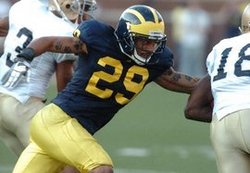
Troy Woolfolk, shown earlier this season against Notre Dame, says, "I'm kind of frustrated myself," about Michigan's struggles on defense this year. (Melanie Maxwell | AnnArbor.com)
Since then, it’s been a cavalcade of errors and missteps for Michigan - most of them coming after halftime as the Wolverines have lost five consecutive Big Ten games.
“I don’t know what it is,” junior cornerback Troy Woolfolk said. “And I’m kind of frustrated myself. It’s too far in the season to still be making those mistakes. We just have to fix it.”
Michigan has been outscored, 135-111, in the second half and overtime this season. While that may not sound that bad, consider this: In Michigan’s last three losses, the Wolverines have been outscored 75-12.
Even worse, Michigan has been outgained in total yardage after halftime in those three games, 836-492.
In two of those second halves - Penn State and Illinois - Michigan was shut out. Against Penn State, the Wolverines had 100 yards of offense after halftime.
And the yardage numbers scream that it isn’t just a defensive problem. It’s an offensive problem, too, for the better part of the Big Ten season.
“It’s just a matter of playing better,” Michigan coach Rich Rodriguez said. “If you go look at, you know, second halves all year from the beginning of the year to the end of the year, it’s just a matter of us, like I said Saturday, a matter of playing better.”
Part of it is on Michigan’s players. Every player Michigan has brought in front of the media has said it’s the players on the field making the plays.
But the players aren’t all to blame. Part of it absolutely is coaching, be it during the week or on game days. Often this season, Michigan’s players or defensive coordinator Greg Robinson have said the opponent showed the Wolverines something they didn’t expect.
In many ways, it is on the coaches to prepare players for everything.
Also, playing well in the second half comes down to making adjustments. Rodriguez said there isn’t enough time at halftime to make major changes but that coaches can make “minor adjustments here or there.”
Except that every Big Ten team Michigan has adjusted better than the Wolverines after halftime. That goes for the best teams in the league (Penn State) to the mediocre (Purdue) to one of the worst (Illinois).
Doesn’t matter the staff or the school. The result remains the same.
“You got time to make some adjustments,” Rodriguez said. “Not like you have a whole week to get ready. Not as much as people think. Everybody talks about halftime adjustments. Really, this is what’s happening, this is what you’re seeing, kind of calm them down then just go play.”
There’s also the question of whether conditioning has anything to do with Michigan’s second-half woes. The more tired players are, the easier it is for them to lose focus and make mental mistakes.
Considering Michigan’s defense is on the field, on average, seven more minutes a game than its offense this season, it’d make sense if the Wolverines were a bit fatigued - Mike Barwis-trained or not.
Rodriguez, though, wouldn’t hear of it.
“Do we look out of shape?” Rodriguez asked the questioner. “I don’t think so.”
When pressed about conditioning and second-half collapses, Rodriguez got even shorter.
“No,” he said.
All of this might be the biggest problem of all for Michigan. Everyone acknowledges there is a problem after halftime. Thing is, no one seems to be able to pinpoint how to fix it.
And time - for a bowl game, a successful season and the ability to remedy what ails Michigan - is running out. Fast.
Michael Rothstein covers University of Michigan sports for AnnArbor.com. He can be reached at (734) 623-2558, by e-mail at michaelrothstein@annarbor.com or follow along on Twitter @mikerothstein.
Comments
mlivesaline
Tue, Nov 10, 2009 : 1:37 p.m.
Stick a fork in them
Danny
Tue, Nov 10, 2009 : 1:28 a.m.
Not so fast my friends! Until Mary Sue and the new AD? say it's time for RR and assistants to go, they are going to be around for awhile. Ofense looks pretty descent for what we have. Put up 36 points you expect to win unless the other team puts up 38 points. Even when Gardner shows up, that will not help the defense. I would love to see Jim H. come to Michigan, however I am in a love hate relationship with RR at the moment. Love his ofense, hate his defense. What did BO Schem say for years, Defense wins games. But he always had a decent offense to go with it. Tate Forcier reminds me a little of Rick Leach, except Tate can read defenses better than Leach could. We need to focus on Defenseive players in upcoming recruiting. Mean, skilled nose guard, fleet and smart safetys and corners and throw in a couple hard nosed linebackers. Thats my XMAS wish list for Michigan. GO BLUE ALWAYS Dan
ConsiderHarbaugh
Tue, Nov 10, 2009 : 1:28 a.m.
Jim Harbaugh is at the perfect stage of his career to bring in now for a nice long era of dignified, high-caliber Michigan football.
wolverinesrockdahouse
Mon, Nov 9, 2009 : 10:14 p.m.
After watching this game in person, I must say emotion is seriously lacking. The boys look deflated even with a lead. Something doesn't seem to be clicking, it's like they can't believe they are winning and then suddenly reality hits after half-time. I didn't notice much hustle on or off the field and that can be directly attributed to the coaches. Where is the coaches spark??? I mean to butcher a 4th and 1 bad enough to be called for a delay game, WTF??? ESPN printed an article on Michigan's D, analyzing most every player individually. Not good. And since when does such a storied team as Michigan even recognize a walk-on??? The program is being washed down the toilet. Our offense is giggling the handle trying to get it to stop, our coaches are watching it spin saying "we need more time, we need another recruiting class," and our defense can't even find the lid to grab the float ball... I've never been a RR fan. Harbaugh would be awesome. Hopefully the alumni are looking. I love Michigan football and I'm disappointed with what it has become. We need to rebound quickly or we'll become that joke up north, not "the team."
tomhagan
Mon, Nov 9, 2009 : 9:49 p.m.
Looks like Barwis does not = decided physiological advantage.
Point_Given
Mon, Nov 9, 2009 : 9:12 p.m.
I definitely agree that the D-coord should have his people under him as opposed the the HC's people... especially when the D that's being taught is somewhat more sophisticated than an average college D (I'm not a football genius and I don't pretend to understand the nuances between what G-Rob wants and what most college Ds do). That's just what I've been led to believe by what I have read. But, when the most prized defensive recruit in a class can't perform on or off the field (BoobieCar Cisoko) I think it indicates a serious lack of attention to that half of the recruiting game. Rich is known to be an 'offensive genius' and he seems to care more about that part of recruiting. True, he would have a better recruiting class at Bama... but, I think it would still be very heavily tilted toward the offense and in a year like this where D seems to rule the SEC, he'd be in big trouble IMO. He'd probably still be there, but I think the welcome mat would be getting pretty thin and he'd be feeling more heat than he does in Ann Arbor right now. I supported his hiring when it happened, and acutually right up until this past Saturday evening. He probably will get at least a couple more years (barring a big NCAA hammer hitting him), and I truly do hope he can lead the program around the corner next year like some think he can. But, until I see it, I'm now going to remain doubtful. I just don't think he's the right guy for the task. Hopefully, he will prove me wrong.
chosen1
Mon, Nov 9, 2009 : 8:35 p.m.
But when you look at how obi has regressed (Jay Hopson is his position coach), how mouton and brown can meet ball carriers and miss tackles, then there is a possible issue with coaching. How can Vlad Emilian be on campus early and still not even be a thought in the rotation if Tony Dews was coaching him up? Our secondary is a mess. All I'm saying is these guys may be great guys and possibly good coaches, but isn't is fair to let G-Robinson get his type of coaches in here to run his defensive scheme? I do think Rich would still be at alabama and I think it's a very real possibility that he could've had a better recruiting class there this year than Saban did. I think his system could work there. I think next year will let us know for certainty if it's going to work or not. But while Michigan will return many starters, so will most of the other teams in the big 10 (unless there is a major junior movement to the pros)
Point_Given
Mon, Nov 9, 2009 : 8:10 p.m.
oooops. The fingers got faster than the brain. That question was for Chosen 1, not Hopson.
Point_Given
Mon, Nov 9, 2009 : 8:05 p.m.
hopson, the D coaches simply don't have the athletes to coach (with the exception of a very select few that are mostly holdovers from Coach Carr). They can teach tackling and coverage until they're blue in the face, but without the speed, strength and athleticism to compete at the required level they might just as well focus on the proper techniques for underwater basket weaving. They (the D coaches) are stuck with this bunch of under achievers because the Big-man-in-charge has focused on recruiting the kind of players that make his gimmick offense work -- and they don't even do so well at that after halftime. Michigan football is rotting from the top down, and it seems a bit unfair to pin the blame on the assistant coaches when they only have the tools (literally and figuratively) that RR has shortsightedly given them. The Big10 ain't what it used to be, unquestionably... but it damn sure ain't the Big East either. Does anybody here think that RR would still be at Bama if he had gone there the year before we "snagged" him away from WVU? I highly doubt it.
chosen1
Mon, Nov 9, 2009 : 7:18 p.m.
The problem is we have defensive position coaches who are friends of rich, but they aren't earning their money. Rich would be wise to go to G-Rob and say if you need to replace them to help out the team then that's what we do. It's still the same as last year...a DC with the HC's buddies. DC needs guys that know his system to help coach up the team. Though teaching tackling and coverage shouldn't be rocket science. However, it's time for Hopson, Tall, and Dews to take a hike.....they aren't earning their keep with their lack of coaching skills....
Lemansblue
Mon, Nov 9, 2009 : 6:58 p.m.
RR out. He cannot make adjustments at half because all he has is to try to surprise the other team and if that does not work he has nothing else. Hurry up offense is brilliant when your own D is gassed. Coach Harbaugh in. Do not wait for another team to get him long term. He would be a great hire. He knows the Big Ten!!!
LakeErieMaize/Blue
Mon, Nov 9, 2009 : 6:44 p.m.
The half-time adjustment or lack their of does not sound well Coach............It just doesn't sound well!!!!RR will learn that the less he says,THE BETTER!!!Especially to his "FRIENDS": The Media!!! Lets GO BLUE!!!
azwolverine
Mon, Nov 9, 2009 : 6:33 p.m.
And I thought coaching was complicated. If I'd have known long ago that all I had to do was to tell a group of college football players to "play better," I'd be making 2.5 million dollars right now! Maybe I'd get 3 million if they listened.
Point_Given
Mon, Nov 9, 2009 : 6:02 p.m.
Hmmmmmm. If halftime adjustments don't exist, I wonder what the hell those other teams are doing at halftime that leads to us being thrashed 75-12 in the last three 2nd halves we've played? It's time to run RR, Barwis and their snake-oil peddling cronies out of town (and someone should sneak into Martin's office an flip his calendar ahead to Sept. 2010 too, lest we end up with the soon-to-be-available Chuckie Weis for our next coach.)
Hogan
Mon, Nov 9, 2009 : 5:41 p.m.
I just heard an incredible stat, Since Bo Schembechlers death in 2006 Michigan is 7th in total Big Ten wins only ahead of Minnesota, Purdue and Indiana!!! Thats stunning and needs to change beginning NOW!!
heartbreakM
Mon, Nov 9, 2009 : 5:10 p.m.
Of course Rod isn't going to air his own failings publicly, so I'm not surprised by his comments. But your comments about lack of adjustments made during halftime (or even during the game) speaks volumes, Mr. Rothstein. Nice article. And I am still waiting for RR to look at the crowd and admit that the coaching has failed the university and the team. Because it has. Repeatedly.