

Big Ten commissioner Jim Delany 'disappointed' in former Ohio State coach Jim Tressel
Calling it a break in the chain of reporting, Big Ten commissioner Jim Delany said he was disappointed and surprised about the downfall of former Ohio State football coach Jim Tressel, but that he wasn’t angry.
Tressel was forced to resign Monday after being accused of lying about his knowledge of and eventually covering up major NCAA violations at Ohio State. When the investigation into Ohio State started in December 2010, he publicly supported Tressel.
At the time, he didn’t know what Tressel really knew.
“I was disappointed. I was surprised and I felt badly about it but, you know, I kind of reserve anger for my dog,” Delany said Sunday. “I try not to get terribly angry.
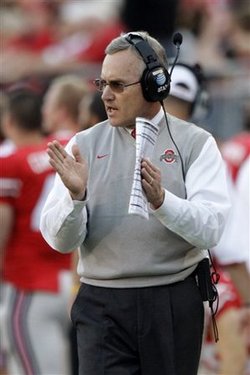
Big Ten commissioner Jim Delany on former Ohio State football coach Jim Tressel: "The chain broke when the coach became aware of the information and didn’t forward it in the chain of command."
During Tressel’s 10 years at Ohio State, the program became the flagship of Big Ten football. He had won or shared seven league titles and OSU became a perennial representative in the BCS for the Big Ten. Even in December, with the Buckeyes playing in the Sugar Bowl against Arkansas, Delany defended Tressel and the Ohio State program.
He acknowledged Sunday that he’s “enough of a realist” to know that coaches can hide things even when people might think he’s telling the truth.
“I was disappointed when that happened. I didn’t feel much more than disappointment,” Delany said. “I knew it was a very serious matter because I know and we’ve been really, for a long, long time making it very clear to our coaches and to our athletic directors and our faculty that when that kind of information becomes available, you have no choice.
“Your only choice is to forward it through the system, and I recognized at the time that the failure to forward that through the system was a fundamental error. And I wasn’t exactly sure how the NCAA or the institution would handle it.”
That, Delany said, was Ohio State’s biggest issue. It is something he said the league has instructed its coaches, athletic directors and presidents to do over the past two decades.
If they hear of something illicit, they have to pass it on instead of hold onto it. That was Tressel’s biggest failing.
“The chain broke when the coach became aware of the information and didn’t forward it in the chain of command,” Delany said. “If you really look at everything else about that investigation with regard to the awareness of the tattoos and the coach having that knowledge, it was forwarded in a timely way to the NCAA.
“A lot of times in positions of authority you run into information that you wish wasn’t there. But the reality is when you get that, you have certain duties and responsibilities to handle it in certain ways, and I think that’s where the breakdown occurred.”
Now, Delany said, Ohio State must wait until the NCAA Committee on Infractions hearing on Aug. 12 in Indianapolis to begin to determine what will happen to the Buckeyes.
He said he wasn’t sure yet if Ohio State would be eligible for the first Big Ten football title game on Dec. 3 in Indianapolis.
That, along with other punishments, will be determined after the NCAA releases its decision.
“There are a whole broad range of things that could happen,” Delany said. “But I can’t predict what that might be.”
Going on a retreat
Along with the selection of Indianapolis and Chicago for various Big Ten title games, the other major issue discussed at the Big Ten presidents and chancellors meeting was a high-level retreat that will take place in August.
The main topic of discussion will be something Delany broached in May about the cost of attendance and the improvement of the college experience for student-athletes.
“What our presidents really focused on is how do we re-establish the collegiate model, what are the welfare issues for student athletes, what are the academic issues for student athletes,” Delany said. “What are the issues related to financing and cost associated with intercollegiate athletics that can bring us to a place where the system is more sustainable, healthier, and I think better for all the coaches, players and fans that are around it.
“We had a lot of great discussion.”
The collegiate model Delany is referring to is the idea to give athletes a stipend to handle other expenses currently not covered by the NCAA scholarship.
Michael Rothstein covers University of Michigan basketball for AnnArbor.com. He can be reached at (734) 623-2558, by email at michaelrothstein@annarbor.com or follow along on Twitter @mikerothstein
Comments
Engineer
Mon, Jun 6, 2011 : 11:03 p.m.
Delany should be fired along with the OSU brass. OSU should get no less than what SMU got. At LEAST a 2 year death penalty! For 10 years woth of violating it should be more like 4 years of death penalty. Of course FB is big money and following the rules is low on NCAAs list of thing a school should do if they are a cash cow so probably be a slap on the wrist and Tressel will kepp 10 years worth of 3 million dollars per year to scrape by. What a joke.
David Briegel
Mon, Jun 6, 2011 : 10:57 p.m.
Isn't it truly sad that the "Big Two" are now both scarred? Instead of Leader and Best! Delaney is like all the other leaders. See no evil, hear no evil and speak no evil. Especially when leadership is required!
semperveritas
Mon, Jun 6, 2011 : 9:15 p.m.
it's amazing to me that folks here think that jim delany exists as an enforcer. his job is to PROMOTE the bigten schools not to castigate them. he will do whatever is necessary to make $$$ for the conference. EVERYTHING that he does is aimed at that mission-----not to berate universities and their coaches. i DON'T LIKE it---but that is what the commissioner does. in truth i don't even believe he is disappointed----but he has to say something.
81wolverine
Mon, Jun 6, 2011 : 5:30 p.m.
I'm SOOO glad to hear about Delaney's disappointment. That makes me feel a lot better that the Big Ten conference is taking the violations at OSU seriously. You read his comments and aside from being incredibly obvious, make it sound like he's sympathetic toward Tressel. C'mon Mr. Delaney - show some guts and come out and condemn Coach Sweatervest and his enablers at TSIO. There's a lot more going on down in Columbus than just Tressel looking the other way when 5 players broke the rules and then lying about it. It's the attitudes and actions of the university leadership from the President on down. There's a prevailing attitude down there that everything is OK as long as they beat Michigan. Nothing else matter. The only way for that mentality to change is for new, strong leadership at TSIO. Only then, maybe, will the tail stop wagging the dog.
1bit
Mon, Jun 6, 2011 : 5:04 p.m.
Hmmm, what IS disappointing is the half-hearted efforts at TSIO at compliance. The coach plays ineligible players, lies about it and then they propose a two game suspension. Eventually they fire the coach but, magically, supposedly no one else knew what was going on.
Hailmary
Mon, Jun 6, 2011 : 4:01 p.m.
You take a guy like Jim Tressel, decent looking, clean cut, gracious manners to friend and foe alike, darn good coach and had the state of ohio in the palm of his hand probably could easily have had the governorship of ohio had he, Jim Tressel so desired. When a guy or lady that has all that going for them and turns out to be a fraud it is a blow to all of us and everything that is good in this world. Bottom line is, Jim Tressel had a lot of responsibility and he, Jim Tressel was not up to the task and he won't be the last. The folks in ohio that are still gravitating mindlessly toward Jim Tressel are simply put, in a state of shock and I suspect when the folks in ohio recover from this temporary insanity there will be some angry buc's in the state of ohio, predictably so. Jim Tressel did a smoke and mirror job on the nice, trusting folks of ohio and this is what happens when you become all trusting and let your vigilance down especially when it comes to your children. Jim Tressel has verified one very important fact to all of us, when it comes to our children we must be constantly diligent.
D21
Mon, Jun 6, 2011 : 7:17 p.m.
It goes to show what kind of Buckeye fans (who mindlessly support Tressel) are.
Bob
Mon, Jun 6, 2011 : 3:07 p.m.
This would have been a good time for, "It's a disappointing situation. Other than that I have no comment." Or he could have turned the microphone over to his dog . . .
Mick52
Mon, Jun 6, 2011 : 2:47 p.m.
Good grief. Is Delaney disappointed in what Tressell did or that he got caught? Delany is the biggest mistake ever. Putting Nebraska in the conference was stupid as is dividing up the conference and putting the "championship" game in a non Big Ten stadium. I prefer sticking with tradition.
oldblueypsi
Mon, Jun 6, 2011 : 2:19 p.m.
And to think that the Big Ten pays this poor excuse for an adminstrative chief.
tater
Mon, Jun 6, 2011 : 2:16 p.m.
I really hope the Big Ten and NCAA don't spin TSIO's rule-breaking as a political statement about the welfare of the student-athlete. Since TSIO hasn't really had many "student-athletes" who bother to go to class, it would be a moot point anyway. The main issue is that TSIO cheated by intentionally and prolifically breaking countless rules to gain an competitive advantage over schools who are trying to obey those rules. The issue of whether or not kids should be paid has nothing to do with TSIO's rule-breaking. I think every benefit any kid at TSIO got should be legal, but the bottom line is that when they got them, it wasn't legal, and Tressel and the rest of his staff both enabled and encouraged the behavior. They willingly broke every major rule in the book, enjoyed a major competitive advantage, and should be punished accordingly. TSIO is going to follow the USC model. They will deny everything, drag their feet, and every individual involved will "lawyer up," as Terrelle Pryor already has. Hopefully, that won't stop the NCAA from giving TSIO the punishment it so richly deserves. The NCAA should put TSIO into a hole similar to that of the University of Michigan's basketball team after the Ed Martin Fiasco. Let them vacate at least all of the Pryor years and hopefully all of the Tressel years. Let them spend the next ten years digging out of their hole. If it was a perfect world, or if TSIO was really the paragon of ethics it portrays, they would do what Michigan did with the Ed Martin Fiasco: admit what they did, punish themselves for it, and move on. Unfortunately, it would take a serious Satre fan to wait for TSIO to show that kind of integrity.
a2roots
Mon, Jun 6, 2011 : 1:27 p.m.
Well let's see...not only do smith and gee need to get the boot and join tressel but so does delaney. Delaney showing he has no backbone. How in the world can he be allowed to continue to run the BT. What a crock. Broom them all.
D21
Mon, Jun 6, 2011 : 1:21 p.m.
Mick, Right on! Seems Delaney is an "abuser" of his dog. Perhaps his dog would be spared if it was named, "Tressel". Delaney and the current OSU president, Gordon "Bow Tie" Gee, are ranked way up at the top for the most lamest comments ever. BIG TEN needs a MICHIGAN MAN to serve as it's next commissioner. GO BLUE!
Tru2Blu76
Mon, Jun 6, 2011 : 6:14 a.m.
"What our presidents really focused on is how do we re-establish the collegiate model, what are the welfare issues for student athletes, what are the academic issues for student athletes," -- Well, Delany has his priorities straight and I only hope he's got his head on straight about these issues. I don't care what he thinks or feels about Jim Tressel - that boat sank just about a week ago.
Mick
Mon, Jun 6, 2011 : 4:11 a.m.
You know, as I was reading this article I was getting more annoyed as I read on. -The only time Delany get's angry is reserved for the dog, what the heck does that mean? He only gets mad at the dog or only the dog can get angry. What a lame comment. -"A lot of times in positions of authority you run into information that you wish wasn't there. But the reality is when you get that, you have certain duties and responsibilities to handle it in certain ways, and I think that's where the breakdown occurred." Well then don't take a job where you have big responsibilities there, big boy. -"If you really look at everything else about that investigation with regard to the awareness of the tattoos and the coach having that knowledge, it was forwarded in a timely way to the NCAA". Oh yeah Delany, TSIO did everything else in a timely manner.........10 YEARS! Give me a break, what a wimp this guy is. I could go on but I think everyone gets the drift. I'm sick of these people in responsible positions of authority no less, walk on egg shells and skirt around the issues, disgusting! Telli it like it is, they freaking cheated for 10 YEARS, ok, quit making excuses for that bum who quit. If he thought he wasn't liable, he never woulda quit!
Randy Rivet
Mon, Jun 6, 2011 : 12:59 a.m.
The fact that Delany is merely "disappointed" in what happened at OSU--as if he were, say, Tressel's pastor, as opposed to somebody who is supposedly "in charge," tells you everything you need to know about the state of Big Time Big Ten sports. Heck, if the Big Ten could notice that a local burrito joint was using its name, and use its legal might to do something about that, how come they didn't know about the hottest little joint on OSU's campus, with fans flocking and players hocking, where the Big Ten itself was gettin' (ab)used ...and do something about that? Oh, that's right--it wasn't called Big Ten Tattoos...