

Big Ten is becoming a league full of playmakers and high-scoring offenses
Mark Dantonio was offered a choice, and it seemed aimed at the Michigan State football coach’s defensive background.
Would he prefer Michigan sophomore quarterback Denard Robinson run or pass when the Wolverines host fellow unbeaten in-state rival Saturday (3:36 p.m., ABC) at Michigan Stadium.
"I would rather see our offense was on the field, personally," Dantonio deadpanned on Tuesday while on the weekly Big Ten coaches teleconference.
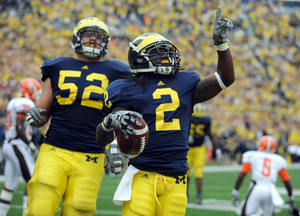
Michigan running back Vincent Smith celebrates a touchdown. Michigan averages 565 yards of offense a game, second in the nation to Oregon.
Lon Horwedel | AnnArbor.com
As daunting as containing Robinson and his 382.6 yards of total offense per game may be, Big Ten coaches league-wide are forced to game plan for opposing offenses that are scoring early and often this season.
Six Big Ten teams average at least 30 points a game. Two of the league's traditional bruisers - Ohio State and Michigan - average more than 40 points.
The Buckeyes and Wolverines each have scored more than 60 points in a game this season. Michigan's 41.4 points per game ranks eighth in the nation and the Wolverines trail only Oregon in yards of total offense (565) accumulated each week.
For Dantonio, that adds up to a lot of headaches.
"This is an extremely explosive offensive football team," Dantonio said. "When you see the number of plays that they run relative to the number of points they put up and the number of big plays that they have, it's amazing."
While Michigan (5-0, 1-0 Big Ten) ranks second in scoring offense, the Wolverines are 11th in the Big Ten in time of possession. The Wolverines average just under 29 minutes in possession time per week - almost four minutes less than Ohio State, which leads the league in scoring (44.2 ppg) and that is second in time of possession (33:46).
Big Ten coaches said Tuesday they anticipate that the high scoring Saturdays to be less common as either injuries begin to factor in or as weather begins to worsen. Indiana coach Bill Lynch also believes scoring will slow once some of the league's high-scoring offenses face tougher defenses.
But so far, they see a league in which high-scoring offenses are more common than ever.
"There are a lot of skillful players in the Big Ten conference," Ohio State coach Jim Tressel said. "As you go through the Big Ten schedule, every game is a battle and people sometimes ask, 'Is this going to be a high-scoring or a low-scoring (game),' but it's all determined by offensive execution or defenses being solid."
Michigan coach Rich Rodriguez said Tuesday that offensive schemes - both Big Ten-wide and nationally - have evolved to the point where it has become more difficult to shut teams down. Although Rodriguez credits some of the shift to technology and coaches becoming more creative, he said an increase in skilled playmakers has also added to the way teams are able to produce.
"You still have great defenses (in the Big Ten), but there's some explosive offenses and some creative systems that you have to go against," Rodriguez said.
Yet, as Indiana found out last weekend in a 42-35 loss to Michigan, offensive firepower isn't always enough. Despite 35 first downs and holding onto the ball for 41 minutes and scoring five touchdowns, Indiana - one of the league's top offensive units - lost for the first time.
It's a mystery Lynch is still trying to figure out in a week when he must get his team ready to handle the league's top scoring offense in Ohio State.
"You would think all that stuff would lead you to a win, and it didn't because of the big plays (Michigan) had," Lynch said. "It just shows you how important big plays are and, particularly, big plays that go for touchdowns. It was great for the fans - I know they got their money worth, because it was one of those games when the last team that got the ball last was going to win it.
"But you've got to score points in this league to win and year in and year out, it shows itself."
Jeff Arnold covers sports for AnnArbor.com and can be reached at (734) 623-2554 or by e-mail at jeffarnold@annarbor.com. Follow him on Twitter @jeffreyparnold.
Comments
MetricSU
Wed, Oct 6, 2010 : 8:54 p.m.
As an MSU fan, I have to admit I think UM's defense will play better than it has. In the past, when it looked like MSU's D would be overmatched, a few times it has risen to the occasion. Playing MSU at home in the loud Big House will likely inspire the team. I'm hoping that MSU's defense is able to slow Denard. Unfortunately, I tend to believe the spread. UM has at least a 60% chance of winning. That doesn't mean they will, but I'll hardly be surprised.
Dan
Wed, Oct 6, 2010 : 3:42 p.m.
"Also, Indiana didn't run the ball as often as they should or they could've easily controlled the game when they were up." They were only "up" for two plays. They scored on their first drive and we answered on our second play. They never lead again!
Sean T.
Wed, Oct 6, 2010 : 12:55 p.m.
Time of possesion works for any offense and it helps the teams defense as well. Are you insane? "The Big Ten is becoming a league full of playmakers". Don't you think it would be smart to keep the other teams playmakers off the field? Also, Indiana didn't run the ball as often as they should or they could've easily controlled the game when they were up. If MSU stops us a few times and controls the clock and scores, that puts us behind and we don't need that in a rivalry game. All of this talk that the "offense makes our defense looks bad" is complete hogwash. Our Defense sucks! I just hope RR decides to control the clock and keep the sparties offense off the field to at least give our defense a breather. Go Blue
thomas h blaske
Wed, Oct 6, 2010 : 7:44 a.m.
EXCELLENT comment by "those who stay" i know it's heresy, but maybe our D isn't as bad as it looks. (Reminds me of the famous Mark Twain quote about Wagner's music - i.e. "It isn't as bad as it sounds." My data = didn't IU have the ball 13 times & score on 5 of them? if we maintain that ration, we win often this year!
ThoseWhoStayUofM
Tue, Oct 5, 2010 : 6:43 p.m.
There is no downside to scoring fast. Time of possession only works for pro-style offenses because, as the game progresses, they can wear down a defense and get some scores late in the game. This implies that in the beginning of the game, scoring is sparse. In a spread offense, you score all the time, and a lot. Time of possession is hugely important to defeating the spread because it keeps their offense off the field, which maximizes your chance of outscoring an offense that will either score instantly or stall. That's what people need to understand. If you have a moderate defense, and your offense scores 40 points per game. You will go undefeated. Seriously! It doesn't matter where you score, how quickly, or whether it's on the ground or through the air. If you score 40+ points every game with a moderate defense, you will win 99 of 100 games you play. The way to beat the zone-read-option-spread offense is to get them to stall (3 and out) by playing your fastest players, focus on contain rather than pursuit, and hiding your coverages from the QB. If you fail to do this, you will get burned for 40+ points. How many times have you seen someone who scored 40 points and lose? Think of it this way. Let's say to start the game, we score in two plays to take a 7-0 lead. Then we stop their offense after a 5 minute drive and get the ball back. We then score again in about 1 minute. Thier offense scores on an 8 minute drive, we get it back and score quick, they get it and score in 7 minutes, and this goes back and forth. We stall a couple times but we end up getting a turnover or two (they run 3 times as many plays as us so they are more likely to turn it over) and they end up dominating time of possession. We still win the game because we came out strong and were able to maintain consistent scoring throughout the game. It didn't matter that they had time of possession. And that is the point. Scoring too fast isn't a double-edged sword at all. Scoring fast isn't the problem. It's the stalling fast that will get you beat.
aftermac
Tue, Oct 5, 2010 : 6:04 p.m.
MIck, I get what Dave is saying, and the lack of rest compounds as the game goes on, because the defense is on the field for 6-8 minutes and the offense is on the field 2. However, if the defense didn't let the opponent drive 80 yards every possession, then time of possession would come back into balance and we would get more possessions per game for the offense. The defense wouldn't necessarily have more time to rest while the offense has the ball, but they wouldn't be on the field nearly as much.
Mick52
Tue, Oct 5, 2010 : 5:48 p.m.
What Dave means aftermac is that with the offense scoring so quickly, the defense barely get time to rest. I sure wish the defense were better, more 3 and outs, then our offensive production would erupt beyond belief.
aftermac
Tue, Oct 5, 2010 : 5:04 p.m.
"That is why our defense is on the field so much." Actually, our defense is on the field so much, because they can't get off the field on 3rd down. If the D could produce an occasional 3-and-out, then time of possession would look a bit different.
michboy40
Tue, Oct 5, 2010 : 4:56 p.m.
The D Line has to have their best game of the year. If they can penerate, and get prodution from Roe, Banks, Van Burgan, Patterson, and crew, then they will win this game going away. (We know Martin will be doubled, or in the backfield every play). If these guys get blocked, and worn down, then we are going to need some Sparty mistakes! I'm guessing we will get some of both, and that spells a close game. Please let Michigan get the ball with 1 min. + left in the game either leading, or down less than 7 points.
David Briegel
Tue, Oct 5, 2010 : 4:30 p.m.
You will get your wish Mark. Michigan and Denard score so quickly that our offense barely gets into a rhythm. That is why our defense is on the field so much. Kind of a double edged sword!