

Dave Brandon on end of NCAA investigation: 'We admitted our mistakes and are moving forward'
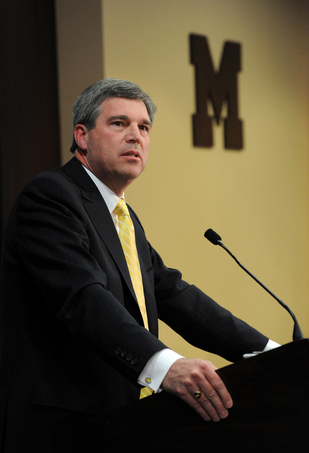
Michigan athletic director Dave Brandon talks Thursday about the final NCAA report regarding the investigation of five major violations in the football program
The NCAA’s Committee on Infractions didn’t let the University of Michigan off with a scolding, but didn’t demand a pint of blood either.
In a 29-page public infractions report released Thursday, the committee admonished the football program for committing five major violations of the rules, even while noting that the two main rules violations were “relatively technical” in nature.
But committee members also served notice that they would pay close attention to the entire athletic department for the next five years, and any future violations could lead to more severe penalties.
The dichotomy noted in the committee’s report - which heavily criticized head coach Rich Rodriguez and the athletic department’s former administration - was evident in the university’s response to the punishment.
Athletic director Dave Brandon spent several minutes at a press conference talking about how the violations were for stretching and mistakes made by “junior” members of the coaching staff. He also criticized the report by the Detroit Free Press that launched the investigation, saying the university’s internal investigation and the NCAA’s instigation did not validate the charges leveled by the paper.
But then, he had to back track a little to make sure he wasn’t undermining Michigan President Mary Sue Coleman’s assertion earlier in the press conference that the university took the charges seriously.
“The (violations) are very serious,” Brandon said. “What I’m doing is appropriately framing … the specific issues. There were major violations.
“We have not been whiny. We have not pointed fingers. We have not tried to rationalize what happened. We admitted our mistakes and are moving forward.”
The big picture
The last time Michigan was sanctioned by the NCAA, Coleman described the situation with words like “shame.”
On Thursday, that wasn’t the mood at all.
While Brandon, Coleman and Rodriguez weren’t jovial in their remarks, an occasional smile was seen as they talked about the NCAA findings.
They seemed relieved and glad to be done with the process.
“I’m very proud today of how we responded,” Coleman said. “I’m proud of how our coach handled this. The basketball issue related to the corruption of young people… I do not put this in the same category.”
The university had plenty of reason to smile, Michael Buckner, a Florida-based attorney who works with universities on NCAA and compliance issues, said.
“Michigan got a wonderful decision. There was no type of post-season ban, no recruiting limitations. Overall, they came out relatively unscathed.”
The findings
Despite changing one of the original charges Michigan faced, the NCAA found Michigan committed five major violations - ranging from practicing too much to failing to monitor compliance with NCAA rules. It’s the first time in the football program’s history it has been found to have any major rules violations.
The committee largely agreed with Michigan’s self-imposed penalties, adding one year of probation.
“Michigan did a very good job of handling this case,” Buckner said. “They did a very good job of balancing on the tight rope of not underpenalizing themselves, but not overpenalizing themselves.”
A large part of Michigan’s defense of itself lay in spreading blame among multiple people, including Rodriguez, football administrators and the compliance department. The university issued letters of reprimand to seven employees.
The NCAA largely bought that defense.
“Overall, the strategy of diffusing the blame worked,” Buckner said.
The individual drawing the most heat in the findings report was Rodriguez, even though the committee changed the violation he was alleged to have committed.
Where the committee differed from Michigan, was in how much blame went to the compliance staff. “The efforts of the compliance staff were thorough and diligent,” the committee wrote in its report. “The compliance office educated the football and strength and conditioning staffs, made numerous attempts to get the football staff to hand in the necessary forms and involved senior members of the athletics department administration.
“The failure to monitor occurred when 1) the assistant athletic director for football and other administrators with football responsibilities withheld the job descriptions and 2) the former director of athletics (Bill Martin) and the senior associate director of athletics did not insist that the football staff immediately comply with the request of the compliance office or sanction the football staff for failure to comply.
“The compliance office attempted on numerous occasions to prod the football staff into submitting the forms. The compliance office involved the senior associate director of athletics in the attempts and it reported the problem to the former director of athletics.
“The members of the athletics administration with responsibilities in the football program continually failed to provide required forms pertaining to countable athletically related activities to the compliance services office, making it extremely difficult for the compliance office to do its job.
“Finally, the former director of athletics and the senior associate director of athletics failed to require the football staff to submit the forms as required. This collective failure partly resulted in the violations outlined in Finding B-2.”
The punishment
Michigan faced a possible big problem when it appeared before the committee. Thanks to the basketball program’s issues in the 1990s, Michigan could have been tabbed as a repeat violator. That would have increased the penalties assessed to the institution.
But the committee didn’t go that way.
“The committee declines to impose enhanced penalties because, among other reasons, 1) it has been an unusually long time since the violations in the previous case occurred. The violations were not uncovered and processed until 2003, even though they occurred from 1992 to 1999.
“They came to light through the efforts of the institution, which pressed the federal authorities handling a related criminal prosecution to require certain individuals in that case to cooperate with the institution to discover the truth; 2) the violations in both this case and the previous case were limited to one sport and they were different sports; 3) there was no lack of institutional control or academic fraud found in the present matter and 4) the violations detailed in findings B- and B-2 of this report are relatively technical.”
Michigan also faced a potential reduction in penalties for cooperation with the NCAA.
In public statements during the process, and again Thursday, Brandon and Coleman repeatedly talked about how much they were cooperating with the NCAA.
But that didn’t lead to any reductions.
“The cooperation the institution demonstrated in this case must be weighed against the conduct and failures of the institution and its personnel as set forth in the findings,” the committee wrote in its report. “The committee concluded that in light of the serious nature of the violations and the failure of the institution to detect and/or prevent them, the institution’s cooperation did not warrant relief in the penalties imposed by the committee in this case.”
The committee issued punishments of public reprimand and censure, the reduction of 130 practice hours (32 hours have been reduced so far this year); three years of probation (the university had recommended two years); requiring Rodriguez attend an NCAA regional rules seminar and require annual reports on compliance.
University officials said the punishment was fair.
“We offer no excuses for the violations,” Coleman said. “They should not have occurred.”
David Jesse covers higher education for AnnArbor.com. He can be reached at davidjesse@annarbor.com or at 734-623-2534.
Comments
Mick52
Fri, Nov 5, 2010 : 5:58 p.m.
This story seems to be bouncing back and forth as to the relative nature of the violations. They are major violations, but not really so bad, in fact the two main violations are "relatively technical" in nature. And Brandon is seemingly downplaying them for what they are, but slamming on the breaks and going back to "major" so as not to step on Mary Sue's toes. Good grief what the heck is going on? It's almost too bad somebody wasn't paying off the players so they could bet on the outcome of the games and take steroids so we could call this a really major violation. It seems kind of mamby pamby for a "major" violation. As for you sports fans suggesting the boot for RR, let me note that Michigan leads the Big Ten in offense and is 8th nationwide. When was the last time that happened. Its one thing defense that is the problem. I think if Michigan let RR go, he would have no problem getting a new job. Just shore up the defense cause defense wins ballgames.
Yelmonian
Fri, Nov 5, 2010 : 5:32 p.m.
TrueWolverine, "It is an unrealistic demand for one coach to keep over 125 players in line, much less an additional 25 coaches. The guy can't be everywhere, looking at everyone at once. When the staff breaks rules, it obviously falls back on his lap so he is responsible in that sense, but he did nothing wrong." Yet... another Universities coach is routinely criticized on this website for players getting in trouble. Now mind you... that coach doesn't have players in trouble AND have a losing record AND have his team on probation. But I guess the spin is made by pro RR fans for the angle that best suits their needs at that exact moment.
Marcia Feingold
Fri, Nov 5, 2010 : 11:29 a.m.
I'd like to hear someone say "We made mistakes" or, even better, "I make mistakes". Using the passive voice, "Mistakes were made" is just a way of avoiding accountability. The mistakes didn't just happen; they were made by people connected with the violations. And in particular, despite Rodriguez's getting off lightly, it is he who was responsible for the entire fiasco. That's what it means to be the boss.
truebluefan
Fri, Nov 5, 2010 : 11:24 a.m.
Thankfully, intelligent people are in charge at UM. They see this thing for what it really is. That said, they take any issue seriously and fix it. The NCAA made it quite clear that they respect the people in charge at Michigan and the decisions they make.
win
Fri, Nov 5, 2010 : 8:29 a.m.
I'm glad to see that we wont be hit with major sanctions. The ones we are hit with are bad enough. I have been a supporter of RR for three years. And yes, I'm one of the people who still think he was undermined by some of the LC hold-overs. RR didn't have a great start to his tenure, and it looks like he won't have a great end either. Having said that, now the focus on be on the field. RR should be judged on his coaching. Sadly, the program has not progressed, particularly on defense. I wish for and still hope for a couple more wins, but I'm not optimistic. 6-6 just won't cut it. I trust D. Brandon to make a good decision for Michigan.
Chilltime
Fri, Nov 5, 2010 : 8:19 a.m.
3 and Out, Harbaugh is going to the NFL not Michigan. So who is next on your list?
Chilltime
Fri, Nov 5, 2010 : 8:17 a.m.
I do not believe the university is going to pay two coaches the sum of $5-6 million for the next three years. Especially in these economic times in the state of Michigan. How do you sell that and then turn around and ask for money. I do not believe Rich will take a buy out if asked. He wants to succeed at Michigan.
MjC
Fri, Nov 5, 2010 : 7:16 a.m.
TRUEwolverine states "Maybe we can replace the old cadavers with young, energetic people..." I find it hard to believe that you're a "True Wolverine" when you can write about people this way. Your statement is hurtful. It contributes nothing to the state of the UM football program or this story.
81wolverine
Fri, Nov 5, 2010 : 7:05 a.m.
Yeah, yeah, yeah, let's all move on. This whole overblown situation is now behind us. But, I'd like to see the Free Press be held accountable for their irresponsible yellow journalism, now that the actual facts show clearly their original story was filled with untruths. I used to deliver the Free Press years ago, when they were a good paper and had REAL journalists working there. Today, I wouldn't use it to line my garbage can with, much less read it. Now the FP is filled with these hack "whatever-gets-the-click" writers like Rosenberg.
OSUbeBetter
Fri, Nov 5, 2010 : 12:55 a.m.
Michigan has self imposed a 4 year Bowl Ban starting in 2008.
The Fan
Fri, Nov 5, 2010 : 12:38 a.m.
Why does everyone want Harbauh for coach. Doesn't anyone remember the comments he made about Michigan in 07. He's not a Michigan man. He wouldn't take the job.
a2citizen
Thu, Nov 4, 2010 : 11:24 p.m.
Too bad the probation can't be retroactive to 2008.
Sean T.
Thu, Nov 4, 2010 : 11:20 p.m.
I've always thought that RR will get a fourth year since Brandon came on board. He seems to like RR who may be charming to those who work with him. But through all of the poor performance and irresponsibility he will definitely be gone next year. Now I actually want to see what RR can do with his fourth year just to laugh at the slappies.
3 And Out
Thu, Nov 4, 2010 : 10:56 p.m.
well then you will be sitting with a lot of opposing fans who bought discounted scalped tickets from true season ticket holders who will be selling theirs to try and get more value from them than what they would possibly see under the field with Rich Rod as coach... I know if my father had not passed away and I had not moved away and we still had our season passes, I wouldnt want to lose my seats for when Coach Harb's comes in to clean up this mess. Ed Murrow....part of what I read above + other comments leads me to believe that Brandon would like to give Rich Rod (gag) another chance...however...should they lose out, or even 1 win out and then lose the bowl game to whatever MAC team they play and end up 6-7 there will not be much support behind Brandon....other than tater and a couple of the posters here lol.
True_Wolverine_Fan
Thu, Nov 4, 2010 : 9:35 p.m.
3andout... if they bring back Rich Rodriguez I will personally buy season tickets next year!
wallaby
Thu, Nov 4, 2010 : 9:10 p.m.
I mean, to what do you attribute the wildly different conclusions of the NCAA's invesigation and the Freep's "investigation?" My opinion is that the Free Press was more interested in sensationalism than facts; more interested in disrupting than informing.
wallaby
Thu, Nov 4, 2010 : 9:05 p.m.
They weren't looking for answers, they were looking for reasons to raise a stink, which they undoubtedly could have done at any point in the past but they chose to wait until someone they didn't like was in line to take the grief.
Teebob
Thu, Nov 4, 2010 : 8:54 p.m.
Engineer, you mean they were doing there job, right? Because that is what journalists do. It isn't just the freep. You are just upset because the freep is looking for answers from everyone, even our mighty blue. Strange.
Teebob
Thu, Nov 4, 2010 : 8:50 p.m.
I don't know about the rest of you fellas, but when it was mentioned on the radio that richrod was 1-16 in the big ten against teams other than Indiana and Minnesota, I figure it is time for him to go. But, like 3 and out, I think Brandon is leaning on bringing richrod back next year. Unlike 3 and out, it isn't whatever he is seeing in this article, but it is my feeling from everything I read overall. And that is too bad because when I met Mr. Brandon at the hockey games in Fort Wayne he seemed like he was in it for Michigan. 1-16 against teams in the big ten other than Indiana and Minnesota is not in it for Michigan. Go Blue. Beat the Illini
wallaby
Thu, Nov 4, 2010 : 8:40 p.m.
All I have to say is that the Detroit Free Press should be ashamed. Hubris will, of course, prevent them from acknowledging the fact that they published a hyperbolic and dishonest article, and that they employ the journalistic integrity of a pack of jackals, but whatever.
orlandomichfan
Thu, Nov 4, 2010 : 8:36 p.m.
move on ya'll its over, it was all crap..nothing more than other programs do, but your all trying to make it out like richrod did something so horrendous..get over it haters, it was all nonsense for crying out loud we got a game saturday, worry about that and hope we can get enough defense to win...gooo blue..
TXteacher
Thu, Nov 4, 2010 : 8:23 p.m.
@TRUEWolverine- LOL! The commitments aren't putting off commiting because of the investigation, they're putting it off because they realize just how bad Big Blue sucks! As long as RR is coach, expect to get whatever MSU doesn't want! Go Green, Go White!
Engineer
Thu, Nov 4, 2010 : 8:15 p.m.
I heard the freep reporters on WTKA asking questions at the presser. They were fishing big time trying to justify their bogus report and insinuating that the NCAA let RR off. I for one will not be buying a freep anytime soon. Hopefully they go under.
GoblueinNE_PA
Thu, Nov 4, 2010 : 8:10 p.m.
3 and out This will come down to wins and losses, which is where it's been heading all along. The violations simply allow us to dump the King of Fools and cut the pay off to this moron. Once he goes to 5-7 this season, that'll be all she wrote.
TRUEwolverine
Thu, Nov 4, 2010 : 7:53 p.m.
3 And Out... It's OK... I hope you and all of your friends go down the street to Eastern for awhile... Trust me, there are thousands of people who have waited years for the opportunity to get these tickets. Maybe we can replace the old cadavers with young, energetic people that would actually make noise (the Big House should be 3x louder every game but there are too many 70 yr olds there). Steve... It is an unrealistic demand for one coach to keep over 125 players in line, much less an additional 25 coaches. The guy can't be everywhere, looking at everyone at once. When the staff breaks rules, it obviously falls back on his lap so he is responsible in that sense, but he did nothing wrong. As far as the allegations go, I am relieved that this painful process is finally over. Several recruits have put off their commitments to see how things would turn out for us, so hopefully we'll have a few more solid commits on the list in the next few weeks. GO BLUE
3 And Out
Thu, Nov 4, 2010 : 7:09 p.m.
It appears that Brandon and Mary Sue will be bringing back Rich Rod next year based on their comments above and others. That would be a huge mistake. It appears that they need to be hit in the pocket books with non renewal of tickets or box suites for them to understand just how far this program has dropped under Rich Rodriguez.
Steve@Clearwater
Thu, Nov 4, 2010 : 6:52 p.m.
You cant blame this stuff on 'junior coaches'. RichRod is responsible for everything taking place in that practice facility. I'm sure the UM coaches scheduled some 'non-supervised' practice sessions, which is a way of getting around certain rules and regs.