

Former Michigan football players find success in politics
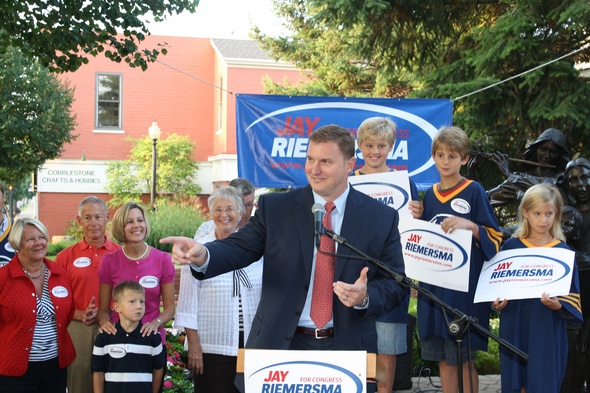
Former Michigan football player Jay Riemersma is one of many Wolverines who have traded the football field for the political arena.
Photo courtesy of Jay Riemersma
ZEELAND - Jay Riemersma and John Holecek spent the better part of four seasons in Buffalo rooming together on road trips.
Blue-collar cogs on Bills teams that made back-to-back playoff appearances in the late 1990s, Riemersma and Holecek couldn’t have had more different game-day routines.
Holecek typically spent his Sunday mornings watching “Edge NFL Matchup” or some other football-related programming, while Riemersma went to chapel. When Holecek headed for breakfast, Riemersma grabbed the remote and turned on “Meet the Press.”
“He was always one of the more thoughtful football players that didn’t really subscribe to the meathead type of culture that, at times, could be the truth,” Holecek said. “Jay was always a cerebral guy.”
Still, Holecek can’t believe the path his good friend’s post-playing career has taken.
After 2 1/2 years working for the Family Research Council, a lobbying group in Washington D.C., Riemersma returned to Michigan last year to run for Congress.
Along with former teammate Jon Runyan, who won a New Jersey congressional primary June 8, Riemersma is the latest in a continuing line of ex-Wolverines who’ve made the jump from pigskin to politics.
Gerald Ford, Michigan’s most famous alum, became the 38th president of the United States 40 years after he played his last game as a Wolverine. More recently, Mike Kenn spent five years as chairman of the Fulton County (Ga.) Commission and now works as president of the non-profit Georgians for Better Transportation; Greg Skrepenak served a stint as Luzerne County (Pa.) commissioner, though he resigned amid a bribery scandal last year; and Dave Brandon was a regent at two state universities and considered a run for governor before becoming Michigan’s athletic director in March.
To fellow Wolverines, seeing a Michigan man in public office is not the least bit surprising.
"The only thing that surprises me is that more guys haven’t done it," said former Michigan kicker Jay Feely, another ex-Wolverine who has designs on maybe running for office one day. "I think we have leaders here, and you talk about the leaders and best, it's cliché a little bit, but I think that's the kind of person that always was attracted to Michigan. And then those were the kind of people that they went out and recruited, and then those were the kind of men that they developed."
A calling, a hobby
Recruited out of Zeeland High as a quarterback and later switched to tight end, Riemersma arrived at Michigan two decades ago with heavy political leanings.
As a middle schooler, he took part in regular dining-room discussions about the politics of the day. His mother, Ethel, worked for the same family policy organization he represented in Washington D.C.
In college, Riemersma met Ford a handful of times at Michigan practices, where the former president was an occasional visitor, and befriended ex-congressman Pete Hoekstra, now a Republican candidate for governor.
While he was still in school, Riemersma spoke at a youth leadership conference at Hoekstra’s request, and at one point said to his political mentor, “I may want to do this some day. How do you do it?”
“I’ve had this in the back of my mind for a number of years,” Riemersma said. “It really is as simple as, ‘Hey, I got something to say and I think I’m going to run.’ And hopefully the people of west Michigan agree with what I’m saying, and so far the response has been overwhelmingly positive.”
Runyan’s foray into politics wasn’t quite as pre-ordained.
“A shocker,” former Michigan coach Gary Moeller called it.
The product of a working-class family from Flint who Moeller remembers as “a quiet kid” who sat in the back of meetings, Runyan didn’t watch C-Span at Michigan like Riemersma and didn’t consider running for office until Republican leadership approached him last October.
When they did, he jumped at the chance.
“You always keep up on (issues) and realize what’s going on around you, and you realize that doesn’t align with the way you think or the way you feel,” Runyan said. “The opportunity was there to go in and do what you think is right and do what the people you represent would think was right.”
For Kenn, like Runyan, politics has always been more of “an ambitious hobby” than a career.
Kenn served eight seasons as NFL Players Association president and always figured he’d start a charitable foundation once his playing days were done. When he retired after 17 seasons with the Atlanta Falcons, his local Republican party had other ideas.
They suggested he run for county commissioner, he studied the process for four months, and eventually decided “it would be a great way to give something back to the community and try to make a difference really on a grander scale.”
Before that?
“I had no aspirations about running for office,” Kenn said. “I woke up one day and I was in my 10th year and I started to think, ‘Geez, when am I going to stop doing this and what am I going to do when I stop?’ And I played another seven seasons after that and basically retired when I was 39 and turned 40 three days after, and that’s when I started thinking about it.”
Brandon, meanwhile, began thinking about a life in politics much earlier. His father and grandfather both served as Salem Township supervisor, and Brandon recalls telling “my grandfather when I was 3 I was going to be governor.”
“Going back to being a kid, running for elected office and serving in that way was always something I was kind of programmed to do,” said Brandon, who was appointed to the Board of Regents at Central Michigan and elected to the board at Michigan. “Certainly over the years I thought about running. There was a time I thought about running for the U.S. Senate, there was a time I considered running for governor. But instead I decided to run for athletic director and I got elected, so I’m just fine with that.”
Leaders by nature
Brandon insists he no longer has any political aspirations.
“I’m not a political guy anymore,” he said.
Still, he understands why some football players, particularly those with Michigan roots, are drawn to public office.
“The combination of the culture of Michigan, the competitive nature of politics, and then the last element would likely be leadership,” Brandon said. “Athletes are, by their nature, leaders. They want to make things happen. It’s kind of that give-me-the-ball mentality, and I think to a large degree that quality in individuals is one of the things that draws one to the political process.
“You’ve got to want it, you’ve got to want it bad and you’ve got to be willing to make a lot of sacrifices to be successful. And that all sounds like the same kinds of qualities that are required of athletes.”
Both Riemersma and Runyan agree the attributes that made them successful football players lend well to politics, and both are embracing their playing experience on the campaign trail.
Riemersma has visited local sports bars and passed out glow-in-the-dark footballs in an effort to mobilize voters, appeared in a TV ad with a football in tow, and borrowed his old “Red Zone” nickname from Buffalo for his staff of volunteers.
Runyan’s name appears in decidedly Philadelphia Eagles-looking green - the team he spent nine seasons with - in most of his campaign literature, and contributors who donate monthly to “Team Runyan” are given All-American, Pro Bowl or All-Pro designations.
Both said they’re routinely asked for autographs when they door-to-door campaign.
“I get it all the time,” Runyan said. “Footballs, sweatshirts, my campaign signs. ‘Can I get an autograph? I want to put it in my Eagles room in my basement.’”
Riemersma said his playing career at Michigan and in the NFL has been “a tremendous asset” in his run for Congress, though he still must convince voters he's gone "from being a football player to a politician with substance."
He awaits an Aug. 3 primary, and jokes that when he and Runyan reunite in Washington D.C. it will be just like old times, with him telling Runyan which way to go - right.
“There’s guys out there that are interested in politics and want to make a difference for their country and want to be involved," Riemersma said. "I don’t think it’s a huge leap (from football to politics)."
Dave Birkett covers University of Michigan football for AnnArbor.com. He can be reached by phone at 734-623-2552 or by e-mail at davidbirkett@annarbor.com. Follow him on Twitter @davebirkett.
Comments
goblue42
Mon, Jun 21, 2010 : 6:51 a.m.
FlintMaize - I was sure there would be a reply such as your's. Sounds like sour apples!
15crown00
Mon, Jun 21, 2010 : 1:20 a.m.
i wouldn't wish politics on my worse enemy.it's a job which in my view is filled with liars,thieves,and cheats. open a paper or a national magazine.that tellsw you all you need to know. the best thing that could happen to them would be to NOT get elected.
heartbreakM
Sun, Jun 20, 2010 : 9:17 p.m.
Interesting article. The thing that you don't really touch on is: Why did the NJ GOP approach Runyan? He was a great lineman, owns a great big ranch in southern Jersey, but never got involved in politics. They are using his name and size and fame to try to win a seat. Will he make a good member of Congress? I would not want to be the one to disagree with him!!! He'll clobber you. :) Reimersma is a no-brainer. He was always interested in politics and was always a bright guy. I wish them all the best, but it bothers me that our highest elected officials should be ex-football players who will be elected based on name recognition, but may not be the best qualified to make decisions affecting our country. And by the way, not only did Skrep resign, but he is in prison. It's too bad, because he probably got mixed up with bad guys, but it is the truth.
Roundin' 3rd
Sun, Jun 20, 2010 : 5:55 p.m.
FlintMaize - I was waiting for a comment like yours!! Sorry most are Republicans.
PortageLkBlu
Sun, Jun 20, 2010 : 9:26 a.m.
Actually, kind of a dumb way to talk about a man who's offering his time to public service for you and me.
Lisa
Sun, Jun 20, 2010 : 8:44 a.m.
LOL @ WillieNelson -- I WAS in class w/ Jon Runyon, and sadly, you're not far off the mark -- on all counts!
InsideTheHall
Sun, Jun 20, 2010 : 8:01 a.m.
Interesting that they gravitate to the Republican Party. Jay Feely will run when his playing days are over.
FlintMaize
Sun, Jun 20, 2010 : 7:55 a.m.
Just a quick note: Not all former Michigan players are Republican.
PortageLkBlu
Sun, Jun 20, 2010 : 7:45 a.m.
I don't care if these guys become a Marine or plumber or a quality career like I had in the Air Force as long as they work hard, pay their taxes and take care of their families. To me any man who works hard, is honest and loves his family is worth his salt and I mean boys and girls. The fact that they played at Michigan only adds to the allure but really makes no difference.
Jarhead
Sun, Jun 20, 2010 : 7:24 a.m.
I meant NEW York not Ney York. Wow, proofread Jarhead.
Jarhead
Sun, Jun 20, 2010 : 7:16 a.m.
Great article Dave. I wish Jay and his family all the best. I have freinds in Ney York and they all loved Jay when he played there. He also was involved in many local charity drives while there. It is so good to read an article without touching on Rich Rod or NCAA compliance situation. Michael Rothstein wrote an article, about a year ago, about a player (John Ferrera if I remember correctly) and he was from N.Y. and his dad is a Ney York police officer. The article also talked about John's best freind who went to Notre Dame and his dad is a New York fireman and the kids were in junior high when 9-11 hit, and how it impacted their families. It was a graet piece. The article showed the personal sides of these soon to be football players. I'd like to see more stories like this as it gives us fans some insight about our players and coaches. Reminds us they are not just robots out there on the field. Of course not many of the Mich or RR haters will blog in on this one, but great article anyways. Thanks. Go Blue!