

Fully revamped Michigan Stadium opens for business on Saturday
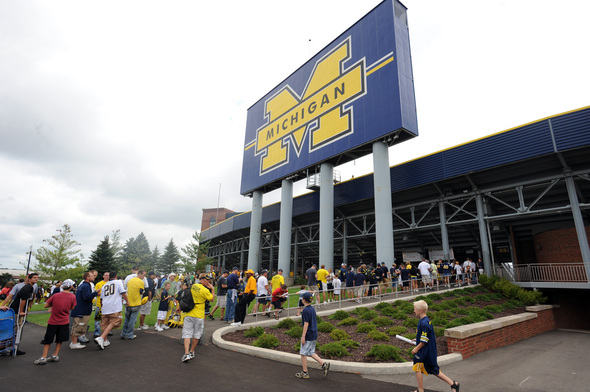
The fully refurbished Michigan Stadium will be rededicated Saturday before the UConn at Michigan football game.
Melanie Maxwell | AnnArbor.com
When then Michigan athletic director Bill Martin announced a $226 million plan to overhaul Michigan Stadium in 2006, he knew there would be detractors.
He envisioned the 80-year-old home of the Michigan football team with towers that stood 85 feet taller than the stadium’s concourses. The stadium blueprints included 82 luxury suites and 2,300 club seats that would generate enough revenue to cover the bill for the remaining improvements.
Traditionalists protested, arguing the original version of Fielding H. Yost’s masterpiece was being trampled. Even some of Martin’s closest friends suggested he was crazy for tinkering with one of college football’s most treasured venues.
“If I was going down,” Martin said, “I was going to go down in flames.”
The Wolverines open the season in their renovated home Saturday with a 3:30 p.m. game against Connecticut. Saturday also is Martin’s final day as a university employee.
From the start, Martin’s goal was to improve the game-day experience for the nearly 110,000 fans who will pass through the stadium’s turnstiles.
For years, Michigan Stadium had been woefully out of date. It didn’t meet building codes nor did it lawfully accommodate the stadium’s physically disabled visitors. The concourses and aisles were too narrow to allow traffic to move freely and there weren’t enough restrooms or concession stands.
When Martin took over Michigan’s athletic department in 2000, he understood Michigan Stadium was a major concern. Martin, who worked in development prior to coming to the university, knew he was entering dangerous territory.
Since Yost built the stadium in 1927, only minor improvements had been made, twice adding seats to the bowl while changing the playing surface on numerous occasions.
Michigan’s Board of Regents needed three votes before approving Yost’s building plans, a fact Martin considered as he moved forward. The stadium, Martin knew, had to include modern amenities, but it also had to honor Michigan’s traditional past.
Design would be a major challenge. Over time, Martin and his team went through 10 sets of plans.
By 2006, he found a winner. Using the architectural building blocks found in the university’s intramural building and hockey arena, the new Michigan Stadium took shape.
The two towers that would house the stadium’s luxury seating would be angled in to help trap noise inside the stadium. The number of women’s toilets increased by 124 percent, the men’s by 50. The concourses would be wider to allow for better traffic flow and enough handicapped seating would be included to meet federal laws.
Along the concourses, 83 plaques would be hung, each bearing the name of a different Michigan county.
But Martin knew he would have to win people over. He’d have to convince the regents that tackling the project all at once made the most sense. He had to change the minds of purists who believed to overhauling the stadium was stripping of its of its integrity.
“Change comes really hard for a lot of people - particularly with something they love,” Michigan athletic director Dave Brandon said Monday. “People revere that stadium, and the vast majority of people who were concerned were concerned because they love place.”
Among the biggest opponents was John Pollack, a 44-year-old former speechwriter for President Bill Clinton. Pollack believed the university could improve the stadium without adding premium seating. He formed a group, “Save the Big House,” which countered the university’s design by saying it could finance the renovations by adding 15 rows of bleacher seating rather than adding the luxury seating.
The plan coincided with Yost’s dreams to add a second deck onto the stadium that would take the venue’s seating capacity to 125,000. Despite the complaints from Pollack's group, the university didn't break stride, continuing a project Pollack still has issues with.
"I think the way the stadium has been altered is a real shame,” Pollack said Tuesday. “What happened was that Michigan Stadium was a unique stadium. With the renovation, it looks pretty much like every other stadium in the country."
Martin acknowledged last week that he and his team didn’t do a good enough job educating the public that the massive renovation project was about more than luxury seating. Had the suites and club seating not been built, Martin said the university would have been forced to add a $15 surcharge per ticket for the next 30 years.
Instead, the revenue generated by suites (65 of which have been committed to for the next three seasons) and the club seating (100 percent of which has been sold for this season) will cover the cost of the rest of the improvements.
Because the majority of the luxury seating is sold, Martin said the project is “beyond break even,” complete without requiring tax dollars or university resources. In contrast, Minnesota’s $288 million, 50,000-seat stadium was funded by selling naming rights, advertising and $137.2 million worth of state dollars.
Martin said he knew from the start that funding the renovations would not be a problem. But he also realized the project had to be billed as much more than just luxury seating.
“We didn’t renovate Michigan Stadium to build 5,000 premium seats,” Martin said. “That was a means to an end. By building 5,000 premium seats, the revenue paid to fix the bowl for everyone else.”
In addition to the revenue that comes from the seating, Brandon said it also caters to many of the football program’s season ticket holders. Before construction began in November 2007, Brandon and other regents traveled to Ohio State’s Ohio Stadium in Columbus and Penn State’s Beaver Stadium in State College.
The tour cemented the fact that Michigan Stadium needed to be improved. It also showed Brandon the need for luxury seating. Brandon and his fellow regents wanted to give season-ticket holders options ranging from chair-back club seating that ranged in price from $2,500 to $4,000 a year to the suites, which come with an annual price tag of up to $85,000 per season.
“We knew we needed to be in that game,” Brandon said.
Perhaps most importantly, the renovation would add seating to the stadium, which dipped in seating capacity during the three-year construction project. During that time, Penn State’s Beaver Stadium took the lead in stadium seating, boasting 107,282 seats. With Michigan Stadium’s construction complete, the venue includes 109, 901 seats, a fact both Martin and Brandon said matters.
“The Big House has to be the Big House,” Brandon said.
Martin’s plan also called for the Big House to be the loud house. The new design will make the stadium 30 percent louder, Brandon said this summer.
In addition, Big Ten athletic directors approved a plan this summer that allowed marching bands to be amplified. Michigan director of bands Michael Haithcock said the technology should distribute the sound of the marching band evenly to keep it from sounding “electronic or canned”.
The excitement of Saturday’s stadium rededication isn’t limited to university officials or players. Although Michigan coach Rich Rodriguez is focused more on Connecticut to the pageantry that will be part of Saturday’s season-opener, he and his players understand the environment will be different.
Sophomore wide receiver Roy Roundtree said Monday that emerging from the tunnel and onto the field is among his favorite Michigan traditions.
Come Saturday, though, he expects the experience to be even better.
“When you see it now, you can’t believe the stadium is looking like this,” Roundtree said. “We know on Saturday, we’re going to have goose bumps because we know when we come in there, it’s going to be packed and it’s going to be loud.”
Saturday’s rededication will include a pre-game ribbon-cutting ceremony, signifying the completion of the project. Brandon said in time, more improvements -- including replacing the stadium’s scoreboards -- could be made. Future enhancements could also bring more end zone seating.
Brandon said he’s proud of the finished project, which he considers up-to-date and timeless. Martin will walk through the stadium on his final day, eager to see it filled to capacity.
He said since construction began, the initial complaints over design have dwindled to being non-existent, a sign he believes fans appreciate the blend of modern amenities and attention to the stadium’s historical significance.
“It was so important that every fan get a better game day experience and that they said, ‘Wow, am I proud of this.’” Martin said. “The Big House is still The Big House, and it’s a better house.”
Jeff Arnold covers sports for AnnArbor.com and can be reached at (734) 623-2554 or by email at jeffarnold@annarbor.com. Follow him on Twitter @jeffreyparnold.
Comments
jameslucas
Thu, Sep 2, 2010 : 7:29 p.m.
I miss the high chain link fence around the entire stadium that had barbed wire on top; it had that industrial prison look.
longtime AA
Thu, Sep 2, 2010 : 7:09 p.m.
(1) The $226 was not sitting there, just waiting for someone to spend it. It came specifically to the athletic department through seat licensing and sale of premium seating and suites. If the stadium was not to be expanded and modernized, the $226 would still be in people's pockets. (2) While we loved the 'Big House,'it was UGLY from the outside, with or without the halo. It now looks better than it has ever looked.
Marvin Face
Thu, Sep 2, 2010 : 6:26 p.m.
I'll post Sunday about what the game was like from the level 5 suite. I can't wait!
a2roots
Thu, Sep 2, 2010 : 1:30 p.m.
@craig l...the underlying issue is the number of bf seats that were being required. The number is significantly larger than what has ever been requested in the past of persons in need. This may be due to location of them and difficulty in maneuvering in the stadium. Time will tell if the investment and change required to add the bf seats was warranted. @rasputin...the cost will be recovered over time by the people that have bought club seats and boxes. Michigan Stadium and Football is a brand well worth the investment.
Craig Lounsbury
Thu, Sep 2, 2010 : 1:23 p.m.
@fjord "Before, people would drive right past the stadium and not see it, then ask someone on the street where the stadium was..." I sort of found that kind of charming and certainly pretty unique. One could drive by the largest college stadium in America and not even see it. I am not however opposed to the new version.
Lorain Steelmen
Thu, Sep 2, 2010 : 1:11 p.m.
I was one of those 'traditionists' who originally had serious misgivings about Martin's plan. I felt we needed to focus on adding benchseats. But I also realized that UM needed to 'keep pace' with our competition, and Martin was able to do that, while preserving the fundamental style of Yost's stadium. I say, thanks Bill, and to all those, including Brandon and Rodriguez, who now continue to strive, to make Michigan 'the leaders and best!' Go Blue! I am one of those 'old timers' (BSE'70/MBA'72), who firmly supports Coach Rod, and his staff, and these players. I think we are in for a GREAT 2010 season. (And many more after that.) I like Coach Rod, for the genuine, down to earth, hard working, family oriented guy, that he is. I think that he is about the pursuit of 'EXCELLENCE', and 'personal integrity', which has also been a tradition of this program since long before I walked in here in 1965. Good luck Gentlemen. Beat UConn!
Rasputin
Thu, Sep 2, 2010 : 12:34 p.m.
@ actionjackson, once again you do not fully understand my sarcasm. :) Let me try again, 226 million dollars could have easily helped out a vast percentage of k-12 students in Michigan close the education gap and go onto, for example University of Michigan. These students in turn, could educate more struggling k-12 students and on and on. Remember: School budgets have been drastically reduced and 226 Million dollars in an awful lot of money to spend on a stadium!? A stadium that was gorgeous in its simplicity and scale, even prior to the "Halo" it was the second largest College Football stadium.
Craig Lounsbury
Thu, Sep 2, 2010 : 11:52 a.m.
From the story: "It didnt meet building codes nor did it lawfully accommodate the stadiums physically disabled visitors." @kfolger "I can't believe there is no mention of how hard the University fought against having to comply with ADA requirements for additional seating for the disabled. The Justice Department and the Michigan Paralyzed Veterans Association had to file suit against the University to get them to add wheelchair seating." One of the things I recall is the university tried to argue what they were doing was a "repair" therefore they were immune from the ADA requirements that came with a "re-innovation" or a "remodeling" project. It was shameful in my opinion.
SueZQ
Thu, Sep 2, 2010 : 11:42 a.m.
This article completely skips two important points: 1 - Michigan Fans are not resistent to change for no reason. Remeber the yellow 'halo' fiasco?? The Michigan athletic depart has shown an affinity for the tacky rather than traditional. Absolutely no mention of the horrid halo and even worse tacky lettering added to it just prior to Bill Martin starting as AD in this article. We fans have no reason to trust the judgement when picking designs. 2 - As someone already mentioned. The athletic department had no intention of making the stadium wheelchair friendlier with this renovation until sued.
Craig Lounsbury
Thu, Sep 2, 2010 : 11:40 a.m.
"Saturday also is Martins final day as a university employee." Does this mean he is currently drawing a paycheck? If so what exactly are his duties?
treetowncartel
Thu, Sep 2, 2010 : 10:50 a.m.
If the team is getting rained on the fans should be getting rained on.
scooter dog
Thu, Sep 2, 2010 : 10:45 a.m.
Well when you pay zero taxes of any kind you can afford to spend the big bucks on a stadium. My question is. How can the average Joe in todays economy afford to go there?
jondhall
Thu, Sep 2, 2010 : 9:12 a.m.
FOOTBALL, is what we are talking about you want to feed families go to the red cross web page!
David Briegel
Thu, Sep 2, 2010 : 8:55 a.m.
Wolverine Lager! Yeah! Mid October.
actionjackson
Thu, Sep 2, 2010 : 8:48 a.m.
We're not in the business of feeding families in Detroit! We are in the business of college football.
Elaine F. Owsley
Thu, Sep 2, 2010 : 8:47 a.m.
Those of us who remember when Michigan Stadium was literally a hole in the ground with seats - the "top" rows were at ground level, marvel at the improvement. Sport it may be but business it is.
glacialerratic
Thu, Sep 2, 2010 : 8:44 a.m.
It's a bloated box, out of place in an institution that claims to be a world-class university.
Rasputin
Thu, Sep 2, 2010 : 8:38 a.m.
Big and ugly, just like everything else in A2. $226 Million buys a lot of text books and feeds a lot of families in Metro Detroit!
Greggy_D
Thu, Sep 2, 2010 : 8:21 a.m.
Does everyone think the $226 million was well spent?
kfolger
Thu, Sep 2, 2010 : 8:07 a.m.
I can't believe there is no mention of how hard the University fought against having to comply with ADA requirements for additional seating for the disabled. The Justice Department and the Michigan Paralyzed Veterans Association had to file suit against the University to get them to add wheelchair seating.
orlandomichfan
Thu, Sep 2, 2010 : 8:01 a.m.
@blue marker.. good point, article is about our fabulous looking stadium not r.r..i hope we win big in it Saturday..just wish that people would stop bashing our coach, its ridiculous to say the least...the season is getting ready to start & we have the finest stadium in the country, lets get behind the team & whip uconn.. GOOOOO BLUE
Ignatz
Thu, Sep 2, 2010 : 7:49 a.m.
They've done a beautiful job. The Big House looks like a lot of other classy Michigan buildings. As far as bringing in brew goes, make it a Michigan micro!
a2roots
Thu, Sep 2, 2010 : 7:44 a.m.
Pollack needs to get out more. Our stadium is still unique and the best out there. I have been to all the Big Ten venues and plenty of others. With the added amenities and improvements our stadium is by far the best in college football in all aspects.
David Briegel
Thu, Sep 2, 2010 : 7:22 a.m.
Theo, How about a Goebel? Frankenmuth? Strohs? Everyone should be allowed to bring ONE into the game!
W
Thu, Sep 2, 2010 : 7:21 a.m.
A major factor cited by Martin in support of the Lux Boxes was that it would allow widening every bleacher seat in the stadium. Re-read the article: I guess Martin just "forgot" to tell the architects/contractors about adding to the 18 1/2" space which fans still get shoehorned into?
Blue Marker
Thu, Sep 2, 2010 : 6:21 a.m.
Well, that took all of two comments. Yes, we get it; some people don't like Coach Rodriguez. Can we consider that point made? Now, back on point, the stadium was done with beautifully with class and distinction.
rreidannarbor
Thu, Sep 2, 2010 : 5:34 a.m.
Toured the upper levels last week after the Detroit Econ Club luncheon featuring David Brandon. The people in the upper levels are definitely in for a better fan experience, that only money can buy. The sight lines are really outstanding, even considering the height above the field. There are some great views of downtown and other surrounding areas from the suite level. Change is resisted almost universally by most traditionalists and that will never change. In this case, change is good and I think they got it right!