

John U. Bacon on a 3-year book project, Rich Rodriguez, and reactions to 'Three and Out'

John U. Bacon
John Shultz
“Three and Out,” written by Ann Arbor author, speaker and instructor John U. Bacon, went on sale this week. As of Thursday, it was No. 24 on the Amazon.com Top 100 and the No. 1 seller in the sports category.
“I got a one-year advance for a three-year project, so, to come back to even would be nice, and that involves sales, obviously,” said Bacon, who is making the rounds of radio shows and appearances to support the book.
Bacon, who will teach the history of college athletics course in the School of Education at the University of Michigan in January, sat down this week for a 20-minute question-and-answer session about “Three and Out.” He talked about Rodriguez, how Michigan reacted to a news story that launched an NCAA investigation, player personalities and more. This Q&A has been edited for length and clarity.
Read the review of "Three and Out."
Q: You just spent three-plus years on this book. What do you know about college football that you didn’t know three years ago?
Bacon: It is a lot harder working environment than I ever imagined. The players can put in 14-, 15-, 16-hour days — that’s where the Free Press definitely had a point. The coaches put in more than that. Eighteen-hour days are almost standard during the season. I saw every coach fall asleep during film sessions at some point or other, just sitting there with their head staring at the screen. It’s not glamorous when you see it up close. They still love it. The coaches still love it. The players still love the bond they have with each other, mainly, and the sense of purpose and identity. But if there weren’t scholarships, you’d probably see fewer players. The best thing to be in college football is not a player or a coach but a fan. If you’re a fan, stick to it, you’ve got the best deal going.
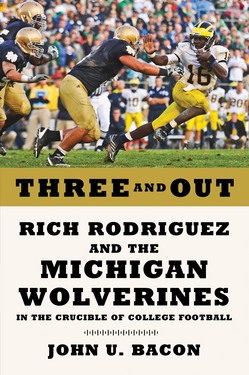
"Three and Out" came out this week.
Bacon: I can certainly see an argument for it, especially when some of these players can’t travel home for the holidays, they can’t travel home when a parent is sick. The players from Florida, I’ve been to Pahokee (Fla.,), and it is one of the poorest places in America. And, you know, can you buy an extra pair of jeans? Can you go out for a meal? That’s where the argument for it is very strong. And $2,000 bucks doesn’t strike me as unreasonable. What I do think you have to think about is, does it open Pandora’s box? People you say you ought to pay players. I’ve got a section in the book, a fifth-year senior at Michigan, out of state, will receive no less than a half million dollars in various things. And that’s conservative, because I don’t include a lot of it. They are paid to some degree, and if you think they’re not, talk to a Chicago dad’s engineering son. It adds up. Second of all, very few athletic departments make any money, so that’s one more cost. And other sports would be cut, and you’ve got Title IX to deal with. What I think you really need is a systemic change where you create a viable minor league in football and basketball, you have a minister of sports, which every other nation has but us, where if you don’t want to be a college student you don’t have to be, where if you want to get paid, you can.
Q: You write in Chapter 8, “Once a coach gets a reputation for disregarding tradition or being ethically challenged, after a certain point it barely matters what he’s really like.” How wide was the gap between Rich Rodriguez’s reputation at Michigan and what you saw?
Bacon: Surprisingly wide. And that is partly his fault, too. The courtship was six days, start to finish. Neither side knew much about the other. Neither side prepared the other side very much for the other, and that’s mainly on Michigan not preparing him for his first press conference and what it means to be a Michigan man, knowing the gospel, basically, if you’re going to sing it. The reader will be struck, is my guess, by how often he beat the drum of Michigan tradition when talking to the players. He knew the stuff. The winged helmet, the banners, “The Victors,” and all this business, and he loved it. He was also coached by Don Nehlen, the West Virginia coach, of course, who was quarterback coach here at Michigan for John Wangler and Rick Leach. Who all he did when it came to West Virginia was turn the “M” upside down to create a “W.” And basically he copied Bo’s program, willfully. Rich didn’t say any of that publicly. And that was the amazing thing. If he said half the stuff publicly that he said privately to his team, he probably would have been a lot better received. And, for whatever reason, he didn’t do that. So I thought he was much more into Michigan than people widely believed, I thought he was a much better person than people widely believed. I think he’s an honest guy, a sincere guy, an incredibly hard-working guy. He gets frustrated. He can feel victimized, and sometimes rightly so. Certainly. But I thought the guy I saw every day was different person than I saw in the paper.
Q: Let’s talk about the Free Press article that launched the NCAA investigation. The hows and whys of the articles play a central role in several chapters. Nothing much surprises me about college sports, but the thread in here on the Free Press did. Do you believe the reporters lacked objectivity when it came to Rodriguez?
Bacon: As you know in the media business, we don’t usually like to talk about other reporters, other writers, for good reason. I can also say unequivocally, and I say it in the book, Michael Rosenberg and Mark Snyder are very smart guys who’ve done very good work in the past and they’ll be doing very good work in the future. I think on this one it’s pretty clear, and it’s in the book, that Rosenberg did not like Rich Rodriguez from the start. And that certainly colors things. If you’re a columnist that’s certainly fair game. You can have any opinion you want. And this is partly on the editors of the Free Press. When you switch hats to investigative journalist, you have to be careful. And having said that, I’m sympathetic to how careful you have to be. My goal was to be as objective as I could get here, but no doubt my personal feelings get into some quarters here and there, no matter how you try to weed it out. I felt that, ultimately, the story lacked some very important elements. If you’re going to do a story on this one rule, on how many hours a week you get, you’d better mention and break down the difference between countable and uncountable hours, something the article never did, something that players did not even understand. They don’t know what the rules are, so when they are talking to the reporters, all they know, rightly, is that they work about 40 hours a week, conservatively. And that’s a big story and that should be written: That the NCAA is completely hypocritical about this. They count it as 20 hours, and it’s really 45. But in a story, you need to include that, and that vital piece was missing.
Q: You wrote in a recent post that Lloyd Carr and Dave Brandon have made it known they don’t appreciate “Three and Out.” How do you think that will play out for you? And has anything at Michigan changed for you so far?
Bacon: I’m aware they’re not fond of the book. And that’s not surprising, and that’s certainly their prerogative. It does change my relationship, no doubt, with certain people at Michigan. Unfortunately. But I still love the Michigan football program, still love the university. As Robert Frost said, “I had a lover’s quarrel with the world.” This is a lover’s quarrel with the university. That’s how I see it.
Q: What was Rich Rodriguez’s final reaction to the book?
Bacon: I don’t want to speak too much on his behalf. He’s free to speak if he wants to. So far, he hasn’t. He is not thrilled about the book. And maybe I should leave it at that. And I can understand that reading about yourself is very difficult. And I did my very best to be as objective as I can. He’s a human being with flaws who made mistakes. And they’re in there. I still think he’s a very decent man. And he’s also a great father and husband. And his coaches are very loyal to him. You look at all that, and I hope it comes across in the book, because it’s true, I think in many ways his public image will improve through this book based on what people perceived beforehand. That doesn’t mean he’s going to like every page.
Q: Is there any anecdote that just didn’t fit in the book, that outlines that or gives a different view of Rich Rodriguez?
Bacon: There are some great family scenes that got cut. There are some scenes back in Grant Town that I had to cut as well. Scenes with his brothers, scenes with coaches. Coaches have a party every July right before they got serious again at one of the assistant coaches houses, and that was just a ton of fun. Fun to see the bonding and to see the real camaraderie that he felt. You got to cut a lot of things to get down to 400 pages. I cut about four books to write this one book. I spared you much.
Q: I thought Chapter 5, which centered on how the Appalachian State loss devastated Michigan, was interesting. If there’s no Appalachian State, does Lloyd Carr get to name his successor?
Bacon: Of course, we’ll never know is the first caveat, but I think the odds greatly increase. That loss sticks out as something as an outlier to almost everything else at Michigan. There have been heartbreaking losses before and upsets, Lord knows. Toledo is on that list in 2008, but that one seemed to reverberate in a way like no other loss I’ve seen in my time of watching Michigan football. He was not on a hot seat; that’s not true. And he left on his own power, that’s certainly the case. But I do think it diminished his power to name his successor. Furthermore, it also diminished their stock. If you’re the offensive coordinator who couldn’t score more than again App State or more than seven points versus Oregon the next week at home, that probably hurt the offense. Or if you’re the defensive coach who let them score 30 some points in that Appalachian State game, that’s not going to help your cause. And if I had to bet right now, if they hadn’t lost that game, you might get Mike Debord or Ron English, but you’d almost get a better shot at getting Kirk Ferentz, who Lloyd Carr also respected. I bet that would have changed the dynamics quite a bit.
Q: Where does Rich Rodriguez go from here? Where does he fit?
Bacon: I would be surprised if he’s not coaching somewhere in January. At some BCS school. I don’t think he’d take a job that’s not BCS. I don’t think he probably should. I think the offers will come up. Michigan has learned a lot of lessons about this. You can see them in how they handled (Brady) Hoke’s press conference to the alums to the fan bases to the PR aspect to paying defensive coordinators market value and then some. I think Michigan has learned quite a bit in his experience. I think Rich has, too. I think he will have a slightly different defensive staff next time around. I think that he’ll probably realize the off-field stuff with alums, administrators and so on that matters quite a bit, and you have to address it. I think he’ll take more initiative on his own behalf in terms of public relations. And speaking for himself. I think he learned a lot of lessons, and he’ll be a better coach next time around. And, I suspect, have an easier time of it.
Q: The current players offer such a different voice than the coaches and other officials in the book. Is Devin Gardner really that funny as Denard Robinson’s sidekick?
Bacon: He’s funnier, actually. Once in a while it got into girlfriends and other stuff, and it got very funny. But some stuff is personal business, so we kept it out. Devin Gardner is a very smart guy, and the odd couple act between these two was one of the great delights of following this team. Whatever went on pro and cons for Michigan football fans, when you get to know these players, as I got to, it’d be hard not to be proud as a Michigan alum or a Michigan fan of the kind of people they’re recruiting and developing. And the kind of people they’re becoming. In my book, I guess, literally the heroes are also the victims, and that’s the players. Whatever else happened, it wasn’t their fault. They dropped a few balls, I get that. A few dumb penalties. But these guys knocked themselves out, and, I think, deserve better.
Q: For somebody who played one season-plus, Tate Forcier certainly captured people’s attention. His name alone always seemed to ensure hits on our site, and in “Three and Out” he comes across as distracted, quirky and talented, all this. What’s your final take on him?
Bacon: Yes (laughing). He’s a complicated guy. I think, if I did my job right, most of these guys will come across as complicated because human beings are, and that includes everybody involved. I didn’t meet any devils, I met no angels. Hopefully they come across that way in the book. But he has a lot of charisma, he’s a very bright guy in a lot of ways. He’s very confident. He’s got some growing up to do; that’s probably fair to say, but what 20-year-old doesn’t? The difference is I didn’t have 100,000 people either cheering for me or booing me. But he always had a relationship with the crowd that no other player I’ve seen has had in a long time. They love Denard. They should love Denard. He’s a great quarterback and a great guy, works hard, very talented, fun to watch. Yet when Tate could come in, in the Illinois or the Iowa game to substitute for Denard in 2010, the crowd got on its feet. And what you’d say about your hits and AnnArbor.com doesn’t surprise me. There is a charisma he had, a connection with the crowd that no other Michigan football player really had. And he knew how to ride it, man. He fed off them, and they fed off him. And that’s something when you see it up close, because it was really exciting to see. That one person could do this was unique in some ways to college football, I think.
Q: The phrase “Michigan Man." Has it worn itself out and become so shredded that any interpretation works?
Bacon: I had to go back to the Justice Potter Stewart, his great line in the pornography case in the Supreme Court: "I know it when I see it." And that’s what you’re left with. That it was overused and under understood, if you will, over the last three years. It became a bludgeon more than something to be proud of in some ways. It’s gone through three rough years, I can say that. And yet, and we both know enough guys who so completely fit the mold of a Michigan man and views that as a model for themselves. To make themselves better people. And I’m not yet willing to chuck it. But I think it should be used in reserve for a while. Until people can really remember what it means.
Jim Knight is the sports director at AnnArbor.com. He can be reached at 734-623-2551 or jimknight@annarbor.com. Follow him on Twitter @JimKnight62.
Comments
JEFF SMITH
Mon, Nov 21, 2011 : 12:33 a.m.
I read this book, great read. If the comments about Carr are even close to being true he should b run out of town. From what I read he did more than anyone to hurt RR and the program. I don't find it hard to believe that Carr didn't want Miles at Michigan, he knew that Miles would make him look bad. His teams were the most under coached in Michigan history, just look at what his kid's have done in the NFL.
Rufus
Sat, Oct 29, 2011 : 12:52 p.m.
Great interview. I can see why John Bacon is teaching a class at the M. Takes me back to my years in AA, and the insightful and thoughtful teachers I had. You always come away with a higher sense of curiosity when you hear or read a man like Bacon. It will be interesting to see how Gardner's role plays out this and next year. Also, looking forward to see how "the tater" does at San Jose State. I'd even like to see what a RR offense would look like if he had solid defensive coaches- and learned from his mistakes. 3 hours until kickoff. Go blue.
1bit
Sat, Oct 29, 2011 : 4:56 a.m.
Great interview. There is no shame in exposing and learning from the mistakes U of M has made. Good luck to Coach Rodriguez, Coach Hoke and all the other coaches and players. Now to the homecoming game. This Is Michigan fergodsakes. Go Blue!
heartbreakM
Sat, Oct 29, 2011 : 3:11 a.m.
Hey Mr. Knight: Thanks for that interview of John Bacon. I actually think he has a lot of interesting insights into the former coach (a coach I always thought was the wrong hire). Some of the things Bacon says almost gives me sympathy for the WVU transplant.......almost. I think Bacon has a lot there.
riverraisin
Sat, Oct 29, 2011 : 2:27 a.m.
" I saw every coach fall asleep during film sessions at some point or other..." Well, that explains alot.
riverraisin
Sat, Oct 29, 2011 : 5:28 p.m.
Point being that the coaching staff slept while a legendary football program became the laughing stock of the B1G?
riverraisin
Sat, Oct 29, 2011 : 2:01 p.m.
Yes, I get it, they put in so many hours that they couldn't stay awake when they were analyzing game films. Do you get that maybe that explains , in some part, why they were never prepared for their upcoming opponent? If a student athlete slept through class because they were putting in so many hours, would that be an excuse for a low grade?
Moonmaiden
Sat, Oct 29, 2011 : 11:57 a.m.
Yes, it explains that you completely missed his point.
spm
Sat, Oct 29, 2011 : 12:58 a.m.
I'm interested in reading the book. I'm sure so much happened outside the public view that this may help explain many things. I was never a fan of RR but I do want to see what he has to say about these past three years.
Terry Star21
Sat, Oct 29, 2011 : 12:30 a.m.
Thank goodness the book didn't come out in January and was titled; 'Four and Out'..... Thank goodness for Dave Brandon and Brody Hoke, our 'Michigan Men' - our heros............ Thank goodness it's Friday, and the Greatest Show on Earth is hours away at The Big House...... MgoBlueForTiM................Thank goodness.....
missionbrazil
Sat, Oct 29, 2011 : 3:05 p.m.
well put TS21 ... Thanks goodness Michigan is on the way back !
GoBlue1984
Fri, Oct 28, 2011 : 11:04 p.m.
Glad to see someone finally telling the truth about Rich Rodriguez. Kudos to you Bacon!
Marcus Ray was Right!
Fri, Oct 28, 2011 : 9:26 p.m.
I have a very simple defintion of a Michigan Man/Woman, which is the same one I am teaching to my nieces and nephews. A Michigan Man/Woman will support and cheer for all thing Michigan. They will do the University proud and be humble about it to the point of being a 'shrinking violet' in their humility. And above all, they will do the Right Thing, no matter the personal cost to them.
Lorain Steelmen
Fri, Oct 28, 2011 : 8:10 p.m.
D21. I think your post exposes SO much more about you, than it does about Bacon, and especially, Theo212. You look 'small' when you persojally attack others...you donlt need that, just sayin'. I haven't read Bacon's work yet, but the few times I have had the opportunity to talk to him, he's always been pleasant and balanced, with me. I think Bacon, genuinely likes Michigan, but even more so, he 'appreciates' the men and women that have contributed to its great heritage, in football, and in other sports. I think we'll see that Rodriguez was not perfect by any means, and may NOT have been the right selection, BUT I think we'll also see that he was undermined by people, ( like Carr), who want us to believe that THEY are Michigan men, all the while, they worked to destroy this program, and thereby, the University, and most importantly, the players themselves, in order to further their own personal agendas. I find that very sad, and very 'small'. I think we'll also see, that the solid, fundamental, character traits that Bo, ( and others here), have supported over the years, WILL endure, and that under Hoke's program will re-emerge as 'driving forces' in the league. I'm an 'OLD blue', and we always used to say that 'the road to Pasadena, runs through Ann Arbor'. It think we'll see that again, very soon. Only time will tell, if Brandon, puts the university 'before self'. Right now, I have seen him do some things that are NOT in the best interests of the football program, or the University. But to be fair, part of that may be part of a learning curve. He's 'young' in the job. I just hope he doesn't 'cheapen the brand' in a misguided attempt to strengthen it. I hope his character is such, that when he skrews up, he'll admit it, and change course, when necessary. 'Tradition' is a precious thing, and when celebrated, can bring life to a university rather than suffocate it. I hope Davey is smart enough to undersrand the difference. We'll see, but I wish him well.
missionbrazil
Sat, Oct 29, 2011 : 3:03 p.m.
"I think we'll see that Rodriguez was not perfect by any means, and may NOT have been the right selection, BUT I think we'll also see that he was undermined by people, ( like Carr), who want us to believe that THEY are Michigan men, all the while, they worked to destroy this program, and thereby, the University, and most importantly, the players themselves, in order to further their own personal agendas. I find that very sad, and very 'small'." That's some good fiction writing Lorain ... ever think about writing a book ?
heartbreakM
Sat, Oct 29, 2011 : 3:08 a.m.
LS: I really like what you wrote about cherishing tradition. I too really embrace the traditions that college football has, and especially that Michigan has. I get the idea that David Brandon is trying to be the "cool kid on the block" and is using his past (he played football, so therefore knows better than all of us attitude) as a crutch to allow him to do what he wants, even if it's detrimental to tradition (at least in my eyes). Example: those uniforms last game vs. MSU. Other example: refusing to make a schedule that Michigan players can look forward to and that paying fans/alumni can be proud of (another game against App State and UMass? Puh-leese). thanks for that nice post.
D21
Fri, Oct 28, 2011 : 11:20 p.m.
Lorain, I forgive you. It's obvious you misunderstood my posting. John 14:6
MRunner73
Fri, Oct 28, 2011 : 9:31 p.m.
Thanks for your reply and I liked your post. Brady is cut from the Bo Schembechler mold and is likely to succeed. My view is that many fans are holding Michigan teams to the 1997-98 standard, thus, any loss is devasting and exposes glaring weakeness on the football team. SImple overreaction and emotion. Go back to three years of the Rich Rod era and you get a major headache and nightmare. As for Dave Brandon, he might be more like Don Canham, rather bold for his time, but I am sure Canham would not dissappove of what Barnadon has done or is doing so far. Go Blue!!
MRunner73
Fri, Oct 28, 2011 : 8:03 p.m.
I can't wait to read this book. It is unfair for anyone to think the past three years should be erased as much as it absurd to think we should also forget about Bo Schembechler's 21 years at the helm. Bo's era was great, sweet and had only a few bad and near tragic moments. The Rich Rod era wasn't that good, a bad dream but equally as relevent. To each their own, read the book or don't read the book. I have no problem with either view. BTW: A Michigan Man is not just a student athlete or caoch. A Michigan Man (or women) is a person that views themselves as part of the greater whole of the athletic program. That means, as a student athlete, you are part of your program, not the star and not the person the program depends on for success. As a fan, you cheer the athletes first, the program and the tradition. I don't understand what the mystery is. Yes, I have my varsity letter jacket but that doesn't make me a Michigan Man. It is me being honored to be a part of the track and cross country program and to have worn the Block M jersey in competition. The best Michigan Man I know of? The Late, Great Bob Ufer.
Lorain Steelmen
Fri, Oct 28, 2011 : 8:29 p.m.
Mrunner. Great post! I'd expand your post to include ALL Michigan students and grads, that see themselves as part of a 'team', in a quest for excellence. That's why this team, and ALL our teams, bring this university family 'together'. Everyone here, 'gets it'! To me, M athletics represents the quest for excellence, through hard work, determination, and persistence. The same ideas are found in ALL the U's programs. (Engineering, and Business, are the two I participate in.) But any of the sciences or humanites here, the constant and continuous quest for excellence in one's field, and their contributions to the society as a whole. Bo, wasn't just coaching football players, he was coaching young men to be contributing members of the society. I think Hoke is doing EXACTLY the same thing. I think Hoke 'get's it', MORE than many fans realize. There is a lot of 'the old man' in Hoke...a LOT! So here's to 'The team, the team, the team'...'The leaders and best'. Good luck guys, beat Purdue!
Lolly
Fri, Oct 28, 2011 : 7:35 p.m.
Fascinating. Can't wait to read it.
MikeB
Fri, Oct 28, 2011 : 7:33 p.m.
I am reading this book and he did an outstanding job. It really appears to be objective. Unless you are there you can't be sure but it is well researched and a very interesting read. Painful at times and since you know the outcome of games there are moments when you wince knowing what is going to happen, but it is an interesting book Worth reading even if you are not a UM fan, it is a handbook of what not to do in a situation and cold be shortened into a business book on handling communication and management
D21
Fri, Oct 28, 2011 : 7:25 p.m.
Hey Bacon, Better get started on your next book, "Hoke Is It: The Michigan Man & His Successful Wolverine Teams" Theo212, Why didn't you collaborate with Bacon with your RR poetry works, oh, you mean Bacon laughed right at your face... TiM