

Michigan admits to violations, self-imposes probation, practice restrictions
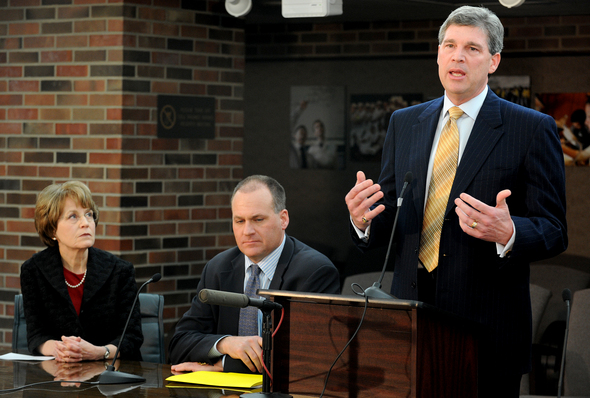
Michigan athletic director Dave Brandon speaks while university president Mary Sue Coleman and football coach Rich Rodriguez listen to him describe the Notice of Allegations delivered by the NCAA in March. On Monday, Michigan self-imposed penalties for the violations.
The winningest program in college football history is going on probation.
Nine months after allegations of improprieties in its football program first surfaced, Michigan admitted to four major violations in a 79-page response sent to the NCAA on Monday.
The university acknowledged it exceeded NCAA limits on practice time and staff size; that it failed to properly monitor its football program; and that former graduate assistant coach Alex Herron lied to NCAA investigators.
Michigan disputed part of a fifth allegation against coach Rich Rodriguez - that he failed to promote an atmosphere of compliance, while acknowledging that he failed to properly monitor the duties of his staff - but still self-imposed a series of sanctions that follow past NCAA precedent.
(Click here for link to Michigan's official web site that details the university's response).
“Nobody wants to be investigated, nobody wants to be found guilty of committing infractions, nobody wants to be found guilty as a result of those kinds of activities,” Michigan athletic director Dave Brandon said late Monday night. “So we don’t like this, I don’t like this. This is an unfortunate outcome for our university and our program.
“We’ve worked hard to correct some things and we feel that we’ve appropriately come up with a list of ways to punish ourselves and remedy the fact that we’ve made those mistakes. And I don’t know what else we do at that point other than to move on and learn from it and make sure it doesn’t happen again.”
Michigan’s ultimate punishment won’t be decided until after an August hearing before the NCAA Committee on Infractions, but the university self-imposed several corrective and punitive measures Monday.
Along with two years of probation, the minimum term according to NCAA bylaws, Michigan:
• Docked itself 130 hours of practice time, double the 65 hours it exceeded NCAA limits by from January of 2008 through September of 2009. The reduction will take place between June 1 and the end of the 2011-12 academic year.
• Cut its number of quality-control assistants, the support-staff members who overstepped their duties by engaging in coaching activities, from five to three for the next two seasons. Quality-control assistants, now called staff interns, also are restricted from attending practices this season and barred from normal game-day activities such as traveling to road contests or being on the sidelines for home games.
• Changed the way its compliance department reports and monitors a student-athlete’s countable athletically related hours.
• Disassociated itself from Herron, who was fired March 6.
• Issued letters of reprimand to seven people named in the allegations: Rodriguez; director of strength and conditioning Mike Barwis; assistant athletic director for football Scott Draper; director of football operations Brad Labadie; senior associate athletic director Joe Parker; associate athletic director for compliance Judy Van Horn; and assistant athletic director for compliance Ann Vollano.
Rodriguez answered the allegations against him with his own 89-page response. In it, he acknowledged that violations occurred and that “he could have done a better job of monitoring the activities of some members of his staff.” But he stressed he did not fail to promote an atmosphere of compliance.
“Rodriguez and his staff are not rogues, renegades or cheaters,” his response said. “Yes, there were violations. But they were not done deliberately or knowingly. Rather, they were inadvertent and in many cases isolated. The underlying activities were done openly and transparently. Finally, the violations did not result in a significant competitive advantage for Michigan's football program.”
Despite a provision in Rodriguez’s contract that allows Michigan to fire him for committing a major violation, Brandon said there are no plans for that to happen now or in the future.
“We’ve been very public and very open over the fact that we do not believe, based on the circumstances that are before us, that it would be appropriate to have it impact the employment status of our coach,” Brandon said. “We’ve made it real clear that he’s going to be our coach in the fall. We made it real clear that these problems, although unfortunate, don’t rise to the level of triggering termination.”
Brandon, who’ll address the media along with Rodriguez via teleconference today, called Monday a “day of relief,” though Michigan’s ordeal is not yet over.
The NCAA enforcement staff still must turn its case summary over to the Committee on Infractions, and the committee will use that, responses by Michigan, Rodriguez and Herron, plus information gleaned at its August hearing to render a final decision.
Brandon, Rodriguez, Michigan president Mary Sue Coleman and seven others have been asked to appear at the Aug. 13-14 hearing in Seattle.
“The best outcome would be we go and appear before the infractions committee in August and they believe that we did a responsible job of matching up our penalties and sanctions with things that were uncovered in parts of the investigation, both theirs and ours,” Brandon said. “And then we move on.”
Dave Birkett covers University of Michigan football for AnnArbor.com. He can be reached by phone at 734-623-2552 or by e-mail at davidbirkett@annarbor.com. Follow him on Twitter @davebirkett.
Comments
Bob
Thu, May 27, 2010 : 11:41 a.m.
@ Ray Scheib - totally correct! U of M, cut your losses now and get rid of this guy....he's been nothing but disruptive since he got here....you'd think with all the prestige Ann Arbor and it's beloved football team have...we could get someone who actually has character and honor for RR has neither
Gary Schmidt
Thu, May 27, 2010 : 10:40 a.m.
To put this into perspective, here's the core finding. Over the course of two years, UM exceeded practice limits by a total of 65 hours. That time was spent doing warmups and stretching (which the staff mistakenly believed were not "countable" hours). The allowed level of "countable" practice time over the course of two years comes out to something like 1000 hours. So let's be clear: yes, these were violations, categorized as "major" by the NCAA. But we're really looking at 65 hours of stretching in the context of some 1000 hours allowed. To me the real story is the hypocrisy and phony innocence of the NCAA regulations. On the one hand, I love college sports, and I'm a UM fan. But the whole system of "amateur" athletics is a scam.
Ray
Thu, May 27, 2010 : 10:05 a.m.
They must get rid of Rodriguez. He has been nothing but trouble since day one.VT was happy as hell to get rid of him.look what he did to that team.And this is the best coach they could get.This fools is the biggest joke in football.
FRED
Tue, May 25, 2010 : 8:45 p.m.
As a former Div I coach, these so call violations are minor. I have witnessed more blatant violations done by revenue sport coaches, yet, the school would simply look the other way. Take a look at John Callapari and the trails of violations he caused at each school he coached. Supporters would say that they are all coincidences the word we use when we cannot see the levers and pulleys. Rich Rodriguez was single out because of his personality, lack of tact and clumsy cleaned house effort immediately after he arrived. You cannot make a wholesale change without a reason especially if you failed to produce right away. Unlike basketball, it will take more than a few years to build a football program fitting the new coaching direction. Rodriguezs long battle with West Virginia over his old contract did not help - simply added fuel to the fire. The many missteps caused his detractors to surface up the minor violations and roll them into a major lack of control charge. If Michigan was a mid level Div I program, none of this would have been an issue. But Michigan is a high profile program with high expectations. In retrospect, Rodriguez should have handle the contract issue behind the scene and settle it quietly and quickly. Also, instead of changing the staff completely, he should have weighted each coachs value and retain some continuity. At minimum, learn the politics of Michigan football before moving the mountain. In a few years, all this would be forgotten. Whether Rodriguez remains a coach or moves on to a greener pasture, no one would care of the minor infractions. Politics and the truth are not for the faint hearted. Hopefully, Rodriguez would learn from this and understand that head coaching Div I is more than just an arrogance quoting machine.
bmaloy
Tue, May 25, 2010 : 6:29 p.m.
Didn't see the presser. Was D Rod crying like he was back in August?
Terry Star21
Tue, May 25, 2010 : 4:28 p.m.
In three more years coach RichRod will have 30 victories and 3 Bowl games for Michigan.
ironyinthesky2
Tue, May 25, 2010 : 2:09 p.m.
Blue Marker makes a great point. RR is not evil; he's not perfect. He needs to be given a chance. I don't know what that translates to next year, but I'll be happy with consistent improvement. The hate is a bit ridiculous, as are the expectations that Michigan, or any school, can always be good enough to go to a bowl. I hurt like the rest of you with so few wins, but I've actually enjoyed the anger and the know-it-alls that just can't accept a few down years. Look around, every other program has had them - Michigan's recent streak of 5,000 straight winning seasons (maybe it wasn't quite that high...) was phenomenal - maybe we can start another one and enjoy what we have, not what we were. If not, can I be 19 again when I was "like a rock" (thanks, Bob Seger)? Otherwise, I'll take one day at a time and make the most of each one. The way I see it, we haven't lost yet in 2010! Really, it (probably) will get better. Or, it won't. Either way, how does it really affect your life? (this is not directed to Michigan Football Staff - it better be important to you!) Believe it or not, I woke up the morning after the last OSU loss and the coffee was pretty good - I just kind of ignored the sports section... Go Blue!
Blue Marker
Tue, May 25, 2010 : 1:42 p.m.
N/A and voiceofreason: Great posts! Kind of what I was thinking. However, I'm looking more at Snyder, Rosenberg and Sharp that Dave. It's amazing the amount of mindless comments on here. One of the main points of UM's response is that many of the people who involved were on staff at UM prior to RR's arrival. But don't let the truth stand in the way of a good post. Just keep on your "this wouldn't have happened if RR wasn't here" bandwagon.
ironyinthesky2
Tue, May 25, 2010 : 1:32 p.m.
Robbie, I hope you're right, but the truth is, none of us really know...
Robbie Webb
Tue, May 25, 2010 : 1:02 p.m.
Tom, you wont be saying that after this year.
Tom Joad
Tue, May 25, 2010 : 12:50 p.m.
Worst football coach the school has ever known--what an embarrassment to the entire state of Michigan and this august university.
Robbie Webb
Tue, May 25, 2010 : 12:46 p.m.
Rich Rodriguez can coach at this level. Anyone who thinks otherwise is just blinded by frustration.
Macabre Sunset
Tue, May 25, 2010 : 12:42 p.m.
Thanks, Rod. Your legacy is now secure. As for the going through the pain, now we experience the reward argument? Don't buy it. The man can't coach at this level. He's in over his head. The sooner he goes, the sooner someone who knows what he's doing will rebuild the program. Elite high school athletes will dismiss the maize and blue as long as this clown is in charge, as his gimmicky schemes are irrelevant for those who want to play in the NFL.
bballcoachfballfan
Tue, May 25, 2010 : 12:24 p.m.
First off, we all have to come to terms with the fact that the NCAA definition of "major" is different than a true interpretation of the word. Nothing Michigan did here is truly major. Major is illegal recruiting. Major is paying athletes to come or paying them while they are there. Major is changing grades or having others take tests for athletes. What happened here pales in comparison to those types of things. The biggest shame in all of this is, in these incredibly difficult economic times, this has cost the University (and therefore the taxpayers of the state of Michigan), the NCAA and no doubt numerous others tons of money. For what? To find out we need better compliance--something that bringing in a true executive like Brandon would have done anyway. This was a colossal waste of time and tax payer money. To those who argue that we would be better off bringing in Harbaugh or Les Miles right now, I say you are terribly mistaken. One of the previous comments said it would set us back 5 years and I think that is true. Yes, 8-16 sucks but now that we have gone through the pain, don't sabbotage the thing right before the pay off. And for he who said "at least they know the rules", you might want to talk to some people (like former Michigan football regime) about Les before making that comment. It is a shame to those of us who have been Michigan fans for so long to have this blemish. But honestly, separate yourself from your Richrod hate and truly analyze this for what it is--basically a whole bunch of nothing.
ironyinthesky2
Tue, May 25, 2010 : 12:17 p.m.
Can we get on with football? It's time to put this behind us and move forward - hopefully (for me) with a lot of passing and completions!
bs
Tue, May 25, 2010 : 11:59 a.m.
hey, Watchman.... believe it or not, I know who is actually behind that mask.... no, really, I do...
alarictoo
Tue, May 25, 2010 : 11:54 a.m.
This quote from Rodriguez in his 89-page novella says it all: "Finally, the violations did not result in a significant competitive advantage for Michigan's football program." Well, we could also replace the words "the violations" with "Coach Rodriguez" and be just as accurate in the assessment.
CountyKate
Tue, May 25, 2010 : 11:51 a.m.
People might be interested in this article: http://www.freep.com/article/20100525/SPORTS06/100525010/1319/Rich-Rod-Im-at-fault-so-are-others (sorry, I can't make it link) in which Rich Rod 's response to each point is documented.
AceDeuce
Tue, May 25, 2010 : 11:28 a.m.
No team is above the laws of the NCAA. But I still think part of this whole thing is ridiculous. Michigan was completely changing their football program from coaches to players to style of defense and style of offense. Any school that has to go through that should deserve the right to extra hours of practice, this is D1, it's not like the players can't handle it.
Robbie Webb
Tue, May 25, 2010 : 11:18 a.m.
Yes, he would. In a couple of ways. Number one, most of the players here now are Rich Rod's and came to play for him and run the spread, if he was gone, say goodbye to alot of them. Number two, Jim Harbaugh runs a prostyle offense, that will not win Michigan another championship. Which is why our last one was 1997. The big ten has to start playing with the times, three national championships from all the big ten teams combined since 1970 is horrible. And you want Harbaugh? Wrong! Give Rich Rod some breathing room. He didn't have experience and leadership, as I have said over and over, to work with. People are mad now, but once they start winning this year, this violation stuff wont matter and everyone who doesn't support Michigan will be calling us cheaters, blah blah blah.
azwolverine
Tue, May 25, 2010 : 11:05 a.m.
Robbie, "Les or Jim would set the program back even further..." Really? Further back than 8-16 and NCAA sanctions? I'll take whatever they've got over what RR has already given us. At least they understand all of the rules (which RR apparently does not) and understand what it means and how to achieve being the "Leaders and the Best."
Rhe Buttle
Tue, May 25, 2010 : 10:49 a.m.
Self-imposed! HAH! That's just spin from RichRod telling us he still hasn't put together a team.
Robbie Webb
Tue, May 25, 2010 : 10:35 a.m.
Nobowl, les or Jim is not going to be here. Michigan will win more than six games. Harbaugh would set the program back even further, and you clearly do not realize that.
mmb
Tue, May 25, 2010 : 10:33 a.m.
As they chant at Yost, "Who Cares??!!"
friend12
Tue, May 25, 2010 : 10:17 a.m.
RR better hope the NCAA final ruling is quick. If not and he has another bad year, the school will be able to fire him for cause which means they don't have to pay out his contract.
genericreg
Tue, May 25, 2010 : 9:12 a.m.
Next time they catch me speeding I am going to tell the cop I will self-impose regulations and he does not need to write me a ticket. The cop might ask why I did not self-impose regulations in the first place, since I was well aware what the rules were.
Sparky79
Tue, May 25, 2010 : 9:01 a.m.
@Watchman - U-M admits an infraction but RichRod denies it? Where? From the article above: "The university acknowledged... that coach Rich Rodriguez failed to adequately monitor the duties of his staff." Okay, but... "Michigan disputed part of one allegation against Rodriguez - that he failed to promote an atmosphere of compliance." And later in the article... "Rodriguez answered the allegations against him with his own 89-page response. In it, he acknowledged that violations occurred and that he could have done a better job of monitoring the activities of some members of his staff. But he stressed he did not fail to promote an atmosphere of compliance." Both RichRod and the University admit he could have done a better job monitoring. But BOTH also deny that he failed to promote an atmosphere of compliance. There is no fact to your statement that U-M admitted to a violation and RichRod denied it. They both admitted to the same monitoring violation of failure to monitor and they both denied the atmosphere of compliance violation. Perhaps next time you should actually read the article, not read what you want to hear.
Mike Gould
Tue, May 25, 2010 : 8:52 a.m.
To me this has been another story that is much about nothing. Ok, one staff member did lie and that in itself should be the cause of some punishment. Yet too I remember when the story broke that there were a lot of comments coming out of other major universities about the time and effort that needed to be put in to be successful, and I have no doubts that if the NCAA investigated every program they would find similar "violations". Which compared to what apparently took place out at USC isn't even worth the media's time writing about.
a2roots
Tue, May 25, 2010 : 8:41 a.m.
Way to many people asking for heads to roll and crying about the black eye to UM. In the scope of infractions what UM is admitting to is as far from major as you can get. To the hypocrites at the NCAA everything is major. Until now your probably could have found these same violations at every major athletic school. We just happened to get caught because of some unhappy wannabes. Certainly someone screwed up and the UM squeaky clean reputation is tarnished but be real folks and pull your heads out of your butts. Get over it and move forward. When things kick in you will want to be on this bus.
Susie Q
Tue, May 25, 2010 : 8:34 a.m.
As The Answer, Allen Iverson, once famously said, "We're talkin' about PRACTICE, man. PRACTICE!" While no one wants to see their alma mater undergo negative scrutiny for NCAA infractions, let's put this into perspective. Let's get past this and support our guys in maize and blue. All the negative fan talk discourages possible recruits from coming here and does a disservice to the current players. Most of the folks who are advocating stiffer penalties are the same old Rich Rod haters who have not given him a chance since the day he got here.
trigg7
Tue, May 25, 2010 : 8:30 a.m.
"UM is now the cleanest major program in the sport" That made me cry it was so funy.Keep up the good work!
ShadowManager
Tue, May 25, 2010 : 8:15 a.m.
Anyone who STILL thinks Dave Brandon was brought in to "clean house" from Bill Martin's leftover messes (primarily The Life and Times of RichRod...) after this tepid response and defacto defense of RichRod...is sorely mistaken.
kulse012
Tue, May 25, 2010 : 8:12 a.m.
Seems Rodriguez has changed his tune a bit since "We know the rules and we follow them". It's still not anything another school does not do, but the flip flopping is just another reason he needs to go soon.
roz
Tue, May 25, 2010 : 8:01 a.m.
@voiceofreason, if the initial reports, as the University states, were "greatly exaggerated if not flatly incorrect", why are sanctions needed at all. In fact, the media reported something that was wrong and needed to be brought to light and corrected. Do you think anything would have changed if those stories had not appeared? Perhaps the early stories went too far. The way the U can protect itself in the future would be to keep its nose clean. I hope it does. I got used to being proud of the Athletic Department's ethics long ago, and I want to get it back.
NoBowl4Blue
Tue, May 25, 2010 : 7:55 a.m.
Never felt comfotable with Rich Rod as thus far while at U of M all he has done is disappoint. Les or Jim will be back for sure next year which can't come soon enough.
chosen1
Tue, May 25, 2010 : 7:49 a.m.
I think we need to look at this as still being a process. It isn't over and we won't really know our punishment until that meeting in Seattle in August. Benwoodruff...u are wrong about not being punishment for Troy Smith. He was suspended for the bowl game and 2 other games. He was forced to pay back the money given to him by someone who wasn't a booster or alumni member. The NCAA investigated and chose to go with OSU's suspension of Smith. And it was like $200 not the $100,000+ that C-Webb got from Martin....big difference
The Watchman
Tue, May 25, 2010 : 7:47 a.m.
Let's see, UM admits to an infraction but Rich Rod denies it. Rich Rod responds with 89 pages. A lot of response for minor infractions. Who paid for his attorney on this one? Let me get this right, I coach football for the UM. My contract states that I can be fired for a major infraction. I receive a permanent letter in my personnel file. Brandon states people do not like letters in their file. I make millions. Put a letter in my file. I make still make millions. Life is good.
voiceofreason
Tue, May 25, 2010 : 7:19 a.m.
Also, All MSU fans should make sure to get their shots in now. It will be the last chance for a very long time!
SemperFi
Tue, May 25, 2010 : 7:16 a.m.
This is a tempest in a teapot. If these supposed "major infractions" happened at a lesser school, the allegations wouldn't have seen the light of day. Move on.
voiceofreason
Tue, May 25, 2010 : 7:16 a.m.
From the actual UofM report given to the NCAA: "... the University is satisfied that the initial media reports were greatly exaggerated if not flatly incorrect." "While the University takes the violations very seriously, the actual violations are a far cry from the initial claims in the media." Mr. Birkett, I believe you and your cartel owe the university an apology.
bruceae
Tue, May 25, 2010 : 7:10 a.m.
Might as well go for the bowl ban for a year too since you won't be going anywhere AGAIN this year. Rich Rod, the gift that keeps on giving to MSU Fans.
BenWoodruff
Tue, May 25, 2010 : 7:09 a.m.
Now, let me get this straight...U of M, too much practice and penalties...USC, Reggie Bush takes money, his family lives in a condo paid for by an agent...no punishment...OSU...Troy Smith admits taking money...no punishment...NCAA sucks.
NoBowl4Blue
Tue, May 25, 2010 : 7:02 a.m.
Knowing Rich Rod he'll find a way for the guys to practice although I assume U of M fans would prefer he find a way to win especially against rivals. He's only here because of the sanctions and will be toast after 6 wins and at best Pizza Pizza bowl this year.
Awakened
Tue, May 25, 2010 : 7 a.m.
And they still didn't have a good year....
N/A
Tue, May 25, 2010 : 6:54 a.m.
Outrage! Uniformed comment. Another uniformed comment. RichRod hate, explanation of why he is the devil. My stupid opinion of what I think should of happened based on my extremely limited knowledge of the situation and rules. Regurgitation of an opinion I read/heard somewhere but I have now made it my own. More speculation and outrage. Statement about how this would never had happened if Bo/Lloyd/Clinton/Simpson/Kiffin/Limbaugh was coach.
outdoor6709
Tue, May 25, 2010 : 6:42 a.m.
If I remember correctly, when this story first broke the practice logs dissapeared. Anyone who drove past the U of M statium on their way to and from work knew at the time U of M was practicing a lot in the new coaches first year. Since the AD who allowed this to happen is gone, how about the U of M President and all coaches involved, or not involved as they kept telling us, return 25% of their pay for the time period in question. That would discourage the lack of accountability that took place.
trespass
Tue, May 25, 2010 : 6:30 a.m.
Where is the punishment? Isn't three quality control coaches still more than any other Big Ten football team? Who was held responsible? No one got fired, except the one that lied to the investigators and I will bet they cut a sweetheart deal with him to keep him from pointing fingers at others. They can't really punish anyone because they would then be free to tell the truth.
barnz378
Tue, May 25, 2010 : 6:30 a.m.
I think we should of forfeited all games from the last 2 years.