

Michigan compliance staff frequently pushed football program - but not Rich Rodriguez - for practice-hours forms
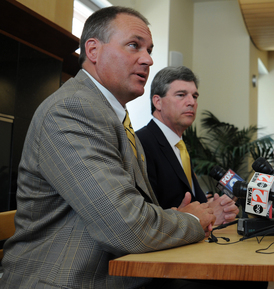
Michigan football coach Rich Rodriguez, left, and athletic director Dave Brandon will address the NCAA later this week.
Melanie Maxwell | AnnArbor.com
(Editor's note: This story has been revised to correct the date that AnnArbor.com gave the university a deposit for information requested under the state Freedom of Information Act, and to correct a description of what the law requires of the university.)
When Michigan football players didn’t turn in forms about what cars they drove and who owned them in 2008, administrators from the university’s compliance office let head coach Rich Rodriguez know.
That wasn’t the case when football administrators didn’t turn in required forms tracking the number of hours the team practiced.
Instead, compliance office administrators spent more than a year-and-a-half cajoling football administrators to turn in the Countable Athletically Related Activities forms, but never copied Rodriguez on the e-mails.
With the university and Rodriguez headed to Seattle for meetings Friday and Saturday to defend themselves against allegations they broke five NCAA major rules, there are still no answers about exactly why the compliance office never told Rodriguez about the missing forms.
Many of those answers might never be known. None of the key players is talking about the breakdown.
All Rodriguez will say is that he didn't know about the missing forms until a university audit noted the problem in a July 2009 report sent to university President Mary Sue Coleman and the Board of Regents. Those forms for the winter and fall of 2008 didn’t get turned in until the end of August 2009. The forms for winter 2009 showed up in mid-July 2009. The forms for fall of 2009 were turned in roughly on time.
More on compliance
Documents released by the university - both in its public response to the NCAA and to a Freedom of Information Act request for additional documents filed by AnnArbor.com - appear to back Rodriguez’ claims that he didn’t know of the practice time violations and the missing CARA forms, while raising questions surrounding the university’s role in monitoring what was going on in the football program.
Not turning in the CARA forms isn’t an NCAA violation. However, the university uses the university-created forms to track how much its athletes practice, something the NCAA monitors. In its initial response to the NCAA, the university said it had placed discipline letters in seven employees’ personnel files. AnnArbor.com filed a FOIA request for personnel files of those involved on June 21 and paid a deposit for those files on July 19. Those records have not been produced by the university. Patricia Sellinger, the university's FOIA coordinator, told AnnArbor.com in an e-mail early last week that she did not have an estimate on when those files will be available. State law requires the university to respond to a request within 15 business days of receiving the request, either granting the request, denying it or asking for a deposit before proceeding on the request. The compliance office - routine calls On Jan. 11, 2008, less than a month after he took full control of the Michigan football team, Rodriguez and members of the university’s compliance office sat down for their initial meeting. The meeting covered more than 20 topics ranging from the role of outside boosters in the program to a review of the 2002 basketball infractions, according to an agenda of the meeting. Also on the agenda was a conversation about the monthly submission of CARA logs. At the meeting, the compliance office pointed out the university had an “unequivocal commitment to rules compliance.” That meeting was hardly the last time the compliance office and Rodriguez would get together or communicate. On Feb. 19, 2008, the compliance office met again with Rodriguez. On the agenda line for CARA forms is a statement that said “NCAA survey on football s-a timepractice a major issue at NCAA Convention. Also, late forms and possible blank forms signed by players.” The compliance office worked proactively and reactively with the football program, documents obtained by a FOIA request show. Staff members monthly sent out interpretations of new NCAA rules, often crossing out the ones that didn’t apply to the football department on the copies given to Rodriguez and his staff. Compliance staffers also held meetings with the football staff, both coaches and administrative staff. The need to fill out CARA logs was on the agendas for those meetings, even when the football staff wasn’t filling them out. Documents don't record what was said in those meetings about the CARA logs. The compliance office also annually sent out a memo to all Michigan head coaches about the CARA forms. “These forms are to be completed on a weekly basis during your playing and practice season. Turn them in to the CSO (compliance office) at the end of each month.” A form is attached to the memo. Set up in a weekly schedule format, it has places for times to be written in for each day and how much time was spent on practice, skill instruction, meetings, weight training/conditioning, film/video review and competition. There’s a space for the signature for the head coach and the compliance office. “The CSO educated the football staff, including the coaching staff and the quality control staff, on virtually every issue now before this committee,” the university wrote in its response to the NCAA’s Infractions Committee. The compliance office and communication with Rodriguez On Aug. 22, 2008, Vollano, an assistant athletic director in the compliance office, e-mailed Brad Labadie, then the director of football operations, asking for the auto registration forms several players hadn't filled out. Copied on the e-mail was Scott Draper, the assistant athletic director for football, and Jennifer Maszatics, Rodriguez’s executive assistant. Four days later, Vollano sent another e-mail, asking for the missing auto forms. Maszatics was copied on the e-mail. In copying Maszatics, Vollano was making sure Rodriguez knew about it. “Rodriguez did not have an institutional e-mail address, with all of his e-mails going to his administrative assistant, who provided them to him,” U-M wrote in its response to the NCAA. The compliance office knew that. In e-mails obtained by AnnArbor.com through a FOIA request, not only did the compliance office regularly copy Maszatics on various compliance issues, they also occasionally e-mailed her directly, asking to make sure Rodriguez knew about things. For example, Judith Van Horn, an associate athletic director in the compliance office, wrote to Maszatics on Feb. 18, 2010. “Jennifer: please print and provide to Rich. Thanks! He has been expecting this guidance from the NCAA. Thank You! Judy” A couple of lines later, Van Horn directly addressed Rodriguez. “Rich: Below is the NCAA guidance we have been waiting for. Please do not hesitate to contact me with any questions or if any additional information is needed.” During this time, Rodriguez was included on several issues the compliance office was working with the football team on, including missing job descriptions for football coaches. On Sept. 3, 2008, Vollano e-mailed Draper about the missing forms. “Scott: Just a reminder that this form was due August 22nd. I have attached another form in case you need it. Please note that we need job descriptions for the non-coaching staff members …” Maszatics was copied on the e-mail. The only compliance issue where it appears the compliance department didn’t copy Rodriguez through Maszatics was the missing CARA forms. A FOIA request by AnnArbor.com for “any and all e-mails, memos or other correspondence between any member of the university’s compliance office and Rich Rodriguez regarding any issues of compliance … from January 2008 to the present date” by AnnArbor.com turned up dozens of e-mails and memos, but none addressing CARA forms until a Jan. 20, 2010 e-mail, well after the summer 2009 issuance of a report by university auditors noting the missing CARA forms. However, university records show that during that time period more than 25 e-mails were sent from Vollano and Van Horn to Labadie and Draper regarding the missing forms. Included are some in which Vollano tells Labadie university auditors are on their way to look at the program. “I just wanted to let you know that the auditors are here doing CARA. They have an empty folder for football. Any chance you can bring them over? They will be here until 11:00 a.m. Let me know what you think. Thanks for your help,” Vollano e-mailed at 9:24 a.m. May 7, 2009. At 12:06 p.m., Labadie responded. “Figured out what the voicemail was about. Sorry I’ve been out this morning and I just got the auto reply that you are out later today.” Vollano wrote back the next morning. “They were here yesterday and are done with CARA. Right now, their report is going to have a finding that there were no CARA’s for football. Can you get them to me ASAP so I can have them reviewed by them? Please advise. Their report goes to Bill (Martin, the athletic director), the President and Regents.” Rodriguez has said that audit report was the first time he knew the forms were missing. A FOIA request by AnnArbor.com for any e-mails between Labadie or Draper and Rodriguez about the missing CARA forms returned no records. Likewise, a FOIA request for any e-mails between Labadie and Draper regarding the CARA forms turned up no records.
However, the report wasn’t the first time Martin was informed of the missing forms. On April 14, 2009, the compliance office gathered for a meeting with Martin. On the agenda? Compliance issues within the department including the football program. The fourth issue on the agenda: “FB has not submitted 2008-09 CARA forms.” It’s unclear what action if any, Martin took after this. The forms weren’t turned in until four months after this meeting.
A FOIA request by AnnArbor.com for "any/all e-mails between Bill Martin and Rich Rodriguez or Brad Labadie or Scott Draper regarding the missing CARA forms" turned up no records. Martin declined to comment. The process changes On Aug. 26, 2009, Martin met with Rodriguez, Draper, Labadie, Van Horn and Vollano to discuss CARA forms. “At the time of the audit during May 2009, no football CARA forms from the 2008-09 academic year has been submitted to the CSO. All other varsity sports submitted CARA forms for the academic year. An inordinate amount of communication between CSO, football administrative staff and sport administrators regarding football CARA forms,” the agenda reads. “The amount of time that student-athletes spend in practice/competition activities is a national ‘hot topic.’ Student-athletes in the sports of football and men’s basketball have organized nationally with practice/competition time commitments being one of the key issues. Having student-athletes provide written verification of the time they spend in countable athletically related activities protects the head coach and institution from unfounded allegations. Considered by the NCAA to be a ‘best practice.’ The group then discussed an action plan for making sure the CARA forms for the 2009-10 academic year were turned in on time. “Brad Labadie has revised the process for completing CARA forms. Dennis Murray, football strength and conditioning coach, will coordinate the gathering of student-athlete sign-offs through the Schembechler weight room. Student-athletes who do not complete their portion of the football CARA forms in a timely manner (approximately 3 days) will be required to engage in some special conditioning activity. Brad will collect completed CARA forms for submission to the CSO. In the event of future issues with collecting the forms, the CSO will inform Coach Rodriguez and Bill Martin in a timely manner.” In the months following that meeting, the athletic department tightened the CARA form process. According to a Feb. 18 memo from Van Horn to all athletic department staff, a new escalation policy went into place on March 1. Under that system, at the beginning of each month, the compliance office will send an e-mail reminder that forms are due in two weeks. After two weeks, “Staff/sports that do not submit the requested compliance document on time will receive a ‘Final Notice’ with copies going to the head coach, the document preparer, the sport administrator and the athletic director. “After one additional week. The President of the University and the General Counsel will be notified of any staff/sports that have not submitted their compliance forms within one week of receipt of the ‘Final Notice’ reminder.” The memo also notes that the compliance office is developing an online form for fall 2010 so “This new system will provide student-athletes the ability to verify and report practice activities to the CSO on a confidential basis.” Athletic director Dave Brandon has said the new system is designed to eliminate problems.
“The thing that will never happen again is that we will never have people at the lower end of the chain of command having discussions about things not happening,” Brandon said when Michigan released its response to the NCAA, “and those discussions not getting passed up the chain of command.”
David Jesse is a reporter with AnnArbor.com. He can be reached at davidjesse@annarbor.com or at 734-623-2534.
Comments
Lemansblue
Mon, Aug 9, 2010 : 9:09 p.m.
He has built a dynasty for all the other teams in the Big Ten.
Jaxon Boyfriend
Mon, Aug 9, 2010 : 1:28 p.m.
Great article, I think it is no secret Mr. Coach Rodrigeuz was innocent. Poor judgement and sloppy doings by other staff caused these problems. He has worked very hard building a dynasty, yes we'll see 8-10 wins this year followed by a National Championship in 2011.
Yelmonian
Mon, Aug 9, 2010 : 11:24 a.m.
What is interesting, is that in WVU's write up, it was specifically stated that WVU compliance directly told RR that he was not in compliance. http://collegefootballtalk.nbcsports.com/2010/08/07/on-august-14th-rich-rodriguez/ If this is true, then RR is not telling the truth that he didn't understand all the rules, and it was not intentional, but rather a misunderstanding. WVU specifically told him he was breaking the rules. He chose not to believe them, or ignore these rules.
ratherbgolfing
Mon, Aug 9, 2010 : 10:30 a.m.
This is coming from a RR supporter. Were there any problems filling out these forms when Carr was head coach? I assume that the compliance office was not replaced with new people just because Carr retired. If the compliance office was the same, why was there such a problem having these forms filled out with RR at the helm.
CountyKate
Mon, Aug 9, 2010 : 8:31 a.m.
There is evidently an assumption here that Rodriguez' administrative assistant didn't pass the emails to him. She has been called a lot of things in these posts, "inept" being one of the mild ones. Those talking about plausible deniability have, I think, the better handle on things. She could have told him about each and every message, but that doesn't mean he paid attention. For the record, even temps at U-M get a uniqname and email account. If Rodriguez doesn't have one, it's an aberration to the norm. It appears there are others responsible for the pickle U-M is in, including Bill Martin, Brad Labadie and Scott Draper. But, the responsibility still goes back to Rich Rod. It's his duty to know what the rules are.
lumberg48108
Mon, Aug 9, 2010 : 7:56 a.m.
Semantics aside, does anyone really believe that RR never read the emails sent to his assistant? To quote SNL - REALLY???
Mike
Mon, Aug 9, 2010 : 6:58 a.m.
That made him aware of what needed to be done and to set up the proper people to make sure it was done. That is the job of any boss to deligate those so that all rules of compliance were met... "The compliance office - routine calls On Jan. 11, 2008, less than a month after he took full control of the Michigan football team, Rodriguez and members of the universitys compliance office sat down for their initial meeting. The meeting covered more than 20 topics ranging from the role of outside boosters in the program to a review of the 2002 basketball infractions, according to an agenda of the meeting. Also on the agenda was a conversation about the monthly submission of CARA logs. At the meeting, the compliance office pointed out the university had an unequivocal commitment to rules compliance. That meeting was hardly the last time the compliance office and Rodriguez would get together or communicate." That gives credence to the claim that the information was given to Rodriguez. Can people really claim that his own executive assistant was in on some "scandal". I think not, but once again with the information was passed to the right people to let Rodriguez know the rules of compliance was not being met. He should have been all up in someone's grill asking why this was not being done. Bottom line is information was given to the right people to make sure that the "BOSS" Rodriguez in the early stages was not being met. "The compliance office and communication with Rodriguez On Aug. 22, 2008, Vollano, an assistant athletic director in the compliance office, e-mailed Brad Labadie, then the director of football operations, asking for the auto registration forms several players hadn't filled out. Copied on the e-mail was Scott Draper, the assistant athletic director for football, and Jennifer Maszatics, Rodriguezs executive assistant. Four days later, Vollano sent another e-mail, asking for the missing auto forms. Maszatics was copied on the e-mail. In copying Maszatics, Vollano was making sure Rodriguez knew about it." The people who talk of scandal and conspiracy theories about not giving him the information is crazy. He was made aware of what needed to be done. His executive assistant was told requirements were not being met. When we look at this in a logical scenario. Do you really think she would hold back information? Do you really think others held back information? Do you think they would put their job on the line? The bottom line is simple. This article shows he had the information and people who planned his day and kept him abreast of the situation had the information. Rodriguez is the only one saying he didn't have it. I wonder if Jennifer Maszatics is still his executive assistand? You can bleed Maize & Blue but stupid doesn't have to be in the equation. The facts are clearly present and thank you for this article and taking the time to clear up any misconceptions about the rumors that Rodriguez didn't have the information. This should dispell all rumors of myth, conspiracy, and that Rodriguez is the only coach to make sure the rules of compliance was not met. Ignorance is no excuse when you make 2.5 Million a year and you are the say all be all of the any organization. He asked for that. He got it. He failed. Now time for him to suck up the blame. If he doesnt accept blame then the whole school is against him and a massive conspiracy was committed all the way down to the executive assistant. That's right 1000's of people were in on it. They all risked there jobs, careers, and future if they got caught. They did all this to make sure Rodriguez was fired. Those damn people who had it in for him from day 1. They had secret meeting. The set it all up. They even had players not sign the Cara slips. They risked college sholarships, the programs integrity, potential contracts in the NFL, and any future plans they might have. Stop holding Rodriguez hand people. It is time to for him to Man UP or Quit. Disclaimer " No scapegoats were killed in the writing of this article though some were fired "
trigg7
Sun, Aug 8, 2010 : 11:26 p.m.
Ignorance is no defence of the law.
Lemansblue
Sun, Aug 8, 2010 : 10:42 p.m.
If I read it right all the other sports teams at Mi complied so how can it be the compliant office that failed? The only team that did not was the football team which is on RR.
BillMK
Sun, Aug 8, 2010 : 8:49 p.m.
How interesting. A bunch of (as of now) untestable hypotheses: sabotage, a set-up, a tip-off by unhappy individuals at one or another institution along Washtenaw Avenue. Untestable. The thing is, sometimes a hypothesis may be true even if it untestable. As a (sometimes) researcher, I have encountered this phenomenon. Often it becomes testable as more information arises. As an academic/administrator, I can tell you that this sort of stuff happens with amazing frequency. As one with many connections to the U (three degrees, professional and alum stuff), I can tell you that the place is rife with this stuff. It's one of many things that go with the U being an interesting and big-time operation. If there is substance to these theories, there will ensue a massive administrative carnage. If not, it's more foolishness in the absence of football. But either way, the man had better lead them to 8 or more wins.
wvtroll
Sun, Aug 8, 2010 : 8:47 p.m.
The only thing that makes me believe RR is not being honest about this is that I'm fairly sure that these CARA forms are supposed to be standard for all colleges. If not, then I'm off base here, but the following quote tells me RR should have asked about them, and should have followed up even if he wasn't notified by his inept executive assistant: "Theres a space for the signature for the head coach and the compliance office." This tells me that he is supposed to sign these forms, and that if he's not getting them, he should have asked where they are. Now there's also the possibility that someone could rubber-stamp these forms, if that's allowed. All in all, there's a lot of blame to pass around up there. In the end, though, I think RR is getting all this crap about what is passed off as insignificant because he's not done well at his $2.5 million job so far, he's made some really bad decisions involving recruiting, his off-the-field business decisions shows he thinks he can avoid them by just walking away from his responsibilities, his commitment to previous contracts shows he thinks he can just walk away from his responsibilities, he has temper on the field, he can't control his emotions off the field by weeping a lot, and on and on. Maybe if his past were a little cleaner, this would be insignificant, but when thrown into the mix, a lot of people are getting tired of all the problems he hung out on the line. I'm sure that if he were a winning coach, his real estate failures would never come up. If he had left WVU without handing UM a $4 million receipt, his salary might not be an issue. You get my drift, I'm sure.
Mick52
Sun, Aug 8, 2010 : 8:22 p.m.
I can't read all these posts so sorry if someone else has brought this up. What I do not like is this reliance on emails. I prefer getting up with the papers in hand and walk them across the parking lot to the person responsible, rather than hope they read the emails in a timely manner, which appears to not be occurring. Or use the damn phone. And, since this is football, a little shouting is, I am sure, appropriate. If I were in this compliance office, I think I would be asking the AD to write a policy that says if a player has not filled out a required form on time, his eligibility is suspended. If a coach does not fill out the form, his pay is suspended. It appears this issue is worthy of such penalties. I like the car registration requirement. I remember when Traylor was driving around campus the biggest SUV I ever saw up to that point. I wondered how he could afford such a huge car. "No player is more important than the team. No coach is more important than the team. The team, the team, the team." -Bo.
wvtroll
Sun, Aug 8, 2010 : 8:20 p.m.
Gotta disagree with AnnArborBlue: West Virginia quickly let go of RR once his true colors were shown. They practically ran him out of town, and that's why he had to steal away under cover. There were threats, or so he said, against him and his family. Does that sound like they couldn't let go? In any event, after he lost the chance at a National championship game to Pitt, a very low ranked team at the time, and Mr. Stewart lead them to a following bowl game, I think they pretty much forgot about RR. The bad taste he left in their mouths still remains, and I'm sure they wonder how they could have been so mislead by such a character. How all of you UMers get over that bad taste after his departure, whenever that may be. Remember, I'm just a WV resident who observed here, not a Mountaineer. You can take it for what it's worth, but I have no reason to feel bitter about his leaving WV as a coach. I just didn't like the guy when he was here.
man of bluue
Sun, Aug 8, 2010 : 7:53 p.m.
annarborblue and truebluefan, nicely stated. It was a poorly and loosely organized athletic department. Organizational accountability and blame always starts at the top, meaning AD and above. Trying to fault the football coach for the University adminstrative breakdown shows the lack of understanding, and the naivete of those who would put it on the shoulders of the coach. It is not his job to find these malfunctions, but once he did he immediately made sure of compliance. His job is to coach and guide his players. I am looking forward to a great year and many more under Rich Rodriguez, Go Blue
trespass
Sun, Aug 8, 2010 : 6:38 p.m.
Welcome to the UM FOIA office, AnnArbor.com. The UM takes the position that once they notify you of the cost they have "responded" to your request. They can then take as long as they like to produce the documents. Of the three requests I paid for, two took 3 months and one took 6 months to get the documents. UM knows that very few people will actually spend $10,000 to take them to court, even though UM loses most FOIA cases. The attitude of the UM General Counsel's office is that "the law is what we say it is, until you beat us in court"
3 And Out
Sun, Aug 8, 2010 : 5:39 p.m.
2 words for y'all: Plausible Deniability http://en.wikipedia.org/wiki/Plausible_deniability It is pretty easy to see how this concept applies to this situation. Nuff Said. Go Blue.
Charley Sullivan
Sun, Aug 8, 2010 : 4:35 p.m.
Getting CARA forms in on time is at the core of compliance. When I was a DI Head Coach, I had nearly as many athletes as a football team to track, and it just wasn't hard to do. The compliance officers appear to have been making a good faith effort to get the papers turned in, and every other sport managed to make that happen, but the football program appears to have just blown that off. "Lack of institutional control," anyone?? A small suggestion. No CARA forms? No practice, no competition. No car form? No practice, no competition. Then see how quickly they get turned in. An eligibility check is carried out before each competition in season, so that clearly must have been getting done, and it gets done because without that done, you don't play.
15crown00
Sun, Aug 8, 2010 : 3:36 p.m.
It's his job to know.How many scandals does he need to be involved in?FIRE HIM.
nathan
Sun, Aug 8, 2010 : 3:34 p.m.
funny how no one is bashing Carr for breaking the rules whats good for the goose is good for the gander.I believe he was named also in the report of rules that where broke.
obe1ball
Sun, Aug 8, 2010 : 1:58 p.m.
There is a certain coach at Eastern Michigan who had a hotline to the freep, if your wondering who leaked the info in the first place.Someone a little bitter about not getting the Def. coordinator's position under RichRod.
saginaw
Sun, Aug 8, 2010 : 1:19 p.m.
My question is "did the FREEP act alone"? Clearly they did not. The FREEP was tipped off by someone at the University -- this is obvious. Probably someone pretty important, but we will never know who. If Mary Sue Coleman (or her designee) knew in late 2008 that she may have hired the wrong guy to coach our football team, then tipping off the FREEP gave her the needed options: 1. If RR is really the wrong coach, hang him out to dry, let the NCAA find something (anything) wrong. And fire RR for breach of contract -- saving millions and allowing us to hire a much better coach. 2. If RR is the right man for the job, then he'll win 8 - 9 games in 2009 and possibly 9 - 10 in 2010. Then we can keep RR and not worry about the NCAA minor static. Mary Sue could not have known everything, but it is now looking like option 1 will be exercised in 2010.
Alan
Sun, Aug 8, 2010 : 12:04 p.m.
Rodriguez did not have an institutional e-mail address, with all of his e-mails going to his administrative assistant, who provided them to him, U-M wrote in its response to the NCAA. I think what they're saying here is that RR has his own email address but he's the only one who monitors it. In the corporate world it's very common for the executive assistant to basically be in control of her bosses email and relay all of the necessary information to him/her. In this case, it appears that email were sent directly to the executive assistant for this purpose. I think it should be pretty to clear to everyone that at the end of the day this is the responsibility of the University not the coach. Everybody has their role to play but this is setup as a business and RR is basically the football department manager. He's certainly made some mistakes regarding compliance but none of this is hard to fix and it has been blown so far out of proportion it's ridiculous. I work in an industry where being audited is a way of life and we are always dealing with it. It's pretty simple, if they find something that needs to be fixed we fix it. The only time an issue is made is if there's an actual violation of law and even then you have to treat it on a case by case basis because some them quite frankly are not that serious. I think everyone who is crying and moaning about this clearly doesn't understand how it works and just how many people it takes to make it work effectively cough cough the freep cough cough.
truebluefan
Sun, Aug 8, 2010 : 11:55 a.m.
metricSU - I will say that RR probably should have followed up with Labadie on the CARA forms. He was remiss in doing so. But the bottom line is Labadie worked for Bill Martin, Labadie wasn't ensuring forms were being completed and Martin should have been aware and done something about it. This article displays more information about RR walked into a bumbling beaurocratic nightmare of an athletic department. To lay this entire problem at the feet of RR is absolutely absurd.
MetricSU
Sun, Aug 8, 2010 : 11:52 a.m.
Sorry, Dave66. I didn't read the posts before posting my comment. That line jumped out at me, too, and the first thing that occurred to me was the plausible deniability explanation.
MetricSU
Sun, Aug 8, 2010 : 11:37 a.m.
"... there are still no answers about exactly why the compliance office never told Rodriguez about the missing forms." Let me hypothesize that RR was kept out of the loop for the same reason the president of the United States is kept out of the loop ( or, at least, no trail is left leading back to the president): when an invetigation comes along, the leader (RR or POTUS) can deny they knew anything. Otherwise, it is inconceivable that they would let it go on for so long.
azwolverine
Sun, Aug 8, 2010 : 11:25 a.m.
By the way, I find it interesting that Bill Martin has completely vanished from the public eye during this entire scandal.
raddesc
Sun, Aug 8, 2010 : 11:21 a.m.
No matter how all of you try to spin this, we're still only talking about practice and UM's punishment to the NCAA is sufficient enough. Interesting article from 2009 on what the NCAA thinks are minor infractions (illegal texting recruits, fraud, paying players, drugs, crime, etc) compared to major (practice) infractions----all in the name of "student privacy." http://www.dispatch.com/live/content//local_news/stories/2009/05/31/FERPA_OSU.ART_ART_05-31-09_A14_D4E14K6.html
maizenbluedoc
Sun, Aug 8, 2010 : 11:15 a.m.
The head coach can be blamed for not adhering to the NCAA rules, and as a consequence, he should be dealt with accordingly. This article indicates that a plethora of people were involved in the noncompliance and possible coverup of the infractions. If nothing else, if the allegations are proven, all those who cite Michigan as an elite sports program will only provide fodder for all those individuals who would like nothing better than to see strong actions taken against the university. There isn't any doubt that many people in the organization knew procedures were not beiong followed and those individuals did not act appropriately. Unfortunately, it took outside forces to discover and report the alleged infractions. Had the people in charge taken the appropriate action at the time of the occurrences, maybe the university would not be in the situation of trying to defend people and explain the reasons for inaction. This issue needs to be resolved quickly so the teams can get on with their primary goals....playing games.
azwolverine
Sun, Aug 8, 2010 : 11:02 a.m.
1bit, You say that 'college football players have better things to do than fill out paperwork.' While I'm sure this is true, the failure to fill out that paperwork, among other things, has led to NCAA sanctions for the first time in UM's proud, storied history. Whether or not they have 'better things to do' is irrelevant. It HAS TO BE DONE! PERIOD!!! Often times on my job, the boss will ask me to do something when if feel that I have 'better things to do.' Doesn't matter. I do the important things that have to be done regardless of whether I "feel like it" or not. Of course the players don't think about it or feel like it, that's why the coach needs to take RESPONSIBLITY (ie - what he's getting paid 2.5 million for) to ensure that it gets done one way or another. He's the top dog and if he doesn't fully understand his job, then...that's damning in and of itself. And as for people backing off, RR has to step up, own his responsibility as our head coach, and do his job both on and off the field (which includes winning games, especially against the likes of Toledo, Illinois, Purdue, and MSU). IF he does what he's being paid 2.5 MILLION to do, people will back off. If he doesn't, they won't. It's on him.
RWBill
Sun, Aug 8, 2010 : 10:29 a.m.
The facts, not emotion or desire to pin blame, establish that the compliance office failed to inform RR of a situation not in compliance with a policy the school set up to help ensure compliance with NCAA rules. This supports the University's stance challenging the NCAA's charge that Coach Rod failed to establish an atmosphere of compliance. Once this was brought to his attention in summer 2009, the football program met the requirements for the following season and to the present. The NCAA will uphold Michigan's contention on this point.
Brad
Sun, Aug 8, 2010 : 9:49 a.m.
"Great,Rod may or may not have known. Take our punishment and move on!Go Blue!!!" We've been punished enough by the bad coaching choice. Rod is what needs to "move on". Go Blue!
Jaxon5
Sun, Aug 8, 2010 : 9:26 a.m.
Regarding AAB's thoughts... Jim Tressel may have supported Michigan because having Michigan in its current mediocre to dismal state is in OSU's best interest. Tressel may be thinking that by keeping the current coaching staff in place, it will keep Michigan at its current position at the very bottom of the conference.
AnnArborBlue
Sun, Aug 8, 2010 : 9:16 a.m.
Again, the Detroit Free Press started this witch hunt and an overzealous NCAA took the bait and exaggerated it. The petty practice time issues at Michigan that the NCAA incorrectly calls "major" infractions are common at schools across the country. That's why even Jim Tressel stuck up for Michigan about this last September. These are just "ticky-tack" fouls that have been ridiculously equated with serious scandals we have seen at other universities. Maybe it's time for someone to investigate the NCAA. Rich Rodriguez is a good man and a great coach. Many of us loyal alums and fans have faith in him. His first two years at Michigan have been difficult because of: A scorned state of West Virginia that couldn't let go of its former favorite son A misguided faction of former players and alums that reject anyone outside of Bo's lineage A couple of anonymous, crybaby ex-players with an agenda A few incompetent bureaucrats in our Athletic Department Two losing seasons due to lost talent, restocking and restructuring An large segment of "fans" who do not understand that positive change takes time Bottom line? Can't wait for Rodriguez and the Wolverines to turn things around this year. Go Blue!
keetmalik
Sun, Aug 8, 2010 : 9:16 a.m.
Great,Rod may or may not have known. Take our punishment and move on!Go Blue!!!
Jaxon5
Sun, Aug 8, 2010 : 9:10 a.m.
I wonder, if the forms had been completed and they indicated players were driving brand new Lexus models, would posters like 1bit and tater feel the same way?
2sweetblue
Sun, Aug 8, 2010 : 9:09 a.m.
If you all think Richie did not know what was going on you all need to take of the blue goggles and think about what your opinion would be if this was happening at another school.
2sweetblue
Sun, Aug 8, 2010 : 8:47 a.m.
Tater you should never use the word troll. I am not drinking the kool aid. Of course Rich is not going to say he knew about it. Wake up people We sound like hypocrites.
wvtroll
Sun, Aug 8, 2010 : 8:44 a.m.
I find it odd that RR had no email address at UM, but that's totally possible. A lot of us folk back here in WV don't even have internet access. But was the lack of an email address RR's choice? Has he explained that yet? As the facts roll out, it starts to seem that RR may have been ignorant of the rules and oblivious to the required forms being requested. Has his executive assistant been asked why such a numerous amount of requests were not passed on? Mind you, I still think RR is a shady type of person, but I hold my opinion on this matter until all of the facts are presented. I can't say that I think much of the UM facilities that are supposed to deal with all of this. My opinion of UM has only risen since I've joined this forum. But when you review the under-the-table talks with RR by Ms. Coleman and your former AD Mr. Martin, and the way this was all done "out of normal protocol" with respect to negotiating an offer to become head coach, I have to think that something stinks with the ethical character of the three involved. Hopefully, RR isn't secretly negotiating another move without UM's permission. It'd be nice if this all just blows over, and it'd be nice if UM has a better season that the past two. I'd hate to see anyone lose their job over something as far unrelated to their real duties as this has become. And hopefully, RR has learned to pick better assistants and better learn what is required of his football department.
larney
Sun, Aug 8, 2010 : 8:26 a.m.
buckeye here, I do not dislike rr, just think um deserves better, I have know idea what is going on with the football program but something has to change. I root for michigan every game but one. For 2.5 mil annually um is not getting much of a return, check out that coach of temple, old school in the woody and bo type, going to be a big ten coach.
NoBowl4Blue
Sun, Aug 8, 2010 : 8:13 a.m.
To some Rich Rod can do no wrong even after all the evidence points to the opposite being true. I'assume yall believe in him because of his record as coach at UM. LOL I know Llyod left the cupboard bare and all the the USA's problems are Bush's fault..ha ha ha ha ha ha ha ah
Dave66
Sun, Aug 8, 2010 : 7:58 a.m.
"...there are still no answers about exactly why the compliance office never told Rodriguez about the missing forms." No answers? Here's your answer: Plausible deniability refers to the denial of blame in loose and informal chains of command where upper rungs quarantine the blame to the lower rungs, and the lower rungs are often inaccessible, meaning confirming responsibility for the action is nearly impossible. In the case that illegal or otherwise disreputable and unpopular activities become public, high-ranking officials may deny any awareness of such act or any connection to the agents used to carry out such acts. (From Wikipedia.) That explains it quite well, don't you think?
nathan
Sun, Aug 8, 2010 : 7:53 a.m.
Fire Loyd Carr too and take away wins for his violations before he retires.
nathan
Sun, Aug 8, 2010 : 7:51 a.m.
Either way like A.I said where talking about practice here...15 to 20 mins a day no one gets an advantage over other schools with 20 mins.Logic says if he was trying to cheat the system knowing consequences for intentionally breaking the rules why not go all out and go over like 2 to 3 hours a day?
johnnya2
Sun, Aug 8, 2010 : 7:47 a.m.
There is PROOF that RR should have known. If an email is sent to my administrative assistant I get that info PERIOD. If RR dis not have an email, what was compliance supposed to do. As for " If U of M's coach, and I don't care who that is, has to spend all their time chasing down forms", you mean if the coach has to follow the University rules? I guess you have shown, you really don't care about the rules. That is his JOB. If he can not handle coaching and turning in the proper forms, than he is not qualified to do the job and should bee terminated on that basis. Those that make excuses for RR, sound like the ENRON guys. " I didn't know anything, even though I am the one in charge, I knew nothing, it was everybody else doing all these things, I was in the dark about it, how could I be expected to know anything, I am just a football coach, it wasn't my job to know or find out, I am too busy, the dog ate my homework"
mireader
Sun, Aug 8, 2010 : 7:40 a.m.
Unless he was hired as a temporary employee, SMAIVE is right, RichRod was given a University email account using his uniqname. It is one thing to send everything to his assistant, but why is the university saying that he did not have an email account?
AA
Sun, Aug 8, 2010 : 7:38 a.m.
A bunch of paperwork mistakes for a college football team. Good God people, let it go.
Cash
Sun, Aug 8, 2010 : 7:34 a.m.
Set up? Sabotage? First purposefully withhold compliance data from a new coach(who one side of the house clearly didn't want).......then report him for violations. Higher ed and even more so Big Ten athletics...is big business. The fastest way to sink a new leader is to withhold information. Sounds like they are close to successful. I'm neutral on UM football program but from the day the article first appeared in the Free Press I had to chuckle. Having been an administrator in higher ed, you know the signs. Only two questions remain: Who was(were) the Saboteur(s)? Is Les Miles ready for their 2011 plan?
nathan
Sun, Aug 8, 2010 : 7:13 a.m.
Tater dont you know these guys know everything about football cause they all either played it coached it or worked for the NCAA.And they all know every Bi Law how it is written and so they can spot a cheater when they see one cause the Freep tells them so.
NoBowl4Blue
Sun, Aug 8, 2010 : 6:41 a.m.
Bill didn't have sex with Monica, Pete Rose never gambled on baseball, McGuire, ARod and others didn't use steroids and Rich Rod didn't do anything wrong. hmmmm
SMAIVE
Sun, Aug 8, 2010 : 6:34 a.m.
Rodriguez did not have an institutional e-mail address, with all of his e-mails going to his administrative assistant, who provided them to him, U-M wrote in its response to the NCAA. Wow, blame the administrative assistant. How low will this guy go to save his neck? So he also never received information regarding his paystub, benefits or other employee related information? All of this information is sent by email to University employees via their uniqname address.
nathan
Sun, Aug 8, 2010 : 6:33 a.m.
How many people between Michigan and WV did they investigate?...I heard around 200 between the 2 schools.They only find 20 mins a day of extra practice time which was actually stretching and they had job descriptions labled wrong due to the NCAA's vague rules.If Coach RR knew he was cheating why didnt he do all the things USC did and pay parents and kids.I mean all the RR haters if hes such a bad guy and he knew he was cheating and gonna be caught why not go all out?The NCAA is like the ACLU outa touch with reality and everyone knows it just ask any coach in college.And everyone knows how the Freep enjoyed every second of exposing the story.And why has no other coach called out RR for cheating?...I imagine because they where doing similar things at there school and they know the NCAA is full of crap too.
utownie
Sun, Aug 8, 2010 : 6:20 a.m.
I agree with Steve Hendel. RR and Martin should have known and they did know. They choose to ignore it because they might win more games if our students were better than the other students. The staff and students are taking the blame for RR and Martin. How horrible. Now we learn RR did the same at WVU. Why is the university not releasing the files as required by the state law? What a mess to a great tradition. Admit the mistake and get a coach with good values. Why is the university letting other staff go and keeping the guy who gets paid $2.5 million/yr? The guy who accepts zero responsibility for anything.
Steve Hendel
Sun, Aug 8, 2010 : 5:49 a.m.
Could we remember one important thing; as head coach, and as such being paid $2.5 million/year, RR is RESPONSIBLE for what goes on in the football program. He should know the requirements, and know enough to ask the right questions about compliance issues.