

Michigan faces 'formally informal' hearing with potentially grave consequences
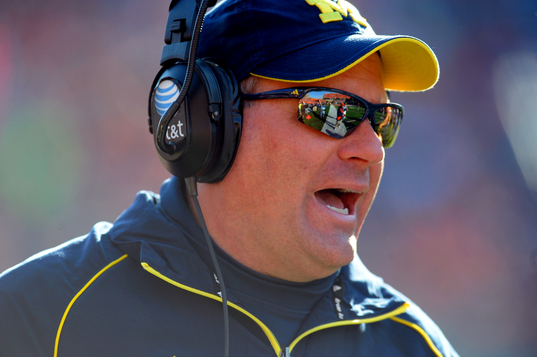
Michigan has to answer to the NCAA regarding five potential major violations, the most serious of which are separate failure-to-monitor counts against the university and football coach Rich Rodriguez. (File photo)
Joe Beckham spent eight hours in front of the NCAA Committee on Infractions two years ago as part of a Florida State contingent hauled in to answer questions about academic fraud.
Beckham, the university’s faculty-athletics representative, said the hearing was civil and the NCAA hospitable, but there was no doubt what was at stake in the room.
“I think the committee is motivated to ensure that their enforcement responsibilities are met,” Beckham said. “I don’t think there’s any question that the committee does not want to be seen as a paper tiger that is not taking its responsibilities very seriously and does feel that they have a very important obligation to impose penalties that have consequences.”
|
RELATED STORIES |
Michigan could face penalties including probation and a loss of practice time if it’s found guilty of violating NCAA rules when it goes before the infractions committee Aug. 13-14 in Seattle.
The Wolverines are charged with committing five major violations, the most serious of which are separate failure-to-monitor counts against the university and football coach Rich Rodriguez.
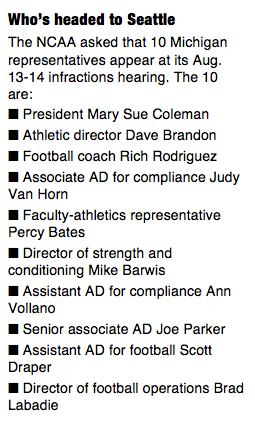
Rodriguez, school president Mary Sue Coleman and athletic director Dave Brandon are among 10 Michigan representatives requested to appear at a hearing that former infractions chairperson Jo Potuto said is “formally informal” in nature.
“It’s like an administrative hearing,” said Potuto, who wouldn’t talk specifically about Michigan’s case. “Nobody’s put under oath, it doesn’t look like the way people would think of a courtroom, even a civil trial and certainly not a criminal trial. It’s more like an administrative hearing, which means the rules of evidence don’t apply.”
The NCAA spells out clear procedures for hearings before the infractions committee, down to the U-shaped set up of the room.
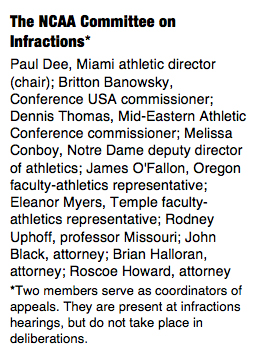
The eight-person committee sits at the head table, with representatives from the school on its right and the NCAA’s enforcement staff on its left. A court reporter sits in the middle transcribing the hearing.
Both sides begin with opening statements that last 15 minutes or less, and the committee chairperson reviews each allegation separately. Only the chair can ask questions of the parties involved, and while Potuto said dialogue is usually free-flowing, Memphis athletic director R.C. Johnson said that wasn’t his experience.
“Maybe if I was on the infractions committee I’d think it was, but when you’re on the other side it wasn’t quite as free-flowing,” said Johnson, who appeared before the committee last year. “Maybe we were unique, but I don’t think so.”
Hearings typically last a day and always take place in a hotel ballroom, both for privacy (“There’s never any windows,” Potuto said) and space reasons.
Former infractions committee chairperson David Swank said he’s seen universities submit up to 20,000 pages of material to support their case.
“In some hearings, each committee member, you have to have the bellhop move the materials because you can’t carry them,” Potuto said. “It’s impossible.”
While Potuto said the committee debates punishments and comes to “general conclusions” at the hearing site, final decisions aren’t rendered for six to 10 weeks.
That process can be expedited when schools self-impose penalties.
Michigan conducted a parallel investigation to the NCAA’s last fall, and Brandon said nothing in the official Notice of Allegations came as a surprise.
It’s unclear how or if Michigan will penalize itself, but Johnson said that always seems to be the best course of action.
“I would tell anybody, I think the more you can do up front the better off you are,” he said. “Regardless of what happens, I think it’s good to be proactive on the charges they give you, regardless of how severe or how much it might hurt you. I talked to Alabama and Florida State quite a bit before we went in because they were ahead of us and they gave me the same advice, to be proactive rather than to go in and be combative and say we’re not doing anything.”
Dave Birkett covers University of Michigan football for AnnArbor.com. He can be reached by phone at 734-623-2552 or by e-mail at davidbirkett@annarbor.com. Follow him on Twitter @davebirkett.
Comments
goblue52
Tue, Mar 16, 2010 : 6:10 a.m.
Tom, Tom, Tom.... do you seriously think we even had "freakin STANFORD with STANFORD talent" when Rich Rod took over? Did we? Not even close! Why do you think Les "THE MICHIGAN MAN" Miles" said no? He wasn't going to leave a good thing for a bad one!?Urban Meyer, Bob Stoops and Jimmy Tressel put togehter would be in the same situation right now. Firing Rich Rod right now or in the next couple years would be a HUGE mistake! I agree 100% with tmdwg1. We have to ride this out. I can't take another 3-9 or 5-7 season! I am not saying Rich Rod was the best hire, but he is what we were dealt. Who is better? Harbaugh? Seriously? GO BLUE!
aarox
Mon, Mar 15, 2010 : 11:21 p.m.
I for one am tired of us underperforming and at the same time being at the center of all of these 'alleged' infractions. Why doesn't the NAACP go after Izzo? I'm sure he's guilty of all this and more and just hasn't got caught. Do we really think RR has less integrity than Izzo??? I think not!
tomhagan
Mon, Mar 15, 2010 : 8:19 p.m.
Yeah "goblue52"... keep talking cause you just weaken your point more and more! Harbaugh is doing this at STANFORD...freakin STANFORD with STANFORD talent and is improving every year... he has beaten USC 2x and kicked their butts last year. Harbaugh has completely turned around a 1-11 program before he got there... and you know it... you know it... meanwhile your cough..."king" has torn down one of the most storied programs in NCAA or any Football history... in just 2 short years. Sad. Sad. Sad.
goblue52
Mon, Mar 15, 2010 : 6:33 a.m.
YES! Bring in Harbaugh... the man is a genius! 17-20 in three years (4-8) (5-7) (8-5) and 0-1 in Bowl game (third year). Similar to that of the KING! We must bring him in NOW!
tomhagan
Sun, Mar 14, 2010 : 11:45 p.m.
well well, its nice to see some of the same old excuse makers and conspiracy theorists making their comments here..... the bottom line though: Rich Rod...Barwis (he he) etc. have failed at Michigan. Its a shame that the university and the student athletes will have to pay for their lack of accountability... especially since they are already paying with poor coaching and subsequent related losses on the field....but it wont be long til old Rich Rod and Barwis etc. are gone.... wont be long.... after this hearing and 5-7 next year at best with that tough schedule... Jim Harbaugh will be on the short list to be interviewed and Rich Rod will be angling for buyout settlement money.
1998pa
Sun, Mar 14, 2010 : 9:22 p.m.
kubrick, you are a slappy. you fawn over michigan and would never question anything within the school. that's fine for you, a fan. not everyone will blindly support UM though. you're clearly incapable of seeing things from a perspective different from your own.
Kubrick66
Sun, Mar 14, 2010 : 9:16 p.m.
1998pa, And you have to be completely bias not to see the difference between an apple and an orange.
1998pa
Sun, Mar 14, 2010 : 8:49 p.m.
i don't care what school you cheer for. you've got to be ignorant on an epic level to think that a media organization is supposed to "support" a school. dave birkett's job is to report on the school rather than be a michigan sloppy.
Kubrick66
Sun, Mar 14, 2010 : 7:13 p.m.
To Stefanie Murray, Lets all start being honest here, can we? "Please make your points in a civil manner and refrain from juvenile insults. Thanks." Shouldn't the "writers" at AA.com be held to the same standards? Lets take off the gloves and be honest... Your site offers little more than daily doses of sensationalistic headlines followed by content meant not to inform, be to further disparage the University of Michigan Football Program. And why? I think the answer to that question falls under the banner of... "juvenile insults" masked as responsible journalism. Prove me wrong.
Kubrick66
Sun, Mar 14, 2010 : 7:08 p.m.
To Stefanie Murray, Lets all start being honest here, can we? "Please make your points in a civil manner and refrain from juvenile insults. Thanks." Shouldn't the "writers" at AA.com be held to the same standards? Lets take off the gloves and be honest... Your site offers little more than daily doses of sensationalistic headlines followed by content meant not to inform, be to further disparage the University of Michigan Football Program. And why? I think the answer to that question falls under the banner of... "juvenile insults" masked as responsible journalism. Prove me wrong.
beagle
Sun, Mar 14, 2010 : 6:23 p.m.
Awesome that Barwis gets to go on the plane. Chocolate milk for everyone! I'm looking forward to more glowing stories of his strength program and the difference it will make in the 2nd halves of games.
goblue52
Sun, Mar 14, 2010 : 6:05 p.m.
AZ, I chose the conjunction AND on purpose. Love our team AND the coach!? You keep hating and I will keep supporting! GO BLUE!
tmdawg1
Sun, Mar 14, 2010 : 6:03 p.m.
This is our school, our program and our coach. We will whether this storm and come out on the other side better for it. I beleive this coach is the one to take us to the pRomise land. It starts now I will, as always, save room for the bandwagon jumpers to get back on. IN ROD WE TRUST GO BLUE!!!!!!!!!
Jaxon5
Sun, Mar 14, 2010 : 2:35 p.m.
Summoning the President of the institution to a hearing is a big deal. There is no way to minimize it. It's a big deal.
Dude
Sun, Mar 14, 2010 : 1:17 p.m.
whats the point of commenting if u keep deleting the negative ones who dont like your article dave?
Dude
Sun, Mar 14, 2010 : 1:11 p.m.
Birkett is deleting posts that disagree with his article just fyi
voiceofreason
Sun, Mar 14, 2010 : 12:52 p.m.
Nevermind, it wasn't showing up before.
voiceofreason
Sun, Mar 14, 2010 : 12:50 p.m.
Can someone explain why my comment was removed from this story? It seems ridiculous to remove a comment that calls into question the motives of a writer, especially when factual information is used.
aareader
Sun, Mar 14, 2010 : 12:22 p.m.
If there are issues in the football program they need to be addressed. The NCAA was created to attempt a "level playing field" in College Sports. If there are allegations they need to be investigated and problems solved. If that includes sanctions so be it. I applaud the AA News for posting stories.. good and bad. That is is their mission as a news organization. Same is true for the Free Press. While we may or may not like what is printed at least it is out there. If these organizations post "crap" they will not last long. If they are posting factual information it is best everyone can read it. AND WE can make our own judgements on the the merits and even reply. One of the quotes I have seen many times on U of M publications is "Knowledge is Power" I believe it is true in this case too. We will all be winners when this issue has been resolved.
voiceofreason
Sun, Mar 14, 2010 : 12:07 p.m.
Wow, this title screams "sensationalism". Mr. Birkett - Don't you think it's a bit dishonest to put "grave consequences" in the title when you know this isn't even a possibility? I know you're angry about losing media access to spring practice, but don't you think you brought this on yourself?
TJ
Sun, Mar 14, 2010 : 10:30 a.m.
Are you F@#$ing serious-- 3 rehashed articles with 1 rediculous headline. You guys are a complete joke. Thanks for wasting my time, dont worry I will never let it happen again. No article about spring practice starting?
GoblueinNE_PA
Sun, Mar 14, 2010 : 10:30 a.m.
Let's keep this in mind (those of us who are alumni and love our university and team, but think this guy is the wrong person to lead our team) 9 points from a 2-10 record in 2009 12 points froma 1-11 record in 2008 Long coach the "King", preferrable at some place else.
azwolverine
Sun, Mar 14, 2010 : 9:59 a.m.
goblue52, RR and Michigan are NOT one in the same. As an A2 born Michigan fan and grad, I love both the program and the university. I also love what the program stands (or stood) for: winning with integrity. Did we always win NC's? No, but I loved the fact that we did it the right way and battled all of the cheaters and usually won (check our record against the SEC). We never lowered ourselves to the ranks of those SEC teams, the FSU's, SMU's, etc. We were different. So, while I love Michigan, I don't love RR. I don't even like him. He's the one who turned us into the same bunch of cheaters as everyone else. And as for "10 points from 8-4"...we were also 25 points away from 3-9 Illinois and 3 losses to LOSING TEAMS from 8-4! Oh, Michigan will win 8 games this year simply by beating those losing teams this year. Heck, even Bill Callahan won 9 games in year 3 at Nebraska...it didn't mean he or his program were any good. RR doesn't fit at Michigan and the NCAA findings are just further proof of that.
Frank99
Sun, Mar 14, 2010 : 8:48 a.m.
The headline to this article was over the top in sensationalism. AA.com would be equally accurate in having front page headlines scream,"Today You Might Potentially All Die!!!".
trigg7
Sun, Mar 14, 2010 : 8:23 a.m.
Those who stay will be...in violation.
stan
Sun, Mar 14, 2010 : 7:36 a.m.
There is no new info in any of today's articles from what you linked to mgoblog.com a day or two after the press conference. I would have preferred that A2.com had used the Sunday print edition published two days before spring practice to spend extensive time previewing spring practice. Having said that, any reason why the infractions committee can't be more accomodating and meet with Michigan in Detroit or Indianapolis?
goblue52
Sun, Mar 14, 2010 : 6:31 a.m.
Let's keep this in mind(those of us who LOVE our team and coach) 10 points from an 8-4 record. 21 points from a 9-3 record and a win over Ohio State. With the "Kids" we had on the field... BIG things in the future! LONG COACH THE KING!! GO BLUE!
NoBowl4Blue
Sun, Mar 14, 2010 : 5:50 a.m.
The "king" is and was dirty.
BlueInBama
Sun, Mar 14, 2010 : 5:14 a.m.
Our beautiful, glorious King will be found NOT GUILTY of these bogus charges! Long Coach The King