

Michigan football coach Brady Hoke has a one-year plan; can he accomplish it?
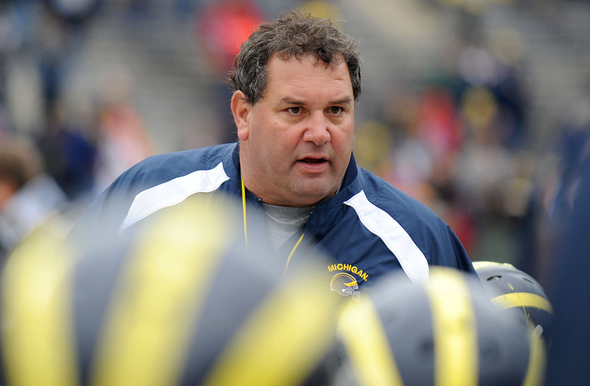
Former player Joey Lynch says first-year Michigan coach Brady Hoke "is not a complicated guy. He knows what he wants and who he is. What you see is what you get, and that’s why guys buy in."
Angela J. Cesere | AnnArbor.com
Some coaches have three-year plans. Others go four- or five-year routes.
Brady Hoke? He has a one-year plan. It renews annually.
“This is Michigan, there aren’t going to be any excuses,” the first-year Michigan football coach said earlier this month. “If we don’t win the Big Ten championship, we’ve failed these kids as coaches.”
High standards — but Hoke wouldn’t have it any other way.
The former Michigan assistant was hired in January to replace Rich Rodriguez, who was fired after guiding the Wolverines to their worst three-year stretch in school history.
Rodriguez always talked about time, and how he needed it to implement his system — specifically, his spread-option offense, which was as different from the incumbent pro-style as schemes can be.
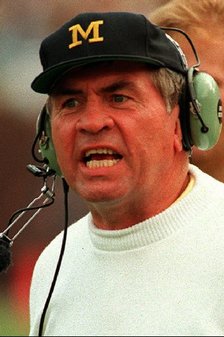
Gary Moeller, shown in a 1994 file photo, is the last coach to win a Big Ten title in his first season.
How realistic is Hoke’s goal of winning a Big Ten title in his first year as head coach?
It’s a rare feat, but not unprecedented. Three men have done it since 1950 and, oddly enough, Hoke is close to two of them: Bo Schembechler (1969), whom Hoke got to know during an eight-year stint as a Michigan assistant, and Gary Moeller (1990), who gave Hoke that job in 1995.
Former Ohio State coach Earle Bruce was the other. He did it in 1979.
Don't self-inflict 'catastrophic' growing pains
It’s a tough trick, to be sure. Offensive coordinator Al Borges, embarking on his ninth offensive coordinator job, knows why.
“As much as I’ve transitioned jobs, what I’ve found is that you’re never going to get exactly what you want in the first game, so you might as well forget that,” he said.
Borges, who coached with Hoke the past two years at San Diego State, said growing pains are normal during scheme adjustments, no matter how well they’re taught. It takes time. The key to successfully bridging coaching regimes, he said, is to make concessions to contain the damage up front.
That means, for instance, giving quarterback Denard Robinson 10 to 15 carries per game, even if Hoke would prefer to have a tailback carry that load.
“Until they get through the transitional growing pains, you have to do as little damage as possible,” Borges said. “You just don’t want to kill yourself in the process. The growing pains can’t be catastrophic.”
Under Rodriguez, they were.
Michigan went 3-9 in his first year, the worst record in school history. The Wolverines couldn’t move the ball on offense, as they tried to run the spread-option attack with pro-style quarterbacks Stephen Threet and Nick Sheridan.
The blows absorbed in 2008 stunted Michigan’s momentum and further exasperated a frustrated fanbase. Rodriguez never did repair the damage.
Don’t expect those same mistakes to be repeated.
“We’re not here to fit a square peg in a round hole,” Borges said. “Brady’s great at getting the best out of his players, even if they’re not running what they’ve run in the past, and it’ll be the same here.”
Two stops, two turnarounds
Hoke has gained a reputation for turning around programs, and it makes him a proven commodity, despite a 47-50 career record.
He took over Ball State in 2003, a school that hadn’t posted a winning season since 1995. The Cardinals won only six games in his first two years, but then won four, five and seven the next three. They broke through in 2008, going a school-record 12-1.
“Coach Hoke changed the culture,” said Joey Lynch, who was Hoke’s quarterback at Ball State from 2004-06. “He did a lot of good things right away, even though wins didn’t show up his first or second year. But he didn’t panic, stuck to what he believed in, and that consistency paid off.”
What did Hoke believe in at Ball State? The answer will sound familiar.
Brady Hoke went 9-4 in his second season at San Diego State, a school that last had a winning season 11 years earlier.
AP Photo
In 2009, Hoke moved on to San Diego State, which hadn’t posted a winning season since 1998 and was 2-10 the year before he arrived. It went 4-8 his first year, 9-4 the next.
How did he do this?
“This program is going to be a program that's based on toughness,” Hoke told the San Diego Union-Tribune upon his hire by the Aztecs. “To play football at the Division I level … you have to be tough-minded. You have to be physically tough and mentally tough."
Hoke's message isn't 'lip-service toughness'
Physicality. Toughness. These aren’t buzzwords he formulated on a January flight to Ann Arbor so he could appease snake-bitten fans. They define the fabric upon which he builds programs, Lynch said.
“Brady doesn’t believe in lip-service toughness,” Borges said. “He believes in, if bodies don’t collide and noses don’t get bloodied a little bit once in a while, then you’re not playing the game right.”
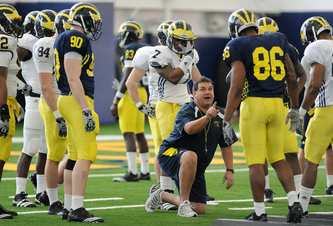
It is not uncommon to see Brady Hoke blow his whistle during a practice to move a player’s foot just inches or bend a knee by just a few degrees.
Melanie Maxwell | AnnArbor.com
“I still coach the same way I did at Ball State and San Diego State, and I’m going to always look at the defense,” Hoke said.
"This is simple: If they can't score, they can't win. So, why wouldn't you want to be out there stopping somebody so they couldn't score?"
It is not uncommon to see Hoke blow his whistle during a practice to move a player’s foot just inches, or bend a knee by just a few degrees, or even simulate the mechanics and execution of a punt.
“Coach Hoke is not a complicated guy,” Lynch said. “He knows what he wants and who he is. What you see is what you get, and that’s why guys buy in.”
Lynch said the biggest sign the culture had changed at Ball State — besides the wins — was the recruits Hoke began to haul in toward the end of his tenure there.
He has recruited fabulously well at Michigan, too. He avoided the attrition that afflicts so many programs undergoing coaching changes — including when Lloyd Carr retired from the Wolverines after the 2007 season — then attracting a consensus top-five class for 2012.
"Most coaches use college as a stepping stone to go somewhere else,'' senior cornerback Troy Woolfolk said during the first week of practice this fall. "With Coach Hoke, you can tell this is his final stone.
“The Michigan pride we see from him has a trickle-down effect, and that’s why you’ve seen so many recruits come here.”
Whatever he’s doing, it’s working. He’s turned around two moribund programs with few resources in non-BCS conferences.
Now, what can he do for college football’s winningest program?
This week, we'll begin to find out.
Kyle Meinke covers Michigan football for AnnArbor.com. He can be reached at 734-623-2588, by email at kylemeinke@annarbor.com and followed on Twitter @kmeinke.
Comments
ChelseaBob
Wed, Aug 31, 2011 : 5:22 p.m.
Oh- And by the way, Notre dame is overrated. Again.
ChelseaBob
Wed, Aug 31, 2011 : 5:12 p.m.
Hmmm..... A lot of non-believers out there. OK- 1. Start with D. We do have talent, it's just we heard for 3 years the cupboard was bare. It wasn't bare, it was just a convenient excuse. That talent is being coached by the best in the business now. Had we gotten fundamentals down last year, we could have won 2-3 more games. We will stop people this year. 2. Offense is balanced now. Denard can still run when he needs to but instead of carrying 20 pounds of scar tissue into November, he'll get help carrying the load and won't be beaten up. 3. We have a kicker. 4. MOST IMPORTANTLY, we have pride again. This is Michigan. It's unthinkable to not be competing for Big Ten Championship, and these kids know and believe it. Get on the bandwagon folks, it's going to be a great season.
Dean edwards
Mon, Aug 29, 2011 : 11:53 p.m.
I am a true blue michigan fan ! The last three years were unlike anything I could amagine worst season ever, got caught cheating unbelievable!!!worst defence i ever saw at big blue !!! and our current loooozzzzing streaks to that school down south and little brother . I don't know about the rest of all you big blue fans but if we win just one of those games it will be a good season,both of those games and it will be a great season.we need to get back to MICHIGAN FOOTBALL !!! hoke will be another michigan football coach in line with BO,LOYD,GARRY AND BRADY. That would be a DEFENSE FIRST minded team something we got away from the last tree years. Maybe becuzzz change in athletic director and a want for higher scoring offenses . it might of looked good on paper but its not MICHIGAN or BIG TEN football!!! I believe that with the new coaching staff in time we will be back to the powerhouse we used to be I AM GOING OUT ON A LIMB AND SAY 10 WINS THIS YEAR and a good bowl game.GO BIG BLUE!!!!!!!!!
Wally the Wolverine
Mon, Aug 29, 2011 : 4:59 p.m.
OK, you can all relax. I hear a Grand Rapids beer swilling sports radio personality picked us to go 10-2 this year. So let's just sit back and watch the Ws pile up. LGB!!
Terry Star21
Mon, Aug 29, 2011 : 1:01 a.m.
I think Hoke is right on, and a very good article here. Michigan will play for the Big Ten Championship, but it won't be against osu whom will receive the death penalty for cheating (all to win) for 10 years. The toughest game will be the msu game because it's away. Michigan has a chance to run the table for sure as nebraska will be out of sync and too intimidated to come into the Big House. Yes, it's a different style of football coming our way, one that will surprise everyone and by the time teams realize what happened - like Drob, Michigan will be long gone. I don't think 2 losses will be acceptable for this team - Hoke won't allow it ! MgoBlueForTiM....sprinting by foe's and winning, before they realize what hit em !
1st Down
Mon, Aug 29, 2011 : 12:55 a.m.
The past 3 seasons....under the previous staff, were the most poorly-coached Michigan teams in my lifetime...by far. -32 in turnovers...dead last in the BT in turnovers all three years.... tons of mental breakdowns and mistakes on defense...a complete lack of preparation and planning... utter disregard for adapting a player's talents to the scheme or vice versa... just bad coaching. Period. Pundits still picking Michigan to win "5 or 6 games" do not understand fundamental football...and how coaching plays in to that....GOOD coaching...aka Bo, Lloyd, Mo that we saw for 40 years: TEAMS THAT DO NOT BEAT THEMSELVES. Brady Hoke knows this and his staff is excellent in teaching the finer points of technique and how to play the game.... This will be a well coached team...a team that knows its assignments and carries them out without beating themselves.... this team will be in every game and has a shot at winning all of them....mark it down. Go Blue.
Edward R Murrow's Ghost
Wed, Aug 31, 2011 : 11:36 a.m.
TruWCiMFHfan, Enjoy watching your boy on CBS. Good Night and Good Luck
truebluefan
Wed, Aug 31, 2011 : 2:16 a.m.
Aye aye aye. This is going nowhere. Enjoy the season, Eddie.
Edward R Murrow's Ghost
Tue, Aug 30, 2011 : 4:28 p.m.
Don't like the logic of your comment, tbf? I suggest you speak with its author. Ought be an interesting conversation. Good Night and Good Luck
truebluefan
Tue, Aug 30, 2011 : 3 p.m.
Easier schedule + nearly all starters returning along with the B1G POY + top notch defensive coordinator = 8+ win season. If the "manifestly incompetent" staff can win 7 games with the same players and a more difficult schedule, then the staff that understands what Michigan is all about and understands B1G football, should be able to grind out 8+. Hoke took a 2-10 team and turned it into a 9-4 team. He made Ball State a winner. This is ridiculous. Why do I have to explain these things to you?! Aren't you the one that did that incessantly while poking holes in the previous regime? If you think we're going to do a 5-7 or 6-6 belly flop then why change coaches? RR would've achieved that, right? Wasn't that your prediction?
Edward R Murrow's Ghost
Tue, Aug 30, 2011 : 11:10 a.m.
Just stating the obvious conclusion--hardly a pessimistic one. If you really think that the same team that got blown out of six games last year and nearly lost four more is now a "near given" to win eight games this year, the only POSSIBLE explanation could be that the last coaching staff was manifestly incompetent. Not a defeatist attitude. Just a statement of the obvious based on YOUR statement. Good Night and Good Luck
truebluefan
Tue, Aug 30, 2011 : 4:20 a.m.
"8 wins "a near given" from the same players who got blown out of all six games they lost last year?" Why even change coaching staffs if you're going to maintain that defeatist attitude?
Edward R Murrow's Ghost
Tue, Aug 30, 2011 : 1:23 a.m.
Actually, just re-read tbf's post. Comedy club material. 8 wins "a near given" from the same players who got blown out of all six games they lost last year? Really? Gee, that must mean that the last coaching staff couldn't coach their way out of a wet paper bag. Good Night and Good Luck
Edward R Murrow's Ghost
Tue, Aug 30, 2011 : 1:20 a.m.
mission, tbf, and esp. 1st Down: Spot on. Good Night and Good Luck
1st Down
Tue, Aug 30, 2011 : 12:48 a.m.
Lorraine... Lloyd Carr may not have pleased you...or some other fans... but to the majority of Michigan fans and Alums: 122-40 record. 5 Big Ten Titles. 1 National Championship. Total class and integrity and ran a clean program. If you have a problem with that...well..then that speaks more about you and your predjuices...than it does about HOF Coach Lloyd Carr
truebluefan
Mon, Aug 29, 2011 : 10:20 p.m.
LS - 8 wins this season is a near given, IMO. Quite obviously, our problem last season was defense. We have upgraded immensely at defensive coordinator. All of our impact players return from last season besides Stonum. How can anyone expect 7 or fewer wins with an easier schedule? Now, 2012 is going to be a bear. I could easily see us regressing in the wins column from 2011 to 2012.
missionbrazil
Mon, Aug 29, 2011 : 9:53 p.m.
I guess the College Football Hall Of Fame lost it's credibility too when they voted LC in. LOL.
Lorain Steelmen
Mon, Aug 29, 2011 : 3:51 p.m.
Please don't include Lloyd Carr in with truely great UM coaches, Schembechler and Moeller. It destroys your credibility. (The tough games are msu, osu, and Nebraska.) Reg; the 2011 season, I think this squad can win 11 or 12 games. The breakeven point for me is 9 games....if UM does not win the three mentioned above. So I expect Hoke to win 10 or more. That is, 1 of those 3. The toughest IMHO will be Nebraska. If UM doesn't beat osu this year, they won't beat them in Cbus next year. Ditto Nebraska. The 2012 schedule is much tougher, since UM plays Alalbama, ND, Nebraska and osu on the road...this is Hokes' year, or he may well be gone by 2014.
missionbrazil
Mon, Aug 29, 2011 : 1:59 p.m.
Well said 1st Down. I agree when you say that we will be in every game and have a shot at winning every one of them ... as compared to last year when we were at least 2 or more possessions away from being in the 6 games we lost.
truebluefan
Sun, Aug 28, 2011 : 11:49 p.m.
If Rich were the coach this season, I believe most of the people that post here would not be happy if he won less than 9 games. I'm an obvious Coach Rod fan and I would've helped Rich pack his bags if he only won 8 games this season. Hoke inherits 19 returning starters that won 7 games against a tougher schedule than they'll face this season. Michigan is forking out big money for one of the finest defensive coordinators in the country. Hoke has the most explosive player in college football starting at QB. I agree with Hoke...there are NO excuses this season. I'm not saying Michigan has to win the B1G but I think it's fair to expect that we are at least in the conversation for the B1G championship as the season winds down. Otherwise, the coaches have failed the players, program and fans.
truebluefan
Mon, Aug 29, 2011 : 10:08 p.m.
WMU is a wash. Nebraska is equivalent to Wisconsin. I'll concede that SDSU is better than UConn. I agree that Notre Dame is better. But we play them at Michigan this season. You make the case that playing AT MSU and AT Iowa are more difficult games because they're on the road (which is highly debatable based on the impact players lost from last season). When speaking about ND, your logic has to apply in reverse as well. Purdue is definitely worse this season sans Ryan Kerrigan. And we have them at home. Minnesota will be a tire fire again. That home game is more difficult than playing at IU? EMU has been the worst team in FBS for three years. How does OSU help your case? I can provide a laundry list of reasons why they'll be an easier out this season (newbie QB, newbie coach, scandal). All you have is "OSU is still OSU". Sure they are, and we have them at home this season. I put a chunk of money on Michigan over 7 wins this season. Obviously, I want Michigan to win a bunch of games. I think our schedule sets up nicely for no less than 8 wins.
missionbrazil
Mon, Aug 29, 2011 : 9:38 p.m.
Not that it matters, because we will still be much better than we were the last 3 years under your guy, but here is why I disagree with your statement that last year was tougher than this year: * San Diego St. is a better team than U Conn * Notre Dame will be vastly improved this year over last year * We play AT MSU this year (tougher than at home) * We play AT Iowa this year (much tougher than at home) * At NW is a tougher game than at PSU because NW should be better team * As you said, IL will most likely be better this year * OSU is still OSU, and they will have all of their players back in Nov. Irregardless, we will be much improved from now on over the last 3 years.
truebluefan
Mon, Aug 29, 2011 : 6:38 p.m.
I had the schedule difficulty dicussion with cousin Eddie Murrow the other day. Not sure how you can say this year's schedule is tougher than last year. We swap at Indiana for Minnesota (definitely easier), at Penn State for at Northwestern (NW is probably a little better this year than PSU was last year but the PSU home field advantage is tougher than NW's), and Wisconsin for Nebraska (about equal). Purdue stinks but we have them at home this season. The wheels appear to be falling off OSU at the moment. Iowa lost two huge impact seniors in Stanzi and Clayborn. MSU is replacing nearly their whole O line and they lost Jones. Illinois may be a tougher game this year than last year. So there you have it. How do you figure this year's schedule is tougher than last year's? 7 wins should disappoint most fans. Hoke would certainly be disappointed. Why shouldn't I be as well?
missionbrazil
Mon, Aug 29, 2011 : 2:02 p.m.
Not sure how you figure last year's schedule was tougher than this year ... I'm sure many people would disagree with that. Either way, we will be far better than we have been the last 3 years under your guy. No doubt about that.
allergictobs
Sun, Aug 28, 2011 : 11:40 p.m.
Chelsea Bob says michigan has a "good, not great defense". And you are basing this statement on what? A gut feeling?, the results from the most recent display in the bowl game? We'll see what kind of defense UofM has on 9/10/11 when ND rolls into town. They have a much better defense than last September and if Crist plays the whole game and abuses the Michigan defense like he did last year then get ready for an early bedtime that night. ND's defense got better as the year went on, ours got worse........And ND has the best defensive recruiting class in the country, added speed and are 2 deep at every position. Que the homers accusing me a treason but I hope I'm wrong.
Chad Williams
Sun, Aug 28, 2011 : 11:50 p.m.
ND is going to be an interesting team. I think they have solved the speed on defense issue and got two elite level d linemen. Kelly can coach his butt off and recruit like no other. Michigan would have been NC contenders right now if the woulda hired kelly. He has proven track record and sustained success. Hoke to me has been a one year wonder and then leaves. Never went back to a team that had success the year before.
allergictobs
Sun, Aug 28, 2011 : 11:50 p.m.
And don't forget we will not have B10 refs to bail us out this time against ND. If they did not take Armando Allen's TD away and call him for excessive celebrating by shussing the crowd on another TD, we lose at home in 2009. ND won't come here anymore unless their are non B10 refs because of the shameless B10 homer calls that go against them.
Chad Williams
Sun, Aug 28, 2011 : 10:52 p.m.
Why cant this TEAM not hoke win the big ten. If the defense is better how can this team not be better. My only thing with hoke is that he never sustained success at his previous stops. His two winning seasons resulted in a new job the next year. Two years at one school with 1 winning season isnt that impressive. If he would have stayed at sdsu how much better would they have been this year? Fact is we gotta coach from the 3rd best team from a mid major. Winning now will be in his best interest because next year the schedule isnt set up for a 5-0 start. That being said MSU, Wisc, and Neb are the most reasonable choices to win the division. They have the players-coaches chemistry. No first year guys coaching so players know whats expected and coaches know the players. Brandon made a terrible mistake firing RR so late. The new coach could have came in in december and gotten more time.
Edward R Murrow's Ghost
Tue, Aug 30, 2011 : 1:34 p.m.
Can you please translate this into English? Thanks! Good Night and Good Luck
MRunner73
Sun, Aug 28, 2011 : 10:01 p.m.
Coach Hoke is setting the bar very high but perhaps he knows something about the roster that we don't know. Either that or he's underestimating the competition. Realistically, we should get to a bowl game. We really won't know how good this team will be until the big match up with Sparty. If we blow out Western on Saturday, expectations amongst us fans might be too knee jerk. We have seen U-M start the season at 4-0 then 5-0 under Rich Rod the past two years only to fall off the table. It won't be that bad this year but again, the meat of schedule starts with Sparty.
10dz
Sun, Aug 28, 2011 : 7:28 p.m.
8-4 is a stretch but it is what i'm pulling for. Our defense will be better, they can't be worse can they??? The special teams can't be worse , can it?? The offense won't score as many "meaningless points" against weak teams and late in the game against average big ten teams to make the score look close. But the offense will be efficient. The schedule is a bit tougher though. Notre Dame will be better than last year. MSU, Nebraska and Ohio St will be hard to win. I think we have a legit shot at all the other ones. The one that could go either way in my eyes is the game at Iowa.
Mick52
Sun, Aug 28, 2011 : 6:55 p.m.
That is what I like to hear. Fantastic. Coach Brady is making no excuses.
allergictobs
Sun, Aug 28, 2011 : 11:53 p.m.
Thats because we're Michigan men............and Michigan men don't make excuses!!! Lol! give me a break....10 months ago he was a San Diego State man and made excuses up the ying yang, but a wand was waived and now the mindless Michigan drones are runnin around with woodys because hoke/Joke is proclaiming this an excuse free zone because we're Michigan!
mt
Sun, Aug 28, 2011 : 2:55 p.m.
If Brady's past predicts the future, just look at his record as a head coach. 47 wins and 50 losses overall. 1 win 2 losses in bowl games. Sounds pretty impressive.
Bogie
Sun, Aug 28, 2011 : 2:49 p.m.
@ChelseaBob. What has Michigan's offense done against quality teams? That's right, nothing. I believe Hoke is going to get this program back to sucess, but please. During Rich Rod's era, the schedule was soft, and Michigan was not close in big games (I do not consider Notre Dame a powerhouse- I was not born in the 19th century).
Mick52
Sun, Aug 28, 2011 : 6:52 p.m.
I think Bogie that if you go back over the years you will see that vs quality teams Michigan's offense never did much. Many of those late in the season games were all low scoring on both sides. Even if RR stayed I would expect two more wins over last year.
truebluefan
Sun, Aug 28, 2011 : 4:07 p.m.
The schedule this season is softer than it was in Coach Rod's last season. I think most fans believe 7 wins should be low water mark. Coach Rod achieved 7 wins with an "inferior" coaching staff and tougher schedule. Everyone keeps telling me Hoke and staff are an upgrade so let's see an upgrade in the wins category. Believe me, I WANT to see Michigan win 8 or more because I have $100 on over 7 wins. And they SHOULD do it.
1st Down
Sun, Aug 28, 2011 : 12:44 p.m.
any comparisons with what Coach Hoke is doing now...vs what he did at Ball St. or SDSU are not very valid to the current situation... UM has a unique history, unique set of problems to overcome currently and a very unique and special set of resources of which it has historically worked upon... Coach Hoke knows all of this and he is the right man for the job. Seasons 132, BT Championships 43, Beat...ohio.
1st Down
Sun, Aug 28, 2011 : 12:49 p.m.
42 typo
frank
Sun, Aug 28, 2011 : 12:43 p.m.
Look at the Big Ten schedule Bob, looks like 3-5 or 4-4. Should go 3-1 or 4-0 in the meaningless non-conference match-ups though.
DennisP
Sun, Aug 28, 2011 : 12:24 p.m.
Well, all of us fans want Hoke and the kids to win and surprise everyone. It would be one of those great stories of a great turnaround and great achievement through perseverance, dedication, effort and integrity. But, there is a reality. This is a big transition for the offense. They were built for Denard's explosive play and will now transition to a more methodical pro-style offense intended to control the ball, eat the clock, keep the defense off the field so it can rest, and score. We'll need a kicker that can put in field goals--a woefully weak area last few seasons. We'll also need a defense that actually stops drives instead of giving up touchdowns like its Halloween. We can all believe the defense will be improved. How can it not be with better recruits and high-level coaching. But, until they play games, we'll not know just how improved they will be. This is what we can expect--the defense and special teams are on a learning curve just to play FSB-level football. As the season progresses, they will gel into something good but their toughest tests will be later in the season. So too, the offense is on a learning curve to play pro-style. The earlier games will be peppered with mistakes the later games will be against stout opponents. It's going to be a tough season--especially with Nebraska in the Conference. Coach Hoke will be dissatisfied for not winning the Big 10 and that's the way it should be--he has no intentions of looking towards next year until next year. But for fans, if this team gets into a decent bowl game then we can be really pleased and we can also really look forward to next year. That's reality. Forget reality next weekend, and have fun. But, don't worry if we don't go to the Rose Bowl just yet...
Mick52
Sun, Aug 28, 2011 : 6:49 p.m.
Here is one making excuses already.
ChelseaBob
Sun, Aug 28, 2011 : 11:46 a.m.
I don't get it. The most powerful offense in the Big Ten is now complemented by a good (not great yet) defense, and everyone thinks we'll lose 4 or 5 games? Folks, this is a one or two loss team that will compete for Big Ten Championship. Why does everyone have such low expectations?
allergictobs
Sun, Aug 28, 2011 : 11:45 p.m.
Hoke looks like one of the 3 stooges and has a .500 record. he was U of M's second or third choice btw. Don't cast him for the statue just yet just because he keeps saying "we're Michigan....no excuses...Bla,bla, bla,bla,bla. I hope he does better than Bo, I mean Bo won a bunch of Big Ten Championships only to get bent over in 90% of the Rose Bowls....but it was OK because we were Big 10 Champs.....I prefer to aim a little higher than just wanting to be better than 11 other teams in FBS, after all there are 117 teams and our goal is to be better than 11 of them? Doesn't that strike anyone as odd?
Mick52
Sun, Aug 28, 2011 : 6:48 p.m.
I agree ChelseaBob. Looking at last year, IMHO, I think with better tackling and less turnovers, Michigan could (shoulr) have won two more games. Since so many players are back and he defensive should be coached much better, I see no reason to not be at least 9-3 this season. What is happening is that some are making excuses already. One fella posted he would give Coach Hoke three years to turn the program around.
obe1ball
Sun, Aug 28, 2011 : 3:11 p.m.
It's like no one believes this team will improve as the year progresses.With a very favorable early schedule(with mostly home games), plenty of momentum can be built up.I don't have them beating ND but if they do, then look out.I'm expecting 9 wins, counting a bowl.The Iowa and Zook coached Illinois road games just don't scare me.A split of the 2 final home games will be needed,I just see big improvements by the end of the season.
burton163
Sun, Aug 28, 2011 : 1:34 p.m.
Get back to me at the end of the season and we'll see if you're right about one or two loss team. Hope you're right. Just don't bet the farm on it...
1st Down
Sun, Aug 28, 2011 : 12:45 p.m.
because it generates clicks on websites of newspapers that are dying (not this website)