

Michigan football offensive coordinator Al Borges discusses his philosophy on player development
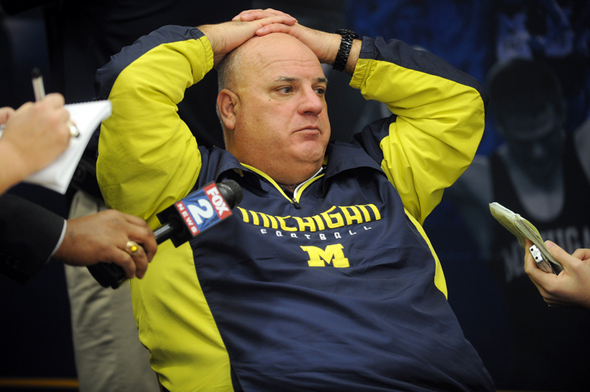
Al Borges answers questions during a February press conference. The Michigan offensive coordinator has two key concepts to player development that he refers to as "body learning" and "functional intelligence."
Melanie Maxwell I AnnArbor.com
Then-sophomore Fitz Toussaint had a strong spring camp last year, standing out among a deep stable of Michigan football tailbacks. He eventually won the job in the fall and rushed for more than 1,000 yards.
Then-redshirt freshman Jake Ryan did the same at linebacker. He was an unknown entering spring camp, but emerged as a leader to start on the strong side. He won that job in the fall and started every game.
See a pattern?
Jobs aren't won in the spring — at least, not at Michigan, and not with this staff. Coach Brady Hoke craves competition and seeks it wherever possible. It keeps his team sharp and combats complacency.
But it's no coincidence that those who go on to win jobs often do so after strong springs. That's especially true of the younger guys, who benefit from the emphasis on player development that marks this time of year.
Offensive coordinator Al Borges peeled back the curtains a bit on his philosophy of player development last week. It includes two key concepts that he refers to as "body learning" and "functional intelligence."
Body learning essentially is the physical process of learning a position and the playbook. For as much as Borges values the "mental reps" earned by reserves, nothing can replace the real thing.
"There's nothing like doing," Borges said. "I'm a big believer in 'body learning.' Just physically going through the trial-and-error part of it so you can fix the problem yourself. Mental reps are great, and you have to take them, but the 'body learning' is really important."
That's what makes this time of year so integral for reserves, because it perhaps is their best chance to do. The Wolverines don't have to devote their resources to installing a game plan or keeping the regulars well-oiled, so those second- and third-stringers get a chance to show their stuff.
Some have capitalized. Reserve, such as tailback Thomas Rawls, receiver Jerald Robinson, quarterback Russell Bellomy and even walk-on offensive lineman Joey Burzynski have received more snaps than they did last fall, and have drawn the attention of coaches.
Michigan also has identified some up-and-comers on the offensive line, going back to the the Sugar Bowl workouts. While the Wolverines rested their starters, players such as Chris Bryant, Elliott Mealer and Burzynski stepped in and proved themselves.
Now, one of those three likely will start at left guard next season.
"Other than individual drills, you just don't get a lot of practical application of the offense (for reserves during the season)," Borges said. "Whereas when you get into bowl practices, you have enough time to go back and look at those kids running your offense, not one off cards (in scout team).
"Those reps, running our offense, for those kids are very valuable. It's almost like having a second spring football."
Although "body learning" is at the crux of a player's development, Borges said it must be supplemented by "functional intelligence."
"Functional intelligence is the ability to transfer what you learn in the film room, on the chalkboard or in the walk-throughs and practically apply it to the game," Borges said. "It's irrelevant what your IQ is when you take a test if, when it comes time to execute the responsibility, you're not able to do it."
Borges said his players have exhibited a better "functional intelligence" now that they're in the second year of his spread-West Coast offense. They have one more week to apply those lessons before camp adjourns until August.
The true test comes Saturday, when the Wolverines put all those reps to work in their annual spring game at Michigan Stadium. It kicks off at noon and is free to the public (although donations are being collected for C.S. Mott's Children Hospital).
"That’s when it’s really the most critical, is when the lights go on," Borges said. "Sometimes, guys in practice are better than they are when it really counts.
"We’re going to find out who the Main Street players are. Or at least we hope to.”
Comments
OldBittyBates
Tue, Apr 10, 2012 : 12:52 p.m.
Is it really such a good idea to allow Nick Saban and the Crimson Tide a chance to humiliate us on a grand scale? Shouldn't we be running away from such opponents at the beginning of the season? We aren't nearly good enough to take them on yet. Too many rookies involved in this match-up. Al Borges will probably coach far too conservatively, and thus we will be trailing 17-0 by the end of the first quarter! Michigan has lost the core of its offensive line, and the new guys suffer from being extremely NEW at their position. We will require lots of prayer and Gator Aide to see us through.
Hailmary
Thu, Apr 12, 2012 : 1:06 a.m.
oldbitty, not to worry it is what it is win or lose.
DB
Mon, Apr 9, 2012 : 5:26 a.m.
My Wolverine family, I'm driving from Birmingham, Alabama to the Spring Game. Thats an 11 hr drive, so make a bruh feel at home when I get there. crimson tide going down! GO BLUE!!!
ted
Sun, Apr 8, 2012 : 7:26 p.m.
The anticipation for my response on this article is palpable among all of you. Al keeps panically digging a hole surrounded by his false existence. Like I have stated before, I hope and pray for the best for Al. I am not sure he has found his bottom. But, at this point, I am pleading with his family and friends to have an intervention and find somewhere where he can get the help he needs. Quite possibly it may be up to all of us here on Mlive to come together on behalf of the Michigan Man fan-base to force the issue with the coaches and his immediate family.
Hailmary
Sun, Apr 8, 2012 : 11:13 p.m.
Just curious Ted, what exactly were you referring to, "not sure he has found his bottom". Were you referring to his ability to coach on a rational level or were you referring to other matters of life ? I find your contributions curiously strange and sometimes funny. Have you found your bottom Ted ?
Steve McQueen
Sun, Apr 8, 2012 : 9:25 p.m.
Oh! Thank yo sooo muuuch Mr. Ted for exposing the big bad Al Borges for being such a fraud as an OC. His 26+ years of being an OC, including stints at Michigan, Auburn, Oregon, UCLA and other programs...was a complete SHAM! and it took Mr. Ted to expose it and let us all know about the scam! Mr. Ted says Al can not coach and is dumb... way to go Mr. Ted... finally someone exposed this travesty... now will big time Head Coaches finally listen to Mr. Ted and banish the Mad Genius from coaching? nah...they would probably do something rational and based in reality such as ...looking at Al Borges' excellent 26 year history as an OC and let him stay on another year at Michigan.. i mean...give the man a benefit of a doubt... but Mr. Ted...keep coming at the Mad Genius...someday you will get him gone... you such a pit bull Mr. Ted. lol
umgoblue47
Sun, Apr 8, 2012 : 8:37 p.m.
i would rather anticipate a root canal then this childish rubbish!!! GO BLUE!!!!!!
Terry Star21
Sun, Apr 8, 2012 : 7:06 p.m.
The was a very well written and well researched article and I enjoyed it very much. I love reading about smart people and champions and our football team is very blessed that way. Can't wait until this Saturday. Miss you Ted. MgoBlueForTiM....loving the 'Main Street Players'...
Tru2Blu76
Sun, Apr 8, 2012 : 5:41 p.m.
We learn by learning and we learn even more by doing. It's very encouraging to see that Michigan's coaches are so attuned to this essential skill & performance building principle. To all the present and future Wolverines Main Street players: may you be winners in life and in football. See you all next Saturday! Go Blue!
Hailmary
Sun, Apr 8, 2012 : 4:43 p.m.
This coming Sat. is a big step towards the start of the 2012 season. I'm very interested in our def. line although I find the whole enchilada tantalizing up to and including the kicking game. It's anyone's guess as to how good we will be, I personally think we will be a solid team by mid season, (some important holes to fill). I don't think we're going to sneak up on anybody this year. If we sneak up on anyone I think it could be Alabama. I don't care how much Sabin warns them Alabama is the," kock of the walk" and they know it. I'm sure Notre Dame is living and breathing beating Michigan. I think this season could be tough but I think it's doable. I think the right coaches are in place for Mich.
azwolverine
Sun, Apr 8, 2012 : 3:57 p.m.
I have complete confidence in this staff. Go Blue!!! Happy Easter!!!
vi4mi4
Sun, Apr 8, 2012 : 2:26 p.m.
..coach 'em up Al.. Go Blue! v