

Michigan football team's wide receivers may have biggest learning curve in offensive transition
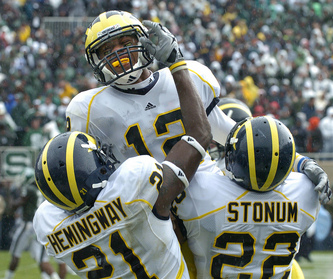
Roy Roundtree (12), Junior Hemingway and Darryl Stonum lead a Michigan receiving corps that may have the most arduous transition from the spread to the pro-style offense this spring. The former placed a premium on speed; the latter on toughness.
AnnArbor.com file photo
On the first offensive series of the 2010 football season, the San Diego State offense made a perplexing first impression on its opponent, Nicholls State.
The Aztecs lined up in a five-wide formation that looked far different than the pro-style set favored by San Diego State coach Brady Hoke and offensive coordinator Al Borges.
Results were inconsequential - quarterback Ryan Lindley threw an incomplete pass on first down and Davon Brown ran for 9 yards on second before the Aztecs returned to their base formation.
But the five receivers on the field proved a point, one that’s worth remembering as Hoke and Borges overhaul the Michigan football team’s offense this spring.
This isn’t necessarily the 3 yards-and-a-cloud of dust cliché from Michigan’s past that onlookers expect Hoke to rekindle. Assumptions like that are troublesome to the coaches.
They’re willing to try anything, especially as they transition from players situated for the spread offense to their pro-style power offense.
“I never want to paint us into a corner where I say this is what we are, and then find out with the personnel that we can’t do that, you know what I mean?” Borges said.
“You start with a blueprint of what you want to be, and that thing constantly gets changed based upon your personnel.” So far this spring, the most curious aspects of that template have centered on quarterback Denard Robinson and the way the new coaching staff plan to accentuate his skills in the offense.
Attention has also been paid to the running backs, who coaches have called the biggest “beneficiaries” in the switch of systems.
By comparison, the receiving corps has gotten relatively little scrutiny. At first glance, the group may be the one that collectively has the most arduous transition from the spread to the pro-style offense. The former placed a premium on speed; the latter on toughness.
The position is filled with smaller receivers. Returning starters Junior Hemingway (6-foot-1) and Darryl Stonum (6-foot-2) are the tallest at a position with plenty of 5-foot-8 and 5-foot-9 backups.
“Don’t assume anything,” receivers coach Jeff Hecklinski said. “You’ve got to get down to what’s in the hearts of these kids and let them go play. It doesn’t matter how big you are or fast you are … what matters is how you produce when the lights are on.”
The Wolverines receivers have done that. Roy Roundtree, last year’s leading receiver, caught 72 passes for 935 yards and seven touchdowns last year. He had the fourth-most receptions in the Big Ten.
Stonum caught 49 passes for 633 yards and four TDs while Hemingway had 32 for 593 and four touchdowns.
Although the Wolverines plan to feature more tight ends this year and put more of an emphasis on returning to a power running attack, that doesn’t necessarily mean those numbers will diminish.
Much like he did at San Diego State, Borges plans to use the best players he’s got, regardless of the blueprint.
Could the Wolverines open the 2011 season with five receivers on the field?
“We might, we might,” Borges said. “What’s our preference? We’ll run four wides five to seven times a game. But if four wides is a group we’ve got to feature more - don’t misunderstand me, we’re never going to be a four-wide team - but maybe we’ll run them 10 times a game, 12 times a game.
“If they’re the best guys for those situations, they’re going to play. It’s that simple.”
Pete Bigelow covers Michigan football for AnnArbor.com. He can be reached at (734) 623-2556, via email at petebigelow@annarbor.com and followed on Twitter @PeterCBigelow.
Comments
Tru2Blu76
Sat, Mar 26, 2011 : 8:31 p.m.
I think Blu n Tpa is right about the "nature" of this team at this time: there's talent in there and there'll be more to come. It's proper understanding of what that talent picture is and how best to use it that Hoke & Company are showing us right now. Many of the same players will be on the field in 2011. What I think we'll see is that they'll be more confident and thus more effective than they have been since arriving at Michigan. It won't all be that they're mostly juniors or that they feel more confident: but a combination of the two. Barring unforeseen problems, I have little doubt that we'll be seeing more than 7 wins in the coming season and the curve will be upward from then on.
tater
Fri, Mar 25, 2011 : 4:08 a.m.
If Hoke delegates the offense to Borges, Michigan will probably be fine. If, however, he starts believing the stuff he is telling the media about how football is lining up against the other team and out-toughing them, Michigan is in trouble. Thanks to the information age, teams are a lot closer to each other in talent now than they were in Bo's or LC's prime. Lining up, saying "this is what we're doing and you can't stop us," and running head on into the other guys doesn't work anymore. That is why USC players used to laugh and say they knew what Michigan was going to run before they ran it. And why elite teams started killing Michigan during LC's last few years. Even 2006 ended in a loss to TSIO and a beatdown by USC. If Michigan does return to what LC did, it's gonna be another loooong decade. Especially if TSIO fires Tressel and hires Urban Meyer. If that happens, the same maggots who got RR run out of town will be complaining that Michigan can't stop Meyer's spread.
UKWolverine
Wed, Mar 30, 2011 : 11:39 a.m.
Dusty, what you call 'one of the best offenses in the nation' is one dimensional, scored 21 points in its final 2 games against decent opposition, and is one of the most turnover prone units I've ever had the misfortune of watching, if thats what you define as a good offense I'd hate to see what you define as a bad one
Dusty
Tue, Mar 29, 2011 : 5:02 a.m.
XTR.... he didn't stop the spread. Not even close. He just, FOR THE FIRST TIME IN HIS ENTIRE CAREER, opened the playbook and used superior talent to outscore it. If the dude had called offense like he did that game more over his career, he would have won so many more games and maybe even beat Tressel more than once.
Dusty
Tue, Mar 29, 2011 : 4:59 a.m.
Near-zero? He's going to have one of the best offenses in the nation, including the reigning Big Ten Offensive Player of the Year and one of the best athletes to ever wear the winged helmet. And on defense... well, he's inheriting a lot of guys who saw playing time and got real game experience early. Hey, I'm a glass-half-full guy.
Tru2Blu76
Sat, Mar 26, 2011 : 8:16 p.m.
Tater, I think you're right on with your concern about Hoke's intentions. But - if you look at the history of Hoke & Borges and what Borges says in this article; it's harder to believe that Hoke is talking too literally. Hoke is the general who trusts his top subordinates: I think you agree with that? OTH - before what we saw was round-robin blaming and subordinates rotated in and out as fast as a roulette wheel. That was a general who was more concerned with his impending "performance evaluation" and who didn't trust (or work with) his subordinates. Borges effectively answers the recurring question about whether the players must adapt to the system or the system be adapted to the best players' talents. The refrain we heard for 2 seasons running was: "they looked great in practice but today they didn't execute on the field." That statement is now proven to be the result of forcing college level players into a "do or die" system that isn't flexible enough to allow for any variance. The players get "graded" as inadequate, thus "excusing" the coaches for their own failures. Worry less about Brady Hoke and more about how long it's going to take for him to rebuild from near-zero.
PortageLkBlu
Sat, Mar 26, 2011 : 11:49 a.m.
Your right Tater USC players did laugh at Mich under LC. I was at a Xmas party 2003 in Anaheim Hills, Ca. and Matt Leinart was there. You are correct Tater USC players thought that Mich. (LC) was easily predictable. I don't like Brady's boasting before he's coached one down as head coach at Mich. He hasn't quite earned that right at least until he coaches one down as a head coach at Mich. Brady talks like someone that just got the keys to a M1 Abrams tank and he's in awe of it. Bragging about how we're going to smash mouth everyone is boasting and not smart football. Let's at least go out and prove we can do that say against Notre Dame before we make ourselves look foolish if we can't smash mouth.
XTR
Sat, Mar 26, 2011 : 11:17 a.m.
Lloyd Carr already beat Meyer's predictable spread! LOL!
Blu n Tpa
Fri, Mar 25, 2011 : 1:36 p.m.
I can tell you that the last 3 years felt like a decade. Oh, that's because we had 10 years worth of loses in those 3 years. Maggots ran off the WCiMFH? I thought his lack of coaching, as shown in his last three games, was the reason. Maggots? Gator Bowl!
Theo212
Fri, Mar 25, 2011 : 12:09 p.m.
Couldn't have said it better myself, tater!
Theo212
Thu, Mar 24, 2011 : 8:34 p.m.
Which receiver will get our one completion per game?
Blu n Tpa
Thu, Mar 24, 2011 : 7:19 p.m.
When your QB is your best RB you don't have balance and other teams with good, not even great defenses, take him away and you have nothing. Get it? Wisconsin, osu and MissStU all did that with chilling results. Getting in a fight with the Michigan offense of yesteryear was the same as fighting a one-armed man. Or don't you really watch the games but just bust out the whooping stick every time you see a glimmer of weakness in someone's post. This coaching staff is using the talent here, not driving it off, and then claiming "poor old pitiful me". Please don't even start to compare staffs. One's doing and the last one do nothing.
Blu n Tpa
Mon, Mar 28, 2011 : 2:12 p.m.
Dusty, so which is it? DR not being a good enough QB due to injuries because he was forced to run so often or because he was forced to pass too much because the defense gave up more points than the usual offense could match? Either way running DRob too much was not good for him or the team. Establishing a balanced running game only helps DR and Michigan. Every team Michigan lost to because if the TEAM lost, so did DRob, or don't you get that?
Dusty
Mon, Mar 28, 2011 : 12:31 a.m.
If the score bothered you, then look at the defense. It sure as heck wasn't Denard's fault that game was a loss. And which teams "with good, not even great defenses" took him away? I don't remember anybody shutting him down all year without knocking him completely out of the game or without him taking himself out with turnovers.
Blu n Tpa
Fri, Mar 25, 2011 : 1:07 p.m.
Dusty, the SCORE! And, what about osu and the bowl game? So you like the running game from last year?
Dusty
Thu, Mar 24, 2011 : 11:31 p.m.
Oh, and what part of Denard's 120 yards rushing, 240 yards passing, and 4 total touchdowns against WIsconsin was "chilling?"
Dusty
Thu, Mar 24, 2011 : 11:28 p.m.
And by "principal" I obviously mean "principle."
Dusty
Thu, Mar 24, 2011 : 11:27 p.m.
This year, the QB is still going to be the best RB. Not using him as much out of pure principal isn't going to magically help the offense.
Blu n Tpa
Thu, Mar 24, 2011 : 1:26 p.m.
I don't have the position chart in front of me but isn't Jeremy Jackson 6'3" , 200 + lbs?
OSUbeBeter
Thu, Mar 24, 2011 : 1:24 p.m.
Michigan is No. 1!
ecmichman
Thu, Mar 24, 2011 : 1:12 p.m.
"You start with a blueprint of what you want to be, and that thing constantly gets changed based upon your personnel." Well said Mr. Borges. This whole transition concept thingy was just a bit too much for the West Virgina staff to comprehend when they moved west.
Dusty
Fri, Mar 25, 2011 : 5:46 a.m.
Arrington and Boren transferring had nothing to do with scheme. Arrington didn't want to bother with a transition season when he could just go to the NFL. And Boren is a punk. His problem was one of personality and not scheme. And Mallett was talking about transferring to Arkansas early in the spring when Mitch Mustaine left the Razorbacks. Long before Rich Rod got there. The spread was just a convenient shade to color it.
ecmichman
Fri, Mar 25, 2011 : 2:39 a.m.
Dusty - Ryan Mallett, Adrian Arrington, and Justin Boren would have been nice compliments to Brandon Minor, but what happened there? Why didn't RR adjust to his personnel like Mr. Borges is willing to do? RR decided to "clean house" so he could install his system with undersized gems such as Sam McGuffie and the fleet footed Steven Threet who was not much more nimble that Mallett. Your claim of RR adjusting his system to the talent at hand is simply not true.
Edward R Murrow's Ghost
Fri, Mar 25, 2011 : 2:20 a.m.
"They only difference is they're soothing the herd by playing lip service to you. Eat it up, sheep. Eat it up" Just like the sheep who continue to pine for their long-lost man crush incompetent coach. Good Night and Good Luck
Dusty
Thu, Mar 24, 2011 : 11:33 p.m.
Are you really going to compare an offense returning 10 starters and the Big Ten Offensive Player of the Year to an offense who's best returning starter was a Brandon Minor who couldn't stay healthy for 2 consecutive games the whole season?
Blu n Tpa
Thu, Mar 24, 2011 : 7:27 p.m.
Thank you, I think ecm2 was 'amazing' because he took the concept of this article and agreed with it. You choose to interject your opinion of his opinion but not the article. My opinion is this coaching staff is adjusting what they want to do with what they can do with who they have. The fact is this season with be vastly better than the WCiMFH's first that your argument will be moot. Have a nice day. TiM Go Blue!
Dusty
Thu, Mar 24, 2011 : 6:16 p.m.
You people are amazing. You hear what they say, but you apparently aren't paying attention to what they're actually doing. They SAY they're going to adjust to the personnel, yet they're changing the scheme just as much as Rich Rod did when he got here. They're not going to play to the strengths of the offensive personnel any more than Rich Rod did. They're going to install as much of their offense as they are comfortable with, and continue to install more until it's all in... just like Rich Rod did. They only difference is they're soothing the herd by playing lip service to you. Eat it up, sheep. Eat it up.
Blu n Tpa
Thu, Mar 24, 2011 : 1:11 p.m.
The Team being defined by the players available and coaches doing their jobs. Wow, that's like the first warm breeze of the spring after a long cold winter. And it's been a looong football winter. The WRs are the deepest group on the offensive side of the ball, if not the whole team. Players will adjust because starters don't like the bench and they have the most game-day experience. Adding a running game with running backs, (what a concept) and including a tight end in your playbook, will change how the defense sets up. The QBs will be fine. Get the defense up to middle of the pack and next fall should be the start of better days. TiM Go Blue
Dusty
Thu, Mar 24, 2011 : 6:13 p.m.
Borges and Hoke aren't implementing any less of their offense this season than Rich Rod did his first season. Adding a running game with running backs? When your QB is BY FAR your most talented runner, don't you think you might get him some carries? Including a TE in the playbook? The TE's last season, Koger and Webb, had 19 receptions between them. In 2007, Mike Massey and Carson Butler had 24 between them... a dropoff of 5 receptions over the year. OH WOW. I'd say we've been using the TE's fairly well recently. Uneducated, blanket statements are fun.