

Michigan football investigation could lead to more changes by NCAA
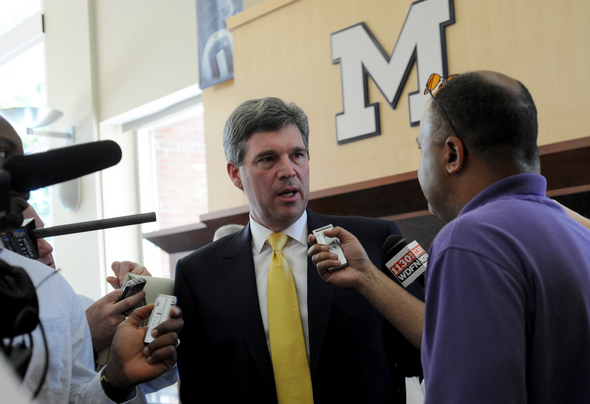
Michigan athletic director Dave Brandon answers questions Tuesday about the university's response to the NCAA allegations.
Melanie Maxwell | AnnArbor.com
Athletic director Dave Brandon made it clear Tuesday that more than one person was to blame for the NCAA violations committed by Michigan’s football program.
“If there was one single person to be blamed for us, we’d be doing it,” Brandon said. “The reality is that, frankly, the blame for this complex set of issues spans a number of different areas and entities within both the football program and the athletic department overall.”
Football coach Rich Rodriguez is partly at fault. Both he and the university acknowledged in their lengthy responses that he didn’t keep close enough tabs on his support staff and could have done more to ensure compliance.
Michigan’s football administration and compliance departments are culpable as well. Documents sent to the NCAA by the university and Rodriguez detail numerous breakdowns in communication between the offices and a glaring lack of follow through.
The individuals who overstepped their duties, knowingly or not, have a stake in the violations, and to listen to Brandon’s press conference Tuesday, the NCAA’s ample and ambiguous rules manual played a part, too.
“I personally believe that when the smoke clears from all of this there’s a number of important topics that need to be discussed,” Brandon said. “There can be tremendous improvement in the clarity around the job descriptions, what is do-able and not do-able as it relates to quality-control staff.”
One of the violations Michigan copped to involved exceeding NCAA limits on staff size. The charges “stem primarily from a misapplication of” rules “and not an intentional disregard of the bylaw’s limitations,” Michigan wrote in its response.
Specifically, quality-control assistants - football staff members who assist with non-coaching duties - conducted skill-development workouts, led warm-up activities, attended coaches meetings and watched seven-on-seven off-season workouts in violation of NCAA rules.
Rodriguez said he thought quality-control assistants could help with skill training and stretching as part of their duties with the strength program, and could take part in film sessions or coaches meetings as observers for their own personal gain.
The NCAA doesn’t recognize the quality-control position by name, but in January it adopted legislation amending the non-coaching activities a sport-specific staff member can take part in to include coaches meetings, film sessions and other “organized activities involving only the coaching staff or administrative duties.”
Both Michigan and Rodriguez cited the rationale behind this change in policy - confusion over what duties were impermissible - as a mitigating factor for the violations, though the university, as part of its self-imposed punishment, banned its three remaining quality-control assistants from attending practices, games and meetings this year. Michigan also cut two unfilled quality-control positions for the next two seasons.
Ironically, the NCAA Football Issues Committee opposed the proposal - committees for baseball and men’s and women’s basketball supported it - because it wanted the positions to “be more administrative and less coaching oriented.”
Southern Mississippi athletic director Richard Giannini, a member of the Football Issues Committee, said Wednesday he expects to see legislation to increase staff sizes sometime in the next year. Currently, football staffs are limited to nine full-time assistants and two graduate assistants.
“They want more than the 11, but who knows what people have out there right now,” Giannini said. “I can really see a number coming down the pipeline as far as NCAA legislation in the next year. … I can’t say whether it’ll be a number or named positions, but what’s happening is that the numbers are increasing and that’s what’s going to be controlled.”
While Michigan used its quality-control assistants to help run off-season workouts, other programs have augmented their coaching staffs with extra strength and conditioning assistants, often with football backgrounds.
Since strength coaches typically run off-season workouts, some feel the NCAA needs to address this gray area next.
“These guys have some pretty good roles in the program,” ESPN analyst and former Georgia coach Jim Donnan said earlier this year. “It’s kind of ironic that a high-school football coach is now a strength coach and he’s helping the kids in summer workouts, and whatever they’re doing he’s out there with them and he’s helping them with it. Within the rules.
“I think that rule is probably something that needs to be looked at.”
Brandon said other things need to be looked at as well, and Michigan would be happy to help.
“There’s always areas for improvement," Brandon said. "We clearly had misunderstandings between our compliance department and the NCAA on the interpretation on some of these rules and regulations, and to the extent as a result of our experience here we can work with them to tighten up those definitions and come to a better understanding of what is permissible and is not permissible, then that as a member organization is what we ought to be doing with the NCAA.
“I don’t want that to be taken as a criticism of the rules, it’s just in some cases we can go back and see where we made the wrong call based on our interpretation of the rule that was in some cases somewhat ambiguous."
Dave Birkett covers University of Michigan football for AnnArbor.com. He can be reached by phone at 734-623-2552 or by e-mail at davidbirkett@annarbor.com. Follow him on Twitter @davebirkett.
Comments
aarox
Sun, May 30, 2010 : 10:02 p.m.
Terry I'm right behind you - lets go 12-0!!
Terry Star21
Fri, May 28, 2010 : 2:39 p.m.
I just woke up a while ago.... the only relevance that #71 ranking has is - after our first '7' games, Michigan will be ranked #'1'.... the coffee sure smells good in Ann Arbor this year.....Great time to be a Michigan faithful..GO BLUE... Michigan - wide awake..RichRod - brews the victories..Michigan - runs the table...
davebirkettisatroll
Fri, May 28, 2010 : 1:29 a.m.
Ann Arbor.com sports is run by a bunch of non-Michigan fans. Sparty Birkett is a prime example. I am cancelling my subscription to Ann Arbor.com
Sean T.
Fri, May 28, 2010 : 12:03 a.m.
Every blogger that doesn't support RR isn't a Spartan Fan. Why can't anyone have the right to tell the horrid truth about our program? And 71 could've easily had been 81 with our defense!
Jaxon5
Thu, May 27, 2010 : 7:43 p.m.
Fans should wake up and smell the coffee. Reality has set in after 2 seasons. Michigan is ranked right where it belongs. # 71! Not 7, not 17, not 31, not 51, but 71! This is our new reality. Not considered to be a serious football program after 2 seasons. Sporting News says # 71. Of course, they Illinois at #90 something and that's just ridiculous.
aarox
Thu, May 27, 2010 : 7:22 p.m.
Ugh. Not that polls are worth anything (unless we are on top) but c'mon. Sporting News has us in between Central Michigan and Bowling Green. We are 28 spots below Middle Tennessee State and 27 below that Rutgers team that we don't want in the Big Ten because they will 'drag us down.' If there is any consolation Michigan State is 'only' 21 spots above us.
Yelmonian
Thu, May 27, 2010 : 5:52 p.m.
By the way... Notice that in the Sporting News top 100 football teams, they have Duke rated ahead of UM. That's got to be a first for UM also. Go RR!
Yelmonian
Thu, May 27, 2010 : 5:50 p.m.
I can't wait for the season to get here. Either Tater and his cohorts are correct... or JimB will be right. http://www.sportingnews.com/college-football/article/2010-05-26/college-football-on-clock-sns-preseason-top-100 Sporting News seems to think JimB will be closer to correct. So... unless the NCAA provides another twist in August... everyone will know whether RR was the right choice by November. 6 months and counting.
Teebob
Thu, May 27, 2010 : 3:46 p.m.
Give me a break fellas, did you guys just get off the bus? Of course Michigan is going to say whatever they can to spin this so they don't look bad. Anybody would. But the real spin is that our wolverines want to be good and stretched some rules that weren't defined well. I doubt they didn't realize what they were doing was outside the lines. So, it is time to move on. Let us hope the ncaa goes with it and sticks to what we set as punishment. Go Blue!!!
trigg7
Thu, May 27, 2010 : 3:29 p.m.
Ignorance is no defence of the law guys. Guilty as charged. Over/under 6 games.
gatling64
Thu, May 27, 2010 : 2:23 p.m.
JIMB obviously you didn't read the article.The point is that the NCAA is nebulous in its own interpretation of the rukes it set in place just 4 years ago.This has nothing to do with RR as a coach.80% of thee coaches in hte nation could be charged for the same thing.The rules considering the number of supervised workouts were poorly written and as the article says,should be changed and clarified.
Buur
Thu, May 27, 2010 : 1:07 p.m.
Wow, so they can just have an interim coach guide the season then have someone in waiting to take over in 2011? How exactly are they supposed to do that, JimB? Secretly hire a new head coach?
bobd
Thu, May 27, 2010 : 11:26 a.m.
Man the soft soap approach you guys at the news now take with all things um related is comical. You really got intimidated by people crying so hard because your predecessor wrote some tough stuff eh?
wolverineinbuckeyestate
Thu, May 27, 2010 : 10:48 a.m.
Hey JimB, money isn't the blocking force. There is a clause in rich rod's contract that says, michigan can fire him with no penalty, if found guilty of ncaa violations. Michigan is holding on to him for some other reason.
stan
Thu, May 27, 2010 : 10:01 a.m.
JimB, this wasn't Rich's fault. I don't know how much more clearly this could have been displayed for you. The documentation clearly shows that Brad Labadie and Scott Draper had issues going back to Lloyd Carr. Rich deserves a chance to coach and not have to endure a witch hunt. Dave Brandon does not want to get rid of Rich, because he supports him as coach.
orlandomichfan
Thu, May 27, 2010 : 9:41 a.m.
GOOOOOO BLUE!! YOUR TRUE FANS ARE BEHIND YOU!!!!once Mich starts winning i think i will keep an eye on all the haters who are so quick to jump on and off the bandwagon.. again i ask you all.. what was the total number of championships(not big 10 titles)that Michigan won with BO & Carr together???? GO MICHIGAN!! WE LOVE OUR TEAM!!!!!
JimB
Thu, May 27, 2010 : 8:37 a.m.
Sad to see lowered standards at the UofM. Rich Rod should have been terminated swiftly. An interim head coach could be installed to guide the 2010 season and a new coach culd be "in waiting" through most of the season in order to get a head start when he takes over so as not to ruin pontential recruting for 2011. Money shouldn't be the blocking force to removing Rich Rod.