

Michigan relieved for now, but NCAA investigation isn't over yet
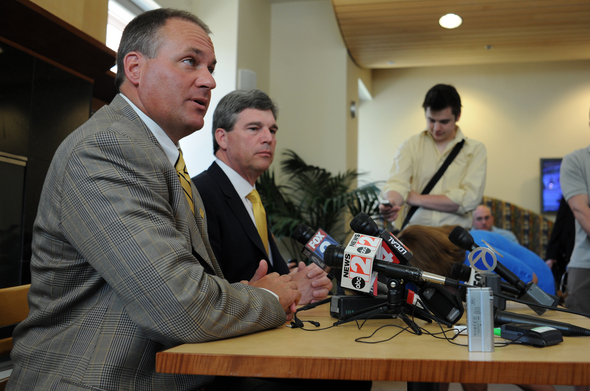
Michigan athletic director Dave Brandon and head football coach Rich Rodriguez answer questions from the press regarding their response to the NCAA allegations at the Ross Academic Center on Tuesday afternoon.
Melanie Maxwell | AnnArbor.com
It was painful and sad and historic, and depending on your point of view, maybe a bit appropriate, too.Â
But in announcing Michigan’s serious-sounding-yet-practically-moderate self-imposed penalties Tuesday, athletic director Dave Brandon chose “relief” as his emotion to best describe the day.
Michigan suffered the worst black eye in the storied history of its football program, placing itself on two years probation and taking away 130 hours of practice time.
But relief came from the fact things could have been much worse.
In a 79-page response released Tuesday to February's NCAA’s official Notice of Allegations, Michigan described systemic breakdowns in its compliance and athletic departments while largely defending much-maligned football coach Rich Rodriguez.
Rodriguez’s dodged, with Michigan’s blessing, the most serious charge against him, a failure to promote an atmosphere of compliance within his program
Brandon said that was less a distribution of blame than where the facts led.
“The reality is that we had failures across the athletic department,” he said. “If you go back and you read the documents you will see that bad decisions were made, there was sloppy handling of information. Some of our checks and balances were not implemented and executed as they should have been. We had failures of communication along the chain of command that led us to where we are today.”
Despite Brandon’s relief, the Wolverines aren’t done with the NCAA process just yet.
Along with probation and practice limitations, Michigan eliminated two quality-control positions and essentially did away with three others thanks to a series of hamstringing restrictions.
The NCAA can choose to add more penalties when Brandon, Rodriguez and Michigan president Mary Sue Coleman lead a university contingent before the Committee on Infractions this August in Seattle.
If the committee believes, as NCAA investigators suggested in their initial report, that Rodriguez failed to promote compliance, there will be steeper punishments to pay.
A third year of probation is possible, and maybe a loss of scholarships or further coaching-staff scale backs.
Brandon said those penalties are unwarranted and excessive, and things the Wolverines chose not to self-impose Tuesday.
“When programs receive bans on postseason play, when they get reductions in scholarships, when they get reductions in coaching positions, typically those are associated with violations that rise to the level of lack of institutional control, unfair competitive advantage, that would have impacted other programs and other players,” he said. “None of that is relevant to the situation that we’re dealing with today.”
Inherently, Michigan gained some advantage by practicing an extra 65 hours over the last two years. Even if the overages were related to miscalculating warm-up activities as non-countable hours as the university submits, those exercises netted the Wolverines an extra 2 1/2 days worth of off- or in-season prep.
Rodriguez, clearly, was the big winner Tuesday, though his 89-page personal response read part caged animal, part blame-shifter. In his defense, he was fighting for possibly his coaching life, and had the documents to back up his claims.
Brandon described Rodriguez as a model coach in terms of working with Michigan’s compliance department and reiterated once again that, major infractions or not, he's going nowhere.
In the last two days, both men expressed regret at being in this situation and promised never to return.
“There’s nothing good about the word investigation, there’s nothing good about the word violation, there’s nothing good about the word probation,” Brandon said. “This is an unfortunate situation that we find ourselves in.
“We made mistakes, we are being transparent about it, we’re accountable, we’re doing something about it. We’re going to be sure they don’t happen again. And beyond that, I don’t know what else we can do.”
Dave Birkett covers University of Michigan football for AnnArbor.com. He can be reached by phone at 734-623-2552 or by e-mail at davidbirkett@annarbor.com. Follow him on Twitter @davebirkett.
Comments
Robbie Webb
Wed, May 26, 2010 : 8:47 a.m.
I never blamed it on Carr and assuming goes both ways. If Rich Rod is so bad, then why did Dave Brandon who played Michigan football under Bo and knows about Michigan football and it's traditions keep him and did not fire him? You need to realize that change was needed for this team, running it down opponents throats will not get Michigan a championship. And last years problem was not offense, it was defense for the soul reason of youth and lack of veterans. There was experience on the line and linebackers, but it was the secondary that did not step up. Michigan will win more than 7 games. Count on it. And if you're a true Wolverine fan, you'll support them no matter who is at the helm.
3 And Out
Wed, May 26, 2010 : 3:18 a.m.
Robbie: Mail me whatever it is you are smoking, because as long as its legal, I could use some of it...sparingly of course. Blind and mindless optimism only gets you so far though...and it makes me wonder if you ever actually played the game... i did DI and I coached it too... Michigan has talent, but the scheme is flawed, coaching worse, Barwis is just an overated over-promoter non factor...and Rich Rod is an average coach made to look better by a few good players in a weak league years ago. 6 losing seasons in 17 is a joke for RR... flat out joke. Michigan is soft in many areas and that is on Rich Rod. For you to assume 6-0 (have you ever heard the joke about making an asss out of you and me with assume?) well that is just crazy...this team is sloppy, poorly coached and not equipped from a schematic standpoint to compete in the Big Ten. 6-6 at BEST and 7th place in the Big Ten...and that is ON Rich Rod... not on Carr as you types tend to blame lol.
Robbie Webb
Wed, May 26, 2010 : 12:37 a.m.
I have to challenge you on the offensive line, with Molk returning is a huge gain! With him, Schilling, and Omameh, they should be alot better, and it all starts with the offensive line. Runningbacks, Vincent Smith showed great promise and Stephen Hopkins is a freezer with a football at aprox. 230lbs. Fred Jackson has been there for 18 years and is a great coach and will do a good job, runningbacks are talented, they just need to find two that can get it done. Quarterbacks are young and will get better.
Robbie Webb
Wed, May 26, 2010 : 12:13 a.m.
Rich Rodriguez is a great coach. You have to put your fandom aside and really look at what was to work with. Talent? Yes. Experience? Not so much. Any coach would have struggled. Although I believe they should have gone to a bowl game last year, I wasn't surprised they didn't. Rich Rod knows football, or he wouldn't be here. This is his year, his year to show if all of this will be worth it. Wait and see. September 4th can't come fast enough.
Robbie Webb
Wed, May 26, 2010 : 12:09 a.m.
Michigan also has many starters returning, the most in the big ten. Which means they were young, mark my words, Uconn is not a push over team, but the Wolverines will pull it out.
Robbie Webb
Wed, May 26, 2010 : 12:06 a.m.
3 and out, Michigan will not lose to Uconn, I know they are not a push over team, but for you to say they are going to just lose to them just like that is inaccurate. Notre Dame is also very winnable. Michigan has the possibility of going 6-0 through MSU.
3 And Out
Tue, May 25, 2010 : 11:58 p.m.
Robbie there certainly is doubt.... i see them dropping the first 2 games... the UConn game at home (stadium dedication) will be a 35-31 loss. UConn is a good team with many starters returning. They crushed an SEC team in their bowl game. Their program is far more advanced and better coached than Rich Rods. Lets be honest here. Kelly will have ND fired up at home. ND is just as talented as Michigan and Kelly is a much better and more effective coach than Rich Rod. ND wins that one 29-17. Michigan takes the next 2 vs lessor opponents and squeeks by IU in the Big Ten opener.... after that are sure losses: Wisky, Iowa, OSU and PSU and probable losses to MSU and Illinois and toss in another one for good measure because we all know its likely...and you get at the best 6-6 with a very probable 5-7 or shudder 4-8... and it wont be due to talent.
Robbie Webb
Tue, May 25, 2010 : 11:11 p.m.
3 and out, whoa whoa whoa. The defensive line is anything but a problem. They wont have a playmaker like Brandon Graham, but they will be good and be able to hold their own. The defensive line was never and issue. Mike Martin, Greg Banks, Van-Bergan, Big Will and Craig Roh will be on the line some depending on the offense they are facing. Kicking and punting will be taken over by Will Hagerup, top punter in the country. Michigan will win more than seven games, no doubt.
3 And Out
Tue, May 25, 2010 : 10:31 p.m.
D Line = very little depth or experience. Lacks playmaker. Hope is that Will Campbell is an effective plugger and Van Bergen continues to improve. Martin may have maxxed out his potential no pun intended. LBs = experienced but lacking in athleticism and speed and play making ability. Secondary = Corners should be decent and they are building some depth there. Safety is still a huge concern. The Cam Gordon spin is off the hook this spring and hed better live up to it because there are still serious holes back there... Coaching and scheme = D. They are just struggling to find any system that works...and the fundamentals and mental breakdowns continue. Overall defensive outlook = C at best....more likely C- to D. Rich Rod = still a blame shifter...nothings changed there. Typical narcissist. Offensively - C on the offensive line. C- on running backs. C on QBs. B for WRs. B for TEs though not an issue in this offense unfortunately. Kicking = INC... and scary. Overall Offense = C+ with a scheme that struggles vs. better athletes of the Big Ten and doesnt play to their individual strenghts. Dont get me wrong, Im cheering for them....but lets look at this realistically and call it 5-7 or 6-6.
Sean T.
Tue, May 25, 2010 : 6:50 p.m.
Actually, the Secondary is where all the talent is according to the defensive side of the ball. There's nothing that implies the d-line will be the stronghold or even average. B. Graham was a huge loss for us and he will be sorely missed! Robbie, I hope that you're right because outside of Will Campbell there's not much to look at.
Robbie Webb
Tue, May 25, 2010 : 5:31 p.m.
Nobowl, the defensive line is not an issue and it never was, even with Graham gone. They will be solid and be able to hold their own. It's the secondary, not the line.
Kubrick66
Tue, May 25, 2010 : 5:23 p.m.
I still think Michigan should've stood defiant, and openly challenged the NCAA and every other Major Football Program to stand up and be counted. Because this whole "investigation" is/was and will forever be nothing more than trivial nonsense.
NoBowl4Blue
Tue, May 25, 2010 : 4:28 p.m.
with the "king of underachieving" at the helm the investigation will continue. Funny how some think the "D" will hurt opposing offenses. It was terrible last year and lose Grahamn. funny
Terry Star21
Tue, May 25, 2010 : 4:09 p.m.
The only 'Black Eye' given, will be to the Michigan opposing offenses this year - or any unfaithful talking smack to Mr. Theo and myself. Michigan Football will make all the faithful proud this year, and send all the unfaithful (commenters here) into hiding or gleaming - I told ya so, I'm the best Go Blue fan ever! Mr. Brandon our emperor and our king RichRod will thrill the Michigan faithful this year, like no other year....in RichRod we trust!