

Michigan tailback Fitz Toussaint picks up where Denard Robinson left off as primary rushing threat
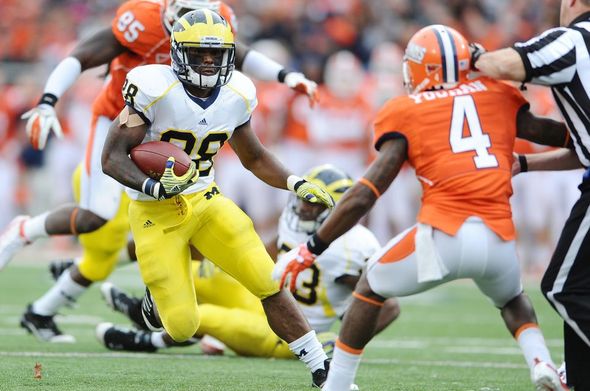
In recent games, Michigan running back Fitzgerald Toussaint has established himself as the Wolverines' primary ground threat.
Melanie Maxwell I AnnArbor.com
CHAMPAIGN, Ill. — The Michigan football team has a defense that can win games. That's nice.
But you still have to score points. The Wolverines have struggled to do that the past two weeks, and it's becoming increasingly clear tailback Fitz Toussaint is more important to that end than quarterback Denard Robinson.
Robinson gets the headlines because he's electrifying and exciting and polarizing and has awesome dreads. But Toussaint, when he's on a roll, makes Michigan very difficult to beat.
When he's not, Michigan becomes very beatable.
And, right now, Toussaint is playing much better than Robinson.
The sophomore tailback set career highs with 27 carries for 192 yards in No. 20 Michigan's 31-14 win Saturday against Illinois. He also scored one touchdown.
Those are impressive numbers. They are more impressive considering Illinois entered the game No. 1 in the Big Ten in rush defense, giving up just 103 yards per game.
Toussaint needed only eight carries and half a quarter to eclipse that total.
“Up front is where we executed well,” he said. “The offensive line, I give them credit for creating creases, allowing me to go through them and explode.”
Toussaint later said he had bigger holes against Illinois than he's had all year, an impressive feat considering how formidable Illinois' defensive line has been all year. That bodes well for Michigan's final two games.
Nebraska — which has lost All-American defensive tackle Jared Crick for the season — entered the weekend eighth in the league against the run, and Ohio State was fourth.
Toussaint has shown bursts before (such as his 170 yards against Purdue three games ago), but also has struggled with consistency and health. Can he keep it going?
Michigan (8-2, 4-2) will need him to, with the way Robinson is playing.
The junior quarterback has never been a gifted passer, but he's always been so deft running the ball, it didn't matter. The passing was the ante Michigan paid to get the ball in Robinson's hands every play.
Now, though, even the run is abandoning him.
Robinson missed several holes against Illinois. He made bad cuts. He sprung one nifty run of 11 yards, but looked a step slow even on that one.
Is he injured? That's more of a rhetorical question at this point, as Robinson has left four of his past five games, including against Illinois due to a bruised wrist. And, in that span, he's averaging just 3.7 yards per carry.
Robinson rushed for just 30 yards on 12 carries against Illinois — a 2.5-yard average per carry — despite an offensive line that, according to Toussaint, was opening its biggest holes of the year.
Worst of all, though: Robinson quickly is turning into a turnover machine.
He had another interception Saturday, and he now has 13 this year, tied for fourth most in the country. Of the other six teams featuring quarterbacks with at least 13 picks, only Southern Methodist (6-4) has a winning record. The six combine for a record of 17-43.
Teams win despite quarterbacks with that many picks, not because of them — if they win at all — and Robinson has thrown a pick in all but two games this year.
That doesn't even include his fumbles. Robinson put the ball on the turf twice against Illinois, and now has three in his past two games.
The bottom line: Robinson is a gifted runner and challenged passer. That's his dichotomy, and it's one that has worked for Michigan in the past.
But Robinson also isn't immune to the challenges of anyone or any team that is one-dimensional: When that one dimension isn't working, you have no dimensions. That's where Robinson is at heading into the final two games.
The reality is, Toussaint gives Michigan a better chance to move the ball, and keep the ball, right now. The Wolverines need to give it to him consistently against Nebraska and Ohio State.
Floyd's late film session pays off
J.T. Floyd.
Joseph Tobianski | AnnArbor.com
J.T. Floyd can attest.
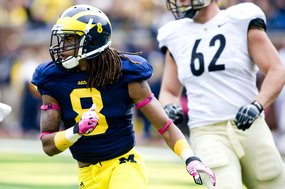
The junior cornerback, who has had a strong year but was coming off a rough day against Marvin McNutt and Iowa, played exceptionally well. He filled up his stat line with four tackles, one interception and two pass breakups.
But it was a morning film session, mere hours before the game, that made the difference for him.
Floyd said he saw something watching that last bit of film that was triggered as Illinois approached the line early in the fourth quarter. And, with the game still in question, Floyd jumped a route by Big Ten leading receiver A.J. Jenkins, picked off the pass by quarterback Nathan Scheelhaase and returned it 43 yards.
It led to a touchdown that put away the game — a fitting touch for a game that was won by the defense to be put away by the defense.
"I saw the split, and the coaches were telling me to trust my instincts," Floyd said. "I just read it. I seen the receiver kind of raise up in his break, and I just went for it."
Defensive coordinator Greg Mattison has been lauded for the defense's remarkable resurgence. Hard to dispute that, when his players are making these kinds of anticipation plays.
Countess, Floyd a one-two punch
Jenkins, who entered the game as the Big Ten's leader in catches and receiving yards, finished with eight catches for 103 yards against Michigan. Impressive numbers against that powerful (weird to say, right?) Wolverines defense. Aren't they?
Not really.
Jenkins had just four catches for 35 yards in the game's first three quarters, when the game was in the balance. He had four catches for 68 yards in the fourth quarter, with the Illini out of reach.
Those catches pad stats, but don't win games. Michigan will take that.
Floyd and freshman corner Blake Countess played exceptionally together, and are quickly developing into a formidable one-two punch for the Wolverines. Floyd has shown flashes of becoming a shut down corner, and Countess already has begun to draw comparisons to former Michigan corner Donovan Warren by coaches and teammates.
Bright future, indeed.
Third-down first-rate ... again
It's difficult to pinpoint which defensive statistic is most impressive from Michigan's mastery of Illinois, but its performance on third down continues to be fantastic.
Consider:
- Michigan allowed Illinois to convert on third-and-short (4 yards or fewer) just two-of-six times, an impossibly low rate. ... What's that? Small sample size, you say? Well, remember, the Wolverines allowed the same 33.3-percent clip on third-and-shorts last week against Iowa. Simply put, this team is tough in short-yardage situations.
- The Wolverines helped themselves with good work on first and second downs. Illinois' average yardage needed to convert a third down in the first half was 10.3 yards. Even in the second half, when Illinois picked up some garbage-time yards, the average was 6.9 for a first down.
- Because of those two factors, Illinois did not convert a third down until the closing minutes of the third quarter. It missed on its first eight tries, and finished 5-of-17.
Rush defense sharp
More from the mind-blowing defensive stats department:
Michigan held the Illini to minus-12 yards rushing in the first half. That is to say, the Wolverines gained 1.2 yards rushing every time Scheelhaase handed off the ball.
Who are you, and what have you done with the Michigan defense?
Entering the fourth quarter, it still had allowed just 20 yards on 19 carries.
"When you stop the run, it starts there," Hoke said. "When you see those maize helmets hitting the ball carrier multiple times, I think that's Michigan defense."
Seeing red in red zone
Michigan won a road game, and made important steps on offense, but it was far from a perfect game for the Wolverines.
Two disconcerting trends: Turnovers, of which three, and red-zone offense.
The red-zone problems are must noteworthy, simply because Michigan had been so good for so long this year. Once among the top-five teams in the country at scoring within the 20-yard line, the Wolverines now are 68th (80.4 percent scores).
They scored on just three of six red-zone trips against Illinois.
"Everyone gets frustrated," Hoke said of the struggles. "You always have to look at your opponent and what they’re d0oing and also look at what you did (in diagnosing the problem). 'Where did we not block the guy right, or hit an open receiver?' — and I think we did that once."
Odoms breaks through
Senior receiver Martavious Odoms entered the season with 87 career catches. He was a prototypical slot receiver who figured to play an important role in Rich Rodriguez's spread offense.
And then Rodriguez was gone, and so was Odoms' role. He had just one catch entering the weekend.
That makes his 19-yard touchdown grab to ice the game against Illinois — on a perfect throw from Gardner, who showed poise in stepping up in the pocket — all the more special.
Some players benefit from coaching changes, and others don't. It's unfortunate, but inevitable. Odoms is an example of the latter.
Kyle Meinke covers Michigan football for AnnArbor.com. He can be reached at 734-623-2588, by email at kylemeinke@annarbor.com and followed on Twitter @kmeinke.
Comments
D21
Tue, Nov 15, 2011 : 5:38 p.m.
Is there anybody out there who misses RR? Don't think so. Bill Martin sure pulled a true Millen move with that dreadful hiring. TiM!
tim
Mon, Nov 14, 2011 : 9:56 p.m.
Nonsense ---- Denard is being trained to be a different kind of QB in a different offensive system. He could go back to a spread ( and get lots of rushing yards) but that would hold up the development of the whole offense.
tim
Tue, Nov 15, 2011 : 1:55 a.m.
Yea-- I did scream run! at the TV a couple of times saturday.
DonAZ
Tue, Nov 15, 2011 : 12:36 a.m.
@tim -- that I agree with ... Borges is no doubt coaching him to exercise a bit more patience in the pocket. My hunch is Robinson hasn't quite mastered the nuance of this ... patience but run when it makes sense ... and he started *thinking* too much, which made him become hesitant.
tim
Mon, Nov 14, 2011 : 11:53 p.m.
Your probably right DonAZ the defenses are definitely are out to stop Denard, but enough of this bunk about him not running well. He's trying to stay in the pocket longer, and adjust to the new offense.
DonAZ
Mon, Nov 14, 2011 : 10:32 p.m.
Agree with the first part of your post ... disagree with the point about Denard getting lots of points. I truly believe that last year's offense run again this year would mean diminished numbers for Denard. Unless magic happened between last year and this so a true second threat was present, defenses would have put all their money on "stop Robinson" and that would be the game plan. And it would work. This is why all the trash-talking of Borges is hooey ... Borges is doing what a *smart* OC does when faced with the reality of a one-dimensional offense ... work hard to develop multiple dimensions. He's doing that ... the evidence is becoming more and more apparent.
15crown00
Mon, Nov 14, 2011 : 9:53 p.m.
if DRob insists on running so much make him a running back.
LHCarr
Mon, Nov 14, 2011 : 9:12 p.m.
For the record, I think Hoke is doing a fantastic job. However, 4th and Goal with a 14-0 lead, defense dominating the game...KICK THE FIELD GOAL AND TAKE A 3 SCORE LEAD!!! Nobody's talking about it because we ended up winning big, but man I couldn't believe it.
DonAZ
Mon, Nov 14, 2011 : 10:29 p.m.
Either (a) Hoke was looking to put the final nail in the coffin, or (b) he felt some need to prove to detractors Michigan can punch it in. But given how the defense was playing I think you're on the money -- take the points and the three-possession lead.
Mick
Mon, Nov 14, 2011 : 7:43 p.m.
Hey Mission, thanks for pointing out what I was thinking after reading Lorain's comment about needing to wait till the night of Nov. 26 before he determines if Hoke is a good coach. Give me a break, Hoke is a great coach and his staff is a great staff, you can bank on that. The future is bright folks, it's bright!
missionbrazil
Mon, Nov 14, 2011 : 8:37 p.m.
Absolutely Mick, we are in good hands and the future is very bright. It will be fun to watch. Go Blue !
Edward R Murrow's Ghost
Mon, Nov 14, 2011 : 8:17 p.m.
LOL. The WCiMFH lost three in a row--none close, and yet there are some who trumpet his coaching abilities. Meanwhile, the same folks set out this year's game with tosu as the litmus test of whether or not Hoke is a good coach. I guess intellectual consistency is the proverbial bridge too far. GN&GL
Edward R Murrow's Ghost
Mon, Nov 14, 2011 : 7:26 p.m.
For those who are grousing about the "unproductive" offense. Michigan went into the cesspool that is Memorial Stadium and scored 31 points. 31 POINTS!!!!! And they did this against the NCAA's #12 scoring defense and its #9 defense in terms of total yards, and yet the MCC are complaining <a href="http://web1.ncaa.org/mfb/natlRank.jsp?year=2011&rpt=IA_teamscordef&site=org&div=IA&dest=O" rel='nofollow'>http://web1.ncaa.org/mfb/natlRank.jsp?year=2011&rpt=IA_teamscordef&site=org&div=IA&dest=O</a> <a href="http://web1.ncaa.org/mfb/natlRank.jsp?year=2011&rpt=IA_teamtotdef&site=org&div=IA&dest=O" rel='nofollow'>http://web1.ncaa.org/mfb/natlRank.jsp?year=2011&rpt=IA_teamtotdef&site=org&div=IA&dest=O</a> I seem to recall that last year's "high powered offense" seemed not to do so well against good differences. Time to give it up folks and credit this team for doing very well this year. Good Night and Good Luck
DonAZ
Mon, Nov 14, 2011 : 10:47 p.m.
"credit this team for doing very well this year" Yes, agree ... but as I point out above in response to Lorain Steelmen ... we really do need to pass a good sturdy test to settle the questions that linger about consistency of execution, particularly on offense. So to that degree the Nebraska game looks to be such a test. It's a winnable game if Michigan plays solid, consistent football. I'm going to have a pretty big smile on my face if Michigan and Nebraska square off for 60 minutes of old school smash-mouth and Michigan comes out the victor. I'll still have a sense of satisfaction if they come out on the short end of the score BUT play good solid football. I'm going to be a miserable grouch if Michigan plays a sloppy game and drops a game it could have won.
missionbrazil
Mon, Nov 14, 2011 : 7 p.m.
"On the evening of Nov. 26th, we will KNOW if Hoke is a coach or not....Not until." Considering that he took over a program that had it's worst 3 year period in it's storied 100+ year history (as the program with the most wins in the history of college football), I would say that COACH Hoke has done a great job. He has led our team to being competitive again in the B1G, and he has done so with basically the same players that were 7-6 the previous year and that were beaten badly by Iowa, MSU, Wiscy, OSU, and Miss. State. Here are just a few of the things that Coach Hoke has accomplished: * He and his staff saved this year's recruiting class and turned it into a top 25 class. * HE hired Coach Mattison and is partly responsible for the resurgence of our D. * He and his staff currently have one of the best recruiting classes for 2012. * UM recorded it's first shutout (58-0 vs Minnesota) since 2007. * We have won 4 games in the B1G for the first time since 2007, and we still have 2 to go. * We have won 8 games in a season for the first time since 2007, and we still have 3 to go (including a bowl game) * For the first time in 4 years our D is not getting worse as the season goes on, it is getting better. * Our team is +4 in turnovers (even with Denard's 13 INT's), the first time since ??? it's not a negative number. * You could go on and on... The man has ALREADY proven that he not only is a very good coach, but he has also proven that he is a fine LEADER too ! Go Blue !
Tru2Blu76
Mon, Nov 14, 2011 : 5:32 p.m.
Lets just speculate that Meinke is right and Denard is off during these last 2 games. I'm still not too concerned because: (1) It looks like Devin can fill in to some extent. (2) Best news is: the O-line is showing real improvement just since the MSU game (where they were terrible). And (3): the defense is now the Real Deal; no doubt about it, they can win games for Michigan. If we've seen anything this year, it's that Hoke & Co. (coaches) are versatile and clearly determined to use every man and every resource they can to make this team a success. Lloyd Carr must really like Brady Hoke because he hasn't thrown a single horseshoe into the works like he did when RR was here. No encouraging the players to leave when Hoke came in, no holding onto the team he no longer coaches, no gathering his clique to cold shoulder the new head coach socially and psychologically. Maybe A2.com should award a game ball to Carr for his new role as a non-saboteur. Don't get me wrong, I'm glad RR is out of the picture - but I feel the same way about Carr.
LHCarr
Mon, Nov 14, 2011 : 9:01 p.m.
None of those things happened. The people that left, including Manningham, Arrington, Mallett, Boren, etc., or gave a "cold shoulder" did so because RR pushed them away. RR came in and didn't want to consult Carr about anything; not even to get the scoop on the players or opponents. Carr received daily phone calls from parents telling him how miserable their sons were playing for RR and his staff. In the meantime RR did everything he could to hinder any player that wasn't one of his recruits (i.e. Brandon Minor, Obi Ezeh, Carson Butler), including bad-mouthing them to NFL scouts (i.e. Morgan Trent).
chiro19
Mon, Nov 14, 2011 : 4:52 p.m.
I am glad I am not the only one that see's Denard as a liability now and not the key to winning games. The pressure has been taken off of his legs and put on his arm and it is just not working! He tries to make plays that dont exist instead of just throwing the ball away or taking a sack he is fumbling. Instead of running he throws into coverage and looks horrible doing so! In terms of MRunner: I stay optimistic because I think he has the talent to throw the ball. He just has not this season! I think he has had every opportunity to be a impact player by throwing it and he has fallen way short all year! The issue then becomes that a defense sneaks up in the box and takes the run away. So then the Offense is left with nothing just like Sat. from the 2nd quarter to the 3rd quarter until Devin came in! I disagree about the Iowa game, Denard had 2 bad turnovers again and he missed receivers down field that were wide open I think 5 times which cost michigan the game! In the MSU game he did not lose it but he definately did not help michigan win it with a horrible pick six! I think that Denard should start against Neb. but if I were Hoke I would simply tell him this week in practice that if he turns the ball over because of a miss read of coverage or another bad fumble that he would be pulled for Devin!
Art
Mon, Nov 14, 2011 : 4:26 p.m.
If this article is correct, and I think it is, Denard is becoming less and less critical to the offense. If he doesn't run for 150 yards his contribution is negligible. Admittedly defenses still focus on him but they are now pretty much ignoring his passing because he can't be effective throwing the ball. As noted by many, you have to love the kid for his loyalty to the program and his teammates but at some point the coaches have to be loyal to the team, the school and the alumni. They have to play the best QB and although DG isn't polished he clearly throws the ball more accurately than Denard. On a final note I have watched Bellamy's high school highlights and he is fast, mobile and has a strong arm. The coaches need to give him a shot next year because after all it is "THE TEAM, THE TEAM, THE TEAM.
Rufus
Mon, Nov 14, 2011 : 4:08 p.m.
Yet the scoring is way down. It looked like Devin Gardner had his best game. I think the plan is for Gardner to play next year and move Denard to receiver. Maybe have him come in for a few series of Nascar offense a game.Maybe.
chiro19
Mon, Nov 14, 2011 : 4:34 p.m.
It seems like the scoring is down a lot from last year but really the scoring is down by .3 points. The average is 32.5 per game this year vs. 32.8 from last year.
jeff blue
Mon, Nov 14, 2011 : 3:12 p.m.
IMHO this has been a very good football season. But, we must remember that the toughest games are still ahead: NEB, OSU, and a good bowl game. The scheduling was kind in 2011 -- no Wisconsin, no PSU, and many home games. And there is no dominate team in the B10 in 2011. We did beat a pretty good ND team early on; but the Irish really helped Michigan in that game. Other than ND, can anyone think of a good team that we have played and beaten? Even our loses were not to really great teams: Iowa & MSU. So. in my eyes, Nebraska is a big game. Here is an opportunity to show that we are really back. And that we will be a top ten team in 2012. JEFF
DonAZ
Mon, Nov 14, 2011 : 10:41 p.m.
I see there's some pushback on Steelmen further down. But I have to side (to a degree) with LS on this. If the season ended right now, we'd be happy with the 8-2 record but I think we'd all be left wondering what this team was really capable of. So yes, the next two games are going to be a very good test of the Michigan's heart and soul in 2011. BUT ... I'll stop short and disagree with the final statement about these final two games being a litmus test of Hoke's coaching abilities ... UNLESS we see a total failure in preparation and game calling, which I don't think we'll see. If the games are fought hard and with Michigan's talent playing up to their abilities and we lose ... then the better team wins. That's life. It happens. Here's a question for you LS ... what's your yardstick for measuring if something that happens during a game is coaching-related vs. execution-related? I'm asking because I want to be watching for that stuff this Saturday.
Lorain Steelmen
Mon, Nov 14, 2011 : 3:41 p.m.
jeff blue's post is right on the money. I agree, we have benefited from a 'kind' schedue, and that they we really have NOT done anyting special yet. I like this team, and their chemistry is great, but NOW, it is time for the 2011 Wolverines to stand up, and make a statement. If they beat both Nebraska, and ohio, I will consider this a good year. I have NOT seen a consistent performance from the offense for four quarters, this year. I have not seen the defense play with intensity, in space. The cornhuskers will test our corners, the Buckeyes will test our offense. On the evening of Nov. 26th, we will KNOW if Hoke is a coach or not....Not until.
ArthGuinness
Mon, Nov 14, 2011 : 2:38 p.m.
Wasn't Denard's one interception this week just the bomb at the end of the second half? I'm not saying he has awesome precision or that the bomb was a good toss, but you can't give him marks off for an interception on a Hail Mary.
MRunner73
Mon, Nov 14, 2011 : 2:27 p.m.
The plan by Hoke and Borges was always have a feature tailback in order to reduce the load on Denard. This wasn't working too well until the Purdue game when Fitz Toussaint had a solid game. He was absent against IA but even more solid against IL. The concerning issue was how Denard's performance fell way off after looking good during Michigan's fist two scores at IL. Denard is getting pieces of his role and expectations in place but for every gain in one catagory, he loses in others. One trend is more solid and that is Denard plays better at home in the Big House. Based on that, my expectations are that he should have a more solid game aginst NE and then OSU. The word on NE is their defense cannot handle dual threat QBs that well so we will need to see the Denard in the first quarter against IL for the whole game against NE. No doubt that Denard has been very polarizing. That means half of the fans will remain negative while other remain optimistic and more understanding. One other fact on Denard is that he did not cost us a loss to eather IA or MSU.
BlueGator
Mon, Nov 14, 2011 : 2:10 p.m.
With all due respect to what Denard has accomplished both on and off the field, I hope there will be a true open competition next Spring for the starting QB position. As the above article points out, even his running has regressed.
unclefred
Mon, Nov 14, 2011 : 3:25 p.m.
Hoke and co are executing to a plan designed to create a winning team that can play heads up against any team they encounter. They have told us all along that the team has a long way to go to play MIchigan football. If they thought that Devin was the answer to do that, he'd be starting. Borges has said more than once that if he felt that Denard was not making adequate progress or was not producing he's go to someone else. He has then stated he is happy with both Denard's progress and production. You can pretty well bet that Denard will have to earn his starting slot again next year, just as he had to earn it this year.
chiro19
Mon, Nov 14, 2011 : 1:23 p.m.
Old Blue that was pretty intense! That was a great game by the Defense on Sat. It was total domination and the score should have been closer to 55-14. That is the first time I have seen a Michigan Corner jump a route in about 5 years! All around the D played really good football. They were completely dominate! The Dline looked great, the LB's minus 2 series looked really good, and the Dbacks looked the best they have in a long time. Great job coaching and executing by the players. The offense on the other hand had only a couple of nice spots. Fitz looked great the first 2 series and then the Illini realized Denard cant throw. They loaded the box and took the run away. Horrible effort in the red zone. Devin looked pretty good but very raw at QB. The big thing is that we are starting to see that Denard is not a starting QB at the college level! It took a while but teams are learning how to shut him down in every aspect. He literally is the worst passer I have ever seen. He makes Taylor Martinez look like Dan Marino. The problem that comes up is that with Denard in, the offense is one dimensional and not dynamic! With him on the bench the offense looks like it can function properly because Devin can throw the ball! One example, Mich was in the red zone and Denard had a receiver wide open in the end zone. There was one defensive player between Denard and the receiver. That D player was 15 yards away from either Denard or the receiver and Denard over threw a wide open receiver again! I just dont see how Michigan can play a guy that turns the ball over 3 or 4 times every game on horrible plays! I think you need to put him at slot and see if he can catch the ball. If not turn him into a kick returner! The big issue is not the lack of scoring from Denard. It is the turnovers. The Defense is good enough to stop a lot of teams from scoring but you can not continue to put the ball in the other teams hands and expect to win! Go Blue!
Bludogg97
Mon, Nov 14, 2011 : 3:42 p.m.
couldn't agree more Chiro19. well stated.. You have to think Brady & Al already know these things. I really think thats why Brady was giving Devin reps in prior games, in case of injury,but more so that Brady yearns for a pro-style QB, and he has one right in his camp..
missionbrazil
Mon, Nov 14, 2011 : 1:10 p.m.
In the photo above, it looks like the ref should be called for holding and possibly for a face mask penalty.
missionbrazil
Mon, Nov 14, 2011 : 6:21 p.m.
I wish I was one of the refs at Iowa
Rufus
Mon, Nov 14, 2011 : 4:11 p.m.
Good spot. You should be a ref. throw that yellow flag.
Brent
Mon, Nov 14, 2011 : 2:56 p.m.
Nice pick up. Maybe we need more of that to break our RBs free!!! Too funny!
oldblueypsi
Mon, Nov 14, 2011 : 12:47 p.m.
About one year ago, with the once proud Michigan defense in total disarray, the now infamous statement was uttered, by a person responsible for Michigan's football performance, to the effect that not even Vince Lombardi could coach this defense. Translation from "coachspeak", the players were inept and incompetent. Fast forward from that time three months -- "Open here I flung the shutter, when, with many a flirt and flutter, In there stepped a stately Raven of the saintly days of yore; Not the least obeisance made he; not a minute stopped or stayed he; But, with mien of lord or lady, perched above my chamber door — Perched upon a bust of Schembechler just above my chamber door — Perched, and sat, and nothing more." And as Edgar Allan Mattison viewed the wreckage of that which, more than a decade prior, he had been the loyal custodian, he was heard to utter in unison with the avian: "(Quoth the Raven) 'Nevermore'." Thanks Coach Greg!!!! Go Blue!!!