

Big Ten wants to stress strength of schedule in college football playoff
CHICAGO -- The Michigan football team is preparing to face Alabama and Notre Dame during next season's nonconference schedule. That, along with the Wolverines' difficult Big Ten draw, has some calling it the nation's toughest slate.
But is it possible teams could move toward similar scheduling practices in the future?
The Big Ten hopes so.
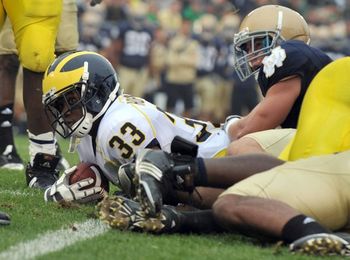
Michigan's rivalry with Notre Dame could help the Wolverines if the Big Ten gets its way and strength of schedule is given priority in determining college football playoff participants.
AnnArbor.com file photo
The league's athletic directors met with commissioner Jim Delany this week in Chicago, where the conversation mostly hinged on hammering out the league's preferred model for a college football playoff.
It became clear they prefer a four-team playoff that exists within the bowl framework -- and encourages tough non-league competition.
"I personally believe that strength of scheduling should be more important, so we don’t get to a world where we’re all being incentivized to come up with the (easy) schedule the way we can, because people forget in December who we played in September," Michigan athletic director Dave Brandon said.
"You may lose a game early in the season because you played a great football team, but I don’t know that should be such a big penalty versus a team that schedules high schools in September to run up their record."
The playoff system the Big Ten will be pushing when Delany meets with the other conferences next month features inclusion of the bowls -- notably, the Rose Bowl -- and a human element such as a selection committee to determine which four teams qualify.
B1G SPRING MEETING
• More alternate uniforms on horizon for Michigan football team, AD says
• Michigan players, Dave Brandon back 4-team playoff that includes bowl system
• Michigan to spend $250 million to upgrade facilities for non-revenue sports
• As Big Ten’s playoff model takes shape, conversation shifts from ‘what’ to ‘how’
• Jim Delany favors raising bowl threshold to 7 wins, reworking ticket distribution
• Athletic directors favor 4-team football playoff that includes bowls; selection committee popular
• Michigan-Michigan State after dark? No trepidation from MSU AD Mark Hollis
If Delany and his league’s athletic directors have their druthers, schedule strength will have a prominent place in whatever formula is used to rank teams in 2014 and beyond.
Schedule strength plays only a minor role in the current BCS system. It was eliminated from the formula in 2004 shortly after LSU (BCS) and USC (Associated Press) split the national title.
It factors incrementally into the computer rankings, and indirectly into the human polls, but its significance is nominal at best. That's not good enough for the Big Ten.
“I don’t want to adopt a model that discourages playing good opponents,” Delany said.
The Big Ten's athletic directors, as well as Delany, appear to be in concert with a general playoff model: Four teams, which are determined in part by a human element -- a la the selection committee used in basketball -- and play at bowl sites.
They also favor automatic bids for two or three conference champs, with one or two spots reserved for non-champs and independents.
But strength of schedule also came up, as much as any other topic. It's clear this is top priority for the league, after years in a system where teams are punished severely for losing to top competition, but not equally rewarded for winning.
“It’s how many wins you get, not who you play,” Michigan State athletic director Mark Hollis said. “I think we need to come up with a system that motivates schools to want to play tougher non-conference games during the season.
“One of the reasons we’re looking at the Pac-12 coalition is to kind of instill that in our schedule and force it in. But I think nationally, we have to have that in play, both for bowl eligibility and for championship qualification.”
Brandon has yet to announce Michigan's plan for the Pac-12 scheduling alliance, but said the school is close to reaching an agreement and an announcement could be forthcoming later this year.
Delany had hoped to have a full slate scheduled for 2017, but that may not happen now.
For Michigan, that could ramp up its schedule considerably. It already plays the eight-game conference schedule and has a three-year rolling contract to play Notre Dame.
Brandon said he can't predict the future of that rivalry, but added there are no plans to scrap it right now. If either team wanted out, it would have to give notice three years in advance.
As for now, Brandon said he's "dragging his feet" with future scheduling until he knows how important strength of schedule will be in the future postseason formula, and the Pac-12 partnership is sorted out.
But if schedule strength does become a prominent component of the playoff formula, Michigan could be in a good position with its Pac-12 game, Notre Dame and the conference slate.
And that's where this thing is headed, if the Big Ten has its way.
"I fear we could get into a world where we’re all scheduling down to make sure our records are where they need to be," Brandon said. "We’ve seen this in basketball, where the regular season has become diminished because this tournament has become bigger than the regular season.
"We shouldn’t let that happen, we can’t let that happen in football, and I think that’s what we need to be concerned about."
Kyle Meinke covers Michigan football for AnnArbor.com. He can be reached at 734-623-2588, by email at kylemeinke@annarbor.com and followed on Twitter @kmeinke.
Comments
ted
Fri, May 18, 2012 : 7:56 p.m.
Using the top 8 and a selection committee there could be a determination of teams that truely deserve to enter into the tourny. The regular season would still remain just as important and teams will be even more inclined to schedule harder opponents due to the importance of strength of schedule and the more likely acceptance of 1 loss teams.
Bmore_Wolverine
Fri, May 18, 2012 : 6:51 p.m.
Why don't they just come out and say that they want the money to be reserved for the BCS conferences and quit pretending that they want the "lesser" conferences to even have a chance...
ted
Fri, May 18, 2012 : 6:49 p.m.
Get rid of the conference championship games. They rarely pit the two best teams in the conference together and have many negative unintended consequences. Determine the winner of the conference the old fashion way. Instead of the conference championship games make this weekend the start of the 8 team playoff with the higher seeded teams hosting the lower seeded teams.
ted
Fri, May 18, 2012 : 6:51 p.m.
Then those winners play the final four in thier tie-in bowls. ie..one of the games is the rose if the higher seeded team includes the pac 10 or big 10, It would be the sugar if the higher seeded team was from the sec or big east. ect..
ahi
Fri, May 18, 2012 : 2:09 a.m.
How does Notre Dame make for a tough schedule? If the entire country didn't love to see them lose every weekend they'd be as popular as Toledo. They haven't been relevant since Lou "Loose Dentures" Holtz coached them to a national championship in '88, 24 years ago!
Bmore_Wolverine
Fri, May 18, 2012 : 6:48 p.m.
Notre Dame is better than almost any, if not every, team in the MAC. Let's face it, the MAC makes up 50-75% of Michigan's non-conference schedule almost every year.
Hailmary
Thu, May 17, 2012 : 9:49 p.m.
It's early, the suits will tweek and tinker over the next few years. As in all things new, the bugs have to be worked out.
ted
Fri, May 18, 2012 : 7:11 p.m.
Wrong......more games, more $.... if every team was granted an extra game at the end of the regular conference season as bowl-play in games against a team from another conference there would be more games and hence more money, while still making the playoff a very selective 8 team tournament.
Bmore_Wolverine
Fri, May 18, 2012 : 6:46 p.m.
If the BCS has taught us nothing, they will fiddle with this system almost EVERY year. The slippery slope they wanted to avoid started tilting down in 1998-99 when the BCS came into existence. They've tweak that system all but 1 or 2 years ever since. This system is no different. It will be inflated to 8 teams, then 16. Heck, we may even see 64. Ridiculous? I don't know. Just look at how they added 3 teams to the NCAA basketball tournament 2 years ago. I thought 64 was good enough. Then they y went to 65 for a few years. Now 68. I think we'll see 128 teams in that tournament within our lifetime. More teams = More $
treetowncartel
Thu, May 17, 2012 : 8:39 p.m.
One caveat is that for a non BCS conference school to get respect they need to play a BCS conference school. What if a MAC team played a top school in the B1G, The Big 12 and the SEC and then went on to dominate their conference, not losing a game all season. Lets say all those three BCS conference schools they faced were ranked in the top 5 nationally for more than three weeks during the season. How does that MAC team get invited to the party? If it were basketball they would at least get a shot a national Championship. I think they should expand the numbers from four for sure, and at least give the top 4 ranked teams a bye for the first round.
ted
Fri, May 18, 2012 : 7:04 p.m.
people want to see inter-conference games. This idea should be enhanced and geared toward the end of the season when teams are playing thier best football. Teams who finish at least 6 and 6 would have the oportunity to play in these games and it would determine what bowl they match up in. They would be playing 14 games, while teams who made it all the way to the championship would play 15
ted
Fri, May 18, 2012 : 6:58 p.m.
There needs to be an 8 team tourny. Thats enough to give the deserving a shot while preserving the importance and hence the tradition of the regular season. Not to mention enhancing what is also uniquely college football. Can you imagine end of the season cross-conference matvhups that would coincide the start of the 8 team tourny. These other matchups would coincide the playoff and would basically matchup teams inter-conferencely to decide where they would play thier bowl games.
ahi
Fri, May 18, 2012 : 2:04 a.m.
The MAC team doesn't and shouldn't get invited to the party. A football season isn't a collection of independent games. You want to play with the big boys in January you need to play with them all Fall too.
Macabre Sunset
Thu, May 17, 2012 : 7:08 p.m.
Or, more simply, you have to win your conference championship in order to reach the playoffs. Then your non-conference record only matters in terms of seeding, and the committee can reward strength of schedule. I think the tournament needs to have at least 8 teams, though, not four.
ted
Fri, May 18, 2012 : 8:06 p.m.
One of the great things about college football are the polls. So having every conference winner eligable to play in the 8 team playoff eleiminates the importance of the polls and hence the close watching of college football week to week. Not to mention some undeserving teams getting in. I think if 8 bof the best teams in the country are solely from the Big 10, Pac 10 and sec than that is alll that should be allowed in. Preserving what is so unique about college football while enhancing what people like about it are the keys to perfecting it.
ted
Fri, May 18, 2012 : 7:45 p.m.
allowing only 8 teams preserves the importance of the regular season while allowing teams that would otherwise not have a chance at all and rewarding teams that come on strong at the end of the season when it counts.
ted
Fri, May 18, 2012 : 7:43 p.m.
15 games is as much as these teams will be allowed to play. Thats the max in the lower divisions. Of coarse it does come down to $. However the amount of teams in the tourny, can be limited to 8 teams, if they add a game for every team who is 6 and 6 and above you will increase the amount of total games without putting any team past 14 games (or 15 in the case of the team that makes it to the championship.
Sparky79
Thu, May 17, 2012 : 10:05 p.m.
I favor that idea, too, though I've always been a fan of just going 16 teams and getting a true tourney of inclusion so we can get a true national champ once and for all. There's 11 conferences. All 11 conference champions get auto bids. Five at-large teams, either picked by committee or whoever the next five in the BCS standings are. Seed'em and let'em go at it. First two rounds on campus sites, semifinal and championship at bowl sites. Four or five weeks later, national champ is decided (maybe first two rounds before Christmas, one week break for holidays, semifinals on New Year's Day, championship a week later). Teams who do not make tourney play in traditional bowl games.
David Vande Bunte
Thu, May 17, 2012 : 7:54 p.m.
I agree with every part of this. 6 BCS conference champions + 2 at large "wildcards" for the 8 total teams.
chapmaja
Thu, May 17, 2012 : 6:29 p.m.
Here is a simple solution. Do what just about EVERY other sport that has a playoff does, use the RPI or a basis of it. Personally I think football should use a hockey like Pairwise system, which when possible compares teams against each other. The majority of the basis of the Pairwise is your winning percentage and the winning percentages of the teams you play, which is similar to the RPI.
Bcar
Thu, May 17, 2012 : 6:28 p.m.
Appalachian state anyone?? CMU?? LOL...
a2cents
Thu, May 17, 2012 : 6:21 p.m.
what? no more marshmallows, no more pushovers. Woe is uom. Will the fans stand for this?