

Moving the Michigan-Ohio State football game would be a bad decision
Just leave it alone.
That’s the best piece of advice on this Sunday. Don’t touch it. Let it stay where it is.
“It,” of course, is the Michigan vs. Ohio State football game.
As Big Ten officials shake up their conference to look more like the ACC, they are flirting with an idea so bad it is borderline laughable.
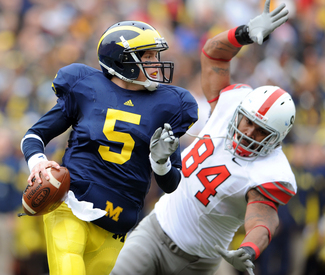
Michigan quarterback Tate Forcier tries to scamper from Ohio State's Doug Worthington in second-quarter action of last season's Ohio State at Michigan game at Michigan Stadium.
Lon Horwedel | AnnArbor.com
The league, at least from parsing the words of Ohio State athletic director Gene Smith and Michigan athletic director Dave Brandon, is thinking about moving the Michigan-Ohio State game off its typical last week of the regular-season spot to somewhere else in the fall.
The reasoning, from a television perspective, is understandable. Having the same two teams play two weeks in a row is undesirable. Ratings could suffer, especially if that first game is a blowout and Michigan and Ohio State are in separate divisions.
You worry about fans filling the seats for the second game at a neutral site. But here is where the Big Ten logic is flawed.
It could happen with any two teams at any time. Rematches happen.
They happen in the NFL, where almost every year a game in the last week of the regular season reappears as a first-round playoff matchup. They happen in college basketball, in college football, in almost any sport you can think of.
So why mess with a bunch of tradition just on the off chance you might see Michigan-Ohio State twice in a row?
Because if you don’t think it’ll alter things, well, listen to Michigan linebacker Jonas Mouton.
“I think that will change things a lot for the tradition of the rivalry and all that,” Mouton said. “I have no control over what happens, you know, but I would like to see it stay the same, the last game of the year.”
Move this rivalry game and it is no longer a destination date on the calendar. Families plan pilgrimages to the Midwest around this game. Bars fill. Hotels jack up prices and immediately sell out.
Moving Michigan-Ohio State off of its for-years place on the schedule is like moving the Indianapolis 500 away from Memorial Day weekend or the last day of the U.S. Open off Father’s Day.
It will look different. Feel different. And it will, as Mouton said, change things. Even though not everyone believes it.
“It’s most important that we’re still playing each other,” Michigan football coach Rich Rodriguez said. “The rivalry, the intensity of it, will be the same whether you’re playing first, middle or last.
“It’s been pretty neat having it the last game, but I think because of the way the landscape is changing and all that, it may be more difficult to do it. I think the most important thing is that we’re playing.”
The majority of the standout rivalries in college football have set dates. Tennessee-Alabama is the third Saturday in October. Notre Dame-USC is Thanksgiving weekend when the game is in Los Angeles and in mid-October in South Bend. Nebraska-Colorado is Thanksgiving weekend, as is Georgia-Georgia Tech and Florida-Florida State.
Having those dates help make the rivalries special. Permanent.
Another part of playing Michigan-Ohio State in its current spot is both teams are tired, worn down. And they have their most important game of the season at the end.
“Usually that game comes down to possibly playing for the Rose Bowl or a Big Ten championship,” Mouton said. “At the end of the season, both teams are beat up, it’s the end of a long season.
“It’s kind of, you have to gut it out against your rivals.”
Playing Michigan-Ohio State as the season opener, for example, does nothing for either team. Coaches won’t like it. Neither team will have peaked. And, for the loser of the game, suddenly it’s infinitely more difficult to reach the BCS.
In Michigan’s case, it would potentially put Ohio State and Notre Dame back-to-back, a gauntlet that would leave the Wolverines with at least one loss most years by mid-September. It’d have the same effect with Ohio State, which often plays a marquee non-conference opponent in the season’s second week.
Putting the game in the middle of the season allows it to be lost in the cacophony of college football unless both teams are ranked near the top of the polls.
Having this game at the end is the culmination of a season-long crescendo.
Michigan-Indiana at the end of the year, for example, doesn’t offer the same cachet.
And it never will.
Michael Rothstein covers University of Michigan basketball for AnnArbor.com. He can be reached at (734) 623-2558, by e-mail at michaelrothstein@annarbor.com or follow along on Twitter @mikerothstein
Comments
Nick
Tue, Aug 24, 2010 : 10:38 p.m.
Preserve the OSU v. Michigan rivalry! http://www.facebook.com/pages/Lets-Preserve-The-Ohio-State-v-Michigan-Rivalry/146555305365864
rensational
Tue, Aug 24, 2010 : 1 a.m.
Dan Wetzel at Yahoo Sports wrote a right-on opinion about moving THE rivalry, as well. What I can't figure out is Brandon is supposed to be a Michigan Man...I'm sure there are outsiders who understand what the date of the rivalry means before he does...why is that? Even in bad times like these for the Michigan program, we still have hope in the OSU game being at the end of the season. We feel like Michigan will be better by then or Michigan can spoil OSU's BCS bowl bids/Big Ten title chances at the last minute or losing 6 or 7 games can somehow be made far more tolerable by beating OSU. Putting the game in October doesn't give us that. MSU-Michigan is a big deal, especially if you're from Michigan, but putting THE rivalry midseason puts it down there with MSU-Michigan...and even a little lower in times like these when Michigan is more on par with MSU than OSU. OSU-Michigan means more than MSU-Michigan, or is supposed to. Look at Oklahoma-Texas; no one remembers who won that at the end of the season, and even in seasons when it should matter which team won it doesn't (see 2008 BCS controversy). It decides nothing, and Michigan-OSU has always had something on the line. And gavsulaker, I actually am pretty angry with Brandon. I am not surprised RR doesn't get it, so that's not an issue to me. And I could see the further ruination of the rivalry (which started with Carr, went to a new low with RR and is now being continued by the Big Ten) coming when the Big Ten=Big 12 became final, but Brandon should not be supporting its ruin.
Jaxon Boyfriend
Mon, Aug 23, 2010 : 1:13 p.m.
Agreed.....Jaxon says we need this and ohio state getting whopping this year!
Mick52
Mon, Aug 23, 2010 : 12:29 p.m.
Call me a traditionalist, but I am disgusted with what the yung-uns are doing to the Big Ten. Adding Penn State was troubling enough, but ruining the conference with these other schools is stupid as well as moving the biggest game in the country from its traditional position on the schedule. I don't give a hoot what other conferences are doing. This is college football and NOT a business. Win the Big Ten and go to the Rose Bowl! Hoorah!
Michigan_Jayhawk
Mon, Aug 23, 2010 : 10:15 a.m.
I think you have to do what is right in this changing environment. People don't like change. But change is inevitable. Do what is right for the situation.
dmichgo
Mon, Aug 23, 2010 : 10:11 a.m.
Easy gavsulaker, you seem a little too attached to RR. The coach stated that he thought: The rivalry, the intensity of it, will be the same whether youre playing first, middle or last." I would bet that the majority of fans both U of M and OSU would disagree. No one is "hating" RR just disagreeing with him. Again, if Michigan and OSU are in the same division, they can play their game at the end of the season, and then the winner goes on to the Big 10 championship game (as long as their records allow).
gavsulaker
Mon, Aug 23, 2010 : 9:51 a.m.
Boy, the Rich Rod haters need a clue. First, RR has little to do with the schedule. His comment pertains to still having OSU ON THE SCHEDULE every year, something that messed with rivalries like Oklahoma-Nebraska when that conference became the Big 12. Second, David Brandon already stated that the game MAY HAVE TO BE MOVED and he was not suggesting it had to be the last game of the year. So why not yell at him since he has more influence on this that RR would. Last, Lord Tressel also said that the "Game" didn't have to be the last contest of the year for both teams. AND he said that one day after he said he would protest (or some crazy nonsense) if the Michigan-OSU game wasn't the last game of the year. So please RR haters, get some facts before you post...
dmichgo
Mon, Aug 23, 2010 : 7:44 a.m.
Keep Michigan and Ohio State in the same division, keep their game at the end of the season, winner goes to the championship. Go Blue! (Come on coach, get a clue!)
Matt McCallum
Mon, Aug 23, 2010 : 7:39 a.m.
Why does it matter anymore? With the demise of the Michigan football program it is not even a game anymore.
klick12
Mon, Aug 23, 2010 : 12:32 a.m.
This opinion is absolutely correct. Moving this game would be a big mistake. It will lose meaning or be too close to other rivalries (like MSU). And I cannot believe our "Michigan" coach does not think this is a big deal. Rich Rod gets harder to like all the time. Oh well I am sure big TV dollars will win out in the end anyway.
Jaxon5
Sun, Aug 22, 2010 : 6:29 p.m.
Agreed, Mike.
iringbells100
Sun, Aug 22, 2010 : 4:43 p.m.
this is what expansion does plays with the schedules lets just hope mich will get on track this year which i feel rr will get this team to. our last game of the year before bowl season should be the big ten championship game so it doesnt matter when we play ohio st. so be it in nov or oct lets just get to that city called indy thats what matters now after this season. GO BLUE ALL IN
NoBowl4Blue
Sun, Aug 22, 2010 : 4:02 p.m.
Agreed