

NCAA: Michigan football coach Rich Rodriguez didn't do enough to monitor staff
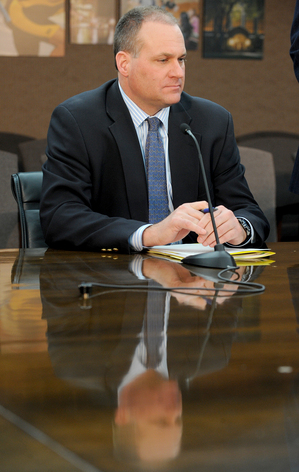
Michigan football coach Rich Rodriguez listens at a press briefing Tuesday about the NCAA investigation. (Photo: Angela J. Cesere | AnnArbor.com)
The most damning accusation suggests Michigan coach Rich Rodriguez “failed to promote an atmosphere of compliance within the football program and failed to adequately monitor” his quality-control staff.
The athletic department also was charged with failing “to adequately monitor” the football program, according to the Notice of Allegations received Monday.
The university has 90 days to respond and will appear before the NCAA Committee on Infractions Aug. 13-14 in Seattle.
Incoming athletic director Dave Brandon said at a press conference Tuesday the university will compare its internal investigation to the NCAA findings and could self-impose penalties.
Brandon declined to detail what Michigan’s investigation revealed, but said nothing in the NCAA report surprised him. He also said Rodriguez will return for his third season as head coach.
|
Read the documents
|
“You can all draw your own conclusions, (but) I think what you’ll find is that there are not situations that jump out at you where there was anybody that was not trying to do their job, that was purposefully, maliciously either falsifying documents or misrepresenting the facts,” Brandon said. “My read of the situation is we had a breakdown internally in communication in some of our policies and procedures that were not followed as carefully as they should be and that led us to where we are today more than any one individual either being guilty of incompetence or any malicious behavior.”
Along with the allegations against Rodriguez and the athletic department, the NCAA investigation found that:
• Members of Michigan’s quality-control staff “regularly monitored” voluntary winter and summer workouts and “regularly assisted” with on- and off-field coaching duties against NCAA rules.
• Football players were required to participate in more than the maximum allowed practice hours by anywhere from 20 minutes to two hours a week.
• Graduate assistant coach Alex Herron provided “false and misleading information” to NCAA enforcement staff about whether he monitored summer workouts he was not supposed to attend.
Most of the allegations took place during the 2008 and 2009 off-seasons, before an audit last May found the football program did not file forms detailing how many hours players spent on Countable Athletically Related Activities per week.
Student-athletes are allowed eight supervised CARA hours per week out of season and 20 hours per week in season, with a maximum of four hours per day.
Two allegations involve exceeding in-season practice time, including one last September, after the NCAA began its investigation. According to the notice, players “were required to participate in as many as 4 ½ hours” per day on Sept. 7, 14, 21 and 28 - the Mondays after Michigan’s first four games.
The Wolverines started 4-0 last season, but lost seven of their final eight games and missed a bowl for the second straight year.
Brandon said “a lack of clarity around whether time spent in stretching and warm-up activities were countable minutes” is one reason for the NCAA findings. Still, he said the allegations are serious.
“We don’t trivialize anything,” he said. “We don’t like being here today, we don’t like getting notice of allegations from the NCAA in any form, in any way, and we’re going to fix it.”
According to the notice, Michigan’s compliance department expressed concern “about the duties and activities” of the program’s five quality-control assistants “shortly after” Rodriguez was hired. Athletic administrators with responsibilities to the football program failed to provide the necessary information, and that “collective failure partly resulted in the violations.”
Quality control assistants help regular staff assistants with administrative duties such as cutting up film and gameplan prep work. They are not allowed to work directly with players.
“It’s my job as a leader to make sure that our guys not only know what the rules are but what the possible interpretations are,” Rodriguez said. “And sometimes when you don’t communicate, or when you communicate, that’s not always coming across as the same. We didn’t have any issues in the past, but that’s not to excuse us for if we misinterpreted the rules. That’s still on us and it’s still on my staff.”
Six quality-control assistants were listed in the notice of allegations as having engaged in on- and off-field coaching activities, including Adam Braithwaite, who was promoted to outside linebackers/safeties coach earlier this month.
During the last two years, the NCAA alleged that Michigan’s quality-control assistants “regularly monitored and conducted skill-development activities” during voluntary winter and summer workouts; “regularly” assisted with warm-up activities during spring and fall practice; “sometimes” watched game and practice film with players; and “sometimes attended meetings involving coaching activities” according to the allegations.
One graduate assistant football coach, one student assistant coach and five quality control assistants also “regularly” monitored voluntary 7-on-7 practices according to the report, and Michigan’s strength and conditioning staff improperly disciplined players for missing summer classes. Brandon said the special conditioning drills players were required to do are allowed during the season.
Herron, the graduate assistant accused of lying to NCAA investigators, declined comment when approached outside his Ann Arbor apartment. According to the notice of allegations, he admitted to being at the beginning of some off-season workouts, but denied attending 7-on-7 drills "when, in fact, he was sometimes present for and involved in such activities."
Brandon declined to say what punishment Herron and others will face, but said the university already has changed some of its policies to ensure violations don't happen again.
He also said Michigan could be subject to the NCAA's repeat violator rule, and therefore more severe penalties, because these allegations occurred within five years of sanctions against its basketball program, but hopes that isn't the case.
"We clearly made mistakes," Brandon said. "And we have already taken action to prevent any of those mistakes from being repeated."
Dave Birkett covers University of Michigan football for AnnArbor.com. He can be reached by phone at 734-623-2552 or by e-mail at davidbirkett@annarbor.com. Follow him on Twitter @davebirkett.
AnnArbor.com sports reporter Jeff Arnold contributed to this report.
Comments
GFY
Fri, Feb 26, 2010 : 3:51 p.m.
You have to put in hard work if you want to be champions.
A2lover
Wed, Feb 24, 2010 : 11:03 a.m.
So, despite the extra practice the team still had a losing season! Says a lot about RR's leadership skills and his coaching staff. However, keeping RR on as coach after all the devastating things that have happened on his watch, exposes the arrogance of the leadership of this University. The head in the sand, and we can never be wrong approach, is not a good example of "leaders and the best".
Nick Danger
Wed, Feb 24, 2010 : 9:37 a.m.
Whats really sad is this abuse of practice time violations has filtered down to high school sports. Coach's now make demands on high school athletes that were unthinkable 10 years ago.Year round practice schedules that pretend to be voluntary, forced participation in summer camps and 7 day a week.commitments. Unfortunately, the Michigan High School athletic association turns a blind eye to this abuse.
Nick Danger
Wed, Feb 24, 2010 : 9:27 a.m.
Welcome to big time college sports
actionjackson
Wed, Feb 24, 2010 : 9:26 a.m.
Fat lot a good that extra practice time gave the team!
mmggttnn
Wed, Feb 24, 2010 : 8:34 a.m.
How can any UM football fan support Rodriguez? Let's see: AD Martin got RR off the hook with a 2 Million dollar payment of our money to West Virginia; RR recorded the worst football record for one year and two years; RR violated NCAA rules; UM football program will be assessed sanctions; I can't think of any reason to support him! Oh yes, UM is too arrogant to admit that they hired the wrong guy.
braggslaw
Wed, Feb 24, 2010 : 8:20 a.m.
Maybe we can have another pep rally
rightmind250
Wed, Feb 24, 2010 : 7:36 a.m.
Tater: The ncaa's report said, a possible 5 MAJOR violations". Your same type of denial is what got richrod in trouble. August: Sanctions are handed down. September: UM opens season with loss to Uconn. October:Richrod and his hillbilly assisstants get fired.
TRIGG6
Wed, Feb 24, 2010 : 12:27 a.m.
SHEEEEEE..UT NICE JOB WEST ARBOR
MetricSU
Tue, Feb 23, 2010 : 11:01 p.m.
Sorry, tater, but the NCAA isn't dumb. RR's "quality control" coaches have all had prior experience with RR. Thus, they must know the rules. It is obvious that RR put his machinery in place to gain a competitive edge. That is the standard for major violations. If they weren't going to be major, they wouldn't have cited RR for not providing the proper environment for compliance, and they wouldn't have cited the athletic department for lax oversight. I think you know this is leading to major violations. A separate issue is what the penalties will be. I have no idea.
MetricSU
Tue, Feb 23, 2010 : 10:42 p.m.
Saying the violations are "minor" is wishful thinking. The NCAA can see that the "quality control" coaches are RR's hand-picked guys who've been around RR and NCAA rules for some time. The plea that they didn't know the rules rings hollow. The charge against RR is serious and reflects the fact that the NCAA does not buy the "we didn't know it was wrong" defense. That's why this could get serious for UM. It is pretty obvious RR was trying to gain a competitive edge -- with 25% more practice time and coaches illegally intervening in player practices -- and that spells major violations.
Ed White
Tue, Feb 23, 2010 : 9:47 p.m.
He's a Michigan man. Let's go Mountaineer's!
tomhagan
Tue, Feb 23, 2010 : 9:38 p.m.
What is Rich Rod going to do now? Have another PR "Victors Rally" and proclaim to be a "Michigan Man"? How sad.
The Grinch
Tue, Feb 23, 2010 : 9:25 p.m.
braggslaw: you and I seldom agree on anything, but on this you are absolutely correct. Time to start rebuilding NOW. Yes, the recruiting class is set, but not its character, nor that of most of the young men on the team. It's time to recognize that this has been a huge mistake and cut our losses. The sooner we do, the sooner it begins to turn around.
braggslaw
Tue, Feb 23, 2010 : 9:19 p.m.
He lied and cheated...nuff said. Time to cut bait.
Just Blue
Tue, Feb 23, 2010 : 9:11 p.m.
Here we go again with the worst coach ever at U-M. Let him and his troll Barwis cause us to get sanctioned. Brandon said it was a "tough day", only one in a long line of tough days since the genius from WV got here and it will only continue. He degrades the Wolverines by his losses, his character and his choice of recruits and associates. What a God-awful disaster. I got an idea,lets have a pep rally organized by that apologist Leach to make us all feel better about our football team before it finally all implodes.
Sean T.
Tue, Feb 23, 2010 : 9:05 p.m.
Just because we would like these violations to be minor doesn't make it so. 5 Majors, They are students not professionals and should be treated as such. I'll judge RR by what he's done and he'll get no more excuses than any of our previous coaches. 3 classes, extra practices, 2 years of our worst records ever with no improvement except for Tate Forcier. Pretty soon the snake oil will start burning!!
bluesteel
Tue, Feb 23, 2010 : 8:52 p.m.
dave birkett, thanks for finally reporting the story as it actually is, without distorting, coloring, or sensationalizing. good REPORTING for a change. now, my quick opinion. i am a um supporter. i support our coach. while i don't support actions that could cause ncaa scrutiny, i do believe the alleged violations are relatively minor, as violations go. i mean, in the scope of agents paying players, and other major violations, punishing kids for not going to class in the summer and 1/2 hour extra stretching and warming up is minor compared to handing troy smith a (just one?) $500 envelope for work not performed, etc. i think it will be pure speculation from here on out until the august hearing is over, but i would be willing to bet the self-imposed punishment um comes up with will be sufficient in the eyes of the ncaa in the end. i also think the violations will ultimately be considered minor. and i, like david brandon, don't think rodriquez should be fired, for these minor violations. however, i am not drew sharp or rob parker, who are obviously way more connected, intelligent, and more qualified than david brandon or mary sue coleman (lol). haters? your move.
UofM_Fan
Tue, Feb 23, 2010 : 8:51 p.m.
Rich Rod, in just 2 years time you've managed to do something no other coach has ever done! You've taken a top-rated football program and flushed it down the drain! Once again, you screwed up and you fail to take responsability. Instead you throw your staff under the bus. The problem with NCAA sanctions is that in the end it's the players that will suffer. The University has been around for almost 2 centuries, and I'm sure Rich Rod isn't hurting for money. So, let's say the team is barred from playoffs, who pays the price? The players who just had their dreams ruined. I wish you luck RR when you have to face the players and explain how you failed them. Well, Dave Bradon. You said you had, "... no problem calling the play...". What's the call you're going to make? Is this the type of football program that you played for in '73? Is this the type of program Bo Schembechler ran?
rightmind250
Tue, Feb 23, 2010 : 8:39 p.m.
Where's Tater? That's 5 MAJOR Violations from the west Virginia cousin.
Sean T.
Tue, Feb 23, 2010 : 8:11 p.m.
TRIGG6, they're hiding from the article the same way they are hiding from the truth about their beloved "KING"!
TRIGG6
Tue, Feb 23, 2010 : 8:08 p.m.
Were are all the blind fans that said its all BS. SNAKE OIL SAYS IT ALL.
A2D2
Tue, Feb 23, 2010 : 7:53 p.m.
Not even on the payroll yet, and David Brandon has his first test as AD. It will be interesting to see how he handles the situation. We'll see his management style and what we can expect in the future............ We'll also find out how long (or short) the leash is for RR.