

NCAA attorney: Avoiding show-cause order a must for Michigan, Rodriguez
Football coach Rich Rodriguez will only answer questions about his time at Michigan when he goes in front of the NCAA Infractions Committee in Seattle next week, but that doesn't mean committee members will ignore the latest accusations against him.
“They’re all human beings,” said Michael Buckner, a Florida attorney who represents coaches and schools in NCAA infractions hearings.
Rodriguez was formally accused Thursday of committing major NCAA rules violations during his time at West Virginia. In February, the NCAA alleged that he committed similar violations at Michigan.
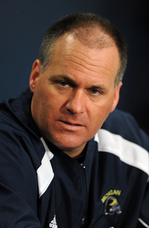
Michigan football coach Rich Rodriguez.
Show-cause orders are sanctions against individuals found to have committed NCAA violations and can include a variety of punitive measures like reduced recruiting and coaching activities.
“Michigan would have to make sure that Coach Rodriguez follows the show-cause order,” Buckner said. “If he’s found to have committed the failure to monitor, issued a show-cause order, and then he goes to West Virginia … and if he’s found to have failed to monitor in that case, than a show-cause order can be enhanced significantly.”
Show-cause orders have been issued in several recent high-profile infractions cases.
Former USC football assistant Todd McNair was fired last month after he received a one-year show-cause penalty for his role in the Reggie Bush case. And former Indiana basketball coach Kelvin Sampson was given a five-year show-cause penalty for his part in a recruiting scandal.
Sampson, now an assistant coach with the NBA’s Milwaukee Bucks, was effectively banished from the NCAA, at least until recruiting restrictions are lifted against him in 2013.
Buckner said Michigan must “provide as much evidence as (it) can to defend Coach Rodriguez so that (it) can eliminate that failure to monitor allegation.”
“Whether or not you can actually do that” remains to be seen, he said.
How the NCAA defines a show-cause order.
• A show-cause order is one that requires a member institution to demonstrate to the satisfaction of the Committee on Infractions (or the Infractions Appeals Committee per Bylaw 19.2) why it should not be subject to a penalty (or additional penalty) for not taking appropriate disciplinary or corrective action against an institutional staff member or representative of the institution’s athletics interests identified by the committee as having been involved in a violation of NCAA regulations that has been found by the committee.
Dave Birkett covers University of Michigan football for AnnArbor.com. He can be reached by phone at 734-623-2552 or by e-mail at davidbirkett@annarbor.com. Follow him on Twitter @davebirkett
Comments
Tori
Fri, Oct 29, 2010 : 2:43 p.m.
No, Jaxon, we got over this "person" as soon as we got our money back that he pocketed and ran off with in the middle of the night. Mountaineers know trash when we see it. Ya'll folks are welcome to him, but I have to wonder when people will ever learn the lesson, "Once a cheater, always a cheater". I wonder who wants to give him a try next? Like any cheater he will find another home. Personally, I'm ashamed to admit that I am enjoying watching him continue to dig his own grave with such earnest. Tori another cosmic possum http://www.cosmicpossum.com/
Jaxon Boyfriend
Mon, Aug 9, 2010 : 1:46 p.m.
West Virginia just can not let go - Mr. Coach Rodrigeuz dumped you, for a better school, a better state, and better fans. Get over it. Good Night.........and Get a Life...
wvtroll
Mon, Aug 9, 2010 : 6:45 a.m.
I believe, raddesc, what Garrison was saying was that RR was asking (demanding) things that were not legal. In fact, RR was demanding that his players get certain perks like reselling their textbooks, and more. When RR didn't get what he wanted, he got mad and left WVU in a not-so-nice way. It cost him (actually UM) a lot of money for not getting his way and showing his temper. You probably should be praising Garrison for standing up and denying RR for the improper requests instead of taking his quote out of context and bending it to fit your means.
johnnya2
Sun, Aug 8, 2010 : 8:07 a.m.
maizenbluedoc, On one level you are right. This is CLEARLY Bill Martin's lousy running of the athletic department. He is a good businessman. That does not make you qualified for the job of AD. ( I would point out that is why Rick Snyder is a major problem). The problem is, Bill Martin retired. He can not be rehired and fired over it. There is blame to go around, but the bottom line is, RR MUST bee fired regardless of the teams record this year. To those that say it is Coach Carr's fault for leaving the cupboard bare, I would say, in no season did Coach Carr lose more than he won. 13 years can not be all of Moellers people, unless a lot of players got NCAA exceptions we all missed. The problem RR fans have is they think the problem during the end of the Carr era was the offense, so they want to bring in this supposed offensive genius. The facts are, the defense let the team down late in games. RR has never had an interest in the defense and changing his defense after one year shows that. How come he didn't change the offense instead? Because he can continue to blame the defense, and say his offense is just fine. If he is such a great coach, tell me which of the QB's improved from week one until the OSU game? RR will be UMs Charlie Weis, but at least at a cheaper rate.
Sean T.
Sun, Aug 8, 2010 : 1:36 a.m.
It seems the only complaining going on is the RR supporters. Many of RR supporters make as many excuses as him and try to divert blame as well. There's nothing wrong with liking the dude but you have to see the chaos he started. Name some positive things that have been done for our program since he's arrived. Almost every program has youth,transfers and a new system at some point. But not many have the tradition, toughness and sportsmanship that we've become accustomed to over the last 40 years. And throwing Lloyd Carr under the bus will not make RR look any better either. Too many control freaks on our forum, I guess. Please continue the love affair with slick ricky and don't forget to kiss his Poster as you dream of the 10 win season he'll never get in AA.
RASWVU
Sat, Aug 7, 2010 : 1:11 p.m.
This story broke at the perfect time for Rich. It has completely diverted attention from the release of the NCAA's APR report. Remember when Rich made the statement that last year's team had the highest average GPA in UM history? Remember when he retracted that after it was discovered that there were no numbers to back that up. Well now there are some hard numbers about his team's academic progress: This years score: 897 4 yr average: 936 (For comparison purposes the 2008 4 yr average was 951, the 2009 4 yr average was 947. When the 4 yr average hits 925 the NCAA can start taking away scholarships)
MetricSU
Sat, Aug 7, 2010 : 10:51 a.m.
If I were a UM fan, I'd plead with tater to stop making predictions. In the last couple of years, he's predicted the following: 2008: UM will go 9-3 2009: UM will go 9-3 2008: Tom Izzo will leave for the NBA 2009: Tom Izzo will leave for the NBA 2010: Tom Izzo will leave for the NBA 2009: MSU will lose in the second round of the NCAA tournament 2009: MSU will lose in the third round of the NCAA tournament 2009: MSU will lose in the fourth round of the NCAA tournament (you get the pattern) 2010: See above about MSU in the NCAA tournament. One week ago: Chris Allen's leaving marks the beginning of the end for Izzo's dominance. This was one day before signing 5* recruit Branden Dawson out of Gary, IN. tater: Don't give up your day job. Now tater is predicting leniency by the NCAA. That doesn't sound good.
Jay Allen
Sat, Aug 7, 2010 : 9:57 a.m.
9-3 or 10-2 and playing on a New Year's day Bowl game does not look so bad does it? You big mouths up in Barton, over in Travis, Stonebridge or the Polo Fields, where are you now? A.500 Michigan team playing in the Motor City Bowl is not acceptable.
Patti Sonntag
Sat, Aug 7, 2010 : 9:54 a.m.
I would like to know why it took the NCAA Infractions Committee 2 years to suddenly decide to investigate possible violations at WV. I would also like to see the punishment fit the crime, if there is one. Obviously politics are playing a part here.
raddesc
Sat, Aug 7, 2010 : 9:49 a.m.
By the way, quote from Mike Garrison: "Based on what I've read and what I understand from the letter from the NCAA, the bulk of the alleged NCAA violations are precisely the type of things Rodriguez was asking for in those final contract negotiations and precisely the type of things certain donors -- and some of our more vocal donors -- wanted me to give him," Garrison told Mike Casazza of the Charleston Daily Mail." Asking in his contract? Excellent work Garrison! By attempting to pile on allegations for RR, you must have forgot your university and current coach did the SAME THING! Nice try pointing the finger elsewhere though. Foot--Insert--Mouth. Awesome!
Jay Allen
Sat, Aug 7, 2010 : 9:49 a.m.
NO ONE is a bigger supporter of the program, per se`, than I am. I do not have to be the loudest on forums to be the most loyal like a few of you are. Those that ARE typing on blogs and forums daily with worthless conjecture are the most blind. PERIOD!!! "Rodie" and "3 & Out" have the absolute best posts in here when you go through and READ [and comprehend] what is being said. The U-M Football Boosters wanted Lloyd gone. That is a fact. He had not done well towards the end of the season and this was not good enough. Thus pressure on Bill Martin FORCED Lloyd out. This is fact. Now those same loud mouths are silent, like crickets chirping just as SprBwlB4Die has said. They got what they asked for. Instead of having a 9-3 or a 10-2 Campaign with a MICHIGAN MAN at the helm, you have a cheater who is not even.500 and has brought the U of M Football program to depths of laughable. Wonder why Lloyd retired from the athletic department? If you have to ask "why" then just don't even post. Walk away and go watch EMU football.
raddesc
Sat, Aug 7, 2010 : 9:38 a.m.
Some interesting thoughts by B. Feldman from ESPN: "If you've been to more than a handful of college campuses in the past decade or talked to any football coaches, you'd know that what the school was accused of are probably the most minor major violations you'll ever hear about." "The NCAA interviewed more than 80 people during the past nine months, arrived on West Virginia's campus in April after its investigation into Rodriguez's practices at Michigan and this is what they've come up with? If the NCAA interviews 80 people at almost any FBS program in the country, they're finding something. I suspect they'd often find a lot more than this." "Coaches I've spoken to after that story came out echoed that sentiment, each with stories of places they or colleagues had been to where they'd witnessed similar violations." "One of the things WVU got flagged for was allowing video graduate assistants to sit and watch film with the full-time coaches, which has since become permissible. I seriously doubt Rodriguez or any other coach is going to be hanging on the word of any 23-year-old wannabe future coach in those settings." Honestly, NOBODY takes these rules seriously. So while the "somewhat" negative press is out there and everyone is having fun taking their shots....."much ado bout nothing" is my opinion. The NCAA, who is currently on the campuses of UMiami, FLA, ALA, UNC, CLEM, USCarolina (and more) SHOULD be taking the "texting recruits" and "paying players" far more seriously than this. WRAP IT UP NCAA---WE'RE READY TO TALK FOOTBALL---NOT PRACTICE!!
Howard the Duck
Sat, Aug 7, 2010 : 8:15 a.m.
"I wonder for those of you that are honest with yourselves what kind of proof you have proving RR is guilty of intentional wrongdoing." If it walks like a duck.....
A2lover
Sat, Aug 7, 2010 : 7:58 a.m.
Not only Is Rich Rod a poor coach (grossly overrated) and should never have been hired in the first place, he's not a good person! He lies, cheats, is incompetent and has little or no integrity. Michigan consistently hires people, not just coaches, of questionable ethics. It's a psychological flaw that pervades the powers that be, from the President to run of the mill Search Committees. Rich Rod being the most flagrant of these miss hires.
maizenbluedoc
Sat, Aug 7, 2010 : 7:54 a.m.
With al the rhetoric against RR by many fans, what does this say about the administration and AD, past and present. If RR is that much of a liability to the University of Michigan, why hasn't someone done something other than paying him big money to do nothing and continue his indiscretions? I guess these people aren't Michigan men (and women), eh? No, I am not pleased with all the allegations and mediocre performance, but RR isn't the only person responsible for this chaos. I just hope all this doesn't hurt the team this year, but I will be surprised if it doesn't.
PortageLkBlu
Sat, Aug 7, 2010 : 7:49 a.m.
Well let's see, I woke up this morning to a beautiful sunshiny day and it's probably going to be a perfect day for everyone but you know what, I'm going to kick the dog, yell at the kids and my wife better run. This is what you complainers sound like and you seem to just be taking it for granted that RR is guilty of everything including leaving the toilet seat up. If I had a choice of any of you backing me or giving me a fair shake vs hanging myself I'd take the hanging. You all know when someone is targeted like a coach, when he's been losing more often than not he's guilty as charged without even due process, in the old West that's called a Lynching. I wonder for those of you that are honest with yourselves what kind of proof you have proving RR is guilty of intentional wrongdoing. I wonder how many of you are basing your proof on these blogs or what you read in the rags which as you know most if not all of them are desperate and are not above doing whatever to sell copy. I don't attack someones character untill I have all the facts and I don't concider info from these blogs or the rags as the final facts. Some of you boys and girls remind me of a piranha feeding frenzy and thank god most of the Wolverine sane fans don't buy into this cheap Witch hunt that some of you are trying to sell. Some of you are trying to turn our coach into a monster rather than our coach who is being accused of some infractions, why don't you complainers come clean and admit that you either have no allegiance to the University of Michigan or you are just plain angry about the win loss record. Some of you are acting like you walk on water and I'm always Leary about someone that doth protest to much, it's not rational and I'm starting to believe that some of you complainers are not rational. RR is our coach and I'm rooting for him and our team and if the powers that be find that he can no longer coach based on proven fact then I will accept that decision but my final thoughts won't be based on anything you complainers have to say.
Twelvestring
Sat, Aug 7, 2010 : 7:36 a.m.
Clearly it's time for RR to fade into the history books and the football program find a Michigan man to lead us back to respectability.
Elaine F. Owsley
Sat, Aug 7, 2010 : 7:30 a.m.
Let's see, he can't coach a winning team, he can't follow rules...someone tell me why this man was hired and who is responsible for it.
gwncb
Sat, Aug 7, 2010 : 6:32 a.m.
I like Ann Arbor Blue's comments and would add that someone take a look at the "faults" with the NCAA. Does anyone believe everything the NCAA says and does??
Steve Hendel
Sat, Aug 7, 2010 : 6:08 a.m.
That's right, AnnArborBlue: blame everyone except the guy who makes $2.5 million a year to run the program. Not to mention the $2.5 million the UM paid on Rodriguez' behalf in July '08 to WVU as part of the WVU-Rodriguez lawsuit settlement. Oh, wait, did I forget the @$1.6 million the UM paid the IRS, etc. (also on Rodriguez' behalf for income taxes, etc. on the whole kit and caboodle? I have documentation for all of thus.
Alexander John Migda
Sat, Aug 7, 2010 : 5:49 a.m.
As an Ann Arbor native, about 10% of me is sad about the Michigan football situation. As an MSU student, the other 90% of me is looking forward to a third consecutive victory against U of M.
ChelseaBob
Sat, Aug 7, 2010 : 5:32 a.m.
Mich Mash- Lloyd left the cupboard bare? Like the Heisman trophy QB that RR drove out? And the all American lineman he chased away? Give me a break. RR is a ethically challenged, mediocre coach with no respect for Michigan tradition. Whether he wins or not is beside the point now. He is a lame duck, and Brandon would be wise to cut bait.
Salinegoblue
Sat, Aug 7, 2010 : 4:28 a.m.
I'm not sure how he can do his job and focus on football with all of the distractions, I believe there are three law suits against him, he hasn't sold his million dollar home in WV and two NCAA investigations. Look for his assistants to start looking for other jobs, they know what will eventually happen.
PortageLkBlu
Sat, Aug 7, 2010 : 12:30 a.m.
1 shared national title and our win was against an average team.
3 And Out
Sat, Aug 7, 2010 : 12:12 a.m.
122-40 for Carr. 1 NC 5BT Titles 7-16 for Rich Rod. Nuff said.
PortageLkBlu
Sat, Aug 7, 2010 : 12:10 a.m.
Right on AnnArborBlue you actually have a clear vision. What we have is a typical Witch Hunt fueled on this blog by the same old complainers with the same old song and dance. Your right RR is a good coach and I for one will enjoy having him around for many years. These violations are minor regardless of what the headline says or the complainers and our same complainers know it. That Detroit Rag that got this started has probably made some money off copy cause it's a local issue. Had they reported on say UCLA it wouldn't have lasted over a week. We all know that most papers are in decline so we know what that means, you report and sell copy at all cost. If by chance RR loses his job over this that is the true loss of integrity for Michigan now the complainers will always disagree but the knowledgeable, faithful and majority of Mich. fans know this to be true I'm talking about the fair minded fans not our complainers that hated RR from day 1.
MichMash
Fri, Aug 6, 2010 : 11:59 p.m.
lemensblue-- Carr played the same running back, qb and left tackle four years straight with no thought of getting playing time to others. He emptied the cover for Les...who he thought was coming. a bitter old man who put his selfishness above the UofM. He couldn't pick his successor so he set him up...it just happened to be RR. Carr's teams were slow and out of shape...how many 2nd half collapses does it take to open your eyes...I can name three instantly...usc, Wash and UCLA. Once named the starting qb under carr...you simply didn't lose your job...ridiculous. Won with Moellers kids...didn't do squat since. Go Blue!
Rodie
Fri, Aug 6, 2010 : 10:42 p.m.
I don't think most of us had a different tone. We have some loud supporters and great fans though. Most of us questioned the decision from the first issue.
Lemansblue
Fri, Aug 6, 2010 : 10:12 p.m.
AA Blue, You are kidding right? A great coach? Based on what? I see you have many excuses for his record here even though he is suppose to be the leader and responsible for his team. It is clear he is a poor decision maker and that leads to poor performances. At WV his record against top 25 teams was 7 wins and 11 losses. At Mi he is 3-13 against the Big Ten. If that is the record of greatness what did that make coach Carr? The fact is RR is not great not even a good coach based on his record he is the most overrated coach in college football. Mi made a major mistake in hiring him and time will not change that. It does not matter your opinion on the violations if he violated the rules he should be man enough to be accountable major or minor you cannot put your team or university in that posistion. He has failed in his job on and off the field. A great coach can win with different talent and with youth coach Carr had Henne and Hart in the rose bowl as true freshman...That is great coaching.
aj
Fri, Aug 6, 2010 : 8:29 p.m.
There was a different tone on this board two years ago. How is the West Virginia Two working out now. You should have kept your receipt Michigan fans. Sorry no refunds.
Rodie
Fri, Aug 6, 2010 : 8:12 p.m.
I'm a loyal fan, and he's got to go. Period. I don't want to see him coach the first game. He's not a michigan man or even a big ten quality level coach.
azwolverine
Fri, Aug 6, 2010 : 8:07 p.m.
Annarborblue, To some degree you may be right, but you are wrong to some degree as well. The loss to Toledo cannot be excused away. It can't. It certainly doesn't equate to 'great' coaching. Further, switching to a 3-3-5 and getting burned by a 3-9 Purdue team doesn't equate to great coaching, as does getting buried by a 3-9 Illinois team after leading at the half. I don't know everything that RR has done NCAA-wise and I'm waiting like everyone else for this to play itself completely out, but as a UM fan, I'm not happy with 8-16 and I certainly don't buy the excuses for all of the losses, especially the ones mentioned above.
GoblueinNE_PA
Fri, Aug 6, 2010 : 8:07 p.m.
This will be the thing that ultimately leads to the demise of RichRod at Michigan. If he get's hit with this show cause order, he's effectively dead as a coach. It will be virtually impossible for Michigan to keep him on. I don't think there will be any amount of games he can win, baring a national title and let's be real here that ain't happening, that will result in RichRod keeping his job if he gets this show cause.
AnnArborBlue
Fri, Aug 6, 2010 : 7:18 p.m.
The Detroit Free Press started this witch hunt and an overzealous NCAA took the bait and exaggerated it. The petty practice time issues at Michigan that the NCAA incorrectly calls "major" infractions are common at schools across the country. That's why even Jim Tressel stuck up for Michigan about this last September. These are just "ticky-tack" fouls that have been ridiculously equated with serious scandals we have seen at other universities. Maybe it's time for someone to investigate the NCAA. Rich Rodriguez is a good man and a great coach. Many of us loyal alums and fans have faith in him. His first two years at Michigan have been difficult because of: A scorned state of West Virginia that couldn't let go of its former favorite son A misguided faction of former players and alums that reject anyone outside of Bo's lineage A couple of anonymous, crybaby ex-players with an agenda A few incompetent bureaucrats in our Athletic Department Two losing seasons due to lost talent, restocking and restructuring An large segment of "fans" who do not understand that positive change takes time Bottom line? Can't wait for Rodriguez and the Wolverines turn things around this year. Go Blue!
Rodie
Fri, Aug 6, 2010 : 6:41 p.m.
This guy has been trouble from the beginning. I really wish they would just get rid of him. If I was this bad at my job I would have been canned years ago.
Yelmonian
Fri, Aug 6, 2010 : 6:13 p.m.
Tommy, I'm not a lawyer... but I read this to state that if they find show cause... a repeat violator (WVU and then UM)... that RR can be penalized more significantly (as an infividual) for having the show-cause twice. He can be penalized at UM. Then have to show up for the hearings for WVU, and be penalized again for that. Both institutions would get a one time offense type punishment, but RR would be hit harder for being a repeat offender.
3 And Out
Fri, Aug 6, 2010 : 5:39 p.m.
Rich Rod's 90+ page denial of responsibility for the NCAA charges which he released in May certainly didnt sit well with the NCAA people. That was a tactical mistake by his camp.
tommy_t
Fri, Aug 6, 2010 : 4:49 p.m.
So, not being very bright or a lawyer - does this mean that if found guilty of charges at WVU, any or all punishment/restrictions derived will/can be piled on/added to/ or extend the current ones on the Michigan program unless something can prevent it? If so, what exactly is the something that could prevent it? I'm confused and worried.
OSUbeBetter
Fri, Aug 6, 2010 : 4:48 p.m.
Eeke, This is starting to sound all wordy and legally. Come on rodriguez, Fight the good fight. whatever you do don't let up. The fans of The OHIO STATE, MSU, Purdue, and all the rest of the Big 10 are pulling for you to get threw this. With Rodriguez at the helm, Michigan has become a very Beatable team, even for the Indiana's and Northwestern's of the League.
3 And Out
Fri, Aug 6, 2010 : 3:51 p.m.
This is turning out to be much more serious than most people wanted to admit a year ago.
maizenbluedoc
Fri, Aug 6, 2010 : 3:50 p.m.
I am almost convinced that the officials of the NCAA will find something to nail RR on. I'm not defending any wrongdoings by RR, but I find it strange that all the allegations and investigations occur just as the season is ready to start. What have these people been doing all off-season? I say, get on with it...time for football.
SprBwlB4IDie
Fri, Aug 6, 2010 : 3:41 p.m.
The sound of crickets is deafening.