

NCAA says Rich Rodriguez guilty of major rules violation, 'but not as egregious as originally alleged'
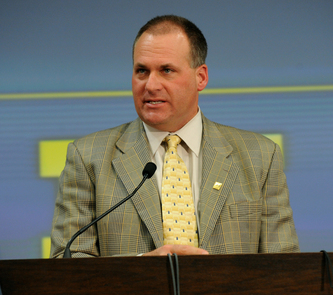
Michigan football coach Rich Rodriguez addresses the media Thursday.
Lon Horwedel | AnnArbor.com
Sometimes the captain of the ship is unaware of the daily duties of his crew. Sometimes the captain is ultimately held responsible for their actions anyway.
That’s how Paul Dee, chair of the NCAA’s Committee on Infractions, explained the mixed message delivered in a 29-page report regarding alleged violations committed by coach Rich Rodriguez at Michigan.
In a ruling anticipated for nearly three months, the NCAA reached a split decision of sorts on the one charge of five the university disagreed with during an August hearing - an allegation that Rodriguez personally failed to monitor and promote an atmosphere of compliance within the football program.
Rather than follow the NCAA enforcement staff’s report that Rodriguez broke NCAA bylaw 11, which deals specifically with the accountability of head coaches, the infractions committee instead chose to charge him under bylaw 2, which deals with conduct of university employees.
The result of that change: the NCAA found Rodriguez guilty of failing to monitor the program, but cleared him of failing to promote an atmosphere of compliance.
“It’s still a major rules violation, but not as egregious as originally alleged,” said Michael Buckner, a Florida-based attorney who works with universities and specializes in NCAA infractions cases.
At the university’s press conference Thursday, Rodriguez said he felt relief the case, which resulted in five major rules violations, had ended. He and athletic director Dave Brandon were “pleased” they decided to dispute the charge.
Still, the Committee on Infractions was “particularly concerned” by some of the inactions of Michigan’s third-year head coach.
It noted Rodriguez and his staff had been properly educated in rules meetings on Jan. 11 and June 3, 2008, as well as on Feb. 12, April 16 and July 29, 2009, yet did not follow them.
“At the hearing, the head coach stated that he had no specific recollection of reading the handouts supplied during the education sessions,” the committee wrote.
Regarding rules violations that occurred because of the misuse of quality-control staff, the committee wrote, “these rules were clearly stated, yet the staff of this veteran, experienced head coach consistently violated them from the time they arrived on campus.”
Regarding Countable Athletically Related Activity (CARA) forms never filed until a athletic department audit noted their absence, the committee wrote:
“The football program had historically been tardy in submitting the forms to the compliance office, but the problem increased once the head coach was hired in January 2008.”
Dee said the committee wanted to show a measure of fairness in its handling of Rodriguez, and that led to the switch to bylaw 2 charges.
“The coach is ultimately responsible, but that doesn’t mean the coach is involved in all the activities that occurred,” he said.
Before leaving Thursday’s press conference early to conduct football practice, Rodriguez said he appreciated the support of the university and had embraced changes.
“Everybody has accepted responsibility in fixing this,” he said. “The processes that were flawed are now no longer there.”
In light of the allegations, the university implemented a new reporting process in the filing of CARA forms. Athletic department spokesperson Dave Ablauf said Thursday all of the football program’s forms have been turned in on time since the new process went into effect.
Although Rodriguez is pleased with the outcome Thursday and escaped more serious penalties than the ones already self-imposed, the NCAA is not done with him yet.
He faces nearly identical charges in a case that stems from his tenure at West Virginia. Any penalties assessed in that case could be more damaging than the Michigan just concluded. Officials at West Virginia are in the process of compiling their response to the NCAA’s Notice of Allegations.
“Coach Rodriguez has already committed major rules violations,” Buckner said. “If the committee finds he committed another one, he could be looked at as a repeat violator.”
Pete Bigelow covers the Michigan football team for AnnArbor.com. He can be reached at (734) 623-2551, via email at petebigelow@annarbor.com and followed on Twitter @PeterCBigelow.
Comments
redwingshero
Fri, Nov 5, 2010 : 12:27 p.m.
Harbaugh as a coach woudl fill all those empty boxes/suites I saw at the UConn and Bowling Green games.
redwingshero
Fri, Nov 5, 2010 : 9:49 a.m.
RichRod can almost feel the Harbaugh train that is about to make it's last stop in Ann Arbor.
XTR
Fri, Nov 5, 2010 : 9:23 a.m.
That practice culture is what he did in WV. He thought that players improve if he burns them out. No wonder there are many freak injuries during practices. The last month of RR's regime has begun.
GoBucks
Fri, Nov 5, 2010 : 8:48 a.m.
Administrators seldom will admit their errors without first enduring a period of hope and prayer that their poor judgement can some how be conceal beneath a thin veneer of "success". So too with UM's selection of RR. An welcome change for UM football program would be to get rid of RR and have someone competent take over the helm. The only question is: how long will it take for the UM administration to admit their mistake?
redwingshero
Fri, Nov 5, 2010 : 8:14 a.m.
RichRod doesn't get to a bowl game this year, I imagine the Harbaugh train will start to gather more steam....
Killosaur
Fri, Nov 5, 2010 : 4:59 a.m.
Rich Rod Buh Bye.
OSUbeBetter
Fri, Nov 5, 2010 : 12:54 a.m.
UofM has self imposed a 4 year Bowl Ban starting in 08'
wersch213
Fri, Nov 5, 2010 : 12:18 a.m.
read the last paragraph of the Lloyd Carr bio on wikipedia...boy how awful a coach Rich Rodriguez is. No Big Ten championships in his first 3 years and he has to go. Let's replace our coach every few years like ND and surely UofM will win another National Championship in the next couple years...get in touch with reality Michigan fans. Coming from a true Michigan fan, we won 1 national championship in the last 40 years and a few Big Ten championships going 9-3 or 10-2...fire Rich Rod if he goes 8-4 or 7-5...get a grip
wersch213
Fri, Nov 5, 2010 : 12:09 a.m.
Better fire Jim Tressel since he self reported over 30 secondary violations since he was hired at OSU. Look up Lloyd Carr in Wikipedia..."Some will remember the struggles he had at the end of his career, most notably that he lost six of his last seven games to Ohio State. His last team lost to Appalachian State in an upset in college football history. Also, Michigan lost five of its six bowl games between the 20012006 seasons. And largely due to an ongoing problem with losing road openers (Carr's Wolverines dropped six in a row at one point), he only had his program in the late-season hunt for the BCS Championship Game once (in 2006) and never reached the game although 11 other college football programs have since its inception in 1998...FIRE RICH ROD NOW IF HE DOESN'T GO 9-3!!! Coming from a Michigan fan, the overall fan base is out of touch, and doesn't know much about CURRENT college football. Michigan won 1 national championship in the past 40 years and a handful of Big Ten Championships in the late 90's early 2000's many of which UM had historic combacks against Minnesota or the like and/or 9-3 or 10-2 records. Go to the games, cheer like hell and allow for some coaching consistency...OR if many UM fans get their way we will be whining when we are on our 4th coach in a decade and wondering how we got housed by Navy. Go BLUE!
wersch213
Fri, Nov 5, 2010 : 12:03 a.m.
Better fire Jim Tressel since he self reported over 30 secondary violations since he was hired at OSU. Look up Lloyd Carr in Wikipedia..."Some will remember the struggles he had at the end of his career, most notably that he lost six of his last seven games to Ohio State. His last team lost to Appalachian State in an upset in college football history. Also, Michigan lost five of its six bowl games between the 20012006 seasons. And largely due to an ongoing problem with losing road openers (Carr's Wolverines dropped six in a row at one point), he only had his program in the late-season hunt for the BCS Championship Game once (in 2006) and never reached the game although 11 other college football programs have since its inception in 1998...FIRE RICH ROD NOW IF HE DOESN'T GO 9-3!!! Coming from a Michigan fan, the overall fan base is out of touch, and doesn't know much about CURRENT college football. Michigan won 1 national championship in the past 40 years and a handful of Big Ten Championships in the late 90's early 2000's many of which UM had historic combacks against Minnesota or the like and/or 9-3 or 10-2 records. Go to the games, cheer like hell and allow for some coaching consistency...OR if many UM fans get their way we will be whining when we are on our 4th coach in a decade and wondering how we got housed by Navy. STFU and Go BLUE!
trigg7
Thu, Nov 4, 2010 : 10:57 p.m.
Coach RR, repeat violator. Fits UM just right.
PeteM
Thu, Nov 4, 2010 : 9:42 p.m.
I wonder if the Free Press will ever acknowledge how wrong and unfair its reporting was. They claimed that Rodriguez's player were forced to practice double the allowed time (20 extra hours a week), whereas in reality stretching (approx. 20 minutes) was improperly not counted. Even Ohio State guys (Herbstreit for one) have said that what's been alleged is insignificant.
mun
Thu, Nov 4, 2010 : 7:57 p.m.
If I recall correctly, Steve Fisher got fired for secondary violations. Rich Rod committed major violations.
NoBowl4Blue
Thu, Nov 4, 2010 : 7:17 p.m.
Rich Rod cheated and still hass more Big Ten loses in 2 1/2 years than the vest at OSU has in 10 years. Doesn't that say something Mr. AD
Steve@Clearwater
Thu, Nov 4, 2010 : 6:48 p.m.
So RichRod felt the pressure of being the football coach at Michigan. And he bent the rules, exceeded practice limits, pretended to not know what was going on, and he still managed to win 8 games in 2 years. And the defense is worse than it was last year. And UM has lost 3 games in a row. Nice.