

A good offense-bad defense combination doesn't prevent college football teams from winning
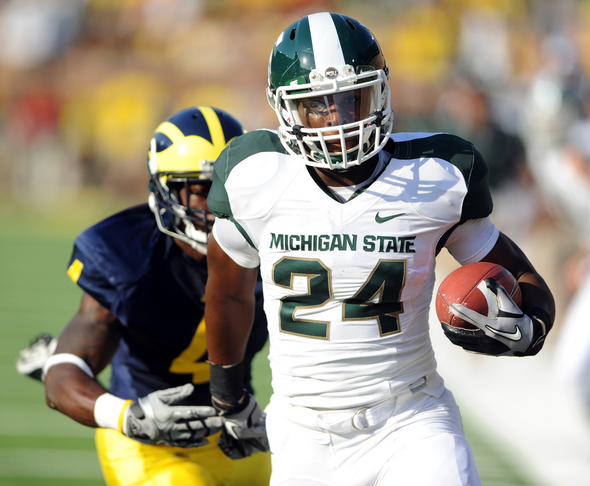
Michigan State's Le'Veon Bell scores against Michigan last week.
Lon Horwedel | AnnArbor.com
Northwestern quarterback Brett Basanez put together a 16-play, 86-yard drive that culminated in a 25-yard field goal from Joel Howells and a 29-27 lead over Penn State.
Just over two minutes remained in the 2005 game. Basanez thought his team had pulled off the win.
The lead lasted 89 seconds.
“We laid everything out there on offense on that last drive to go down and score and put us up and we figured just shut ’em down, get a turnover, get a stop, whatever and we’ll be good,” said Basanez, whose team lost to Penn State 34-29 that day. “Then Penn State came back and won, and since then it was like, ‘We have to score every time we touch the ball.
“It doesn’t matter if we score with 1 minute left, if we get the ball back, we have to score again.’”
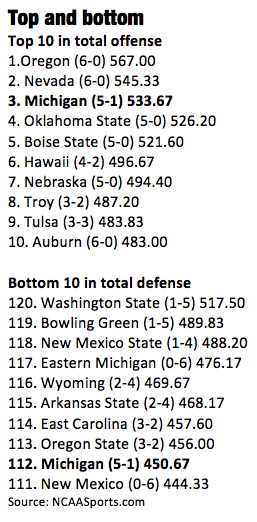
Since 1999, at least one Football Bowl Subdivision team has had an offense in the top 10 and a defense 90th or worse. This season, three of the top 10 offenses in the FBS - Michigan at No. 3, Troy at No. 8 and Tulsa at No. 9 - are among the bottom 30 defenses.
None is worse than Michigan, which is 112th in total defense after six games and stands 5-1 overall, 1-1 in the Big Ten Conference entering Saturday’s 3:30 p.m. game against No. 15 Iowa (4-1, 1-0).
What happens when a team has a top-tier offense paired with a bottom-level defense - and what it really means - is a convoluted equation.
After all, five players from Northwestern’s beleaguered 2005 defense eventually made the NFL.
It's tough on younger players
Michigan’s defensive struggles have been blamed on youth as seven true freshmen have played defense this season. That’s tough to overcome, most coaches agree.
While offensive skill players are able to quickly transition from high school to college, the strength factor is steeper on defense, coaches say.
“Defense is so much more physical. Kids come out of high school and they are 17, 18 years old and they are two good off-seasons away from being physical enough to play on defense,” said McMurry coach Hal Mumme, who was at New Mexico State when it was No. 3 in total offense and No. 99 in defense in 2006. “It’s harder on defense than on offense.
“… I’d rather have the less-talented upperclassmen any day because … they’ve already been coached and will eat up what you ask them to. If you’re able to build to those kids, they are the kids that you recruited and they’ve been playing for you for three or four years, that’s a good thing.”
At Troy and Michigan, the depth is an issue - especially in the secondary. Injuries hurt Troy. Michigan was hit with injuries, defections and recruits unable to be admitted.
“With the younger guys playing and not anticipating that many having to play,” Michigan coach Rich Rodriguez said, “that probably stunted the growth a little bit more than we wanted it to.”
Coaches, players, don't talk about it In 2005 at Northwestern, Basanez said coaches never said the Wildcats’ defense wasn’t good. During their 7-5 year, they focused on offensive production and quality.
But the players always knew.
“You just get so frustrated that you have to keep yourself from saying, ‘You guys are screwing this up,’” Basanez said. “When in reality it is the whole team. So the senior leadership was really good on that squad, Zach Strief and myself on the offense had to say ‘OK, they are trying. We just have to score every time we touch the ball.’ “But I’d be lying to you if I said it didn’t wear on me or piss me off.”
If the coaches had acknowledged the defensive deficiencies, Basanez said, it would have caused a rift in the locker room. And no coach - or team - wants that.
Because at the end of the day it’s about one thing - winning. And defensive problems usually aren’t a question of effort. It’s a matter of youth, of talent, of coaching reputation as an offensive or defensive mind, of recruiting and in some cases, of scheme.
“Everybody feels our pain,” Rodriguez said. “For our guys, its not a lack of effort or lack of focus. It is, some of it is fundamentals, but a lot of it is execution. So it’s some things we know we’re going to get fixed.
“I’m just hoping we’re going to get it fixed in a hurry.”
Teams can give up yards and still win The thing that stands out about big-yardage defenses is the overall team success.
Of the 32 schools that finished seasons as a top 10 offense and No. 90 or lower in defense from 1999-2009, just nine finished with losing records. Stanford, which had the No. 5 total offense (467.09 yards) and No. 110 defense (452.8) in 1999 went to the Rose Bowl under Tyrone Willingham. Six teams - BYU in 2001, Hawaii in 2006, Tulsa in 2007, Rice and Missouri in 2008 and Houston last year - had 10-plus win seasons despite the differential.
So are yardage numbers overrated?
“Yes, very much so,” said June Jones, head coach at SMU and known for his high-scoring offenses. “The game has changed. It’s not like years ago when you could physically beat everybody and play offense to keep from losing. It’s kind of how everybody used to play, play very conservatively to not lose the game and try to win the game on defense.”
Instead, Jones said it is about forcing turnovers. The more forced, the more opportunity the offense has to score points.
The yardage gains also mirrors the evolution of the spread. Even when Basanez played at Northwestern in 2005, he said he felt the Wildcats’ offense didn’t help the defense in practice because the spread offense they ran was different than most of the I-formation, power teams in the Big Ten.
The spread has made this era of college football about offense.
“The grasp and depth of the offensive strategies now are really challenging players in those areas where you’ve got to defend the passing game,” Troy coach Larry Blakeney said. “Then you overdo it, and you don’t have enough to compensate for the gaps in the running game.
“So it’s sort of a guessing game. But certainly you’re on to the culture of college football right now across the board.”
Just the facts Since 1999, 35 teams that had an offense that finished in the top 10 defenses No. 90 or lower in the Football Bowl Subdivision. Nine of them finished the year under .500
1999 Georgia Tech (8-4) No. 1 total offense (509.36), No. 100 total defense (413.80) Nevada (3-8) No. 2 total offense (471.92), No. 112 total defense (470.2) Stanford (8-4) No. 5 total offense (467.09), No. 110 total defense (452.8)
2000 Tulane (6-5) No. 7 total offense (453.55), No. 104 total defense (436.73) Idaho (5-6) No. 8 total offense (453.18), No. 105 total defense (437.64)
2001 BYU (12-1) No. 1 total offense (542.85), No. 102 total defense (448.54) Idaho (1-10) No. 6 total offense (464.82), No. 110 total defense (478.55) Hawaii (9-3) No. 7 total offense (462.67), No. 94 total defense (431.67) Nevada (3-8) No. 9 total offense (453.91), No. 114 total defense (494.82)
2002 Illinois (5-7) No. 10 total offense (446.33), No. 98 total defense (420.50)
2003 Texas Tech (8-5) No. 1 total offense (582.77), No. 106 total defense (453.38) Louisville (9-4) No. 5 total offense (488.85), No. 93 total defense (428.62)
2004 Memphis (8-4) No. 9 total offense (460.33), No. 90 total defense (417.75)
2005 Arizona State (7-5) No. 2 total offense (519.08), No. 114 total defense (468.75) Northwestern (7-5) No. 4 total offense (500.33), No. 117 total defense (480.42) Minnesota (7-5) No. 7 total offense (494.75), No. 90 total defense (412.67) Washington State (4-8) No. 8 total offense (489.27), No. 106 total defense (442.64)
2006 Hawaii (11-3) No. 1 total offense (559.21), No. 93 total defense (377.79) New Mexico State (4-8) No. 3 total offense (475.17), No. 99 total defense (389.42)
2007 Tulsa (10-4) No. 1 total offense (543.93), No. 108 total defense (451.86) Oklahoma State (7-6) No. 7 total offense (486.31), No. 101 total defense (443.00) Nebraska (5-7) No. 9 total offense (468.25), No. 112 total defense (476.83)
2008 Houston (8-5) No. 2 total offense (562.77), No. 100 total defense (413.46) Nevada (7-6) No. 5 total offense (508.54), No. 91 total defense (400.23) Oklahoma State (9-4) No. 6 total offense (487.69), No. 93 total defense (405.54) Missouri (10-4) No. 8 total offense (484.14), No. 98 total defense (411.50) Rice (10-3) No. 10 total offense (470.92), No. 111 total defense (452.23)
2009 Houston (10-4) No. 1 total offense (563.36), No. 111 total defense (451.29) Nevada (8-5) No. 2 total offense (505.62), No. 96 total defense (409.31) Troy (9-4) No. 3 total offense (485.69), No. 104 total defense (424.54) Texas A&M (6-7) No. 5 total offense (465.77), No. 105 total defense (426.31) Idaho (8-5) No. 9 total offense (451.38), No. 107 total defense (433.23)
2010 Michigan (5-1) No. 3 total offense (533.67), No. 112 total defense (450.67) Troy (3-2) No. 8 total offense (487..20), No. 92 total defense (408.60) Tulsa (3-3) No. 9 total offense (483.83), No. 102 total defense (429.33)
Michael Rothstein covers University of Michigan basketball for AnnArbor.com. He can be reached at (734) 623-2558, by e-mail at michaelrothstein@annarbor.com or follow along on Twitter @mikerothstein
Comments
Sean T.
Fri, Oct 15, 2010 : 8:50 a.m.
Robbie's Boyfriend, you are correct!
RobbiesBoyfriend
Fri, Oct 15, 2010 : 3:49 a.m.
@ Mr. Rothstein Last year, Ohio State has a Miserable Offense. but their defense carried them to the rose bowl and a victory against THE #1 SPREAD team Oregon. I dont know what that means, and i havent crunched any data, but im just saying what i saw last year. Wasnt Ohio State like at the bottom of the big ten, and waaay low in the national rankings on Offense last year?
Metalc0reJ
Thu, Oct 14, 2010 : 6:51 p.m.
"...so why not bother the QB as much as possible and cut down on the amount of time that our DBs have to TRY to cover the receivers??" ----- It's called a draw play. Fake the pass, hand the ball up the middle, the defense over-pursues, running back doesn't get touched on his way to the endzone. Michigan's defense showed how truly inept it is in all facets of the game versus MSU. Sure they're young, sure they're inexperience, sure some guys are injured, sure some guys left or whatever. Sure. But surely, you can't deny they sure are terrible.
Jaxon5
Thu, Oct 14, 2010 : 6:49 p.m.
Great research, Mike. It looks like it is possible to win with bad defense and great offense. Michigan is proving that so far this season. When we look at the 3 Big 10 teams that are on the list, they finished up around.500. I think that is all Michigan will do as well. Can't win in the Big 10 with bad defense.
Howard the Duck
Thu, Oct 14, 2010 : 5 p.m.
"It is important because you give young guys a chance to get a month more of practice (with the hopes that practice is worth while)." Haven't they been getting a lot of extra practice time anyway?
Steve Graves
Thu, Oct 14, 2010 : 4:05 p.m.
@ Chiro91: Great Post. I am baffled by G. Robinson. This guy was the DC for 3 different NFL Super Bowl Teams during his career. How the h@ll did he accomplish this???? He shows no imagination whatsoever here at UM. First of all - the 3-3-5 defense is the absolutely worst lineup for the player talent that UM has on its roster. I have been saying for the last 6 years that we should be running a 7 man front with some sort of blitz package going on practically every down. Everyone knows that our Dbacks can't cover anyone, so why not bother the QB as much as possible and cut down on the amount of time that our DBs have to TRY to cover the receivers??
Mick52
Thu, Oct 14, 2010 : 2:19 p.m.
I don't buy it. Defense wins ballgames and gets results. If Michigan's defense were typical, Michigan would be ranked in the top five. One could argue that with a poor defense, your offensive stats increase because you have to play your first team all game long. MSU played a great game but did not impress as significantly better than how they typically perform. Every five or six seasons you can expect a good team at MSU if players to not go NFL early or get jailed. They always find a way to screw themselves. Not having osu on their schedule is a huge gift but they will fail anyway. Iowa will be a big test. If they shut down the offense that is a big problem for the rest of the season and perhaps the RR regime though I think he should get his whole contract in years.
Sean T.
Thu, Oct 14, 2010 : 11:54 a.m.
Only one team (2001BYU) won their conference, I believe. None of them were in NC contention as well. So if we are seriously trying to go somewhere we need to fix things soon. And CHIRO19, It couldn't have been said better my friend. Your post was golden!
Wolveroon
Thu, Oct 14, 2010 : 11:49 a.m.
All we need is a good defense and we will be among the top teams in the nation. Patience boys, patience (and recruit some 5 star D players)!!
truebluefan
Thu, Oct 14, 2010 : 11:36 a.m.
az and heartbreak -- I'd guess that teams that finished with a top 10 defense and #90 or worse offense fall on the same type of bell curve as those shown in the article above. To compete for championships, the key for Michigan will be to get the D to 50-60th ranked or better. Combine that with a top 10 offense and those are the makings of national title contenders.
jameslucas
Thu, Oct 14, 2010 : 10:08 a.m.
Michael Rothstein great article, thanks for all the work you did on it. Its a breath of fresh air to see a journalist or annalist actually show their work, not just repeat platitudes like great defenses win championships. Well done!
heartbreakM
Thu, Oct 14, 2010 : 9:04 a.m.
This was an interesting article, but I second az's point. Nearly all of those teams had middling records or worse. I'd be interested in seeing stats on the top defensive teams. What rank were their offenses, and what was the overall record and ranking at the end of the year? Do you have that? And more importantly, for Michigan, what were the B10 stats on these things? It's interesting with the current stats that despite Michigan's gaudy stats on offense, none of the bottom 10 defenses were our opponents (meaning that Michigan's crazy numbers have not skewed those team's numbers too much...)
azwolverine
Thu, Oct 14, 2010 : 8:33 a.m.
Look at the record of those teams. Outside of BYU's 12-1 and Hawaii's 11-3 records achieved in the pitiful WAC, all of those teams won roughly 7-8 games per year. So, as the title of the article suggests, a good offense and a bad defense don't prevent a team from winning...they just prevent a team from winning championships.
SprBwlB4IDie
Thu, Oct 14, 2010 : 7:52 a.m.
MikeB, Apparently my post was not directed at level-headed UM fans such as yourself, but rather those who hang onto the illusion that Michigan has a divine right to play for conference and national championships and belittle Dantonio's accomplishment of taking MSU to bowls in each of his seasons in East Lansing. These fans like to point out that we finished 6-7 last year and completely ignore the fact that we were playing on New Year's day the year before or that during those same two seasons, Michigan lost all those extra practices and recruiting exposure that that accompany bowl invitations. By the way, Dantonio is only the second MSU coach to take MSU to bowls in his first 3 seasons - the first was Saban. With OSU off our schedule until next year, the table is set for a special season for MSU if we continue to take care of business and compete at a high level. Many Michigan fans like to say that beating Michigan is all we care about and we'll now turn into an average team or a pumpkin or something. That is complete crap. Projecting history onto the Dantonio regime is weak-minded and fails to acknowledge that Dantonio has built a strong program at MSU that is not going away regardless of what happens in Ann Arbor. The recruiting is the best I've ever seen for MSU and the talent evaluation skills of Dantonio and his staff are extraordinary. Some of our best players were unheralded - does LeVeon ring a Bell? We are building the talent and depth to compete with anybody and to suggest otherwise is ignorant or delusional. Part of me wishes that OSU was on the schedule this year so I could see how this year's team measures up. We might not yet be ready for them, but I would not bet against MSU versus any other Big Ten team. Let me rephrase that. I would not bet against MSU at all.
saginaw
Thu, Oct 14, 2010 : 7:39 a.m.
chiro, I agree, a bowl game this year is an absolute requirement.
chiro19
Thu, Oct 14, 2010 : 7:29 a.m.
A bowl game would be very important for this program right now! Not because michigan gets to play Puerto Rico State Techinical College in the Acme Sprocket bowl. It is important because you give young guys a chance to get a month more of practice (with the hopes that practice is worth while). I still think it is important to evaulate the D staff and make some major changes to that side of the ball. As the University of Michigan how do you keep the defensive coordinator of one of the worst defenses in college football? You buy into the premise that young guys cant play well on D! So if the problem is to many young guys, why does the coaching staff put as many out there as possible in the secondary? Why would you not limit the amount of youngsters out there? Coaching isnt just about X's and O's its about putting thoses X's and O's in the right position based on there talent and that is what Robinson is FAILING at!!! Change the scheme this year to fit a strong front 7, because it wont make a difference to the Back 4 (they already get shredded) and put pressure on the qb by blitzing from all over the place.
MikeB
Thu, Oct 14, 2010 : 7:11 a.m.
Question to SprBwlB4IDie, why will it be hard to enjoy a Bowl game? I hope they both get into a Bowl game and they both win. I agree with you, it is hard to be a really good team with an all offense approach, but unless that "really good" team is a top 5 team, it can be done, Texas Tech, Hawaii, etc
SprBwlB4IDie
Thu, Oct 14, 2010 : 6:02 a.m.
"A good offense-bad defense combination doesn't prevent college football teams from winning" True dat. But it does prevent college football teams from winning versus GOOD college football teams most of the time. At least this year's death spiral will probably leave UM bowl-eligible. However, it will be hard to enjoy the Cap'n Crunch Cereal Bowl while MSU is playing in a BCS bowl.