

The curious case of the missing big plays, and how they cost the Michigan football team a win
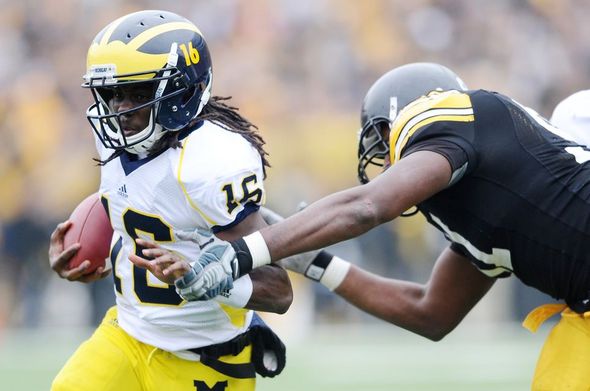
A 22-yard run by Denard Robinson, above, was Michigan's longest gain against Iowa last weekend. Two-thirds of the Wolverines' plays gained four yards or less.
Melanie Maxwell | AnnArbor.com
The Michigan football team beat Iowa in first downs, passing yards, total yards and time of possession.
Yet, the Wolverines scored only 16 points -- well off their season average of 34.8 per game -- and lost to the Hawkeyes. Why?
Offensive coordinator Al Borges said, more than anything, it's because the Wolverines didn't reel off any big plays.
Although it moved the ball more consistently than Iowa, Michigan did not have a single play of longer than 22 yards. Two-thirds of its plays gained 4 yards or less.
"(The) biggest reason that we didn’t win this game is because, from an offensive perspective, we had no big plays," Borges said this week. "If you look at the seven games that we’ve won, almost all of them, there’s been huge chunks of yardage taken off in certain drives.
THURSDAY LIVE CHAT
The Wolverines are 17th in the country in plays of 30 yards or longer (24), and second in the Big Ten behind Wisconsin. However, 22 of the 24 came in their seven wins.
Just two came in their losses to Iowa and Michigan State.
Likewise, Michigan averaged 37.7 points in its seven wins, and 15.0 points in its two losses.
Borges thinks the two are correlated.
"Sixteen points? You have to score more points," Borges said, "and the way you do that is you move the ball incrementally, and turn around once in a while and take a big bite of the defense."
If that trend holds, Michigan could have a hard time when it travels to Illinois on Saturday (3:30 p.m., ABC). The Illini have allowed only 10 plays of 30 yards or more this year, which is 14th in the country.
Coach Brady Hoke -- still a defensive line coach at heart -- agreed with Borges' theory, and looked at it from the other side of the ball: When Michigan gives up big plays, it struggles to win. He pointed to a 44-yard pass that Iowa completed on its first drive and turned into seven points.
"I think big plays are a big part of (winning) or we, as defensive coaches, wouldn’t stress so much about giving up big plays,” Hoke said.
Michigan has allowed the sixth-fewest 30-yarders in the country (eight in nine games), a big reason for its turnaround this season on that side of the ball.
Kyle Meinke covers Michigan football for AnnArbor.com. He can be reached at 734-623-2588, by email at kylemeinke@annarbor.com and followed on Twitter @kmeinke.
Comments
Rufus
Fri, Nov 11, 2011 : 4:26 a.m.
the missing big plays are Denard breaking run after run for 200 yards a game. Go Nascar spread offense and win. Go drop back - Denard in cement boots offense and we lose all 3 remaining games. My guess is we go LLoyd Carr on tranquilizers offense and lose all 3. This team has a foolish consistency on offense. Wanting something they don't have and refusing to make the best with what they have. But at least they open things up with 8 minutes to go; but why even bother at that point. It's too late.
lindor
Fri, Nov 11, 2011 : 5:41 p.m.
Matt - I don't think we're necessarily disagreeing with each other that much. I know in a year or two we'll have a pro-style QB in place, and we'll be back to our old offense. Couple things though: 1) I hope we aren't running the same boring offense, and the 4 yard out throw on 3rd and 7 like we had done for years. 2) I think the coaches (Borges) have failed to adapt to Denard's strengths this year. Even against the teams we've beat, Denard couldn't throw the ball down field. Let him throw to the slot when no one is on him, or quick slant routes, it plays into his game, and I'm fine with it. I just don't like bottling him up, and I flat out don't understand it. It gives us a better chance to win in my opinion. 3) Rotating QBs. Don't get that either, especially when nothing creative has come out of it. Re: tradition - I want to see us win. Period. I'm not sure what tradition gets you in that department besides stubbornness. We followed tradition with LC for several years and we were 0 - for how many years again OSU... in a mediocre Big Ten without a title. And that is what I don't get, everyone was happy and that is what we're aspiring to be again... Complacent. Everyone prefers to see us finish 9-3, ranked 12-15 in the country every year as opposed to 12-0 and competing for a national title every few years so long as we're keeping tradition. Doesn't make sense and not very leaders. I also think WVU would fare just fine in the Big Ten. Look at the points they're putting up (even against LSU), they just have no defense either.
Matt Patercsak
Fri, Nov 11, 2011 : 5:14 p.m.
anybody can throw to the receiver in the flats off a one step drop. so that stat is skewed because they don't throw downfield. those stats mean nothing. because there is no NFL team that runs the spread and shred offense. even Mike Vick runs a pro style offense. in a couple years, look me up a stat of how Denard is doing in the NFL. i wanna know what his passer rating is.
Matt Patercsak
Fri, Nov 11, 2011 : 5:06 p.m.
lindor the number one and number two teams in the country run pro style offenses. LSU and Alabama. they have all the speed in the world. but what makes them great is they also have toughness. no, i don't like losing. but I'm also conscious of the future. Michigan football, by definition, is tough. and trying to box out defenders and run around them will not cut it in this conference, it never has. so no, i don't like losing. I also don't like Denard Robinson or Devin Gardener (they have beat NO ONE). but I'm putting up with them for the time being because I know that in a few years this program will be back to the gold standard it once thrived on. look at Mississippi State, they run a lot of spread and shred. and they are a second tier SEC team. Oregon is also spread and shred. but very stoppable once you take away the edge. they also have a football culture different from ours. they shun tradition while we embrace it. how do you think west virginia would fare in the big ten? ..well, about like Michigan did for the last 3 years. going to the spread and shred was about the same as building a new tunnel in the big house. it can have the fanciest floor, walls, ceiling and lights. but it's just not the same. FUTURE FUTURE FUTURE. once we're winning with a pure pocket passer, the denard robinson era will be a bad memory for everyone. one that we've all moved on from.
lindor
Fri, Nov 11, 2011 : 4:44 p.m.
Matt - So the spread is garbage and not the real way to play football? In 2009 ESPN did a study and it shows that 40% of NCAA teams run a form of the spread. In today's BCS rankings 12-14 of the 25 teams run the spread or a variation of it. We need to run the spread because Denard can't throw deep passes or see over the line. I don't see the point in not running it, you like losing? Here's another stat on Quarterbacks drafted in first or second round career numbers, since 2005. Look pretty similar to me. Spread No Spread Players 11 13 Starts 256 341 Career win pct .518 .481 Playoff W-L 5-5 8-6 Comp pct. 59.6 59.0 TD-INT ratio 1.22 1.39 Passer rating 80.7 80.4
Matt Patercsak
Fri, Nov 11, 2011 : 3:12 p.m.
then our defense is on the field for way longer than it should be. this is a ball possession offense that is intent on keeping the defense off the field. the longer our d is on the field. the longer the other team will have to score. spread offense is garbage. a cheap and sloppy brand of football. this is a culture change. a return to toughness with bringing back the old michigan football and all, you should feel lucky to be running the QB powers, sweeps and jet sweeps that we are. I cant wait until a big, smart, pocket passer runs the offense so we can get rid of garbage fluff formations and plays. that way we have a QB who throws, and a running back who runs. and we can play football, the right way.
Matt Patercsak
Thu, Nov 10, 2011 : 9:40 p.m.
guys its ok we just have to have patience these weird formations and choppy play calling is done out of necessity, not tendency. Al Borges is a very black and white offensive coordinator, its not his M.O. to run dual QB type stuff but for now, its what we have. and he's simply trying to make the most of it. I'll tell you what though, I'd rather see Shane Morris start in his freshman year than Devin Gardener. Devin has all the physical gifts in the world but his ego is too darn big. he thinks he can elude everyone and stiff arm defensive ends. He needs to learn how to be pass first and stay compose in the pocket. he looks downfield for a split second then heads for the corner...then usually turns around getting chased by 3 defenders and loses 8 yards. as for our power running game im impressed. I love what I see out of our backs Hopkins (FB) and Toussaint (TB). the power running culture is becoming stronger every game and soon it will be our bread and butter. I just wish rawls got some snaps with the first team. but the reason we dont stick with it is simple, with denard's "passing game", defenses will eventually load the box to shut down our power game and we are forced into predictable throwing scenarios that we simply cannot produce on consistently. we, for the time being, because of limitations personnel wise, have to keep the defense on its toes with multiple looks in order to establish any time of offensive success against legitimate opponents. the problem is (as coach hoke has said) execution.
lindor
Fri, Nov 11, 2011 : 5:21 p.m.
I just don't buy this. We've had personnel issues on defense for years now (we're starting 4-6 true freshman) but somehow, with great coaching, they've turned this around. Now we've got personnel issues on offense - since when? We've got coaching issues on offense. . I would love to see what our offense could do tailored to exploit their strengths. Last year we had to score EVERY time on the field because our defense couldn't stop a JV team. I cannot imagine that type of pressure on Denard, or anyone else on offense. Now our defense stops the ball but we cannot put up points. We don't have to run dual QBs, I have yet to see one way we've benefited from it. It breaks any rhythm we have going, and usually results in negative yardage. I'm also not sure Devin has a big ego either, he just hasn't had many reps and he loses all composure.
A2D2
Thu, Nov 10, 2011 : 7:39 p.m.
"You have to score more points" - Al Borgas Dear heaven, am I the only person that thinks this is the most innane comment in the history of college football? A close second is this comment: "(The) biggest reason that we didn't win this game is because, from an offensive perspective, we had no big plays," - Al Borgas Gee, maybe you had no big plays because your butts got beat at the line of scrimmage, your play calling was inconsistent, your offense has no personality and Denard has been put in a nunnery. But other than that, everything's fine.
Macabre Sunset
Thu, Nov 10, 2011 : 6:46 p.m.
Looking at the statistics from the game, Iowa should have won, and it wasn't because of a lack of big plays. Michigan had 20 incomplete passes, Iowa had 7. Michigan also had 2 turnovers, Iowa had 0. Both of those statistics have a much higher correlation with a losing performance than you'd expect. One of the big reasons Michigan doesn't have an elite offense this year is that it's 102nd of the 120 FBS teams in pass completion percentage. Everything else is in place.
heartbreakM
Thu, Nov 10, 2011 : 6:52 p.m.
Interesting points Macabre. I guess you can generalize it even more and say that any time DR has to throw 37 times, you are likely going to lose. (Heck, to Bo, if you had to throw 5 times, you were likely to lose). The funny thing about passing stats is that you never want your QB with high yardage or lot of attempts because that usually means you are playing catch up or shoot out.
Terry Star21
Thu, Nov 10, 2011 : 6:20 p.m.
Kyle.....you read my mind. I wanted to tell everyone, hey we did this much and we did all that - we should have won, but it's excuses and I won't do that. The last three years with the old coach ( the losing king) we were so close, did all those things and I knew we would get better and win those latter games (we didn't). This year is different (the king is dead now), and again I believe that with our coaching staff and the continued getting familiar with the players we will shine, if we continue to make the better stats. The old coach (long gone king) kept making excuses ("we're almost there), but the new coach doesn't make excuses - he will just keep plugging and we will win. Although this weekend, the illini should be better at home - I believe this is where this Michigan team will put it all all together - and the Michigan Football Nation will be proud ! MgoBlueForTiM...............the king is dead, long live the Might Hoke !
lindor
Fri, Nov 11, 2011 : 4:23 p.m.
The new coach might not make excuses but he sure doesn't explain why Borges makes such poor calls on offense. We're good, not great, but good. But, we could easily be 9-0 right now. MSU handled us but we still had a chance to tie that game with 6 minutes left with MSU completely incapable of moving the ball against the wind. What happened? Fourth and an inch we decide to throw. What's the justification? Well, we've had success the past 2 years at SDSU with that play. Give me a break, Denard was getting lit up all day, why pass? I could sneak that ball two inches behind center. Fresh set of downs from the 6. Then Iowa - They get beat by a marginal Minnesota team running the spread offense the week before. Do we run the spread, heck no? Why would we? We bottle up Denard the entire game and make him sit in the pocket - they must be telling him leave the pocket and you're benched. Then, on 1st and goal from the 3, we throw 3 more passes and don't give Denard a chance to run. And he had the chance, 4th and goal, clock stopped, roll him out!!!! Last but not least, the Devin Gardner debacle. Put him in, we lose 10 yards. Or, Denard runs to the line, we hand off to him or to a RB. EVERY TIME. Talk about predictable. Let Denard run to the line than break down field. Do something different. RR is gone, but I'm already sick of all the excuses we're making for Hoke and Borges. Its coaching. Look at our D, Mattison has done a great job, with what we all thought was weak talent. We've got the talent on offense and we've gotten worse. Denard is not a pro-style QB, never will be.
David Briegel
Thu, Nov 10, 2011 : 4:45 p.m.
Dropped Passes. Batted Down Passes. Bad Passes. Keepin' the little guy in the pocket where he can't see OR throw over the big boys! Other than that we have a great offense?
Terry Star21
Thu, Nov 10, 2011 : 6:21 p.m.
DB...ya gotta believe those will stop, remember the second half at NW game - that is how good we can be !
Jojo B
Thu, Nov 10, 2011 : 4:10 p.m.
Well, enough with the clever trick dual-QB plays, OK? When you do the same trick play three times in three games and get total gains of about 4 yards, it's time to drop it and be more clever. DB is a great scrambler in the pinch. We're not taking advantage of that. We're making him stand still and pass (trying to turn him into a "real" QB) and we're feeding him some uninspired and fruitless pre-canned runs that typically fail. We're taking the Denard out of Denard. Either play the offense to his strengths or make Denard a rusher!
BornInA2
Thu, Nov 10, 2011 : 4:40 p.m.
We played the offense to his strength last year. We sucked at the end of the season in part because good teams shut down a one-dimensional offense and also because Denard was playing more and more hurt. So the clamor to let him "do his thing because it works" are simply not accurate, or healthy for Robinson.
heartbreakM
Thu, Nov 10, 2011 : 3:05 p.m.
The offensive stats are also slightly misleading in the iowa game, because 80 or so yards came on that last drive. Granted, it doesn't matter when you get the stats in the total scheme, but it not indicative of the entire game because we had essentially one other drive of significance. To me, big plays are great, but general execution has been lacking for large parts of the tougher games (MSU, Iowa, ND) and until that occurs, Michigan will lose some of these tough games. (Incidentally, I think the same thing could be said for the last 3 years with the "spread" offense--many big plays but not great execution throughout games that allow you to control it and keep your D off the field and wear down the other D).
BornInA2
Thu, Nov 10, 2011 : 3:01 p.m.
Big runs are setup by big pass plays. And our QB is really struggling with accuracy on downfield passes. Short, long, out of bounds, to the other team, pretty much everywhere except to the receiver. Robinson is a great athlete, but until he gets the kinks worked out of his throwing, he's an average at best QB and opposing teams will keep stacking the box to take away short passes and the running game.
alarictoo
Thu, Nov 10, 2011 : 7:20 p.m.
Well, In DR's defense, when he does get it to the receivers they are frequently having troubles making an actual catch. Not sure if it is surprise that the ball actually got to them...?
alarictoo
Thu, Nov 10, 2011 : 2:54 p.m.
It took 'til Thursday to come up with this, Kyle? Seriously? Theo212 - Yup. He would have fixed everything. Just like he did for the three years he was here. Bazinga!
OldBittyBates
Thu, Nov 10, 2011 : 2:49 p.m.
The only reason we won last year's game against Illinois is it was played in the Big House, and Tate Forcier was QB at the end. Had Robinson been in there - we would have gotten slaughtered. Denard's lack of a professional throwing arm makes him a major liability in this one. Devin Gardner (the back-up) has proven time and time again he's no Tate Forcier. Maybe its time to try a third person at the QB position and turn Robinson into a RB. Needless to say, the Michigan offense must see changes in order to win this week or any time soon.
Terry Star21
Thu, Nov 10, 2011 : 6:28 p.m.
Man OBB, I really miss Tate...always felt comfortable with him - yes, he made mistakes but, I felt good when he was in there.
MRunner73
Thu, Nov 10, 2011 : 12:38 p.m.
The game against IL should have the potential for big offensive plays. Hopefully, our defense can minimize big play for IL. If not, it will be a long afternoon. Go Blue!