

Michigan football team's defensive unit bridges the language gap
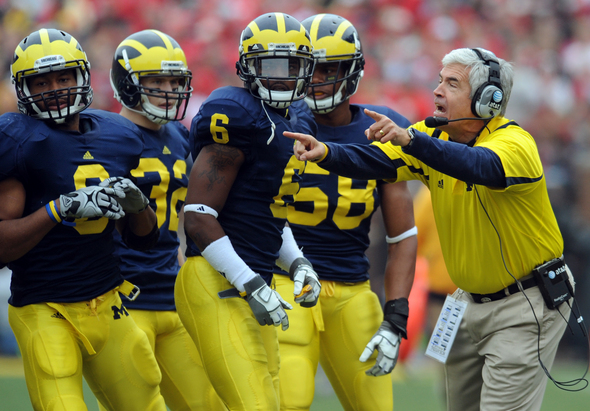
Michigan defensive coordinator Greg Robinson works with his defense in the Ohio State game last season. Michigan's defense was eighth in the Big Ten in scoring defense (27.5 points per game) in 2009 and ninth in total defense, allowing 393.3 yards per game.
File photo
While football was the primary language on Michigan’s defense in 2009, the Wolverines had something akin to British English vs. American English going on, kind of like England’s “mind the gap” as opposed to the United States’ “watch your step.”
Greg Robinson, in his first year as the defensive coordinator at Michigan in 2009 brought his way of describing defensive sets and what he wanted from position coaches and players on certain calls from his time at Syracuse.
His then-new colleagues at Michigan spent years speaking in a coaching dialect handed down from West Virginia.
It led to a communication barrier and some of Michigan’s defensive problems in 2009. While there wasn’t much they could do about the speed and skill levels of the players once the season started, the coaching staff needed to communicate without needing a football translator.
“If you really think about it, if a coach is having to adjust on the move … I think it gets to be tough,” Robinson said. “You don’t know where the message is lost.”
After Michigan finished 5-7 last year, falling apart on offense and defense during the Big Ten season, Robinson and Michigan head coach Rich Rodriguez had a discussion. English was the primary language.
The result: Robinson scrapped his terms in favor of the West Virginia-based language.
Implemented in the spring, questions no longer revolve around, “What the heck are you talking about?”
“It’s been good for our players, because our coaches are comfortable,” Robinson said.
While it would be easy to question why Michigan’s coaches didn’t realize this sooner or why the defensive assistants struggled with the translation during last year, give the Wolverines staff credit - and specifically Robinson -for being willing to compromise.
“I figure it’s better for me to do that and so that everybody else, it’s just, I can feel it,” Robinson said. “I can see what it’s done and we’re able to get to the point quicker. “The message is delivered in a way where everybody can feel very comfortable.”
That out of the way, Michigan can focus on its talent. The secondary is young and inexperienced, even more so with cornerback Justin Turner choosing to transfer Tuesday.
Replacing Brandon Graham on the defensive line is not going to be something one player can do. The linebackers, where Robinson is now also the position coach, underachieved a season ago and have to rediscover their swagger.
But hey, at least everyone understands each other.
“We simplify the defense, and (it) allows us to react instead of be thinking and seeing plays in front of us and still thinking, ‘Can I go?’” senior cornerback Troy Woolfolk said. “It just allows us to react to something much sooner, which is also really pleasant, because we have a lot of young players out there.”
The terminology change, combined with the typical in-team optimism every August brings regardless if you are Alabama or Eastern Michigan, leads Michigan to believe it will be better on defense.
“There’s a strength in numbers,” Robinson said. “If there’s a number of guys that really feel comfortable with what they got going, we’re going to be OK.
“I think they do feel that way.”
Michael Rothstein covers University of Michigan basketball for AnnArbor.com. He can be reached at (734) 623-2558, by e-mail at michaelrothstein@annarbor.com, follow along on Twitter @mikerothstein or find him on Facebook.
Comments
PortageLkBlu
Fri, Aug 13, 2010 : 4:32 p.m.
So lets see nanu, nanu means you need to post the same thing twice? There won't be any mass suicide if MSU loses to us this year they are very calloused about losing to us. The reason losing to them doesn't bother UM folks so much is becuase we know that they are beating the worst teams we've fielded in over a century and that it's good for the game for them to win once in a while. The MSU fans on our site are gloating and I don't blame them we've been beating them up so regularly I think we're due for a bit of gloating from them I don't mind at all, it won't last. Also, I like MSU I just don't like those ugly uniforms the kids are okay. I'm excited about this year and strangely as it sounds I'm excited to see the improvement. We should see more wins I hope at least but I think this is a work in progress hence I'm interested to see how far improvement has come. In this type of system I don't doubt that wins will come with improvement so that's what I'm looking for improvement and how much.
RobbiesBoyfriend
Fri, Aug 13, 2010 : 3:35 a.m.
3 and out, Pro coaches dont know anything about Football!!! Im sure Jets coaches are hoping Rodriguez and Robinson dont decide to make the leap into the NFL.
3 And Out
Fri, Aug 13, 2010 : 12:12 a.m.
Just finished watching the Jets camp show on HBO and they previewed next week episode... D. Warren makes a play and a Jets coach grabs him and says "Thats It! Way to go...if you had made plays like that last year, Michigan might have won some games" and that is the differences in coaching techniques with Gibby vs. the NFL...not even close.
clarklaker
Thu, Aug 12, 2010 : 7:48 p.m.
Why are there so many worried msu bloggers on a michigan site? Just imagine if msu looses to michigan this year.Can you say mass suicide.
Jaxon5
Thu, Aug 12, 2010 : 7:24 p.m.
Translation Table Message sent by Def Coord => Message received by coaching staff Left side => Right side Up field => Down field Stop the run => Let them score 4-3 => 3-4 3-3-5 => Touchdown
Yelmonian
Thu, Aug 12, 2010 : 6:45 p.m.
"His then-new colleagues at Michigan spent years speaking in a coaching dialect handed down from West Virginia." And none of them speak "Michigan".
RobbiesBoyfriend
Thu, Aug 12, 2010 : 6:17 p.m.
Way to go Greg Robinson. we have officially attained the High School level of Football Defense.
Sean T.
Thu, Aug 12, 2010 : 5:25 p.m.
I can agree with simplyfying terminology but Macabre is right about that this should've been brought up in Robinson's interview for the position. It can go only two ways; the D-coordinator plays whatever the Head Coach wants or the Head Coach allows the D- Coordinator to run his own defense. So I hope they have this finally shored up!
michboy40
Thu, Aug 12, 2010 : 1:02 p.m.
Our D will continue to get better with stability in the coaching staff. This is the first time in 4 years the players have had the same set of coachs. they will be improved, but not greatly because they lost a lot of talent.
Macabre Sunset
Thu, Aug 12, 2010 : 12:24 p.m.
I find it difficult to believe that a coaching staff of a program this size could have this type of a problem. At the NFL level, whenever there's a new hire on defense, the first issue addressed is defensive terminology (it's not like there are that many ways to count gaps or name positions). Basically just one more example of why he-who-cannot-be-named is in way over his head coaching our football program.
MetricSU
Thu, Aug 12, 2010 : 11:02 a.m.
When I saw the headline, I figured the first defensive set that UM will call is the "Nanu-Nanu."
MetricSU
Thu, Aug 12, 2010 : 10:41 a.m.
When I saw the headline, I figured the first defensive set that UM will call is the "Nanu-Nanu."