

Argo Dam control system fails, causing Huron River to rise and fall quickly
Water levels on the Huron River began fluctuating wildly late on Saturday, according to a stream gage monitored by the US Geological Survey. At peak flow levels, water discharge reached near 700 cubic feet per second, a high water mark with conditions that make it difficult and dangerous to wade in the river. At the low water mark, less than 70 cubic feet per second of water went down the river, leaving the bottom of the river mostly dry. Tom Weaver of the Michigan Water Science Center confirmed that the gauge was reading properly and was not malfunctioning.
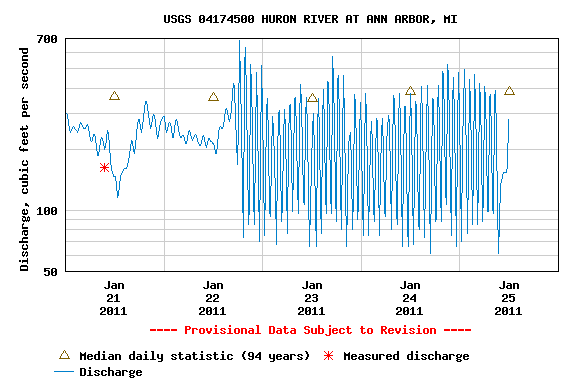
Water levels on the Huron River fluctuated wildly downstream of the Argo Dam.
US Geological Survey
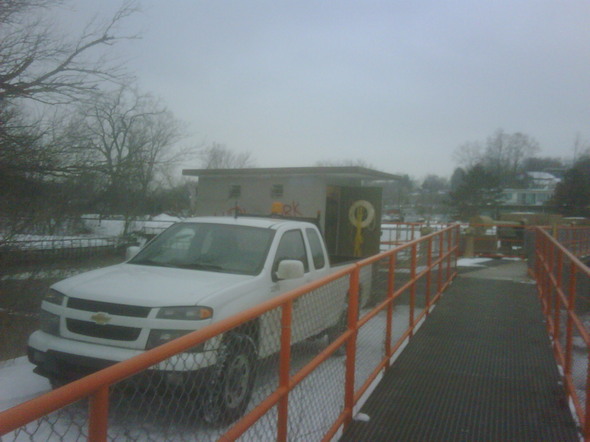
Work is underway on site at the Argo Dam Wednesday morning to determine and correct the cause of a control systems problem which has led to extreme water level variations downstream of the dam.
Edward Vielmetti | AnnArbor.com
A transducer is a pressure gauge used to measure water levels on Argo Pond. The transducer is placed in a stilling well, which draws water from the pond through intakes beneath the pond's surface. Signals from the transducer are sent to control systems at the dam which cause the gates on the dam to move, letting more or less water downstream in order to keep the pond at a constant level. If the transducer fails, or if the intake valves are blocked by debris, ice, or zebra mussels, the water level as measured at the dam will be incorrect.
The control systems on Argo Dam have failed before, with similar results. In April 2010, the river’s flow went from 50 cubic feet per second to more than 1,000 cubic feet per second in a few hours. Rapid water rises cause anglers wading in the river to scramble for the banks, and rapid water drops leave canoeists beached on river bottom mud. The Huron River Watershed Council, led by executive director Laura Rubin, conducted public meetings last July to discuss river fluctuations.
Aquatic biologist Dave Fanslow noted the poor flow management of the river in an electronic mail message on Tuesday to the watershed council. In a telephone interview, he described the impact of these extreme flow variations on the mayflies, caddis flies, and stoneflies that provide food for fish on the river.
"The dam needs some tweaking if it's going to stay," said Fanslow, noting that these issues were "ampiflying the environmental degradation" associated with dams.
Edward Vielmetti writes about the Huron River for AnnArbor.com. Contact him at edwardvielmetti@annarbor.com.
Comments
ribs1
Fri, Jan 28, 2011 : 1:50 p.m.
@tru2blu76 There are no significant hatches of mayflies in the entire stretch between Argo dam and Gallup park. Just upstream in the metroparks there are tons of mayflies all summer. Hexagenia, Ephoron are the major species but there are many more that emerge all summer. Below Argo there are pretty much none These fluctuations are dangerous. Have you ever been in the water when the river went from 50cfs up to 700 cfs in 1/2 hours time? We are talking a 10 fold increase in only 30 minutes. It is no joke. Veteran fisherman around here no how the recognize the signs of these events and we know to quickly get out of the water, beginners and people not from the area do not. 700cfs is enough to sweep you off your feet very quickly. This river is no joke. Just look at all the articles about rescues over the past 2 seasons. The fire department knows it is no joke too. I have personally rescued many inexperienced canoeists during some of these events.
Tru2Blu76
Fri, Jan 28, 2011 : 12:05 a.m.
So far, how many fishermen were forced to scramble to safety? So far, how many aquatic insect larvae have "vanished forever?" A bit of drama - best saved to the big screen, TV and the stage. Just saying what "recognized experts" omitted: there's no permanent danger to the fish food supply (as it exists) in the Huron - because: the actual source for these insects comes from upstream down to here and is replenished (often by the same washout conditions) at least seasonally. This is also why we have rattlesnakes and turtles (sometimes) within this area - they are brought down by the river, especially when it's running fast. The HRWC people started with exaggerated claims ("the dam is in danger of failing!! Run!) and are continuing the Big Lie Technique of repeated exaggerations now. We need dreamers, but lets remember that dreamers are often alone as well. For good reason: because some dreamers (such as those posting here) get confused about who wants to share their dreams and about people having their own preferences which don't match the dreamer's dreams. We could solve the whole "dam problem" if we just reduced Michigan's population back to pre-Civil War levels. Ah, the Pioneer Life! Shouldn't we insist on bringing it back? Anyone? ;-)
poohbah
Thu, Jan 27, 2011 : 9:24 p.m.
As I recall, the year of the 100-year storm was 1968. The Geddes dam was not washed out but the river flow was so heavy it overflowed the dam and washed out the railroad. The city opened the dam by cutting through the gates in order to forestall further damage (the gate controls failed). As a result, Geddes Pond went dry. On the boards at that time was a proposal to build a bridge across the river to replace the one-lane bridge at Geddes road. The city manager (I forget his name) proposed a "ground level" bridge that would be made possible by simply filling in all of Geddes pond and turning it into "park land." You can imagine the response that created! The islands were created because the property owners on the north side of the river refused to grant easements for the proposed trail thru Geddes park. As a sidebar: Geddes pond had been a bird sanctuary but lost its status when it went dry. But since it was still annexed to Ann Arbor Township, duck hunters showed up the following year. Again, I don't recall how long this situation lasted but, eventually, the city annexed the pond. Since it's illegal to discharge a firearm in the city, hunting came to an end.
Rork Kuick
Thu, Jan 27, 2011 : 9:10 p.m.
If you think Gallup is beautiful you might want to see the real river, or a real lake (there are lots around here, some pretty wild). My eye sees mostly tragedy and selfishness.
Sally
Thu, Jan 27, 2011 : 4:34 p.m.
At least somewhat related to this failed dam topic... I remember (I thiink correctly) during the mid-60s that Gallup Park was created during a dam failure. Most of the islands were added and probably the bridges, while the water level was minimal. I keep seeing that some people want to be done with the dams in the area. I'm wondering if that would not end the beauty of Gallup Park--and if so, whether the folks in charge are aware of that.
mmouradian
Thu, Jan 27, 2011 : 3:34 p.m.
The river is a living balanced system. These type of events are devastating to the health of the river. If the small bugs clinging to the bottom of the stream are washed away or frozen in the dry riverbed, the fish will not have food in the spring. Also these animals clean up the river so if they die or are gone you end up with a sterile environment. We know what happens when you fill a pool with water and let it sit. It fills with algae stinks and becomes a nuisance. This is a bigger issue than just the water rushing down the river. As Ribs stated it does effect the rest of the river because this slug of sterile/algae water will move down the river and effect the balance of the plants and animals as it works its way to the lake. If we have a dam it should work.
Edward Vielmetti
Thu, Jan 27, 2011 : 2:18 p.m.
The Federal Energy Regulatory Commission (FERC) regulates Argo Dam as part of the Barton Dam project, FERC 3142.
Russ Miller
Fri, Jan 28, 2011 : 2:53 a.m.
Ed, A2 applied to FERC for exemptions for Argo (docket P-4150) and Geddes (P-3143) in 1981 along with Barton and Superior. They were granted in 1982, then abandoned in 1983 after the decision had been made not to pursue hydro. I don;t think the federal government has any jurisdiction to regulate Argo or Geddes - the reasons most hydro dams are included is that they either involve interstate commerce by tying to the electric grid, include federal lands, or involve navigable waters. MDEQ (or is it MDNRE now?) regulates Argo and Geddes under Part 315, Dam Safety, of the Natural Resources and Environmental Protection Act, 1994 PA 451, of 1994, hence their authority to order the headrace closed. Federally regulated dams are exempted from state control in Part 315. <a href="http://www.michigan.gov/deq/0,1607,7-135-3313_3684_3723---,00.html" rel='nofollow'>http://www.michigan.gov/deq/0,1607,7-135-3313_3684_3723---,00.html</a> The other dam regulation common in MI is the lake level control act (Part 307) which is administered by county Water Resource (formerly Drain) Commissioners.
RiverGirl
Thu, Jan 27, 2011 : 2:52 p.m.
The requirements that the City of Ann Arbor, as owner of Barton and Argo dams, needs to meet for FERC licensing are more lenient than typical due to an effort by the Carter administration to expedite hydropower production during the 1970s energy crisis.
Annoyed87
Thu, Jan 27, 2011 : 2:09 p.m.
FYI Ribs1....FERC (Federal Energy Regulatory Commission) does NOT regulate Argo or Geddes Dam. There are no hydros there!
ribs1
Thu, Jan 27, 2011 : 9:38 p.m.
Argo Dam is regulated by FERC. Do your research.
Edward Vielmetti
Thu, Jan 27, 2011 : 5:45 a.m.
Here's a few more details that would have been in the original story, had I had them close at hand. <a href="http://a2docs.org/doc/43/" rel='nofollow'>http://a2docs.org/doc/43/</a> The Federal Energy Regulatory Commission license governing operation of Barton Dam contains requirements mandated by US Fish and Wildlife Service and Michigan DNR. This letter details numerous instances of un natural flow fluctuations caused by the project, and notes lack of required flow gaging stations up and downstream. <a href="http://annarborchronicle.com/2009/06/29/huron-river-of-data/" rel='nofollow'>http://annarborchronicle.com/2009/06/29/huron-river-of-data/</a> A June, 2009 Ann Arbor Chronicle story regarding river fluctuations.
Epengar
Thu, Jan 27, 2011 : 2:18 a.m.
I just checked the gauge readings that Mr. Vielmetti linked to. I looks like the flows have evened out a little.
DonBee
Wed, Jan 26, 2011 : 10:39 p.m.
@braggslaw The dams were added for a reason. Watching rivers without the dams act after violent rain storms in California has made a number of people who were in favor of removing small dams, less so. Yes, you will reduce dam maintenance, but you may end up with stream bank maintenance and in the summer the river may at times be nothing more than the Rio Grande is, a trickle down the middle of a patch of mud.
braggslaw
Thu, Jan 27, 2011 : 2:51 a.m.
Disagree completely Dams were put in to run mills generate electricity etc. This dam does none of these functions The stream bank will be fine just like other rivers Tear the dam out
Epengar
Thu, Jan 27, 2011 : 2:15 a.m.
DonBee, Argo and Gallup dams have no significant role in flood control, they are operated as "run of the river", and cannot hold back much more water than they do. They've always been first and foremost for power generation. Also, your comparison to California and the Rio Grande is bizarre. The rainfall patterns and landscapes there are so different from Michigan that it's not just apples to oranges, it's apples to broccoli.
ribs1
Wed, Jan 26, 2011 : 9:54 p.m.
Another point, The city is in violation of Ferc licensing for this dam for every incident where the level drops below 100cfs with potential for fines. By my count the level has spiked below 100cfs 68 times in the last 4 days.
southyoop
Thu, Jan 27, 2011 : 4:38 a.m.
So, enlighten us as to what the FERC license actually says.
ribs1
Wed, Jan 26, 2011 : 9:51 p.m.
Mr Stanton, These spikes may not be unpredictable but they are sudden. 70cfs up to 700cfs in an hour is about as sudden as it can be without a complete dam failure. We are talking 10 times the flow rate over an hours time. These events affect aquatic insects more in the winter because most mayflies, caddis and stones are in there larval and egg stages clinging to rocks on the bottom. They can be flushed out very easily. During the summer they are fully grown larva or adults able to swim to deeper water. I found it odd that there is little mention of the effect on fish. Some of these spikes were actually all the way down to 50cfs. At this level the river is close to dry and any fish that don't make it to deep water will die. Also fish can die from the stress of rapid fluctuation especially when it goes on for 4 days. What people failure to understand is that these effects are felt from Argo all the way down to the mouth at Lake Erie, about 50 river miles.
Rod Johnson
Wed, Jan 26, 2011 : 11:22 p.m.
Is that true? Seems like the seven or eight dams downstream from us would smooth out these fluctuations. Why would the spikes even get past Dixboro Dam?
braggslaw
Wed, Jan 26, 2011 : 9:45 p.m.
Tear the dam down and there would be no wild fluctuations and no maintenance.
Rork Kuick
Wed, Jan 26, 2011 : 6:22 p.m.
@Belgium: It's Ed Vielmetti writing, so there's no shock. Always lessons, no tuition.
Ryan J. Stanton
Wed, Jan 26, 2011 : 6:18 p.m.
According to Molly Wade, what's happening is something is causing the gates to think they should open and close — there's no threat of dam failure or anything like that because of this. She says the fluctuations are occurring at a steady pace, which helps to dampen the effect in the river . If the spikes were sudden and unpredictable, she says, this would be more disruptive In addition, the time of year helps, as there are not many people using the river and aquatic life is not as active.
Belgium
Wed, Jan 26, 2011 : 6:13 p.m.
Wow, reporting that includes fact and documentation. Nice work.
Ben Connor Barrie
Wed, Jan 26, 2011 : 5:38 p.m.
I was running along Argo Dam on Sunday night and thought the water level downstream from the dam looked really low. It's good to know I wasn't imagining things.
The Ben
Wed, Jan 26, 2011 : 5:35 p.m.
As a regular commenter on online articles, I feel as though I should criticize someone for what happened with this dam, even though I know absolutely nothing about how dams work.
John of Saline
Wed, Jan 26, 2011 : 5:31 p.m.
Place redundant sensors so that, if one fails, others take up the slack.
sandy schopbach
Wed, Jan 26, 2011 : 5:29 p.m.
Not only will a problem arise "if the intake valves are blocked with ... ice", as the article states, but also if the transducers are subjected to extreme conditions, such as the persistent low temperatures we've been experiencing. This shouldn't be too great a problem to solve. There won't be any tsunamis on the Huron.