

Ann Arbor's Sylvan Avenue said to be first public street in Michigan using permeable asphalt
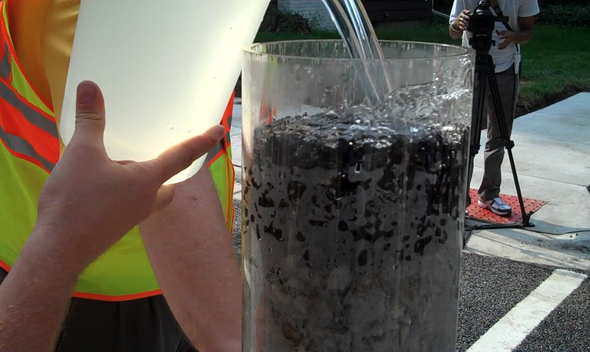
Water is poured into an oversized test tube layered with the same kind of material used to construct the new permeable pavement on Sylvan Avenue in Ann Arbor. Water passes almost instantly into the porous asphalt and is caught in a stone reservoir below. The newly paved road was unveiled during a ribbon cutting ceremony on Friday, Aug. 20.
Edward Vielmetti | AnnArbor.com
Sylvan Avenue has been repaved with a new section of porous pavement, designed to better handle stormwater and deal with the problem of persistent damp basements in central Ann Arbor. The permeable asphalt allows rainwater to pass almost instantly through the pavement down into a reservoir of stone — thus, in theory, drastically reducing the chance of flooding or even puddles.
It is believed to be the first street of its kind in the state of Michigan and was unveiled on Friday following a ribbon cutting ceremony and question-and-answer session.
The completion of the repaving project presents an opportunity to look at some history of this short Ann Arbor street.
Where is Sylvan Avenue?
View Larger Map
Sylvan Avenue is a short street that runs between White Street and Packard Street, south of the University of Michigan campus. It is one of two streets that is part of
Assessor's Plat No. 13 (PDF), a neighborhood that was platted October 1930. To its north is Roger's subdivision, which includes Arch Street; to the south is C. H. Cady's subdivision. A common name for the area is the student ghetto, and when that phrase is used in city documents, it's generally perjorative.
Who lives in the area?
When I went to visit the ribbon cutting and open house and walked down the street, I saw a mix of undergraduate students, graduate students, long time city residents and a parent with young children. A late night walk down an adjacent street let me overhear some young adults noisily enjoying adult beverages.
Several houses on the street were rentals, but I don't have a complete list; at least one was for sale.
Who used to live there?
Sylvan Avenue residents in 1917 included the candy manufacturing Hoffman Brothers, Arthur W. and Dudley Hoffman, who lived at 909 Sylvan. Their neighbor was John S. Drake, a motorman for the Detroit United Railway. In 1917 there were four homes on the street, but the plat map of 1930 shows 29 parcels on the street, with lot sizes as small as 2,700 square feet, or having a dimension of 40 feet by 68 feet.
In 1917 the Detroit United Railway operated streetcar lines including a line down Packard. AÂ 1910 railroad history timeline shows the state of the rail system then; not too far away was the interurban station at the corner of State and Packard, a convenience place to commute to if you were a motorman.
When was the street built?
Part of the reconstruction of Sylvan Avenue, and the part that took extra time, involved getting a new gas main put in. The line dates from the 1920s and was replaced before the new street that was unveiled Friday was put in.
The 1917 directory shows homes in the 900 block but not the 800 block of Sylvan.
Why was the street rebuilt?
Sylvan Avenue has been subject to flooding. Homeowners have sump pumps and prior to being rebuilt, the street didn't drain very well. There was ponding and standing water in the street regularly. When it came time to resurface, the decision was made to rebuild it entirely.
In April, coverage of the city council meeting that approved the reconstruction said:
• Resolution to award a $343,875 construction contract to ABC Paving Co. for the Sylvan Avenue Permeable Pavement Project, which consists of the reconstruction of Sylvan Avenue, a 20-foot-wide, 800-foot-long residential street running between Packard and White streets.
What does the new pavement look like?
Think of it like a layered cake.
At the top of the street, you have a layer of three inches or so of permeable asphalt, described as the structure and consistency of "Rice Krispies treats" at the top. Below that layer, there's a section of clean crushed stone, then a section of clean smooth stone, and below that a layer of sand.
Unlike the Downtown Development Authority lot, located at the corner of South Fifth Avenue and East William Street, this project uses a permeable asphalt layer which has a polymer in it to make it more permanent and less subject to surface wear than the DDA lot.
What kind of skateboard wheels to use when skateboarding down this street?
If you were to get a permit for a block party to block off this block, you could skateboard down it without violating the city's skateboarding ordinance. If you were to do this, Ann Arbor Skatepark Action Committee member Trevor Staples recommends "big, soft wheels."
Edward Vielmetti walks down Sylvan Avenue on his way to AnnArbor.com. Contact him at edwardvielmetti@annarbor.com.
Comments
Yeah !
Tue, Sep 21, 2010 : 7:19 p.m.
Just wait until the snow plows go over this stuff. If anybody has time go look at the old y lot you will see what the road will look like next year. The asphalt will not hold up in the changing seasons!
Mike
Thu, Sep 2, 2010 : 11:45 a.m.
Many of us want to know relative cost and durability. It seems that we should be able to get this from City Council meeting minutes. Our reps surely would have been given this info - or asked for it - before voting on this, wouldn't they? If not, this is incompetence bordering on malfeasance. PS Just because several other cities are jumping into this doesnt mean they researched it any better than we did.
C6
Sun, Aug 22, 2010 : 7:42 a.m.
There's no such thing as a permeable road surface. I know that, because the city has told me so. On their web site they say "Examples of impervious areas include roofs, pavement, sidewalks, patios, and gravel or crushed stone surfaces" here: http://preview.tinyurl.com/25db6u3 They wouldn't lie to us about that, would they?
SonnyDog09
Sun, Aug 22, 2010 : 6:50 a.m.
Given that this new fangled road requires more and different maintenance than regular roads, and given the poor track record that the city has in maintaining existing roads and bridges, I am not expecting much good to come from this. They would have to develop a level of competence that I do not see any evidence of. The project does get the mayor a nice photo op and he can add this to his list of green accomplishments, so even if they have to tear the whole thing up and replace it with a normal road in a year or two, it will have achieved its primary objective.
CynicA2
Sat, Aug 21, 2010 : 10:56 p.m.
Haaa! This stuff reminds me of one of those TV drug commercials, where some fast talking announcer tells you the stuff will cure you if its' various side effects and adverse reactions don't kill you first. One good winter and the "rice krispy treats" will probably look like an entire elementary school had at them! And this is coming from the same bunch of clowns who can't maintain regular asphalt worth a damn! Would you hire them to maintain YOUR roads and bridges?!
amlive
Sat, Aug 21, 2010 : 6:22 p.m.
Aside from the plowing, I'm curious as to how it will handle the freeze/thaw cycles. Once the ground is frozen through, the surface will thaw on sunny days, and the entire porous surface will fill with water blocked by a frozen dam beneath it. Won't this wreak havoc as the trapped water repeatedly thaws and freezes in warm mid-winter spells or late winter? I assume this is somehow accounted for in the engineering and testing, but it seems a tough challenge for any pavement.
Ryan Munson
Sat, Aug 21, 2010 : 5:01 p.m.
Quite a big difference there with the permeable asphalt.
Vince Caruso
Sat, Aug 21, 2010 : 5 p.m.
Many northern areas are putting in porous pavement. Portland Maine is doing a 6 lane road this year. Snow melts quickly off porous, in 2" or less before the plows arrive. Philly is planning to do all it's roads. A developer of 60 home subdivision in north west save $250K doing porous, and when other neighborhoods flooded near them last summer they had no standing water. Can you imagine not listing to road noise off Packard, Stadium or I94 all night long, I can - places all over the world are installing this just to sound deaden roadways, skipping sound walls all together. California reduced death rates on a highway 50% due to no hydroplaning and road spray with this pavement. Ann Arbor is under the gun to reduce pollution to the river by the EPA and may need to build a treatment plant for stormwater at great cost (it all now flows directly to the river- pollution, trash, salt and all). This watershed pollutes the waterways and Great Lakes more than any factory in Michigan.
Brad
Sat, Aug 21, 2010 : 4:41 p.m.
Actually I've observed the pavement in the south lanes of the Stadium bridge to be highly permeable as well. I guess that's why it rates a lower priority than Sylvan.
Spyker
Sat, Aug 21, 2010 : 3:29 p.m.
Three quick maintenance problems with use of permeable pavements in snow belt states: 1) You can't plow for snow removal, you must use power brooms. Not a problem on walking paths or areas with little now, but a major issue with streets in Michigan. 2) You can't use salt or other deicing chemiclas as these will pass through the pavement and enter the ground water. These chemicals used on traditionally paved streets flow to storm water treatment facilities before discharge. 3) You must power vacuum the surface at lest once per year to remove all fine silt from the pavement's pores and keep it permeable.
CynicA2
Sat, Aug 21, 2010 : 3 p.m.
Doubtless it costs more and is less durable - the clueless ones in city hall need to have a fire lit under them so they'll redouble their piddling efforts to resurface the city's crumbling streets. In this economy, they don't need to rebuild everything under and around the roadway, they just need to get some smooth asphalt down. They can worry about rebuilds when (and if) times get better. Since Roman times (if not before), a well maintained system of public roadways has been recognized as one hallmark of a great civilization. Whether you drive, ride the ride, or pedal your way around, all will benefit from nice, smooth roads - and for the taxes we pay to reside in this overrated burg, we certainly deserve them. Someone down there wake-up Hizzoner.
Craig Lounsbury
Sat, Aug 21, 2010 : 3 p.m.
here is a link to a fact sheet I found. One interesting point is a caution about the use of snow plows, salt and sand. So how are we the people going to deal with that white stuff that falls in the winter? It also says it should be vacuumed quarterly. Does somebody from the city have that scheduled? http://www.dauphincd.org/swm/BMPfactsheets/Porous%20Asphalt%20fact%20sheet.pdf
sbbuilder
Sat, Aug 21, 2010 : 10:12 a.m.
What happens when you run a snow plow over this surface? How about the occasional dump truck? Some of this surface is bound to wear away, and those particles will just wash into the Huron River. Also, yes, as per other posters, what is the cost comparison per unit length? What is the expected life duration? Why not just go with a variation of the cobblestone? Europe still has thousands of streets that are cobblestone. When an underground repair is called for, they just pop up the stones in a big heap, do the repair, then put the stones back. (Think recycling.) I know Fendt makes a fabulous interlock brick that is extremely strong, lasts many years, is quiet do drive on, and of course is permeable. In addition, using concrete based products means that were not using fossil fuel based products.
AlphaAlpha
Sat, Aug 21, 2010 : 9:14 a.m.
Mr. Vielmetti - Great article; most commenters have asked excellent questions which hopefully you will answer; the durability and filtration related questions in particular. It would also be interesting to know who developed this long overdue process.. If 24 of the average 32 inches per year of precipitation pass through this 20 x 800 foot road area, ~240,000 gallons of water will be absorbed where it falls, instead of getting into the river. A small step in an important direction.
BTPud
Sat, Aug 21, 2010 : 9:07 a.m.
I agree- some technical info on this new process would be MUCH appreciated.
justcary
Sat, Aug 21, 2010 : 8:47 a.m.
Yes, charming history of the street, but I thought the article would cover the new paving technology, whether it is proven, its cost, etc. as did the other comment contributors. Another article please!
Ignatz
Sat, Aug 21, 2010 : 8:04 a.m.
Won't it act like a filter and so, eventually clog up?
Vince Caruso
Sat, Aug 21, 2010 : 7:57 a.m.
As a member of the Allen's Creek Watershed Group we have been advocating for for the use of porous roads for some years and were part of a city task force recommending this type of project. Glad to see it installed. 40% of this project is funded by federal stimulus funds. With all the flooding and water pollution in this watershed this pavement could make a real difference on roads and parking lots, and some say and show at the same or less cost if you include stormmwater management costs. Benefits of porous pavement are many: virtually total natural detoxification of road pollution as water filters thru it, infiltration rates of up to 200" and hour, no heat island effect, up to 70% less road noise, 70% less salt use and less plowing, frees up space for other uses, no hydroplaning and no heat shock to waterways. Lots of places are doing porous roadways worldwide. Chicago is doing 2,000 miles of alleys, California is now doing highways with it and Philly PA is doing all it's roads with it as they are fixed or rebuilt. Thanks for the photos and video.
Spencer Thomas
Sat, Aug 21, 2010 : 7:39 a.m.
I wondered why it took so long. It seems like it's been going on all summer. I'm thinking this might be a good paving technique for a lightly-traveled street like Sylvan, but wouldn't work well on a street like Packard. And if it helps the neighborhood's flooding problems, then it's probably worth it. Will it need special attention when snow plowing? Probably not a good idea to scrape it until it sparks, like they sometimes.
Kim Kachadoorian
Sat, Aug 21, 2010 : 7:25 a.m.
My hope is that this lasts longer than what is on the old YMCA parking lot - same stuff - the lot is falling apart into little pebbles that are now being washed into our river via the drains.