

Mitchell Elementary School 4th grade field trip rescues a muskrat stuck in a fence
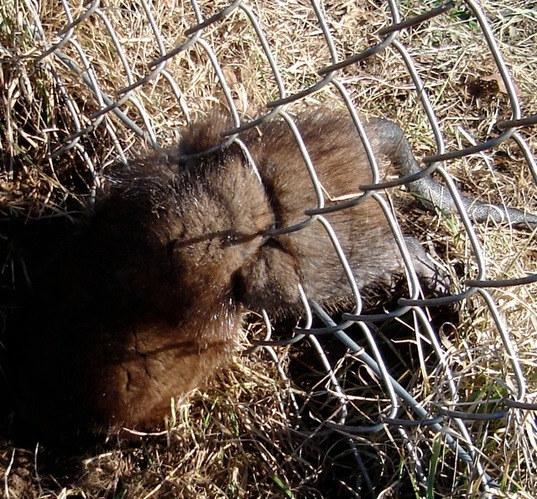
A muskrat caught in a fence at the Portage/Baseline Lake Wastewater Treatment Plant was set free with the help of students of Kathy Spiess's fourth grade class at Mitchell Elementary School. The students were on the Ann Arbor Public Schools Water Tour, led by AAPS environmental educator Dave Szczygiel. Szczygiel leads about 400 field trips each school year.
Courtesy Dave Szczygiel, Ann Arbor Public Schools
A fourth grade class from Mitchell Elementary School on the Ann Arbor Public Schools Water Tour of the Portage/Baseline Lake Wastewater Treatment Plant got an unexpected education in the adaption of aquatic mammals to urbanization on Tuesday. An unfortunate muskrat was heading to its home in one of the water treatment lagoons when it got stuck in a cyclone fence.Â
Dave Szczygiel of the AAPS Environmental Education program led the field trip, which is part of a program that takes all students in grades K-6 on outdoors trips throughout the year. (Good news: The muskrat is OK now.)
The fence was cut open so the muskrat could escape. He scampered off and could not be reached for comment.
Habitat
Muskrats are aquatic mammals. They don't hibernate, but they do build mounds in marshy wetlands along the Huron River and in other watery areas to help them overwinter. Good locations for muskrat spotting are easily seen by canoe along the Huron River, and city parks like Swift Run Marsh and Furstenburg Nature Area have good muskrat populations.
Muskrats in literature
The juvenile literature of the muskrat is not extensive. Cork & Fuzz: Short and Tall by Dori Chaconas tells the story of the friendship between Cork, a muskrat, and Fuzz, a possum; Cork decides that since he is older, he has to be taller than Fuzz.
Muskrat science
The University of Michigan's Animal Diversity Web has a profile of Ondatra zibethicus, the muskrat. "Muskrats are widespread and abundant. Populations remain stable even when they are being hunted for fur, affected by disease, or a target for large predator populations because muskrats have the ability to reproduce quickly."
Muskrat love
"Every time I sing this song, I think of Henry Kissinger," says Toni Tennille in the introduction to this song. If your cultural reference points don't include this version of Muskrat Love, written by Willis Alan Ramsey and performed by the Captain and Tennille, well, all I can say is you're missing something.
Muskrat cuisine
The fall 2004 edition of Repast, the journal of the Culinary Historians of Ann Arbor, features stories and recipes of the muskrat. The tradition of eating muskrat during the season of Lent originates in Monroe County. The story, as recounted by Laurie K. Schulz of Monroe, in a story "Muskrat and the early French settlers", notes that the winter of 1813 was tough for the Reau families who were driven from their homes in the aftermath of the Battle of the River Raisin. They settled on Guard Island in Maumee Bay. "When Father Gabriel Richard found them huddled together there in some native huts, they were starving and asked for dispensation to eat muskrat on Friday. Father Richard granted their wish."
When consumed as meat the muskrats are pronounced as "mushrat"; the Monroe Yacht Club's essay How the muskrat became a fish preserves the legend.
Edward Vielmetti writes about town fauna for AnnArbor.com . Contact him at 734-330-2465.
Comments
jns131
Thu, Mar 18, 2010 : 7:24 p.m.
I have to say this. I loved driving the Water Tour I have learned more about Ann Arbors water supply then I ever thought possible. Thank you for Toni's Muskrat Love. I really miss her. Great job for David although I always seem to get Kathy. But I will pass on the dinner. I guess I am not one for exotic meat.
Bob
Thu, Mar 18, 2010 : 12:52 p.m.
Yes good story...it's always nice to see animal stories with a "positive" ending...and yes, it's an up close lesson that the kids would not have gotten sitting in a classroom so I say... WIN/WIN situation!
Rici
Thu, Mar 18, 2010 : 10:02 a.m.
We're working hard to get more hyperlocal news like this up on AnnArbor.com Personally, I find this way more interesting than a bunch of people getting drunk on St Patrick's Day (total waste of bits). Too bad the local news focus didn't extend to the Grinds of March skate park fundraiser.
suswhit
Thu, Mar 18, 2010 : 7:37 a.m.
Kudos to Dave Szczygiel for teaching kids about compassion and the environment. You can't give young people an experience like that sitting at a desk in a classroom -- I bet they will remember that field trip for a very long time.
FreedomLover
Wed, Mar 17, 2010 : 11:45 p.m.
Let's get rid of those nasty fences so this doesn't happen again.
Ryan Munson
Wed, Mar 17, 2010 : 10:31 p.m.
shadykay--do what I do online. Read the news you want and bypass what you don't. You read the story didn't you?
Epengar
Wed, Mar 17, 2010 : 9:56 p.m.
When young muskrats mature, they sometimes have to disperse away from the wetlands they grew up in. There was one feeding on the cattails in West Park a couple of years ago, and I even saw one trundling through front yards along Division near Hill a few years ago (no idea where that one came from!).
Vivienne Armentrout
Wed, Mar 17, 2010 : 8:33 p.m.
Now that's what I call thorough coverage. Only one thing concerns me. How did those starving French settlers get hold of canned cream-style corn?
Jim Pryce
Wed, Mar 17, 2010 : 8:04 p.m.
I have been on many field trips with my kids & Dave through the years of their elementary education. This is something that the kids would not have been able to do sitting in a classroom. The kids need more field trips in the outdoors, to see natures beauty. How many have seen a sunrise, in the woods? How many have seen the woods wake up in the morning? How many have had a song bird perch right next to them on a limb at eye level? My guess, Not many. Parents take your kids outdoors on a hike, or go fishing, get them away from the video games & tv. There is a whole world passing them by. Thanks A2.com for this story. Kids for more info on animals go to Michigan United Conservation clubs Tracks magazine. It is written on a 4th grade level & you can get a classroom subsciption for $10.
Duane Collicott
Wed, Mar 17, 2010 : 7:17 p.m.
Not "means," "meals".... you know what I meant.
Duane Collicott
Wed, Mar 17, 2010 : 7:12 p.m.
Dave, you should have fried him up. There's at least a weekend's worth of means there.
Snuvs
Wed, Mar 17, 2010 : 7:09 p.m.
What a great story and write up! Only in Ann Arbor...Thanks!
tdw
Wed, Mar 17, 2010 : 6:56 p.m.
Good for the kids good for A2 on reporting on something thats not a bummer.I do have a question,is it common for those things to carry rabies?
spm
Wed, Mar 17, 2010 : 5:47 p.m.
It's called uber-local news. Good going kids. I'm sure the muskrat is much happier.
shadykay
Wed, Mar 17, 2010 : 5:23 p.m.
thank god for the ann arbor news and their hard-hitting muskrat coverage. unbelievable.