

Ann Arbor's Washington Street, now and then
If you have just moved to Ann Arbor, the new resident handbook doesn't include the crucial information that helps you navigate like a native. The native, or the immigrant who has picked up enough of the local folklore to pass for a native, is always prepared to refer to a place by what used to be there.
To illustrate this, here's a walking tour of Washington Street, starting at the University of Michigan and heading to the Old West Side and slightly beyond. This is properly done with a kind of augmented reality software on your shiny mobile phone where you can point to a place and see how it used to be; pretend for a moment that you have that available to you.
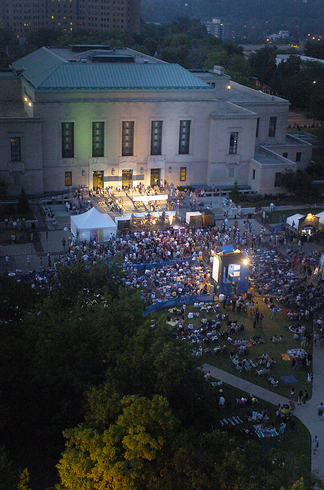
The Ann Arbor Summer Festival's Top of the Park is held on East Washington Street in front of U-M Rackham Building, with the audience flowing into Ingalls Mall.
File photo | AnnArbor.com
At Thayer you get to the construction site for the new North Quad. It replaces the Frieze Building, which was torn down in 2007 after many years of deferred maintenance. I had my first year Econ 201 classes in Frieze in the 1982, and it was drafty and dusty then.
If you go back far enough, you knew this building as Ann Arbor High School, which closed in 1956 when the new school now known as Pioneer High School was built. Frieze held the University's Theatre Department, and when it was torn down the department moved to North Campus, but not before engaging in some collective despair about the loss of the building that held departmental memories.
Going past State Street, there's a low building on the south side in the shadow of the Liberty Square Parking Garage known by a very few as the Cadillac Building. It's had a range of businesses in it that few people would remember unless they were working there. When I worked in that building in the 1990s, the pony-tailed electrical contractor noted that it was right next to the lost Ann Arbor People's Ballroom, a non-profit, community-operated rock and roll dance center that opened in September 1972 and closed in December 1972 after a disastrous fire. The John and Leni Sinclair papers at the Bentley Historical Library have history and archives from the era, including long lists of bands that clamored for dates in the space.
At Division Street, the Art Deco structure of the old Ann Arbor News building is on your right. It's for sale; you might look to use it for a downtown conference center, perhaps, or it would make a dandy place for courtrooms or a police department.
Across the street is a vacant lot that once held a used car lot and has gone through several proposals for development, most recently as Metro 202, a hotel concept. Down the street is the Neutral Zone, a teen center in a former auto dealership that had most recently held Kolossos Printing.
Fifth Avenue brings you to a part of downtown where historic buildings are largely intact, even if the businesses there come and go. Metzger's Restaurant was long time anchor; they closed in 1999 when construction on the parking structure across the street deprived them of loyal patrons, and reopened a few years later in Scio Township.
A photo from the 1970s shows a very conservative looking Metzger's facade next to a wildly painted psychedelic Harry's Army Surplus; it was explained to me that Harry's (now the site of The Arena, a sports bar) took over the lease from the Draggin Inn, a pinball parlor.
Fourth Avenue's historic blocks also have nostalgia on tap. The current site of the Arbor Brewing Company brewpub was for a long time the home of the Bimbo's, a bar known for its peanut shells on the floor, thin crust pizza, and regular singing by the University of Michigan Men's Glee Club. "They had Pong next to the tables, back when computer games first hit the scene," notes an entry on Arborwiki, the local encyclopedia of lore of lost restaurants.
Nostalgia has its limits, and I'll end at Main Street. From Main you can see out toward the Old West Side, which starts at the viaduct carrying the Ann Arbor Railroad tracks.
West Washington's residential areas look just the same as they did in the 1960s and the 1920s, due to the city's strong historical preservation efforts. They still house graduate students looking for a convenient place to live for a few years before heading to Chicago or New York or Seattle for their careers, and further up the street they still house city residents drawn to the area for its proximity to downtown or the campus or the relative ease of getting to the interstate for their commute.
Historic preservation has its limits. Wood rots, roofs leak, and old buildings are hard to keep up to modern codes. Every so often, a functional building is torn down for a new building.
Washington Street has seen its share of development, but even if buildings or businesses go away there's enough of a well-preserved college town nostalgia that can summon up the smell of beer and peanuts or flammable silk-screen solvent on demand.
Edward Vielmetti walks around town for AnnArbor.com . You can reach him at 734-330-2465 or at edwardvielmetti@annarbor.com.
Washington Street starts at Fletcher on the University of Michigan Central Campus. The Rackham Building is on your right as you walk to the west; it's the home of the Rackham Auditorium, a very lovely and plush lecture and concert hall, as well as study rooms and administrative offices for the University's graduate programs. Across the street from it is the Ingalls Mall, which is recently home to the Ann Arbor Summer Festival's Top of the Park. If you squint, you can imagine when this grassy expanse was a parking lot, full of cars parked all the way to the edge of the Diag.
At Thayer you get to the construction site for the new North Quad. It replaces the Frieze Building, which was torn down in 2007 after many years of deferred maintenance. I had my first year Econ 201 classes in Frieze in the 1982, and it was drafty and dusty then. If you go back far enough, you knew this building as Ann Arbor High School, which closed in 1956 when the new school now known as Pioneer High School was built. Frieze held the University's Theatre Department, and when it was torn down they moved to North Campus, but not before engaging in some collective despair about the loss of the building that held departmental memories.
Going past State Street, there's a low building on the south side in the shadow of the Liberty Square Parking Garage known by a very few as the Cadillac Building. It's had a range of businesses in it which few people would remember unless they were working there. When I worked in that building in the 1990s, the pony-tailed electrical contractor noted that it was right next to the lost Ann Arbor People's Ballroom, a non-profit, community-operated rock and roll dance center that opened in September 1972 and closed in December 1972 after a disastrous fire. The John and Leni Sinclair papers at the Bentley Historical Library have history and archives from the era, including long lists of bands that clamored for dates in the space.
At Division Street, the Art Deco structure of the old Ann Arbor News building is on your right. It's for sale; you might look to use it for a downtown conference center, perhaps, or it would make a dandy place for courtrooms or a police department. Across the street is a vacant lot which has gone through a lot of proposals for development, most recently as Metro 202, a hotel concept. Down the street is the Neutral Zone, a teen center in another former auto dealership which had most recently held Kolossos Printing.
Fifth Avenue brings you to a part of downtown where historic buildings are largely intact, even if the businesses there come and go. Metzger's Restaurant was long time anchor; they closed in 1999 when construction on the parking structure across the street deprived them of loyal patrons, and reopened a few years later in Scio Township. A photo from the 1970s shows a very conservative looking Metzger's facade next to a wildly painted psychedelic Harry's Army Surplus; it was explained to me that Harry's (now the site of The Arena, a sports bar) took over the lease from the Draggin Inn, a pinball parlor.
Fourth Avenue's historic blocks also have nostalgia on tap. The current site of the Arbor Brewing Company brewpub was for a long time the home of the Bimbo's, a bar known for its peanut shells on the floor, thin crust pizza, and regular singing by the University of Michigan Men's Glee Club. "They had Pong next to the tables, back when computer games first hit the scene," notes an entry on Arborwiki, the local encyclopedia of lore of lost restaurants.
Nostalgia has its limits, and I'll end at Main Street. From Main you can see out towards the Old West Side, which starts at the viaduct carrying the Ann Arbor Railroad tracks. West Washington's residential areas look just the same as they did in the 1960s and the 1920s, due to the city's strong historical preservation efforts. They still house graduate students looking for a convenient place to live for a few years before heading to Chicago or New York or Seattle for their careers, and further up the street they still house city residents drawn to the area for its proximity to downtown or the campus or the relative ease of getting to the Interstate for their commute.
Historic preservation has its limits. Wood rots, roofs leak, and old buildings are hard to keep up to modern codes. Every so often, a functional building is torn down for a new building. Washington Street has seen its share of development, but even if buildings or businesses go away there's enough of a well-preserved college town nostalgia that can summon up the smell of beer and peanuts or flammable silk-screen solvent on demand.