

Failing with his namesake auto was a blessing in disguise for Ann Arbor inventor Howard Coffin
Howard Earle Coffin's failure to market his automotive namesake turned out to be a good thing for the Ann Arbor inventor, not to mention for society. Can you imagine bragging about your Coffin's safety features?
Yet Coffin demonstrated a consistently golden touch in his many undertakings that followed.
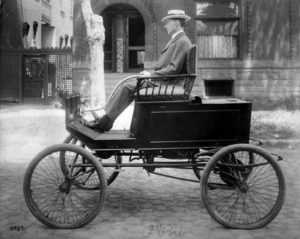
The Coffin Steamer by Howard Coffin would certainly have been one of the first automobiles to drive on Ann Arbor’s streets.
Photo courtesy of the Bentley Historical Library, University of Michigan*
Born in 1873 to a Quaker family in West Milton, Ohio, Coffin graduated from high school in Ann Arbor. As a University of Michigan engineering student in 1899, he laid out the formidable sum of $400 to develop a steam-powered carriage. It’s likely the inspiration came from the well-publicized Locomobile steamer made that same year in Massachusetts. Some sources say the Coffin Steamer was completed in 1901. The driver sat high on a bench and steered with a tiller. Just to help keep him alert, the steam boiler was positioned under the seat.
One trade press notice lauded the Steamer for its working parts, which were said to be “a model of economy.” Coffin had access to the U-M shops for his tinkering, and he also experimented with an internal-combustion engine there.
His two-cylinder steam engine was probably adapted from an existing powerplant like those used to operate pumps or industrial machinery.
White gas, similar to today’s lantern fuel, ignited in a burner, and the flame heated water in the tank. About 30 minutes were required to achieve a boil and make steam. With a steam-powered car, one didn’t contemplate a quick trip to the corner for pizza.
The superheated vapor was then inducted into the engine’s cylinders, forcing pistons through a rotational cycle and creating motive force.
Output from the engine was taken by chain to a sprocket that turned the rear axle. There was no transmission. If it was a “walking-speed” car, braking would have been accomplished by closing off the engine’s inlet valves, thereby stopping the pistons’ action.
No word on how well the Coffin cornered.
One account says Coffin delivered mail in Ann Arbor. If any mention of other journeys exists, it’s buried in local newspapers of the era.
The Coffin Steamer would certainly have been one of the first automobiles to drive on Ann Arbor’s streets. In 1896, Charles Brady King had become the first person to drive in Detroit.
The attempt failed to capitalize a company to manufacture Coffin’s prototype.
The car eventually ended up in the collection of the Henry Ford Museum, where it stayed for decades. It may have been acquired in 1985 for Tom Monaghan’s collection. Today, it belongs to the Terrill Antique Car Museum, in De Leon, Texas.
By his pioneering effort, Coffin staked out a position as a leader in the exciting new automotive industry. In 1902 he was lured with another U-M student, the super-salesman Roy Chapin, to the Olds Motor Works. Coffin ultimately led Olds’ R&D effort. The relatively low-slung, “curved-dash” Olds became a mass market sensation, and several thousand examples were issued from the Detroit factory.
Chapin and Coffin sojourned together during a subsequent, important tour of duty with the Thomas-Detroit (later Chalmers-Detroit) automobile company. By 1907, they started to direct their efforts toward a new car financed by the department store magnate J.L. Hudson. Introduced in 1909, the Hudson Model 20 smashed first-year records with around 7,000 units produced and sold.
The Model 20 adopted a left-hand driving position with controls placed at the car’s center. Other makes would eventually copy this layout.
As a charter member of the Society of Automotive Engineers, Coffin worked to standardize specifications and materials. Patent sharing was another emphasis. Scholar Maxwell Taylor Courson credits Coffin’s efforts with helping the industry to burgeon.
Hudson’s “Mile-a-Minute” roadster in 1912 certified Coffin’s reputation as a genius engineer. Hudson advertised their man was the best automotive engineer in the country, which caused consternation at Ford Motor Co. and an exchange of what Courson calls “combative” letters.
Through official appointments, Coffin helped the United States prepare for World War I. Like other auto industry figures who entered national politics—for example, Edwin Denby and William Knudsen—this earned Coffin no praise from the Eastern press.
“Hardly anybody knows who he is or what he did,” Courson wrote in an e-mail.
“The revisionist historians have had a tendency to demonize Coffin and all who were accused of fraud and mismanagement during 1917-18. The worst accuser at the time probably was Gutzon Borglum, the Mount Rushmore sculptor. He blamed Coffin and a few others for not producing the airplanes needed for the war effort.
“Keep in mind that the United States began making warplanes from scratch in 1917 and from models designed by Europeans. Fortunately, Coffin was exonerated.”
Coffin later had a hand in establishing the organization that grew into United Airlines.
But his real estate development in Georgia was his crowning achievement. “King of the Georgia Coast,” he was called.
First drawn to Savannah, Ga., for a 1911 auto race, he became enamored of the coastal islands and bought property. Directing his gaze to the south, he eventually acquired a vast estate on St. Simons Island, near Brunswick, and purchased Sea Island. After Glynn County built a causeway to St. Simons, Coffin and his cousin Bill Jones, created a resort hotel, The Cloister, that remains a leading Southeastern destination.
And so the road from Ann Arbor to the Georgia islands was cemented.
*Editor's note: This photo, BL000228, is from the Bentley Image Bank, Bentley Historical Library.
Comments
Ann English
Mon, Aug 16, 2010 : 5:45 p.m.
Sounds like the Hudson model was named after J. L. Hudson. I only first heard about Hudsons last month; years ago I first heard of Packards, Nashes and Studebakers, but no stores with those names.