

Gallery Project explores the animal world in 'Umwelt'
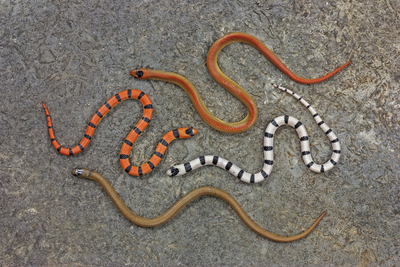
“Polymorphism and the Evolution of Mimicry (Ground Snakes, genus Sonora)” by Alison Davis-Rabosky
“Umwelt,” the Gallery Project’s latest exhibit, serves up a menagerie that can only be described as one of the most fascinating cross-pollinations of art and science we’ve seen locally in quite some time.
Curated by Fred Dyer of Michigan State University, John Mitani of the University of Michigan, and Rocco DePietro and Gloria Pritschet of Gallery Project, “Umwelt” is built around the theory of German scientist Jakob von Uexkuell (roughly a century ago) that’s now foundational to the study of animal behavior.
As Gallery Project’s exhibit statement tells us, “Umwelt—or subjective world—challenges us to think about animals (or indeed any organisms) as they might experience the world through their own senses and respond to it with their own bodies, according to their own (evolved) priorities.
“Adopting this view has led behavioral biologists to a deeper understanding of how evolution shaped the bodies and brains of animals. It also led to the discovery of sensory and behavioral abilities not present in the human ‘Umwelt’ including the ability of honey bees and other insects to see ultraviolet and polarized light; the ability of bats to navigate and hunt prey via echolocation; and the ability of many animals to sense electrical or magnetic fields and to use them for navigation.”
It could be said that “Umwelt” is a way of labeling any creature’s reality by representing all the significant elements of its lived experience as it interacts with the world. And as such, the Gallery Project has been transformed in a manner that’s unusual for this venue’s typical post-modernism.
What has tended to make the Gallery Project’s sometime acerbic view of contemporary society palatable has been its artists' sometimes cock-eyed view of life. There’s a welcome sense of largely light-hearted discovery that makes “Umwelt” legitimately exciting. The display’s unique spread of scientific and artistic talent has yielded a number of video display monitors illustrating or explaining scientific principles.
Among these videos are James W. Atkinson’s “Rotifer Behavior” and “Haplotrema Concavum Transport Behavior”; Fred Dyer’s “Chameleon”; Julia Fahlke’s “Cast of Asymmetrical Skull of Eocene archaeocete Whale (Basilosaurus isis)”; Brian Hare’s “Field Studies of Bonobo Behavior, Democratic Republic of Congo” and “Canine Pointing Experiments at Duke University”; Aaron Sandel’s “Looking into the Lemur Mind” and “Rocks Used by Chimpanzees in Imaginative Play and Learning”; and Michael Sheehan and Elizabeth Tibbetts’ “Wasp Memory.”
Each artifact reports on one facet or another of some animal or insect’s worldview. It’s fascinating to watch the behavior of these creatures (large and small) as they live life on their unique terms.
Uexkuell’s insight was that no species of animal’s lived experience is remotely alike and each creature should therefore be expected to exhibit patterns of behavior uniquely suited to its existence. The proof is in the presentation here.
In the end, however, Gallery Project is a highly talented stable of far-flung artists who seek to illustrate the 21st century in his or her highly individualized way.
Kalamazoo’s Ladislav Hanka has contributed an etching and bees wax triptych, “Bee Tree I, II, III,” and a single print “Reclaiming the Night: Night Pollinators,” which feature his trademark moody landscape representation (in this instance, forlornly dense barren trees) with clumps of beeswax strategically attached to the print’s working surface.
Alternatively, Ann Arborites Evan Economo and Eli Sarnat’s vivid “Ant Profiles” and “Ant Heads” clutch of color photographs give us a dramatically oversized glimpse of what these tiny creatures look like really, really up-close. After a careful study, I have to admit to prefer them life-sized.
And Lapeer’s Rick Pas gets a hearty Gallery Project nod for his playful “Aerial Support” acrylic on board painting. This (almost) photo-realist painting of a woman mowing the grass in her front yard while a squadron of large dragon flies buzzes her overhead is hermetic in its bird’s-eye view, but pure Umwelt in its impulse.
Pas’ clever painting archly gives us the human scheme of things while also reminding us that this insect’s umwelt is something radically different from how we see the world. In essence, we and other animals have fundamentally different views of reality. After a glimpse of Pas’ witty “Aerial Support”—as well as the other artworks and scientific experiments exemplifying so many differing worldviews—our umwelt will never look quite the same again.
“Umwelt” will continue through Oct. 30 at Gallery Project, 215 S. Fourth Ave. Exhibit hours are noon-9 p.m. Tuesday-Saturday; and noon-4 p.m. Sunday. For information, call 734-997-7012.
Comments
Ladislav Hanka
Wed, Oct 19, 2011 : 1:20 p.m.
John, I am pleased to see you still reviewing art and remembering my work. In the Umwelt show I'd just like to correct you a smidge - the point of hanging the Bee Trees was that the artwork was installed in a bee hive throughout the course of the summer and the honeycomb was thus a response by the bees to the intrusion of my artwork into their environment (or Umwelt in German). Some work was chewed up completely and spit out before the hive, other pieces were essentially untouched for months and of the two dozen or so I had in the hives scattered around Kalamazoo, several had enough going on to be visually interesting and those I hung. The didactica I sent along were apparently not hung with the work, so I suppose one must surmise what it is one is actually looking at. The Gallery Project is definitely a worthwhile addition to Ann Arbors cultural scene and I'm glad to see you giving it regular attention in your writing. Best wishes Ladislav Hanka Ladhanka@yahoo.com
Epengar
Wed, Oct 12, 2011 : 3:12 p.m.
This is a wonderful collection! Beautiful works, and really interesting. I think kids interested in science, nature, or art (or all three!) would really enjoy it too. I hope the Community High kids can walk down and see it at least.