

Gypsy jazz bands teaming up for centennial salute to Django Reinhardt
Whether you call it Gypsy jazz, jazz manouche or le jazz hot, rest assured the bands performing Friday night at the Michigan Theater are two of the genre’s best.
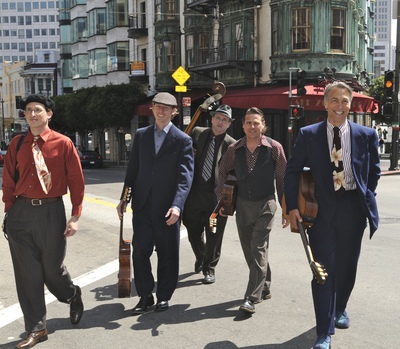
Hot Club of San Francisco
photo by Stuart Brinin
The Hot Club of San Francisco and Hot Club of Detroit team up for “Silent Surrealism: Django Reinhardt’s 100th Birthday Celebration,” a concert at the Michigan Theater presented by the University Musical Society.
The groups celebrate the music of guitarist Reinhardt and violinist Stéphane Grappelli’s pioneering Quintette du Hot Club de France, which shook up the music world in the 1930s and ‘40s with a sound derived from European Gypsy culture and the fertile, polyglot Paris of the 1920s.
As an added attraction, The Hot Club of San Francisco’s segment of the program will incorporate two short films — one funny and one Halloween appropriate — from the 1930s, courtesy of the San Francisco Silent Film Festival.
PREVIEW
"Silent Surrealism: Django Reinhardt’s 100th Birthday Celebration"
- Who: The Hot Club of San Francisco and Hot Club of Detroit, presented by the University Musical Society.
- What: Program of Gypsy jazz, which includes two silent films accompanied by The Hot Club of San Francisco.
- Where: Michigan Theater, 603 East Liberty Street.
- When: 8 p.m. Friday.
- How much: $18-$40. Order online at ums.org, by phone at 734-764-2538, or buy in person at the Michigan League ticket office, 911 North University Avenue.
“It’s just like old school, where you’d go to the movies and there’d be a live orchestra playing,” explained guitarist Paul Mehling, who leads The Hot Club of San Francisco. “We’ll play a lot of my own compositions and a few Reinhardt competitions — we use them as departure points for improvisation. We don’t really score the music to fit the films; what we do is we pick through pieces that fit certain themes in the films, then we improvise, like jazz musicians.” Listen to Hot Club of San Francisco's take on Reinhardt's "Pavane Pour Une Infante Defunte" (MP3).
He said the program is called “Silent Surrealism” because the films are mind-expanding.
"It’s a good fit for Gypsy jazz because Gypsy jazz is already kind of different for most audiences. For the price of admission, they get this time-travel experience where they get to go back and see how people used to act, live and walk, and get to hear old music. … Hearing old jazz played by living musicians is kind of a forward / backward kind of thing — that’s what we offer,” he added.
Although this is The Hot Club of San Francisco’s first Ann Arbor appearance, Hot Club of Detroit is no stranger to Ann Arbor audiences — the group blistered the paint at Kerrytown Concert House’s 25th anniversary celebration last fall, and the group’s accordionist / bandoneon virtuoso Julien Labro has also performed solo at KCH. The band’s honors include first-place in the 2004 Detroit International Jazz Festival competition and multiple Detroit Music Awards.
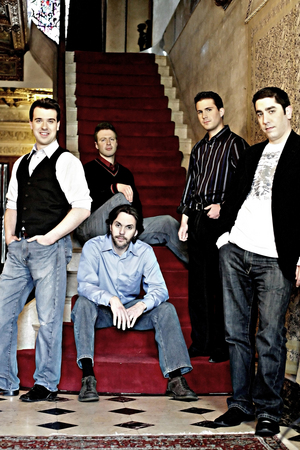
Hot Club of Detroit
photo by Cybelle Codish
Rather than stick slavishly to Reinhardt’s sound, Hot Club of Detroit, formed in 2003 by students at Wayne State University, uses that sound as a jumping-off point for music that’s all its own. While they've maintained some recognizable elements — no drums, the percussive la pompe rhythm guitar technique — the quintet applies those elements to a more modern sound.
“No matter how you try you can never be as good as the original,” Labro said. “If Django was alive today there’s no way he would still be playing the same way. In the 43 years he lived you can see the more bebop he played, swing, the more modern sounds, trying to emulate Charlie Parker or Dizzy Gillespie. We embrace Django and we make sure was always keep that in mind but we also try to bring modern elements to it because we certainly believe Django would have done the same thing.”
When it comes to Gypsy jazz, Reinhardt pretty much invented the musical style, Mehling and Labro agreed.
“There would be no Gypsy jazz if Reinhardt hadn’t come along, he defines the genre,” said Mehling. “Without him we wouldn’t have a Gypsy jazz revival. If there was no Django Reinhardt there would be no Gypsy jazz.”
“We revere him as a hero,” Labro added. “Who knows if the style would have been born (without him). ... He loved American jazz and grew up playing somewhat traditional French music. They combined it all, hooked up with Grappelli and decided to create a drumless ensemble that was very unique, so unique that at the time, it got pretty popular pretty quick in Europe. Even in the (United) States, Django is considered the first European jazz musician.”
Reinhardt, whose musical accomplishments are all the more impressive considering his hand was badly burned in a fire in 1918 (doctors believed that he would never play guitar again), died in 1953.
“Regardless of the injury, he determined nothing would stop him,” Labro said.
Mehling and Labro have noticed that Gypsy jazz is undergoing a bit of a renaissance, thanks in part because of Woody Allen’s movie “Sweet and Lowdown” and the animated film “Triplets of Belleville,” both of which featured the genre on their soundtracks.
“(Woody Allen’s) movie put the music back on the map,” Labro said. “In the last few years, having Hot Clubs all over the country playing that kind of music popularizes the genre.”

Roger LeLievre is a freelance writer who covers music for AnnArbor.com.
Hot Club of Detroit performing live earlier this year at the Michigan Jazz Festival:
Comments
Gordon
Tue, Oct 26, 2010 : 7:45 a.m.
Great coverage - interesting group Cool!