

Huron Players present a spirited and playful 'A Midsummer Night's Dream'
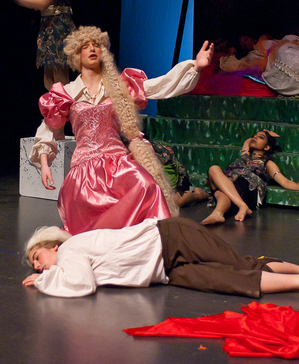
Thisbe (David Field) laments the tragic death of her lover Pyramus (Megan Wesner) in the Mechanicals' play before the duke.
Photo by Brad Orr
This is part of an ongoing series of theater reviews of local high school productions, written by high school students appearnig on AnnArbor.com. This week, Skyline High School's Jonathan Jue-Wong (see bio at end of story) reviews Huron High School's production of "A Midsummer Night's Dream."
Amidst a certain recent highly-anticipated royal wedding in Shakespeare’s native country, the long-awaited advent of spring weather, and the arrival of the "lusty month of May," how fitting it seems for a springtime production of "A Midsummer Night’s Dream." Despite the title’s implication of a midsummer setting, the play is set in the days and nights leading up to May Day, May 1. How appropriate, then, that the Huron Players opened their production of "A Midsummer Night’s Dream" last weekend, on April 29 - an auspicious date for a creative and original Huron Players performance.
William Shakespeare’s A Midsummer Night’s Dream is a satire focusing on love. From cool-tempered nobles, to passionate youths, to capricious fairies, each character in the play is directly affected by “love” and its many manifestations.
The story opens on four young people frustrated in their pursuits and denials of love. Lysander and Hermia are a young couple very much in love. Hermia’s hand in marriage is sought by Demetrius, who in turn is literally chased after by the lovesick Helena. Of course, domineering parents and the local duke are involved, and so to escape the law and authorities, Lysander and Hermia flee to the forest. They are pursued by Demetrius and Helena, and thus begins a strange spring night of, mischief, mistaken identity, and magical manipulation. Add in no less than three sub-plots involving a lovers’ quarrel between the fairy king and queen, an approaching royal wedding of the duke and his fiancée, and a company of rough workers (the “Mechanicals”) preparing a play that tells a love story for said royal wedding, and the result is one of Shakespeare’s most beloved and most memorable comedies.
The Huron Players’ "Midsummer" featured sustained energy from many of the cast members and unique dual-focus direction by guest director Phil Walker. In the superbly-executed confrontation scene in Act III, scene 2, Helena (Eleanor Howell-Shryock) and Hermia (Claire Erba) are verbally and physically sparring stage right while Demetrius (Manuel Anderson) and Lysander (Ryan Hibbs) are angrily thumb-wrestling stage left. In another dual-focus scene, the Mechanicals rehearse their play in the woods as the crafty fairy Puck (Sophie Ruf) plays tricks on them, drawing humorous reactions even as the spoken dialogue continues unimpeded.The technical elements mirrored the multi-focus style direction, with very fluid set-pieces accommodating the extremely transitory nature of the play.
With so much of the plot’s action and characters’ motivations related to relationships and desire, well-developed and believable relationships are essential to any production of "A Midsummer Night’s Dream." Lysander (Ryan Hibbs) and Hermia (Claire Erba) were a very sweet and convincing couple. Hibbs’ Don Juan-style antics in repeated attempts to (shall we say) impress Hermia were highly amusing and a highlight of Act II. In turn, Erba adeptly portrayed Hermia with the requisite broad range of emotions, from fawning affection to shrewish anger. Although the dynamics between Demetrius (Manuel Anderson) and Helena (Eleanor Howell-Shryock) needed development, there were some very intriguing dynamics amongst the Mechanicals. Bottom (Megan Wesner) and Quince (Sarah Stein) appeared to possibly have a thing for each other. (Actor-director relationships? Absurd!)
Although the play’s central message on the madness of love was successfully communicated through the absurdities and antics of the fairies and young protagonists, several of the play’s secondary themes fell flat. Class distinctions and Shakespeare’s commentary on status were weak areas, especially given the lack of nobility in the noble characters’ portrayals. An exception to this disappointing observation was Oberon, King of the Fairies, played by a majestic Ahmed Mohamed. With a Caribbean costume and accent, fierce makeup, and confident stage presence, Mohamed was truly regal. Also, the courtiers Philostrate and Egeus (both played by a committed and decisive Jenny Thompson) were appropriately submissive and subservient.
The aptly named “Rude Mechanicals” often serve as foils to the reserved and dignified nobles; the Mechanicals’ common, error-filled speech contrasts with Shakespeare’s metered prose and rhymed verse written for the nobility. Though the human nobles largely did not act with nobility, the Mechanicals nonetheless were lively, entertaining, and developed characters. Especially engaging was Quince (Sarah Stein) and Bottom (Megan Wesner). In a unique take on Bottom, typically portrayed as arrogant and conceited, Wesner played Bottom with a much more playful character, exhibiting exuberant enthusiasm and a dazzling smile. Ironically, Wesner had the clearest diction and vocal projection in the cast.
Notable performances in the cast were closely matched by technical crews. Director Phil Walker decided to set Huron Players’ "Midsummer" on a colonial era Caribbean island, based on “the recent success of 'The Pirates of the Caribbean,’” an artistic choice that Walker hoped would help actors and audiences to connect more with the “universal” material. The highly effective set (designed by Gabrielle Blakemore) consisted of two large, movable pieces that had painted palm trees and foliage for the Caribbean jungle on one side and walls of stone brick for the genteel locales of the colonial city on the reverse side, in addition to smaller, auxiliary set-pieces.
The sound design and execution (led by the very capable Rebecca Guralnick) was almost flawless. Nearly all of the many sound effects and musical transitions were on cue. The music chosen (much of it Disney) was appropriate for Walker’s playful conception of the play. The “Fairy Song,” a lullaby to the fairy queen Titania sung by her attendants, was a rare quiet and soothing moment in the play and sung very proficiently by a fairy quartet. Costume and hair design were disappointing; for the colonial time period several costumes and hairstyles were clearly anachronistic. Especially puzzling was the fact that Hermia and Demetrius were wigged while Lysander and Helena had their natural hair, which looked very much out of period.
Walker’s main goal in presenting "A Midsummer Night’s Dream" was to “tell the story clearly.” "Midsummer" is a story about the foolishness and irrationality of love and lust. In presenting the play, Walker was not afraid to bring out the play’s more risqué elements, and it is that unflinching courage that is required to direct Shakespeare. Even though the raunch was slightly watered down for high school audiences and actors, it was still emphasized just enough to be humorous and effective. The physical comedy was absolutely superb. However, in strongly emphasizing the core protagonists’ relationships, secondary themes of class and social distinction were lost. Nevertheless, the Huron Players under the imaginative direction of Phil Walker presented a spirited and playful "A Midsummer Night’s Dream" that I very much enjoyed.
Jonathan Jue-Wong is currently a junior at Skyline High School. He is a member of Ann Arbor Civic Theatre and has participated in the Skyline Theatre program in the past. He has performed in numerous productions there and elsewhere, one of his favorites being Moliere's "The Imaginary Cuckold." Since 2009, he has been a member of the International Thespian Society, Troop #7400. He is very interested in writing and journalism, and is considering a career in those fields.