

Performance Network's 'Circle Mirror Transformation' only skims the surface of its characters
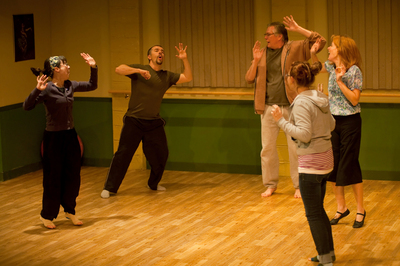
From left, Terry Heck, Taras Michael Los, Mark Rademacher, Eva Rosenwald, and Sarah Ann Leahy in "Circle Mirror Transformation."
photo by Jude Walton | Courtesy of Performance Network
The thing that struck me every time I taught a creative writing class was how ready students were to write about, and thus reveal to their peers (and to me), some of the most painful and difficult parts of their lives.
The desire to plumb these defining moments and be understood by others seemed, for many students, to be substantial part of the class’ appeal. And the inevitable result of so much sharing was that the students quickly developed a level of familiarity with each other that was sometimes startling.
The handful of community ed drama students in Annie Baker’s “Circle Mirror Transformation,” now being staged at Performance Network Theatre, experience something similar, using the stories of their lives as material for theater games and exercises.
Marty (Terry Heck) is the well-intentioned, earnest teacher; James (Mark Rademacher) is her economics professor husband; Schultz (Taras Michael Los) is a lonely, recent divorcee and carpenter; Theresa (Eva Rosenwald) is a former actress who recently left New York, and a bad boyfriend, for Vermont; and Lauren (Sarah Ann Leahy) is a 16 year old who dreams of being an actress or veterinarian.
“Circle” is episodic in its structure, providing mere glimpses (theater exercises and games, student interactions during breaks, etc.) of the class’ six meetings. For this reason, the play is more character-driven than plot-driven, so there’s little in the way of momentum to push it along.
And while “slice of life” narratives certainly have the potential to be just as emotionally powerful as linear ones, they’re far trickier to pull off, and “Circle” ultimately feels undercooked. The nearly two hour, intermission-less play only dips its toe into the complexities of each person’s life, so none of them ever come fully into view - substantial questions are raised that are never answered - and thus the results, while occasionally moving, don’t add up to a wallop.
You also tend to wonder, during the scenes that focus on the silliest theater games - seemingly for no other reason than to provide a laugh - whether all the scenes truly earn their place in the script. Director John Seibert takes great pains not to short-change or rush through even the most drive-by scene, and the play’s moments of revelation are often affectingly staged; but one can’t help but feel that the direction is perhaps too reverent of the script for its own good.
These issues notwithstanding, however, the Network’s cast is sound, with the women delivering some of the most memorable moments on opening night. Leahy injects an appealing, if acerbic, brand of youthful, plainspoken energy to the production. Rosenwald exudes the easy confidence and grace of an experienced actress among beginners, making a brief role as a tree look artistically, ludicrously fulfilling; and Heck does good work as the patient, earth-mother instructor who’s surprised by her own journey of self-discovery.
Daniel C. Walker’s hardwood-floored, multi-purpose room set fits the bill perfectly, filled out with Charlie Sutherland’s props (note the loaded-up bulletin boards and eclectically stocked closet); and Walker’s lighting is on best display in the final scene, when what could be a tricky transition is visually clarified by a shift in the lighting and a small costume change (courtesy of Suzanne Young).
But this final scene once again points to “Circle”’s limitations as a play. A character says something that’s intended to have resonance, and send us back to the play's earlier events; but because we’ve only been afforded small peeks into the lives of these five people, it’s hard to feel more than a passing, general sense of wistfulness.
Jenn McKee is the entertainment digital journalist for AnnArbor.com. Reach her at jennmckee@annarbor.com or 734-623-2546, and follow her on Twitter @jennmckee.
Comments
Sarah
Sat, Apr 30, 2011 : 8:28 p.m.
This play might not be as moving for some people- However, giving the headline a title such as the one Ms. McKee did suggests that it is not worth seeing. The play is hilarious, and has absolutely beautiful moments that so many people can relate to. The biggest problem the reviewer seems to have is the writing and story itself- clearly not her cup of tea. But to convince her readers that the play is basically not worth seeing just because she can't relate to it is just wrong in my opinion. Plenty of people obviously think the writing is amazing- Obie Awards aren't just handed out to everyone. Since she states that the acting and technical aspects are great, I would suggest going to see the play and forming your own opinion. It's likely that it will be different than that of Jenn's. Oh, and the men in the show are fabulous too.
Jeff Gaynor
Sat, Apr 30, 2011 : 1:49 p.m.
This review reflects my sentiments as well - a play that was just a light character sketch, with some amusing and could-have-been poignant moments, that could have been much more.
Playgoer
Sat, Apr 30, 2011 : 1:48 p.m.
Naturally, we don't all have to agree with each other. However, it seems to me the reviewer's and the previous commentator's takes on the play are a bit limited. Not plot-driven? Here's the plot: These students sign up for a class promising to make them better actors. We don't find out whether THAT succeeds. But it makes them into different people, arguably returning them to better lives than they lived before. Is that not a plot? And do we not know just enough about each character to follow his or her trajectory? -- (I do agree that the playwright made regrettable compromises with the types of audience that comes to any play not clearly marked as tragedy with the unshakable determination to "have a good time," i.e., to guffaw at every line that will half-way support it. That sort of compromise is all too common in our age of canned TV laughter.) There was indeed some fine acting and not only from the women.
A2lover
Mon, May 2, 2011 : 6:23 p.m.
"Here's the plot: These students sign up for a class promising to make them better actors. We don't find out whether THAT succeeds. But it makes them into different people, arguably returning them to better lives than they lived before. Is that not a plot? And do we not know just enough about each character to follow his or her trajectory?" No that's not a plot. It's a cop out playwriting gimmick - If I keep things back from an audience and not fully realize the situations, then the mystery will entrance audiences and critics into believing the emperor has new clothes. The Network did the best they could, but it really was a poor selection for the season. Maybe they need to get to New York and see some of these plays before the decide they are right for the theatre. Just judging by reviews and awards is not enough.
A2lover
Sat, Apr 30, 2011 : 12:01 p.m.
I'm surprised this play got the attention it did in New York. When I saw it there I, too, thought (as Ms. Mckee seems to) that it was an acting exercise about an acting exercise. A slight piece of theatre that came from a writing assignment in a playwriting class; full of gimmicks, trumped up laugh lines and a catchy title. Nice to see Ms. Mckee a bit more astute in her review though.
Lovaduck
Sat, Apr 30, 2011 : 5:14 p.m.
I had the same reaction to the NY production. It's really in my (to steal from Woody Allen) "academy of the overrated" list. I wondered if Performance Network could do anything with it. From the review, looks like they didn't. It's really not their fault--it IS essentially a drama exercise, and often like those exercises of interest only to the participants. Too bad.