

Amalia Pica display at UMMA explores difficulty of communication
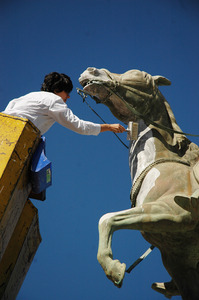
"On Education"
The fact that this is also the title of one of her 6 artworks on display only heightens the stakes. As Jacob Proctor, UMMA associate curator of modern and contemporary art, tells us in his gallery statement, Pica’s blending of metaphor and semaphore—in both visual and historic narratives—ties her art in semantic knots.
“The work of London-based (Argentine) artist Amalia Pica,” says Proctor, “includes sculpture, photography, film, and installation, as well as temporary interventions on buildings, monuments, and objects.
“Across this diverse body of work, Pica has pursued an interest in how personal and collective histories are perceived, transmitted, and represented in different cultural and historical contexts. In particular, the desire for—as well as the uncertainty of achieving—communication is a recurring concern in Pica’s work.
“Devices for communication such as megaphones, antennae, podiums, and signal flags are reappearing motifs,” says Proctor. “They attest to what Pica has described as a longing not only to have something to say, but for the moment of actually finding one’s voice.”
The interesting thing about Pica’s display is that with the exception of two artworks, her exhibit is a secondhand approximation of what’s previously occurred as performance art. This objective distancing conditions the translation—as well as transmission—of what it is she’s attempting to communicate.
Two of these artworks—an 8mm recording of her “On Education” art performance and a series of slides titled (yes) “Babble, Blabber, Chatter, Gibber, Jabber, Patter, Prattle, Rattle, Yammer, Yada, Yada, Yada”—find Pica using her multi-media art to address our relative ability to communicate.
“On Education” was recorded in 2008 at Montevideo, Uruguay, where Pica whitewashed an equestrian statue. She was apparently deconstructing a South American joke asking the color of Napoleon Bonaparte’s “white horse” while the video also quotes Jean-Jacques Rousseau’s 1762 pedagogical treatise, “Emile, or On Education” where Rousseau sought to explicate his views on the fractious relationship of the individual to collective society.
There’s some nearly impenetrable symbolism taking place in “On Education”—so one must be in on the joke or it loses its impact. By contrast, 2009’s “Babble, Blabber, Chatter, Gibber, Jabber, Patter, Prattle, Rattle, Yammer, Yada, Yada, Yada” uses 80 8mm slides to project these English words through the use of semaphore flags—“one letter or space per slide” (as the gallery card tells us). The performance reflects on translation through a rapid-fire carousel of abstract meaning.
“Escapees,” another carousel series of 35mm slides, is communicatively opaque—by design. In this 2008 slide show, Pica excises the horse from rider-on-horseback photographs taken of equestrian monuments around the world. The images flashing on the gallery wall thus feature these horses' absence. Sardonic and witty, “Escapees” is easily the most engaging of Pica’s works in this UMMA project.
Two installations—2009’s “Reconstruction of an Antenna (as seen on TV)” and 2011’s “If These Walls Could Talk”—find Pica communicating with her audience in other guises. “Reconstruction of an Antenna (as seen on TV)” consists of various found elements (shovel handle, scrap metal, plastic grip) to create a sculptural antenna that’s anachronistic in this age of digital television transmission.
“If These Walls Could Talk” consists of two large walls set in the center of the gallery where 60 embedded aluminum cans have been crisscrossed in intricate connecting coils to imitate a crazy-quilt telephone switchboard. Frustrated attempts to communicate—we’re once again confronted by a (lack of) “Babble, Blabber.”
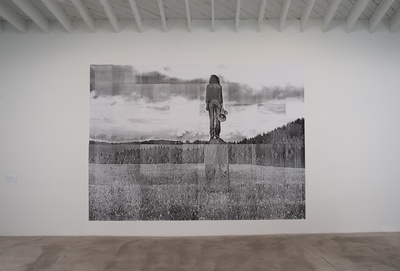
"Sorry for the Metaphor #2"
A summing up of both her gallery project and personal philosophy, “Sorry for the Metaphor No. 2” touches on Pica’s social and political posture through her chosen symbolism. Looking at the empty grove of trees surrounding her, Pica communicates herself; albeit through a lack of communication. Isolated, yet standing in subtle defiance, she’s not sorry—and she’s not finished, either.
“UMMA Projects: Amalia Pica” will continue through Sept. 18 at the University of Michigan Museum of Art, 525 S. State St. Museum hours are 10 a.m.-5 p.m. Tuesday-Saturday; and noon-5 p.m. Sunday. For information, call 734-763-UMMA.
Comments
Elma Galeano
Tue, Jul 12, 2011 : 12:01 p.m.
Not many know that online courses follow the normal academic schedule for each term. They are not self–paced. For instance all registered students at the "High Speed University" proceed through the course as a group