

Brief trip reveals my inner Canadian
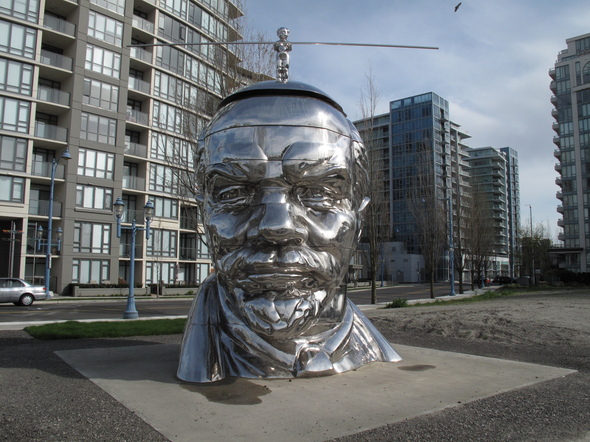
Critics of a single-payer health care system described the Canadian system as “socialized medicine,” so my inner Joe McCarthy was not surprised to find the Gao brothers’ controversial temporary art installation of Vladimir Lenin with “Miss Mao” perched on his head just a block from my hotel in Richmond, British Columbia. The installation was part of the Vancouver Biennale.
Dennis Sparks/Contributor
Jet travel has become commonplace, but for me it remains a miracle of sorts. On Thursday I got up in Ann Arbor at 5 a.m. and around 3 p.m. PT walked from the Vancouver airport into the splendor of British Columbia. To do so, I hurtled at hundreds of miles an hour some 35,000 feet about the earth inside a relatively modest sized metal tube that landed in the correct city on the right runway at its scheduled time. My inner child thinks that’s pretty amazing!
While in Vancouver, my inner Mark Twain wanted to ask my Canadian hosts — who were school administrators from around the province — if while I was there they could arrange for me to attend a death panel for old people or children afflicted with expensive diseases. But having explored our comparative health care systems on previous visits to Canada, I already knew of the sad bewilderment Canadians feel when I tell them that in the United States people die because of the lack of health care or go bankrupt trying to pay for it, problems that I hope will be resolved as the United States moves toward universal health care.
Instead I decided to take another tack by using a luncheon to distribute to my hosts some U.S. dollars I had brought with me believing that the steep tax rates that fund their social safety net we so fear in the United States must put a real crimp in their lifestyles. But I got distracted listening to them talk about trips they had taken to Singapore, Africa and New Zealand, to name a few destinations, and my inner fiscal conservative caused me to remain seated on my wallet.
Travel reveals our identity and commitments
I enjoy Canadians’ humor and hanging out with people who ride trains and ferries to work and talk knowledgeably over dinner about sustainable energy. I appreciate the conversations I have with them about educational issues and about larger world affairs. They are unassuming and understated while quietly demonstrating that they are more informed about politics in the U.S. and world events than are many, if not most, of our citizens. And because Canadians are comparatively well traveled, their grasp of global perspectives enriches those conversations.
Canadians’ travel and national culture — perhaps because their participation in the British Commonwealth taught them they were citizens of the world rather than superior to it — seem to open them to other points of view in ways that are largely absent in this country. I know that Canadians, like citizens of other countries, are a varied lot. My experience with an outlier occurred on a 4 a.m. shuttle ride to the airport with a driver who was upset that his country doesn’t apply capital punishment to the “wild dogs” who wantonly kill other human beings. But he didn’t express any resentment about Canada’s gun control measures, which we discussed at some length, perhaps because in his country the government is viewed as an ally, not the enemy of its citizens as it sometimes is here. My Canada feeling was quickly restored, though, by free wifi at the airport!
Perhaps I am overstating the case, but my sense is that Canadians through their social democracy demonstrate the value they place on family and community in ways to which we only pay lip service in the United States. The Canadian health care system — which Canadians are quick to admit has its flaws — is but one expression of that value. And the first-hand impressions that many Canadians acquire through their international experiences teach me that the most valuable forms of travel change us by broadening and deepening our perspectives.
My time in B. C. reminded me of something that Alain de Botton observed in The Art of Travel. “[T]he charm of a foreign place,” he wrote, “arises from the simple idea of novelty and change . . . . But there may be more profound pleasures as well: we may value foreign elements not only because they are new but because they seem to accord more faithfully with our identity and commitments than anything our homeland can provide.”
Perhaps what this brief trip really revealed to me was my inner Canadian. I’m aware, though, that I also have an inner malcontent who would likely find fault with many things if I were a citizen and taxpayer of that country, which would probably just make me a typical Canadian.
Nonetheless, I want to feel national pride, as Canadians do, while also recognizing that we are not in this life alone. Self interest seems to be part of human nature, but so, too, is our connectedness to others through our families, in our communities, and as members of the family of nations. A better understanding of our unique identity and commitments is a gift of the commonplace miracle of international travel when we are open to being changed by it.
Dennis Sparks’ “Things Observed” essays and photos encourage readers to see familiar things in new ways. His latest book, Leadership 180: Daily Meditations on School Leadership is being published this month by Solution Tree Press. You can also read his blog on school leadership and contact him at dennis.sparks@comcast.net.
Comments
Steve Gilzow
Mon, Apr 19, 2010 : 7:17 a.m.
Dennis, I enjoyed and concur with this piece. My own inner Canadian is nourished by canoe trips on their wonderful waters. One way of nurturing that inner Canadian is listening to CBC radio (89.9), especially Vinyl Cafe at 9 on Saturday mornings. Thanks for writing this. Steve Gilzow