

Home energy audits can stop money from flying out the window
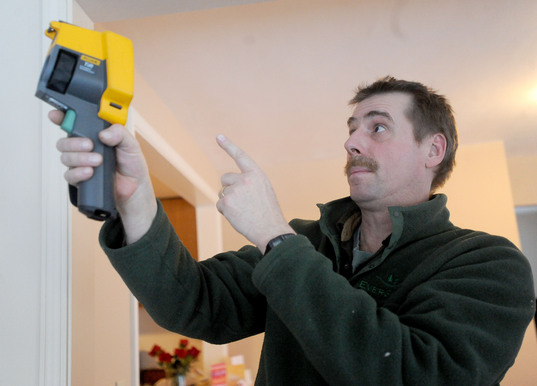
HERS rater Nate Munson uses an infrared imaging device during an energy audit at the home of Wilfred and Megan Smulders.
Angela J. Cesere | AnnArbor.com
“Wilfred would rather replace windows than buy a new leather couch,” said his wife, Megan.
They dial their thermostat down to 50 degrees at night.
So after the couple bought their first home, a 1948 two-story, wood-frame house in Ann Arbor Hills neighborhood, they took Realtor Rob Ewing up on his offer for a free energy audit. Their house would be analyzed from the basement to the chimney top for energy efficiency.
They waited six months after they moved in to have the audit performed, Megan said, so they would feel attached to the house before they were hit with any bad news.
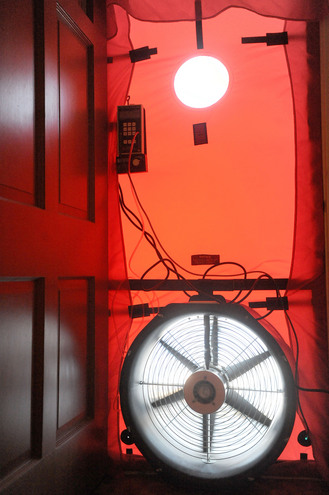
A fan is mounted in the door at the home of Wilfred and Megan Smulders during an energy audit. The fan blows air out of the house so that air leaks can be found from air coming back into the house.
Angela J. Cesere | AnnArbor.com
Enter Nate Munson, owner of EverGreen Energy Savers, armed with a blower door (a fan in a temporary door) that creates a vacuum throughout the house, an infrared camera that reveals breaches and a sleuthy little smoke stick that ferrets out drafts around molding, lighting fixtures, switch plates and more.

Munson creates the vacuum and then uses the smoke pen to look for breaches, from the baseboard to the trim above an inside wall door to the rim around a ceiling lighting fixture. If the tiny wisp of smoke moves horizontally, it is being pushed by a stream of cold air from a breach.
The infrared camera takes a picture of the house’s heat signature, looking inside the walls of the house for insulation - or the lack of it.
Ewing, a certified ecobroker and real estate agent with Charles Reinhart Company, offers free energy audits as a marketing tool to help his buyers identify cost-efficient ways to improve energy usage. The house sales doesn’t hinge on the audit, which is done after closing and when there is at least a 10-degree difference between the outside and inside.

“It’s a closing gift that keeps on giving,” Ewing said.
The energy efficiency of most houses can be improved between 25 and 75 percent, he said, and there are government incentives for many of the improvements. 

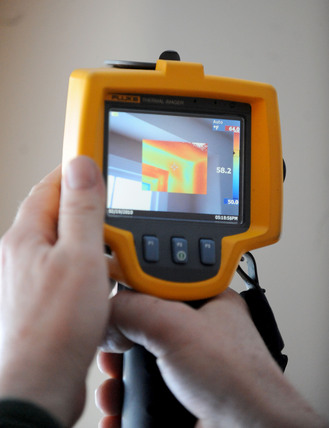
An infrared imaging device is used during an energy audit at the home of Wilfred and Megan Smulders.
Angela J. Cesere | AnnArbor.com
“Air infiltration is the biggest way to lose energy efficiency,” Ewing said. That means leaks around outlets, around windows, where the ceiling meets the wall - anyplace that leads outside.

“Air infiltration if the most common but the least understood,” Munson said. “It’s where your heating costs go out the window. Insulation, everyone understands. But insulation without air seal is ineffective.”
The warmed air will travel over the insulation to the hole or cracks that leads outside. 
Simple solutions such as sealing up the drafts and installing insulation in key places can save 25 to 50 percent of annual heating costs, Munson said.

Once the seals are tighter, attention can be turned to creating the heat, Munson said. Older furnaces are 75 to 80 percent efficient while new ones are up to 95 percent efficient.
New windows will also cut energy bills but will take much longer to recover the investment, Munson said.
The Smulders’ preliminary results showed some of the usual suspects in Munson’s energy audit:
They could reduce 35 percent of their energy loss simply by sealing leaky areas. Munson listed 29 separate locations, from the plumbing penetrations in the basement to the front door on the first floor to single-pane windows on the second floor.
They could add insulation to the attic along with the foundation walls.
They could seal and weatherstrip windows and replace the single-pane basement windows with glass block.
There were also recommendations, further down the list, that would require more of an investment, including replacing the old inefficient furnace and air conditioner with high performance units. 

The Smulders plan to start simple.
“We’re looking for easy fixes that will save the most on our energy bill.” Megan said.
Janet Miller is a freelance writer for AnnArbor.com. Reach the news desk at news@annarbor.com or 734-623-2530.
Comments
BobbyJohn
Tue, Mar 2, 2010 : 4:15 p.m.
Ms. Miller states in the article that older furnaces are 75-80% efficient. Actually, many new furnaces are 78-80% efficient and are sold as "high efficiency" furnaces by the manufacturers and dealers. Many older furnaces are 55-70% efficient, so replacing with an ultra high efficiency furnace of 95% which qualifies for tax credits and utility rebates will have a quicker payback. Let's check our sources to get info right!!
Ryan Munson
Thu, Feb 25, 2010 : 11:21 p.m.
Oh dear. After reading this article I have to debate between replacing my furnace and air conditioner or redo the kitchen. Tough choice.
kbk
Thu, Feb 25, 2010 : 10:32 a.m.
What's the cost on these audits? Any idea what the payback time on the audit itself is?
Sling Blade
Thu, Feb 25, 2010 : 8:22 a.m.
We voted for our favorite snowman, maybe we should have a caption contest for this photo.