

Crop rotation is necessary, even for the backyard gardener
Janice Leach | Contributor
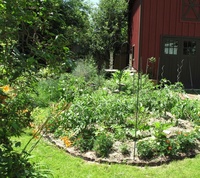
Until recently, I thought that crop rotation was a topic of interest only for farmers — people who grew lots and lots of plants. Crop rotation, the practice of growing a series of dissimilar crops in the same area for subsequent seasons, seemed like too complicated a concept for a backyard vegetable gardener like me to worry about.
Besides, I liked my habits: tomatoes, peppers and broccoli in the round bed, more tomatoes in the bed by the trellis, the cabbage and kale in the same spots. I liked the familiar shape and layout of the garden from year to year.
This year in the Master Gardener course, I was exposed to another point of view — one that showed the positive sides of crop rotation. As I’ve done more reading on the topic, I’ve come to the conclusion that rotating crops among the beds of a backyard garden is actually an important and interesting practice, and also one that we needed to adopt in our garden.
What are those positive effects of crop rotation?
Disease control. Many diseases and pests tend to affect plants of the same types. Rotating crops reduces the likelihood of diseases which can remain in the soil. For example, tomatoes, peppers, eggplant and potatoes are in the Solanaceae family and have similar susceptibility to diseases. If a gardener wants to rotate crops, any of the plants in this family should not be planted where other members were grown in the previous season.
Nutrients. Different plants use different amounts of nutrients from the soil. A crop which requires a high amount of a particular nutrient from the soil — for example spinach’s need for boron — could eventually lower the levels of that nutrient and then not do as well in that area.
The other example most people are somewhat familiar with is how legumes like beans and peas fix nitrogen in the soil. It makes good sense to alternate them with other plants that can take advantage of that nitrogen.
Soil improvement. Rotating crops can also improve soil structure by alternating deep rooted plants with shallow rooted plants.
If you’ve already planted your veggies for the year, suggestions to consider rotating your crops are coming a bit late. If you are like me, however, you might need a little time to think about your practices and your willingness to make changes.
If you are considering making changes next year, you can make a map or diagram of what you planted in which spots this year. It’s a good idea to keep those garden plans so you can compare them year to year.
I'm interested in observing what differences crop rotation might make in our backyard garden.
- Is crop rotation too much bother for your garden? Or is crop rotation part of your gardening practices?
- If not, is it something you might consider doing in the future?
Janice and Jim Leach have been gardening together for close to 30 years. They tend a backyard plot in downtown Ann Arbor, where they try to grow as many vegetables and other plants as possible. For the last four years, they've published gardening tips, photos and stories at their 20 Minute Garden website.
Comments
KJMClark
Sun, Jun 26, 2011 : 11:10 p.m.
The farmers mostly do rotations just for nitrogen these days. Most of the commercial farmers seem to almost always do a corn/soybeans rotation, and they would probably do corn all the time if the soybeans didn't fix nitrogen for free. I'm not sure what rotations the wheat farmers are using. I hope it's not just wheat all the time. You have to talk to organic farmers to get serious rotations. I'm thinking about a five-year rotation, but I'm trying to figure out how to do alfalfa in that. It's kind of a waste to do alfalfa only a year or two. We've been doing rotations in our home garden for, geez, 15 years or so? Pretty much as soon as we set up our garden as a square-foot garden we started doing rotations for disease/pest control. It's pretty important for disease control, but on the small garden scale it's less important for the other reasons. It's easy to broadfork a garden, but try that with an acre. Ouch. We put compost in all of our plots each year, and do a bit of pH correction over time. The easiest way to do rotations in the garden is to not plant the same family of plant in the same plot each year. It's even better if you skip two years, but for most soil pests/diseases, every other year is probably good enough.
KJMClark
Tue, Jun 28, 2011 : 8:31 p.m.
Yeah, that's not bad. I know you don't want to put cole crops in the same beds more than every three years because you can encourage club root. You don't want root crops to follow grass/sod because of wireworms. You should rotate root crops otherwise because of nematodes. I'm sure there are many more diseases.
Jim and Janice Leach
Tue, Jun 28, 2011 : 1:38 p.m.
I've been reading Jeff Ball's _60 Minute Garden_ (Rodale Press, 1985). He advocates working with 4 raised beds and cycling families of crops through the beds over a 4 year period. If there's room, he suggests a gardener add a fifth bed and grow a cover crop (something grown to enrich the soil and then turned under). His plan would be especially good for someone starting a garden from scratch. We've designed our garden beds to fit the shape of our yard so none of them are traditional rectangular raised beds. The idea of rotating crops is one I will continue anyway.
KJMClark
Mon, Jun 27, 2011 : 10:08 p.m.
Alfalfa doesn't really look any different from timothy for nutrient removal. Except you'll notice the second link doesn't mention needing any added nitrogen for the alfalfa. That's because you don't need it; alfalfa adds its own nitrogen. And alfalfa needs fertilizer if you're selling all the cuttings. If you're primarily using it for soil improvement, your fertilizer needs go down a lot. We only sell a bit to friends with chickens at this point. I planted it to put back nitrogen and rough organic matter, and to loosen our clay soil.
Jeremy Miller
Mon, Jun 27, 2011 : 8:07 p.m.
While I care more about production than organic. Most alfalfa rotations require fertilizer to get back in shape for next season. <a href="http://www.ipm.msu.edu/cat09field/pdf/E2904.pdf" rel='nofollow'>http://www.ipm.msu.edu/cat09field/pdf/E2904.pdf</a> -- see table 3 for how much it pulls relative to other field crops. Also <a href="http://news.msue.msu.edu/news/article/whats_the_real_cost_of_fertilizing_alfalfa" rel='nofollow'>http://news.msue.msu.edu/news/article/whats_the_real_cost_of_fertilizing_alfalfa</a> Sorry for the link dump. I have field of mixed grasses I have been consider turning to alfalfa. I have never put alfalfa in a garden so I assume for human consumption so I will also assume very low yield (yuck ;P) so this may not matter.
Enso
Sun, Jun 26, 2011 : 10:22 p.m.
Hell Yeah! Good article. Thanks!