

A guide to Ann Arbor-area native plants in the winter, part 2
Winter continues, and so does the chance to explore a different side of nature, and native plants, than you see when the leaves are out. So far, I’ve talked mostly about herbaceous plants, which disappear at the end of a growing season, only to spring back as the warmth and sun return. But, woody plants are the trees and shrubs that you see through the winter, and can have some pretty interesting features to see as well. In fact, winter brings out the best in some plants that aren’t as showy in the summer.
Red osier dogwood (Cornus stolonifera or Cornus sericea) and Silky Dogwood (Cornus amomum) are native shrubs that are mostly found in wet/moist soils so you’ll find them in wetlands, and along stream banks, but they also thrive in drier situations. While they have bright white flowers in late May-early June, what gives red osier dogwood its name is the bright red bark it displays in the winter.
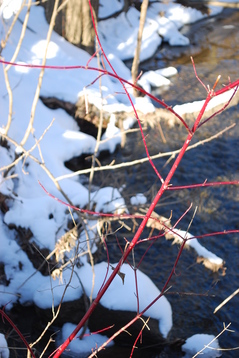
Red osier dogwood (Cornus stolonifera) along a wintry stream
Rick Meader|Contributor
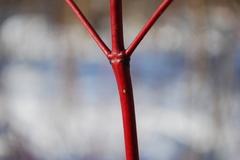
Red osier dogwood twig
Rick Meader | Contributor
You can distinguish between the two by their bark striations (red osier’s markings are mostly horizontal, across the stem while silky’s are longitudinal, along the stem). You can also distinguish between the two by cutting into a small twig. Silky dogwood’s pith (center) is light brown, while red-osier’s is white. While similar non-natives may be found in manicured landscapes, if you fall in a stream and grab a red-barked shrub to help yourself out, you can likely give thanks to one of these two native species.
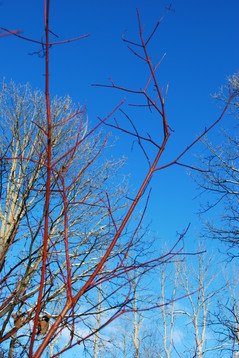
Silky dogwood (Cornus amomum) against a clear winter sky
Rick Meader|Contributor
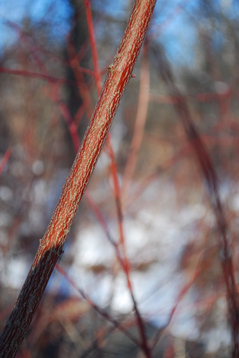
Silky dogwood bark striations
Rick Meader | Contributor
Nannyberry (Viburnum lentago) is another wetland shrub with a fun winter feature. If you look at the end of a Nannyberry shrub’s twig, you’ll see a very interestingly-shaped bud. It’s kind of shaped like a tear-drop - a very big, goofy-shaped teardrop. You might think it looks more like a genie’s bottle. In any case, it’s fun and distinctive, so you can amaze your friends by identifying the shrub based solely on its buds.
Nannyberry can get up to 15 feet tall (there’s a huge one at the north end of the Nichols Arboretum Main Valley that is even taller) and its leaves turn a brilliant red in the fall. The berries are edible, but not tasty (I can tell you this from firsthand experience).
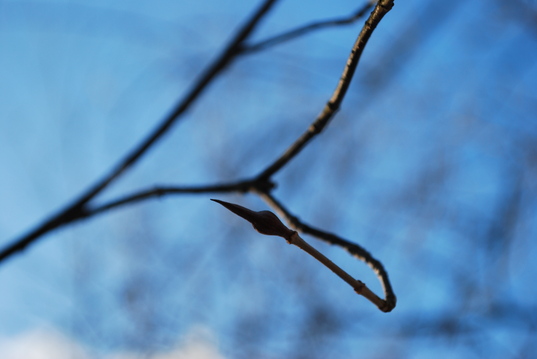
Nannyberry (Viburnum lentago) bud
Rick Meader | Contributor
Finally, for today, let’s visit the prickly gooseberry (Ribes cynosbati), from a distance. As the name implies, the berry is prickly, but not as prickly as the plant itself. It sports both fairly rigid spikes and smaller prickles that give it a presence throughout the year, but now it’s even more visible, without the cover of leaves of its own, and of its neighbors.
It frequently grows in open, dry woods such as oak-hickory forests and oak savannas but can also be found in beech maple forests, which tend to be a darker, with moister soils. This may not be a shrub you want in your yard, as it seems to take the place of cacti in our woods, but it is a distinctive shrub that only grows between 3-5 feet tall, and gives you another chance to amaze and annoy your friends. (I’ve gotten used to it.) You definitely do not want it in your yard if you have White Pines, as it is an alternate host for the eastern white pine blister rust disease.
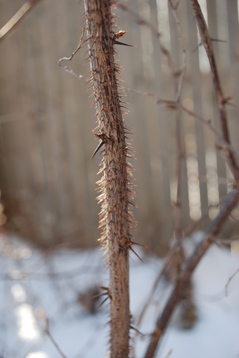
Prickly gooseberry (Ribes cynosbati) - mature stem
Rick Meader | Contributor
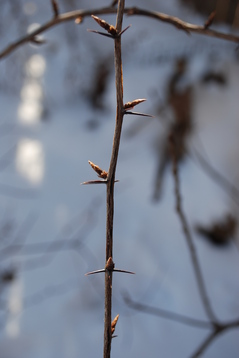
Prickly gooseberry - young stem
Rick Meader|Contributor
There are many more native shrubs to visit, both prickly and smooth, with winter interest and without, but these may help make your winter walks a little more interesting. Talk with you again soon!
P.S. If you want some hands-on experience with seeds from native plants, you are cordially invited to attend the Wild Ones meeting Wednesday, Jan. 13, at 6:45 p.m. at the Matthaei Botanical Gardens. We'll be cleaning seeds from a wide variety of native plants that will then be used in plantings in the Botanical Gardens and Nichols Arboretum. It's fun, and you'll learn something new, I guarantee it. And, despite the name, the Wild Ones are a pretty docile lot.
Comments
Rick Meader
Wed, Jan 13, 2010 : 9:54 p.m.
I'm glad they're helpful, and I'm glad you're reading the blog. There will be more!
Sandy Peterson
Wed, Jan 13, 2010 : 2:53 p.m.
I love the pictures. This helps me in my back yard.