

Native plants that add some color to a green, green woods
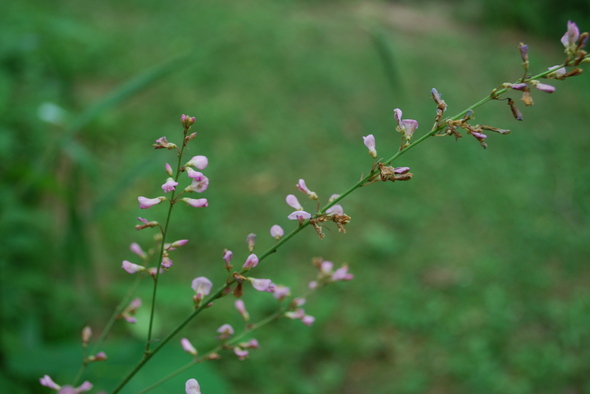
Woodland tick trefoil (Desmodium glutinosum) sprays pink into a shady setting
Rick Meader|Contributor
Summer in Michigan — I love it. I love the heat. I love the swimmable lakes. I love the deep green of our woods. But one thing that doesn’t thrill me is the lack of any other color in the woods.
In the spring, the woods are alive with whites, lavenders and pinks. In the summer? Green, lots of green. But, there are a few colorful members of the woods family, and we’re going to learn more about them today in the hopes that you might want to add them to wooded parts of your yard.
Woodland tick trefoil (Desmodium glutinosum) is a cute little plant that has nice foliage and dainty sprays of pink flowers sticking up about two to two and a half feet tall. The flowers don’t last long and form seeds with a Velcro-like surface that helps them spread far and wide.
It is blooming in my yard right now, and has been for the last week or so. Due to the “sticky” adaptation, it is now moving about the shady parts of my yard.
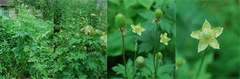
Thimbleweed (Anemone virginiana) adds some subtly colorful structure to a shady setting.
Rick Meader|Contributor
Thimbleweed (Anemone virginiana) is another plant that is blooming right now. It has a five-petaled yellowish-white flower that is about three-quarters-inch wide. It’s not super-showy, but it has a couple of cool things going for it.
First, the plant itself, which reaches a total height of three to four feet, has a tiered look, much like the Pagoda Dogwood (Cornus alternifolia). It might be a neat landscape effect, if you have a Pagoda Dogwood, to plant a bunch of Thimbleweed around it, to accentuate the tiered effect of both plants.
The other fun thing about Thimbleweed — which, by the way, should not be confused with Thimbleberry (Rubus parviflorus), a plant more common up north that produces tasty berries that make a great jam — is that the seedhead is persistent and forms cottony balls at the end of the stalk which may last much of the winter. Thimbleweed also is adept at spreading itself, but not too annoyingly so.
Fringed loosestrife (Lysimachia ciliata) is a moderately tall plant, about three to four feet tall, from the Primrose family that has bright one-half to three-quarter-inch five-petaled yellow flowers at the top of the plant that droop downward.
It’s not super showy, but its habit of forming masses that multiply the plant’s effect in the woods. While the “loosestrife” part of its name might cause fear in the hearts of some who have learned of the negative effects of purple loosestrife, this plant is a native, while purple loosestrife is not.
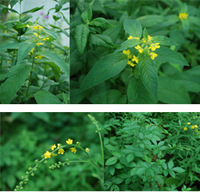
Fringed loosestrife (Lysimachia ciliata) (Top) and Agrimony (Agrimonia gryposepala) add yellow to shady landscapes.
Rick Meader|Contributor
Agrimony (Agrimonia gryposepala) is another plant with sticky seeds, but it has little yellow flowers at the end of the flower stalk that add some subtle yellow color to the woods. It prefers moist to moderate soil conditions and full to partial shade. I have quite a bit of it in my yard which has partial shade and dry (but not sandy) soil. As I said, it has sticky seeds and these spread quite well — too well for my taste, but it is a plant with its fans.
Finally, while it’s not a flower, I’d be remiss in not mentioning the black/purple color that ripe black raspberries (Rubus occidentalis) are adding to woods clearings and woodland edges right now. The pain inflicted by their sharp thorns is definitely worth it (though severe) when you taste a handful of the juicy and seedy berries or put some on your cereal in the morning.

Black raspberries (Rubus occidentalis) are well worth the pain you might feel in gathering them.
Rick Meader|Contributor
Well, that concludes our tour of a colorful (but mainly green) wooded landscape. This week, blooming in my yard, are Woodland tick trefoil, Agrimony, Fringed loosestrife, Thimbleweed (in the shadier areas), Wild bergamot, Swamp Milkweed, Common Milkweed, False sunflower, Bottlebrush grass, Big bluestem and Yarrow. Get out and enjoy nature, and some black raspberries, everyone!
Rick is a local landscape architect with a special interest in all things natural, including native plants and the critters that eat them. You can contact him at yourland1824@gmail.com.
Comments
Rick Meader
Sat, Jul 16, 2011 : 8:10 p.m.
I received an e-mail from Amanda KIain of Native Plant Nursery that they will soon have plugs of Woodland Tick Trefoil (Desmodium glutinosum) available for sale. You can talk with them on Saturdays at the Ann Arbor Farmer's Market, or check out their website at <a href="http://www.nativeplant.com" rel='nofollow'>www.nativeplant.com</a>
Rick Meader
Thu, Jul 14, 2011 : 3:48 a.m.
Hi everyone, thanks for your comments. Rork, regarding spotted knapweed - Kill, Kill, Kill! It's allelopathy makes it a bad neighbor for native plants that can support more than just honeybees, so I support your efforts. Regarding where you can get the plants in the article, you can get all but Woodland tick trefoil and Black raspberry from Wildtype Nursery and/or Native Plant Nursery. If you really want the trefoil, there is a nursery in Kalamazoo named Hidden Savanna Nursery (<a href="http://www.hiddensavanna.com/plants.php)" rel='nofollow'>http://www.hiddensavanna.com/plants.php)</a> that carries it. I really wouldn't try to get the black raspberries growing in your yard - the berries are good but it's a pretty rapid spreader and you can probably find enough berries growing in the wild to satisfy your needs. I have it growing in my yard, but I didn't plant it, knowingly.
suem
Tue, Jul 12, 2011 : 5:29 p.m.
Thanks dading. Great info
Bertha Venation
Tue, Jul 12, 2011 : 4:14 p.m.
Don't do what I did... Watch out for that native Poison Ivy.... "Late at night while you're sleepin', poison ivy come a-creepin' around."
suem
Tue, Jul 12, 2011 : 2:57 p.m.
Where can you acquire some of these plants legally?
dading dont delete me bro
Tue, Jul 12, 2011 : 3:54 p.m.
check with the washtenaw county conservation district (wccd) <a href="http://www.washtenawcd.org" rel='nofollow'>www.washtenawcd.org</a>
Rork Kuick
Tue, Jul 12, 2011 : 12:36 p.m.
I have discovered lopseed (Phryma leptostachya) in my yard, and it's kinda cute. I wasn't familiar with it and it took a minute to figure out it was not in mint family. Turns out it is the only species in the lopseed family. I don't really understand it's requirements yet. Another plant I admire starting now is downy false foxglove (Aureolaria virginica) - at least that is what I think it is. Looks like a yellow foxglove. Tough in drought. I don't think it can stand really dark shade. In the wild I see it in white oaks, on gravely west slopes that have open marsh to the west. It's July, so I and other volunteers will be killing spotted knapweed out there on the sunny public lands. We apologize to bee keepers, but we're making room for fancier native stuff in prairie remnants. Fire doesn't really knock them down much, so we pick by hand. There are some new insects against them that we may get to try someday.