

Ann Arbor principal: State achievement gap label unites AAPS staff, promotes 'no more finger pointing'
Although the state’s new Focus School designation highlighting achievement gaps at Ann Arbor schools has spurred its share of confusion and complaints, one district principal has found a silver lining.
Superintendent Patricia Green named Terra Webster, principal at Logan Elementary School, somewhat of a secret weapon in her plans to eliminate the district’s achievement and discipline gaps.
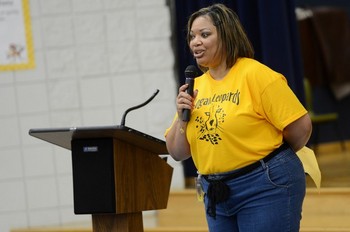
Logan Elementary Principal Terra Webster addresses students on the last day of the 2011-12 school year. Webster will play a significant role in the district's professional development to eliminate its achievement gap.
Melanie Maxwell | AnnArbor.com
While Webster agrees the Focus School designation is nothing more than yet another label, she said the publicity the district received these subsequent weeks after making the list was a good motivator.
“It’s out there now, the world has seen it. No longer can people say, ‘It’s not us. It’s those districts around us.’ Or, ‘It’s not me and my kids. It’s the kids on the other side of town, or in a Title 1 school,’” Webster said.
“The labeling increased our sense of ownership. People can no longer use the excuse that only our financially stressed families or families with single parents are low achieving. … This really has become everyone’s problem. … It’s equal. Across the board. No more finger pointing.”
On Aug. 2 when the Michigan Department of Education released its annual school report cards, 27 of Ann Arbor’s 33 buildings were placed on a list denoting those schools with large discrepancies between their highest and lowest 30 percent of performers on state examinations, such as the Michigan Educational Assessment Program test and the Michigan Merit Exam.
Webster said the Focus School designation has united teachers in buildings across the district and has given everyone, teachers and administrators alike, a sense of urgency.
“During professional development (in August), we reaffirmed our commitment to one another and our commitment to students. Teachers are becoming more active members in the strategic process. We now know the students who are in that gap. The gap may be 30 students or it may be two. Regardless, a spotlight was shown on where those students are, and we’ve made a commitment to attend to them at all costs.”
The focus of Webster and Parks’ leadership, according to the achievement gap plan, will be working to eliminate Ann Arbor’s inconsistencies in: grading and assessment practices, knowledge of culturally responsive teaching techniques, instruction practices and the use of supportive interventions.
While parents and students may not notice a lot of changes in the classroom this year as it relates to the achievement and discipline gap plans, changes will be taking place, Webster said.
At Logan this fall, students in the gap are being assigned an adult mentor to be a reading buddy or just to check-in with the student from time to time — to put some “additional focus, additional attention” on that student, Webster said.
She said everyone from the front office staff to the daytime custodians is getting involved in this initiative.
“The parents may not see it, but what they will see is hopefully an increase in their child’s success. … We hope the child will start sharing stories — more teachers are interacting with me other than my classroom teacher,” Webster said.
Personalized learning plans and culturally relevant teaching will be a big focus this year. Webster said knowing a child’s likes, interests and passions can be crucial to helping a struggling student grasp the material, especially at the elementary level.
All of Ann Arbor’s 21 elementary schools were named to the state’s Focus Schools list.
“Sometimes just knowing this student is a football fanatic and incorporating that into your math lesson is all the hook that that student needed,” Webster said.
Danielle Arndt covers K-12 education for AnnArbor.com. Follow her on Twitter @DanielleArndt or email her at daniellearndt@annarbor.com.
Comments
snapshot
Tue, Sep 18, 2012 : 3:37 a.m.
You educators want to promote more good will towards yourselves, stop bashing charter schools and tell your union leaders to stop lobbying for protective and self serving legislation. Try giving in to reason instead of drawing lines in the sand. Lets start thinking about the kids without being forced or coerced to think about the kids. Not every teacher needs a masters degree, not every teacher deserves tenure, not every teacher is motivated, and every teacher needs some form of accountability but unions and teachers continually refuse to be accountable or even put forth a comprehensive plan of their own for accountability. Stop preaching and start reaching out to your opposition.....they are a voice that demands to be heard so start listening.
thecompound
Mon, Sep 17, 2012 : 8:30 p.m.
Three stories appeared on aa.com around 5:50 this morning. One was about the NHL classic at Michigan Stadium being in jeopardy, one was about Ann Arbor being on so many "best of" lists and one was about AAPS and the achievement gap and Superintendent Green's "new weapon" for addressing it. Guess which one is already on page two of the home page?
towncryer
Tue, Sep 18, 2012 : 3:05 a.m.
I just looked up a bunch of stories about AAPS. Most of them seem to post around the 5:50 mark. It seems that through the course of the day they get bumped (need to have at least 5 UM football stories per day) from the first page and I am guessing many who read this site after work just look at the main stories on the first page. Just a guess.
Billy Bob Schwartz
Mon, Sep 17, 2012 : 7:52 p.m.
Okay, here's a new plan that might do away with the gap. The parents of the top 30% will adopt the kids in the bottom 30%. End of gap. LOL
cibachrome
Mon, Sep 17, 2012 : 5:51 p.m.
When I moved to Ann Arbor in the early '70s, the "GAP" was already on the city schools agenda. The GAP is a universal, (global) problem everywhere I've lived not just the US or Michigan or Ann Arbor. My school days in Buffalo, N.Y. public schools were spent in classrooms having up to 43 students per class. No problems, no tolerance for class disruptors, no tolerance for absenteeism, or tolerance for incomplete homework. Teachers were non-union and stayed after school for anyone who needed help or encouragement. You were welcome at a teacher's home if you were hungry or needed shoes. No grades = no sports. At the schools where I now live, the teachers race the students out of the buildings to get home. Prarents harass teachers who grade the way it is. And, an 8th grade student can't compute the mileage of their family car. I'd recommend segregating students by desire to achieve and let them fly unleashed. The rest can become worker bees for America the Reality: the newest Chinese colony.
lynel
Mon, Sep 17, 2012 : 10:23 p.m.
cibachrome, not sure when what years you were in school in Buffalo, but the Buffalo Teachers' Federation has been around for some time. I found an article about the teachers there striking in 1947.
aamom
Mon, Sep 17, 2012 : 8:40 p.m.
cibachrome - I mostly agree with you. I've had a much different experience with teachers willing to stay after school though. I just attended curriculum nights for elementary and middle school. I received teachers home numbers and the days of the week that each teacher could stay after to help students.
Pickforddick
Mon, Sep 17, 2012 : 7:21 p.m.
Welcome to our entitlement society........no amount of money will change this gap....it only pads the pockets of our educators.
grye
Mon, Sep 17, 2012 : 5:29 p.m.
Resolution of the gap will only occur when there is buy-in from all three sides; students, parents, and teachers. Like a 3 legged stool, it takes all 3 sides to work. If any one of the legs fails, the program will fail. The blame cannot be pinned on any one leg. If a student refuses to learn and cannot see the need, there is nothing anyone can do to change that attitude. There are some students and even parents that will cause the program to fail. Teachers are almost always the constant in the equation. What is interesting is schools that have some of the highest scores in the state are also on the focus list because of the wide range between low and high scores, yet others with an overall lower score are not on the list due to the minimal change between low and high scores. Very much a disparity when the focus is on gaps and not on improving all low scores. In addition, teachers that are unable to raise a child's score to an acceptable level, will receive a lower evaluation that could affect salary, despite all the effort to resolve a child's learning capability and overall test scores. Quite unfair.
snapshot
Tue, Sep 18, 2012 : 3:46 a.m.
You never fault teachers! Are all teachers perfect? You must think so since you specifically point fingers at students and parents. I disagree with you. Teachers can turn students and parents off and then those same inadequate teachers point fingers at the parents and students. You have no suggestions what-so-ever for improving a teacher's performance. That's a bias that encourages and feeds the opposition; the failure to admit any falut. I don't even want to listen anymore.
Macabre Sunset
Mon, Sep 17, 2012 : 5:27 p.m.
And yet another story about the parenting gap. Unfortunately, the only way to change the parenting gap is to get rid of bad parents. That's not practical or even desirable. The only way to reduce the gap in test scores is by reducing the test scores of the children who have good parenting. is that what a group of united African-American principals are proposing?
KJMClark
Mon, Sep 17, 2012 : 5:07 p.m.
Have to kind of second A2Reality's point. I went to the Dept. of Ed. website and looked up the MEAP scores. Their system is kind of a pain (you have to select things one at a time to view), so I only looked at MEAP math scores. I looked at Intermediate School Districts (ISDs) across the state - there are 56 of them, which you can only look at two at at time. I looked for one category - "% Advanced", which meant the % of students in that ISD, testing as "Advanced" for math. Washtenaw ISD had the highest percentages in the state. The "% Advanced" by grade were: 3rd - 6% 4th - 13% 5th - 13% 6th - 11% 7th - 11% 8th - 13% Most ISDs had <5% advanced, for all grades tested. The problem with the metric the State is using is that *all* districts have lots of students who scored "Not proficient" in math, but only a few had lots of students that scored advanced. So the "Focus" school designation will almost automatically fall on the districts with high-scoring kids. Schools in Oakland ISD got nailed with "Focus" designation for the same reason - those districts had the second highest percentages "Advanced" in math. Basically, the schools with the most high-scoring kids are being punished for that.
snapshot
Tue, Sep 18, 2012 : 3:56 a.m.
If educators put a leash on their unions and start talking serious reform to legislatures and citizens and put forth some action plans, maybe we can cut through all the bureaucratic crap and start providing students with a real education that teaches them how to think, solve problems, promote creativity, and learn how to learn instead of just test passing strategies.
Cathy
Tue, Sep 18, 2012 : 2:04 a.m.
I thought the same thing. Ann Arbor absorbs a lot of very smart people from all over the state because of the university. That means that there is going to be some crowding at the higher-achieving end of the curve because there is a disproportionate number of smart kids from educated, high-achieving families in our schools.
KJMClark
Mon, Sep 17, 2012 : 7:39 p.m.
Yeah, I had the same thought! Actually, since the schools are now having pretesting in classes (to find out how much the kids already know - and determine how well the teacher did by how much they learned), we've had discussions at our table that if the kids really like the teacher, they might want to do poorly on the pretest. Then when they ace the class, the teacher looks really good, and can fend off the administration for a while. But really, no one cares about the MEAP except the state anyway. We generally tell our kids to just do their best, but it's only important for their class tests and on the PSAT, SAT, and ACT. If the administration is now going to disadvantage the kids who can do well on the tests, maybe my kids have better things to do than try to do well on the MEAP.
Jrileyhoff
Mon, Sep 17, 2012 : 5:35 p.m.
Good info. So, if I tell my 2 children to not try so hard and to not do their best on the MEAP, they will be helping their school & AAPS by scoring "proficient" instead of "advanced".
Tanzor
Mon, Sep 17, 2012 : 3:36 p.m.
The "gap"will always exist, it exist in all school districts throughout our great country. It's not hard to understand, everybody is not going to be an "A" student. There are those that will not score well regardless of what teachers do. The biggest factor in the "Gap" is parenting. Growing up I was never a good student, however I received good grades. My Mother and Father would accept nothing less; they spent countless hours helping me with home work, math, reading and writing. AAPS has wasted hundreds of thousands of dollars on consultants in an effort to close the "gap"; only strong parenting will close the "gap". It is time to point the finger - point it directly the parents, it's their responsibility help their children succeed in school.
J. A. Pieper
Mon, Sep 17, 2012 : 11:37 p.m.
Tanzor, what you have said is so true. The gap will always be there unless every parent does their job related to supporting their children with school. Most normal people KNOW this, but in education today, we can't make this statement. The AAPS administrators have come up with a new buzz word, TBU (true, but useless).Whenever anyone brings up a fact like the parents need to be more actively involved, it is TBU, because we, as educators cannot do anything to solve that part of the equation! Our only choice is to try anything possible to work on this issue, hence we will be having even more professional development in this area. I wonder how anyone can fit in the making of a sweet potato pie into a jam packed curriculum, just to make it more relevant. Or, is everyone going to want their child to learn rap?
badge823
Mon, Sep 17, 2012 : 5 p.m.
Amen Tanzor! My thoughts too. And year after year, educators get more and more money that never solves the problem.
dotdash
Mon, Sep 17, 2012 : 3:09 p.m.
There is some confusion, it appears, between "the achievement gap" -- which seems to be used to refer to a gap between ethnic or racial groups -- and this "focus school designation" -- which measures the size of the difference between the top and bottom 30% of students regardless of race or ethnicity. It is not necessarily bad to have a big gap between the top and bottom. Do we actually think all kids can score the same or nearly the same? We don't think they could all be the same height or weight or equally good at sports. Why do we aim to have uniformity of intellectual achievement? As long as we aren't shortchanging anyone, we should expect some natural variation.
Macabre Sunset
Mon, Sep 17, 2012 : 5:31 p.m.
The "focus" designation is a way to highlight a race-based agenda without declaring larger districts with a high percentage of minority students as failing.
AnnArborDon
Mon, Sep 17, 2012 : 2:45 p.m.
This weekend's episode of "This American Life" (from NPR) was very relevant to this conversation. It was a less confrontational, more hopeful view of how to address the Achievement Gap. I think it would be worth a listen for all of the administrators mentioned in the article, and for all of the cynical commentators here.
A2anon
Mon, Sep 17, 2012 : 3:37 p.m.
Listening now, good catch, thanks for posting!
AnnArborDon
Mon, Sep 17, 2012 : 2:47 p.m.
Tried to embed a link, but it wouldn't let me. Here's a different link: http://www.thisamericanlife.org/radio-archives/episode/474/back-to-school
Billy Bob Schwartz
Mon, Sep 17, 2012 : 2:09 p.m.
"grading and assessment practices, knowledge of culturally responsive teaching techniques, instruction practices and the use of supportive interventions." Well, I was reading along, and I ran into a wall. I call it eduspeak. It's jargon that mostly administrators use that they must have picked up in an ed class or something. Please! If you are talking to the community and not trying to cover something up, speak plain English. That said, I agree completely with the statements of those who consider the whole test mania a huge waste of time, and much more seriously, a way to downgrade public schools and to send them in a totally wrong direction. Much of this, I fear, may be the result of the apparent desire of the rightists to destroy public education by getting people to pull their children out of public schools and send them to private for to publicly financed private schools. This is a terrible mistake that, even once it is stopped, may not be correctable.
A2Realilty
Mon, Sep 17, 2012 : 1:37 p.m.
The idiocracy of the statistics behind designating a school a "Focus School" with an achievement gap can be understood by anyone with any training in statistics. It is a ridiculous metric. To avoid this label, you simply need to have a homogeneous society. The more diversity that you have, the greater the distribution of your student population across the bell curve and the move distinct the "gap" between the upper 30% and lower 30%. For example, you could eliminate the "Focus School" label for all of the Ann Arbor schools simply by redistricting the schools to try to achieve uniformity in each school with regard to socio-economic standing. This would solve the "Achievement Gap" within each school. This metric is stupid. Any rallying behind it is a waste of time.
Macabre Sunset
Mon, Sep 17, 2012 : 5:33 p.m.
They've already done that redistricting. You're right that it's a silly metric for measuring the success of a school - it's more a measure of the parenting abilities of the group of students that have been selected to attend the school.
Brad
Mon, Sep 17, 2012 : 2:44 p.m.
So then how would you explain why we have so may "Focus Schools" here in a town that has long been known to have only above-average children?
Joel A. Levitt
Mon, Sep 17, 2012 : 1:16 p.m.
Hooray! Also, the astoundingly successful, but expensive, Harlem Children's Zone has demonstrated that prenatal counseling, preschool, continuing parent counseling and support for family health and nutrition are key, as well.
towncryer
Mon, Sep 17, 2012 : 12:38 p.m.
I clicked on the link for "culturally relevant teaching" and am a bit confused, maybe some of the teachers can explain it better. The link gives examples in the classroom for developing cultural competence such as bringing in non-offensive rap lyrics to study poetry and a parent teaching kids how to make sweet potato pie while studying George Washington Carver. So what is the fine line between stereotyping and this cultural competence? Also, the whole "labeling increased our sense of ownership" sounds like fluffy Green-speak. What's the old saying, you can't polish a t*rd? I do like the adult mentoring plan at Logan, but shouldn't all schools be doing this? Sounds like a good plan, I hope it is successful.
towncryer
Mon, Sep 17, 2012 : 4:06 p.m.
LOL, then I stand corrected. Now I need to go check out youtube...
alarictoo
Mon, Sep 17, 2012 : 3:29 p.m.
While I tend to agree with your assertions regarding the "fine line between stereotyping and this cultural competence ", it appears that you may have missed a classic Mythbusters episode. Contrary to the old saying that "you can't polish a turd", the episode I speak of (http://www.youtube.com/watch?v=Tl7ca_QL5kY) features the hosts utilizing the Japanese art of Hikaru Dorodango (http://en.wikipedia.org/wiki/Dorodango). to sculpt and polish said turds. Perhaps this is the Professional Development that the article refers to?
Howzitchick
Mon, Sep 17, 2012 : 11:24 a.m.
How are teachers supposed to implement all these new policies when their classroom sizes have increased dramatically? Our elementary school went from around 19 students in 1st grade to 28 this year. Second grade has 26. Four days before school started, a teacher was pulled from the school, a split created and a 2nd grade teacher was told she will be teaching 4th grade. Of course no one talks about the elephant in the room - the easiest way to close the gap is to bring down the top. Let's hope the state puts money back into the school specifically to prevent the growing class size and fund their expectations.
aamom
Mon, Sep 17, 2012 : 8:25 p.m.
Badge - I know lots of kids who go to St. Francis and they are all middle and upper middle income kids. Not a lot of high risk type kids. That is the key difference. When you have 30 in a class and 15 needs special services or have uninvolved parents and a tough home life, then the class size really matters. I agree that you could successfully teach a class of 30 filled with kids who have stable home lives and involved parents with maybe 1 or 2 who don't. That's not what you tend to find in the public school.
badge823
Mon, Sep 17, 2012 : 5:12 p.m.
I attended St Francis in Ann Arbor from grade 5 through 8. Our class size was always about 30 students. i received an excellent education. It isn't about class size! Additionally, taxpayers have had it with putting more and more money into education. That's been the request from educators for years as an answer to better education. The increases in education spending never equals any improvement with students. The real problem is kids not having a mom and dad supporting them.
alarictoo
Mon, Sep 17, 2012 : 3:19 p.m.
@brimble - You forgot an option. Homeschooling is alive and well in Ann Arbor. There are several homeschooling organizations, both secular and religious, in the Ann Arbor area. Not trying to advocate homeschooling, necessarily; just saying that it's anther option available.
andy kelly
Mon, Sep 17, 2012 : 1:36 p.m.
Okay Steven, I'll bite. Please list the research evidence that supports your claim.
brimble
Mon, Sep 17, 2012 : 1:21 p.m.
Public school districts hope that you will assume you have no alternative to your neighborhood elementary school. In-district transfers, charter schools, parochial schools, and private schools are all alternatives -- each with varied costs and benefits, of course. And pursuing the best choices requires significant time and energy, which not all parents can devote to this challenge. The result is that the neighborhood public schools (and the District as a whole) are not pressured to do more.
A2anon
Mon, Sep 17, 2012 : 12:40 p.m.
steven, false. Way to cherry-pick "research."
steven
Mon, Sep 17, 2012 : 12:35 p.m.
Research has shown us that classroom size has very little effect on student achievement.
local
Mon, Sep 17, 2012 : 10:51 a.m.
The achievement gap is present, has always been present, and will continue to be present in our public school system. But let's call it what it really is, a socioeconomic/parent gap. Most schools had open house this week, ask teachers how many of their "at risk" families showed up to meet the teacher and see what was, or will be, going on in THEIR child's classroom. Our district higher ups talk a great game, but don't live it daily in the classroom to see the really truth. Teachers can only influence kids from 8:45-3:45 daily, after that, those at home need to do their part.
Classof2014
Mon, Sep 17, 2012 : 6:44 p.m.
Totally agree!
Lola
Mon, Sep 17, 2012 : 6:38 p.m.
You nailed it! At the recent capsule night at Slauson Middle School I saw one parent of an "at risk" student and I know who they are. If the parents don't care how their kids do in school how is anything else going to make a difference? We're all just spinning our wheels here. What we need is a program that gets the parents of these kids to care about education and stress the importance of it at home.
tom swift jr.
Mon, Sep 17, 2012 : 10:30 a.m.
The concept behind the identification of "focus schools" due to this "gap" is so faulty that any effort to make a change will likely just further embarrass the school. The solution probably doesn't lie within the scope of influence a school has on a child's life. When the authority to direct change in an impossible situation is passed down from the top administrators, is it only a way to avoid the responsibility when the effort fails?
RUKiddingMe
Mon, Sep 17, 2012 : 10:23 a.m.
I'm sorry, but didn't I recently read a story in which AAPS said that this gap had already been a priority of theirs for 16 years (which kind of indicated to me that they either needed to pick up their game, or just drop it as a priority)? And how is it that it's only NOW you know who the students are and where the problem is? You have the same access to test scores, etc. that the feds used to laebl the "Focus" school, didn't you? This just seems like lip service and grandstanding in reaction to a fed labeling due to issues that PURPORTEDLY were well known and being worked on already. If, after 16 YEARS, the only thing that "increases your sense of ownership" was a Fed label, then I think perhaps the source of the problem might not be students at all. BTW, I think all the attention paid to the gap is useless; I'm just pointing out the shoddy performance of the staff, given that THEY think it's important. Maybe we could do with less administrators and assistants to assistant vice principals.
Django
Mon, Sep 17, 2012 : 3:11 p.m.
Don't even mention skill development before moving on...grades and test scores mean nothing if the student does not have the prerequisite skills.