

Local veterans gather for National POW/MIA Recognition Day at Ann Arbor VA hospital
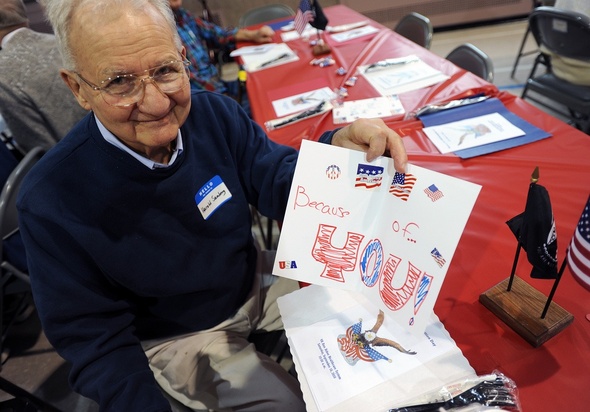
Harold Samberg, 86, a WWII veteran and former POW from Toledo, shows off a card made by local school children during the Saturday, Sept. 18 National POW/MIA Recognition Day brunch held at the VA Ann Arbor Healthcare System auditorium. The annual event pays tribute to those who were/are missing in action or prisoners of war.
Lon Horwedel | AnnArbor.com
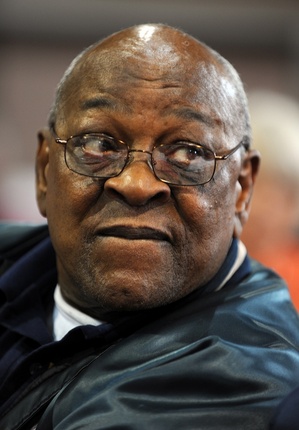
Robert Fletcher
Lon Horwedel | AnnArbor.com
When former POWs are admitted for care at the hospital, they become priority patients because of a long list of presumptive diagnoses, ranging from ischemic heart disease to skeletal debilities, all related to the poor nutrition endured during captivity. More than 7,000 Americans were taken prisoner in the Korean War, a significantly larger number than were taken in World War I and more than 10 times as many as in the Vietnam war.
Fletcher suffered a heart attack at age 48 and has undergone double knee replacement. A second heart attack five years ago led to a pacemaker implant. After a career that included owning Stadium Bicycle throughout the 1970s, Fletcher, 77 years old, now serves with the Advisory Committee on Former POWs.
While waiting to eat brunch, the father of five kept putting his hands in his pockets. “I’m having trouble with the joints on my fingers now from just this coolness,” he said of the lingering effects of frostbite.
In the first months as a prisoner in North Korean city Pyuckton, he dropped from weighing 180 pounds to 90 pounds. Between 300 and 500 black prisoners were kept together in the notorious Camp Five, where scores of Americans of all races perished.
Fletcher attributed his survival to divine favor. “Somebody up there liked me, and that was the only reason. And the other thing that happened was that they couldn’t find my shot records when I got over there to Japan,” he said, which was the stopover point for troops going to Korea. “So my tetanus, typhoid and diphtheria vaccines, I had to retake them.”
By the fall of 1951, the cracked corn diet was supplemented by millet and sorghum. “Canary food, we called it, because it was bird seed to us.”
Despite the malnutrition, he managed to keep his teeth healthy by rubbing them with salt. “You didn’t get a lot of salt, but when you’d get it, you would hoard it.”
The situation improved after 1952 because of concerns in China, which became directly involved in the war, that the starving prisoners from United Nations’ forces would reflect poorly if the war suddenly ended. Cabbage and small amounts of pork and beef were added to the diet.
Fletcher said he would take out the small strip of meat provided with his food, putting it on the bowl’s edge and relishing it at the meal’s end. The downside of the increased Chinese influence was the daily indoctrination in Communist ideology.
“I think they really felt that we would come back to the United States and start little Communist cells," Fletcher said.
Released on Aug. 8, 1953, after the July 27 armistice ended hostilities, Fletcher walked across the Bridge of No Return, saw the American flag waving in the breeze and “just broke down.”
But he said none of the released POWs felt free until the troop ship steamed away from port.
“Once you couldn’t see Korea, we all let out a big whoop.”
Comments
kenUM
Sun, Sep 19, 2010 : 8:56 a.m.
What GRANDPABOB said!! Thank you and God Bless
GRANDPABOB
Sun, Sep 19, 2010 : 6:40 a.m.
THANKS to all the sacrifices these Veterans made for all of our freedoms which we enjoy. And THANKS to all of of our service men & women serving now to protect our feedoms.