

Pondcast 19: Frogs fill full pond
Pondcast: Week 19, May 9-15, 2010
Q: How deep can a frog go? A: Knee-deep

Black Pond on May 14, 2010
Two rainstorms inundated Black Pond this week, raising the water level to its deepest depth this year.
Several species of frogs were heard calling during the day: spring peeper, chorus frog (perhaps), gray tree frog, and green frog. Several green frogs were seen sitting on logs in and around the pond.
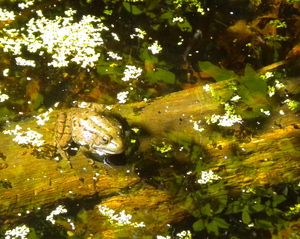
A green frog at Black Pond.
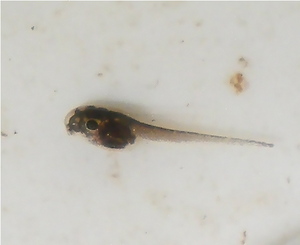
A tadpole of a chorus frog or spring peeper.
The first frog tadpole was collected early on in the week, probably that of a chorus frog or spring peeper who successfully mated several weeks ago. These tadpoles seem lackadaisical in their movement, frequently appearing to be stunned or dead in the water. Perhaps their survival relies on camouflage. If they moved about too much, they would be eaten. Perhaps also their fast rate of growth uses their energy since these smaller tadpoles must mature before the pond dries up in the fall.
In the pond, a new litter of phantom midge larvae (PML) appeared. Apparently the PML seen previously attained adulthood and were able to consummate their maturity in reproductive bliss.
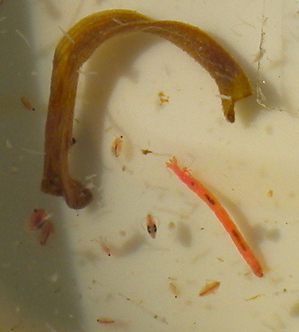
A non-biting midge larva (red) with daphnia (orange dots), naididae (tiny white lines) and phantom midge larva (tiny, clear lines).
Aquatic earthworms (Phylum Annelida) of the subclass Oligochaeta, family Naididae, were back. These critters look like 2-3 mm long, white threads. These Oligochaetes were last observed in Pondcast: Week 6. It is likely that they are of the genus Nais.
A few non-biting midge larvae were also seen. Unlike the PML, these red, 1cm long wormy-looking things wriggle and squirm as they travel through the water seeking detritus to consume.
Fingernail clams were again found only on the east side of the pond.
Several clam shrimp swam around hunting for smaller organisms.
Scores of daphnia (water fleas) went about their business and were consumed by predaceous diving beetle larvae.
Again, on top of the pond, only a single male mallard duck was spotted. Was this the same one seen in previous weeks? Was his lady friend sitting on a nest or otherwise gone from the picture?
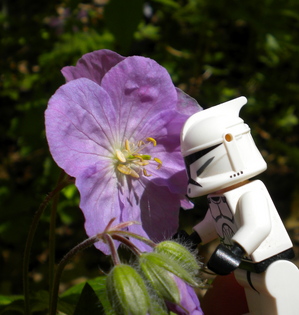
This is the wild geranium we were looking for.
In the Black Pond Woods, both mayapple and wild geranium were in full bloom. The trillium were aging gracefully with their white flowers gone to purple.
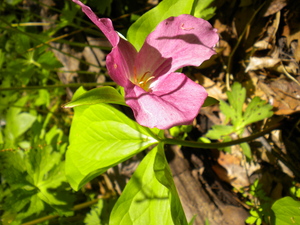
Goodbye to an old trillium. See you next year.
Stefan Szumko is a middle school science teacher by trade, an outdoor environmental educator by calling, and a homedaddy by choice. He can be reached at slugwhisperer@gmail.com. To view all the video pondcasts, visit his YouTube channel at http://www.youtube.com/user/slugwhisperer.
Comments
Your Neighbor
Sat, Jun 19, 2010 : 2:34 p.m.
Since June 2 there has been another batch of rain and more Western chorus frogs or American toads have been singing and then producing more tadpoles. If the tadpole or toadpole phase lasts 40-100 days, they will have to bury themselves in the mud for part of the time if they are to survive in our on again off again wetland. The birds are eating some of them, I think. I'll see if I can collect some tadpoles in a jar.
Stefan Szumko
Thu, Jun 10, 2010 : 8:26 p.m.
Hello Neighbor, I just got a report from the Ann Arbor Frog and Toad survey. Apparently newly formed adult toads have been leaving the newly created wetland at one of our local parks. They are really tiny and really cute. It's possible that the Good Shepherd's tadpoles (toadpoles?) have grown up and left the pond to fend for themselves.
Stefan Szumko
Sun, Jun 6, 2010 : 10:59 p.m.
A drying pond is one of the main causes of tadpole mortality in non-permanent ponds. I'm not aware that the early amphibians are capable of surviving in the mud. But I suppose that it is possible. I'm sorry to say that it's not looking too good for your amphibian friends. American Toad eggs hatch after 3-12 days and they remain tadpoles for 50-60 days. A high tadpole density negatively affects metamorphosis. So, these guys need about 2.5 months to metamorphose. Toads are the most likely amphibians in your pond. Spring Peeper eggs hatch in less than a week in warm water and they remain tadpoles for 90-100 days. So these critters need 3 months of water to reach adulthood. Western Chorus Frog eggs hatch after 3-14 days and remain tadpoles for 40-90 days. These frogs would need 3.5 months of water. One thing that you can do next year, is to collect some tadpoles or even the eggs and place them in a large jar or an aquarium. Be sure to let the algae grow since tadpoles tend to be herbivorous. Toad tadpoles will also eat decaying organic matter.
Your Neighbor
Wed, Jun 2, 2010 : 9:39 a.m.
Do those tadpoles go down in the mud when the pond starts to dry up? We had thousands of tadpoles at Church of the Good Shepherd's detention pond, and then no rain for a week. Only a few tadpoles were to be seen. We worry about them.