

Borders plans to move headquarters 'somewhere within metro Detroit,' but search 'includes Ann Arbor'
(This story has been updated.)
Bookstore chain Borders Group Inc. plans to move out of its Ann Arbor headquarters, the company said.
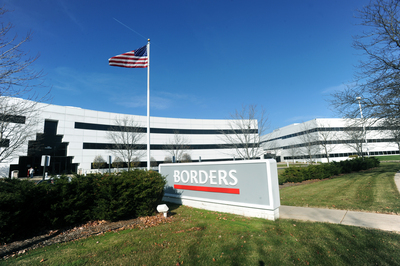
Borders is moving its headquarters out of Ann Arbor, according to the Wall Street Journal.
The Wall Street Journal reported that the company would move its headquarters to "cheaper office space in the greater Detroit metro area."
Borders spokeswoman Mary Davis told AnnArbor.com this morning in an e-mail that the company is "looking to move our HQ to somewhere within metro Detroit," but she clarified that the real estate search "includes Ann Arbor." She said the company is considering "a variety of options" but that a final decision "has not been made."
Her statement raises the possibility that the company could be lured to stay in the city of Ann Arbor.
Davis said the company is maintaining a "focus on reducing expenses and running our business as efficiently as possible."
She added: "We are currently reviewing our options with regard to where we will relocate our company headquarters and beyond that we have no comment."
The company is believed to have about 550 workers at its headquarters on Phoenix Drive, down from about 1,800 at its height several years ago. Borders rents space from Agree Realty, which has recently been seeking other tenants and even lured cell phone recycling firm ReCellular to sublease office space there.
The decision comes after Borders' chief financial officer, Scott Henry, hinted in a March 11 call with publishers that the company was considering further reductions to its corporate office space.
Under Chapter 11 bankruptcy, Borders can renegotiate leases or cut leases altogether with the court's approval. The company is simultaneously closing 226 superstores in an attempt to return to profitability and emerge from bankruptcy as a viable company.
Agree Realty in the fall quietly put the 460,000-square-foot building that houses Borders up for sale, seeking $18.349 million.
Borders bankruptcy coverage
- Borders files for bankruptcy protection
- Timeline: From the founding of Borders in Ann Arbor through today's news
- Borders wants bankruptcy court to approve up to $8.3 million in executive bonuses
- Bankruptcy fallout: Landlord of 2 Borders properties in Ann Arbor now in default on 3 mortgages
- Borders gets lease negotiations extension in bankruptcy hearing
- Blockbuster's proposed bankruptcy sale is uncomfortable reminder for Borders
- Borders must change business model if it is to survive bankruptcy
- Borders store-closing sale draws overwhelming response at Ann Arbor's Arborland
- Borders plans store closings in addition to locations identified in original filing
Asked this morning whether the company's corporate relocation would lead to additional job cuts, Davis said: "We are looking forward to implementing our new business model and continue to evaluate our staffing level to ensure that we have the right people in place to execute our plan. We are confident that with the support of employees, publishers, suppliers and creditors, and the reading public we will emerge from Chapter 11 as a stronger, more relevant book seller."
The loss of Borders' headquarters wouldn't have a significant immediate impact on the city's property tax base, said Tom Crawford, Ann Arbor's chief financial officer.
Borders' headquarters building and flagship store accounted for about $1.5 million in property taxes in 2010, according to city records.
"We’ve monitored this in the press for some time and are clearly disappointed to see the company struggle financially," Crawford said in an e-mail. "Longer-term, of course, we’ll have to wait and see how effectively the space can be marketed to others for use."
Borders' possible exodus is not comparable to Pfizer's departure a few years ago, when the pharmaceutical giant completely closed its Ann Arbor operation and about two-thirds of the scientists left in a blow to the real estate market and property tax base. With this situation, however, Borders employees who also live in the Ann Arbor area may be able to commute to their new workplace.
Meanwhile, Borders is quickly trying to put together a reorganization plan to present to the U.S. Bankruptcy Court and its creditors with hopes of exiting bankruptcy in the fall.
But some experts believe the company may find it difficult to convince the court that it can achieve a sustainable business model.
Borders started as a uniquely Ann Arbor company. Brothers Tom and Louis Borders launched the company in 1971 as an 800-square-foot used bookstore called Borders Book Shop on South State Street in the shadow of the University of Michigan.
The store got a warm reception in this college town and, fueled by a smart business model and innovative inventory tracking software, the company started to add locations throughout the country. By 1992, with about 21 stores, the brothers sold Borders to Kmart Corp., which proceeded to merge it with the small-format bookstore chain Waldenbooks.
The company went public in 1995 as Borders Group Inc. and continued its nationwide expansion, disrupting the book store industry and reshaping the shopping experience for readers.
By 2006, the company had ballooned to 567 superstores. But, by all accounts, the company was bloated and was losing the Internet sales game.
Borders narrowly avoided bankruptcy during the height of the global financial crisis in 2008, but the company is now fighting for its survival inside bankruptcy.
Borders President Mike Edwards told the Wall Street Journal that the company doesn't envision revenue growth until 2013 and that it would consider a sale of the company as a potential conclusion for the bankruptcy process.
Davis said Borders' plans include "an innovative business model" that will include "aggressively growing Borders.com and expanding our eBook market share, expanding and enhancing our overall retail mix, including non-book offerings, and continuing to enhance our Borders Rewards Plus program."
The company faces a steep climb to profitability. The firm, which was publicly traded until its bankruptcy filing, lost $604.8 million from 2006 to 2009 and another $168.2 million in the first 11 months of 2010.
According to a recent AnnArbor.com analysis of Securities and Exchange Commission documents, average sales per square foot at Borders superstores fell 33.7 percent from a peak of $261 in the 1998 fiscal year to $173 in 2009.
Adjusted for inflation, average sales per square foot at Borders superstores declined 49.6 percent from 1998 to 2009.
Contact AnnArbor.com's Nathan Bomey at (734) 623-2587 or nathanbomey@annarbor.com. You can also follow him on Twitter or subscribe to AnnArbor.com's newsletters.
Comments
15crown00
Thu, Apr 7, 2011 : 5:23 a.m.
go on get out of here.NOW!
say it plain
Thu, Apr 7, 2011 : 1:12 a.m.
Gotta love all the implying that it is somehow the earthy-crunchiness or 'liberals' of Ann Arbor causing Borders to look for cheaper pastures... How much simpler does it need to get as a scenario?! Borders feels the need to move for the same reason that the only things on Main Street are restaurants and the only things near campus are corporate burger shops.... Rents are too high--and perhaps some of those landlords pretend to be earthy-crunchy but even if they do we know what their 'real' orientation is, to maximum profit whatever the costs!--and so folks gotta move to where they can afford to avoid bankruptcy!
Danah Greer
Wed, Apr 6, 2011 : 8:24 p.m.
"SOMEWHERE IN DETROIT"!! That's the Thanks we get for supportingh Borders for all those years??! Detroit can have them. Good riddance, I say!
FredMax
Wed, Apr 6, 2011 : 5:23 p.m.
Sign of the times; move away from any business that has the possibility to be entirely automated effectively, e.g. by an Amazon website complete with detailed product specifications and reviews.
Tom Joad
Wed, Apr 6, 2011 : 5:03 p.m.
how humiliating to be economically cast out of Ann Arbor
Tru2Blu76
Wed, Apr 6, 2011 : 4:14 p.m.
Lets remember that this Borders is not the original Borders Books on State Street. I have nostalgia for the latter but in actuality, the Big Corp Borders which has existed for a long time was always a step behind and it lost its "Ann Arbor Character" years ago. I'm still miffed because I lost my Borders customer loyalty card and their own system can't find me listed as a customer *just since 1975 though so I guess I haven't been a customer long enough*. - So no replacement card is available. Customer loyalty? Hah! Oh, does anyone know if the bonuses talked about for a few top level Borders people went through? Nice touch, that.
rs
Wed, Apr 6, 2011 : 3:22 p.m.
Yeah, I bet real estate companies are lining up around the block to lease office space to a failing company in Chapter 11. Do they actually thing they will find somebody to lease to them after they just closed all those stores and weaseled out of 100's of store leases. Borders doesn't have the best name in the corporate real estate game right now.
Nathan Bomey
Wed, Apr 6, 2011 : 3:21 p.m.
Borders now says that its real estate decision is not final and that it could still land in Ann Arbor, although not at its current headquarters. I've updated the story with this: >>>Borders spokeswoman Mary Davis told AnnArbor.com this morning in an e-mail that the company is "looking to move our HQ to somewhere within metro Detroit," but she clarified that the real estate search "includes Ann Arbor." She said the company is considering "a variety of options" but that a final decision "has not been made."
Scott
Wed, Apr 6, 2011 : 3:14 p.m.
Seriously, what is wrong with many of you commenters? Why are you celebrating the loss of yet another business in this community? Just because a bookseller may have acted a little snooty to you at some time, then it's ok to revel in the fact that a company that has played a large role in this area is going down. Never mind that the folks who work there are dealing with tremendous stress, confusion and uncertainty. Guess what people: the loss of Borders is a great loss for this area. The people who work there are your neighbors, friends, family, etc. Their jobs are hanging by a thread, but it's ok because they so deserve to be on the unemployment line because the newest hardcover was marked five bucks less at Walmart. This is a tragedy, not a celebration.
eagleman
Wed, Apr 6, 2011 : 9:34 p.m.
Walmart has nothing to do with Borders. Amazon is what has killed Borders. I say this has a prolific purchaser of books. Why spend $20 on a paperback at Borders when I can get the same exact book in the same exact condition on Amazon, for half that? People bash Wal Mart because they offer cheaper goods. What nonsense. As a blue collar worker I really enjoy the cheaper alternatives. It saves me money.I'm sorry that others may lose their job, but I am not about to pay more for a product just so they can keep their job. I'm going to do what is best for me because no one else is going to take care of me.That is the reality of it. A reality people the world over understand, but for some reason bourgeois liberals do not.
SonnyDog09
Wed, Apr 6, 2011 : 2:54 p.m.
Does annarbor.com plan to contact the Mayor for a comment?
Joseph
Wed, Apr 6, 2011 : 3:16 p.m.
lol...that was a joke right? That would require actual reporting and someone may have to leave their cubicle. When Detnews or Freep reports the mayor's comments, AANews will run their quotes. Why is that? Because while it is costly to do business here in AA, we also don't spend enough to support our local paper, because we have electronic choices- hey, that sounds just like what bankrupt Borders.
Goofus
Wed, Apr 6, 2011 : 2:29 p.m.
The best analogy for what Borders is now is.... "a sick cat".
WWBoDo
Wed, Apr 6, 2011 : 2:03 p.m.
I always felt it was an uphill battle for Borders, however, when the CEO got cross ways with Tom Carney, one fellow on the executive team that could make a difference, and accepted his resignation, I knew the battle had been lost. Highly talented, strongly committed to getting the job done, Borders could ill afford to lose people of his character--many companies out there will undoubtedly line up to secure his services should he decide not to retire. If the CEO is not committed to keeping people like that in the fold, Borders will surely fold up like a circus tent. Adios, Borders! Fun while it lasted!
A2Realilty
Wed, Apr 6, 2011 : 1:51 p.m.
Unfortunately, Borders has done a terrible job of anticipating the emergency of disruptive technology. Music: Napster, iPods, Online music sales Movies: Netflix, Online streaming Books: Amazon, Kindle, ebooks Sadly for Borders, they've missed huge technological advances in every facet of their business. I don't wish Borders ill will, but I've thought that their business was effectively finished for quite a while. I simply don't see how they can revamp their model to embrace any of the technology that they's missed without being a "me too" at best. I wish it weren't the case, however, I doubt that they will even recoup the moving costs that they incur if they do relocate to cheaper space before they have to close up shop for good.
Jon Gordon
Wed, Apr 6, 2011 : 1:47 p.m.
If and when Borders moves their headquarters from Ann Arbor, they will have successfully made the final "break" from the community in which the company was founded. Closing the Liberty Street store becomes likely and easier for them to do because the public relations issues will be greatly reduced after they relocate headquarters. We must also keep in mind that the Liberty location is a series of old buildings that were blended together over time and were never intended to be used as a book store. I'm sure a store which does not conform to the new operating plan will, regretably, close.
Lets Get Real
Wed, Apr 6, 2011 : 1:45 p.m.
Let's Get Real about this - 550 jobs going to cheaper space in Detroit? Facts: 550 people will have to pay income tax in Detroit in addition to their state & federal income tax. Fact: 550 people who live in the Ann Arbor area will have to drive to a Detroit location to keep their jobs. Fact: 550 employees will bear more expense so the corporate giant can bail itself out of the mismanagement mess it got itself into when it ignored industry trends & failed to innovate ways to maintain employee loyalty & meet demands. A landlord will rent his overpriced space to another business wanting to headquarter here. Really? When? 3 years, 4 years? In the mean time, will that landlord be able to continue to keep the property tax paid with no income from the property? I'm glad Ann Arbor's Crack Financial Officer doesn't see the $1.5 million in property tax lost as not having much impact. From where is it that tax revenue will come? On the backs of the residential property owners? Or the other small businesses? And what about the tax revenue from the company's personal property on equipment? What is that additional calculated loss & from where will that amount be generated? Hint. The city has recently taken it upon themselves to contact VERY small businesses - home offices, home kitchens (allowable under the new state law), homes renting a room, home sewers, home caregivers, etc - sending them letters saying "It has come to our attention that there is a business being operated at this location," threatening the homeowner with confiscation of property if they do not remit personal property taxes. THAT'S WHERE! On the backs of people who've started small businesses when they lost their jobs. Are you nest? Business friendly Ann Arbor; business friendly Michigan. For economic recovery to occur, we need collaborative governments & tax reform to encourage businesses to stay, not prohibitive rules and harrassing bureaucrats seeking to sav
Cash
Wed, Apr 6, 2011 : 3:36 p.m.
Uh....Let's Get Real..... Read carefully, The article does not say they are moving to Detroit. Metro area could be Oakland County, Macomb, elsewhere in Wayne County, or Washtenaw or Monroe County. It never mentions the City of Detroit.
Garrett
Wed, Apr 6, 2011 : 1:39 p.m.
It's funny because you'd think that if Michigan was such a business unfriendly state, Borders, who are obviously not opposed to moving their headquarters, would move it out of state. Maybe there is not a lot of truth to the Republican talking points? No! Couldn't be that...
AA
Wed, Apr 6, 2011 : 1:16 p.m.
Overrated compnay that lags behind technology. Move. Bye.
Brad
Wed, Apr 6, 2011 : 1:03 p.m.
How dare they move from Ann Arbor for lower rent! They are dead, dead to me. Are you people serious?
Tex Treeder
Wed, Apr 6, 2011 : 12:59 p.m.
I'll be sorry to Borders leave. I worked for Borders briefly some years back and thought it was a great place to work. Even if the corporate HQ is going elsewhere, I hope they succeed.
clownfish
Wed, Apr 6, 2011 : 12:50 p.m.
Scary how wrapped up in ideology some people are here. Greenhouse gases, liberals, city govt...all to blame, certainly not the people that ran the company into the ground. The Great Irony is that many of these same posters will come around and write about "personal responsibility".
David Briegel
Wed, Apr 6, 2011 : 12:36 p.m.
They are leaving their Taj Mahal monument to incompetent Corporate Governance and Fiduciary Responsibility!
Basic Bob
Wed, Apr 6, 2011 : 2:14 p.m.
That's not all it takes to run a business. Their failure was in the loss of their market to their competitors, which in turn led to an inability to make a profit. Reorganization under bankruptcy law is the responsible thing to do at this point. If their landlord thinks they can sell or lease 460,000 square feet of Taj Mahal to someone else, well, good luck to them.
Top Cat
Wed, Apr 6, 2011 : 12:30 p.m.
Maybe they were concerned that they could not meet their goal for reduction of greenhouse gases if they stayed in Ann Arbor.
Wolf's Bane
Wed, Apr 6, 2011 : 12:27 p.m.
Oh Baloney!!! They're moving out of A2 because they anticipate being able to open elsewhere as a smaller and leaner company! That's all. The company will trim at least half of its workforce in an instant and do a complete overhaul. Let me spell it out for y'all: Border's vanishes of the national radar of embarrassment, does its restructuring and re-branding, and re-emerges elsewhere. I wish them luck, but unless you have new leadership, Border's 2.0 will most likely also fail.
Dr. I. Emsayin
Wed, Apr 6, 2011 : 12:07 p.m.
Borders got it all wrong when the let go the book folks who were running the company and hired the supermarket folks to run the company. You can't eat the hot fudge sundae you read about on kindle! And most people don't do all of their grocery shopping online.
Hot Sam
Wed, Apr 6, 2011 : 12:07 p.m.
Stick a fork in em'...they're done...
salineguy
Wed, Apr 6, 2011 : 11:52 a.m.
Barnes and Noble will buy up what is left of Borders within the year after top execs get their pay, creditors get little to nothing, and the woker bees get screwed on the way out the door. Anybody see the scenario playing out any differently? I don't. No great loss, Borders has offered nothing unique for a long, long time.
DJ
Wed, Apr 6, 2011 : 11:25 a.m.
Cheaper office space? I guess when you take a great store and sell to KMart we should expect nothing less than bankruptcy. I for one will never set foot in a Borders again, nor will I go to Briarwood after kicking out the only reasonably priced theater for a lousey MC Sports.
average joe
Wed, Apr 6, 2011 : 11:22 a.m.
I guess I don't understand why everyone is upset that they are leaving A2 because they can purchase/rent somewhere else & save money. Isn't that what the public did when they went to amazon, etc. to buy the same items that Border's sold?? Borders is just following the public's lead...
KJMClark
Wed, Apr 6, 2011 : 4:28 p.m.
Because a lot of us in Ann Arbor have always supported them.
Jojo B
Wed, Apr 6, 2011 : 11:17 a.m.
Folks, Borders is already dead. They just don't realize it yet. Moving shop only postpones death by a few months.
joe.blow
Wed, Apr 6, 2011 : 11:09 a.m.
Wow, this is bad for AA. More and more companies are leaving this city. The people on this blog thinks it's okay to see people leave, but just think of the economic impact. I'm sorry AA couldn't be there for Borders in a time of need. Don't worry, as the liberals run this city, more companies will leave.
Garrett
Wed, Apr 6, 2011 : 1:44 p.m.
I have never met anyone as consistently off in their analysis as you, Blow. Guess who it was that forced Borders to move? It was the owners of the building they lease out of. As it says in the article (did you read it?) they are moving because they are paying too much in rent. Whose fault is that? It's the owners of the property. Whether they are liberal or conservative not even you can say. But one fact no one can dispute is that they are capitalists.
clownfish
Wed, Apr 6, 2011 : 12:46 p.m.
Are "liberals" running Borders? Can you show evidence that "liberals" are the reason Borders is leaving A2?
runbum03
Wed, Apr 6, 2011 : 10:55 a.m.
The average "chain store" in the US is around about ten years. Why should Borders be any different? It was real.
huh7891
Wed, Apr 6, 2011 : 10:55 a.m.
Don t blame them, moving to an area out of Ann Arbor will help reduce costs and by reading the nasty remarks on here they have lost the community support. I may be one of the few , but I do hope they survive.
Cash
Wed, Apr 6, 2011 : 10:35 a.m.
Well University of Michigan "experts" predicted big job increase in the next year.....now 500+ jobs are leaving instead. I hope McDonalds starts hiring soon so that the prediction can come true.
Cash
Wed, Apr 6, 2011 : 3:29 p.m.
Epengar, Article was on this site.....few days ago. <a href="http://www.annarbor.com/business-review/michigan-to-add-38600-more-jobs-than-previously-projected-u-m-economists-report/">http://www.annarbor.com/business-review/michigan-to-add-38600-more-jobs-than-previously-projected-u-m-economists-report/</a>
Epengar
Wed, Apr 6, 2011 : 2:11 p.m.
"University of Michigan "experts" predicted big job increase in the next year" Source? did the predict it for the city of Ann Arbor? for the county? for the state?
Wolf's Bane
Wed, Apr 6, 2011 : 12:30 p.m.
Yeah, McDonalds plans on hiring about 5000 folks nationally, the only negative aspect to this news item is that the all jobs are at McDonalds!
ypsituckian
Wed, Apr 6, 2011 : 10:14 a.m.
Eh, let em go. Border's has been a sinking ship for the last 3 years. Let's be done with them. We'll be better for it.
glimmertwin
Wed, Apr 6, 2011 : 8:44 a.m.
Does the city of Ann Arbor have an income tax? This article focuses on the real estate aspect. But losing 550 workers is going to affect nearby businesses as well. This is just another chapter in this sad story about Border's problems. It doesn't sound good.
Epengar
Wed, Apr 6, 2011 : 2:10 p.m.
No, the city does not have an income tax, though the idea is being considered these days. The primary source of city revenue is property tax.
dotdash
Wed, Apr 6, 2011 : 5:55 a.m.
That is the loyalty that Ann Arbor is repaid with: "We're taking our 550 jobs and moving to someplace $10 cheaper"? I, for one, will not be buying any more books from Borders if they leave Ann Arbor. They probably won't be around long enough to care, but I make the gesture anyway. Dance with the one that brought you.
Marshall Applewhite
Wed, Apr 6, 2011 : 6:52 a.m.
Borders is on the brink of having to liquidate. They're currently doing anything possible to cut costs, and I don't think "local Ann Arbor customer loyalty" is very high on their list.
Mick52
Wed, Apr 6, 2011 : 5:05 a.m.
Moving to Pittsfield Township probably.
Marshall Applewhite
Wed, Apr 6, 2011 : 4:52 a.m.
I'll be shocked if they're able to get $18M for the building. If they're able to get anywhere near that, my guess is that we'll have another company headquarters moving to Ann Arbor.
bunnyabbot
Wed, Apr 6, 2011 : 4:51 a.m.
I'm glad Borders is leaving, I haven't bought anything from Borders since the original store. Customer service was POOR after that.
Wolf's Bane
Thu, Apr 7, 2011 : 11:58 a.m.
Cash, I wish I were. Thank god I'm no longer in retail. Geez!
Cash
Wed, Apr 6, 2011 : 3:26 p.m.
Bill, LOL , you MUST be kidding! That is hilarious.
Wolf's Bane
Wed, Apr 6, 2011 : 12:34 p.m.
I used to work at Border in the early 90s and I can tell you that as soon as they did away with the very challenging application exam, the level of employee literacy dropped significantly. However, I also remember customers coming in asking if they could 'borrow' a book and take it to Kinko's to Xerox… I'm just saying.