

DDA unveils 3 possible scenarios for downtown Ann Arbor at meeting with business leaders
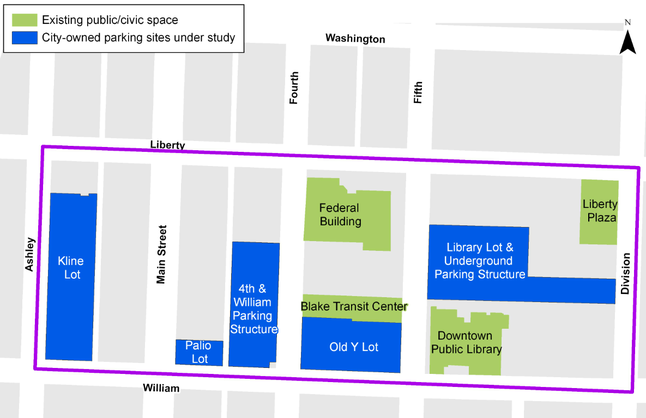
The DDA is hoping to come up with a comprehensive plan for this area in downtown Ann Arbor that includes multiple city-owned properties.
Map courtesy of DDA
The three scenarios were put together by the DDA with the help of a land use economist, technical experts and feedback from surveys conducted by the organization. The scenarios laid out a range of options for the areas that included mixes of residential, office, retail, hotels, parks and performance center spaces.
Labeled “scenarios A, B, and C,” the ideas were progressively bolder in their use of the space, with most buildings proposed in scenario C reaching more than 10 stories in height. Proposals B and C included hotel space, while A kept building heights to a minimum and focused on increasing residential capacity, especially along Ashley Street in the Kline lot. Scenario C included space for an “anchor retail” store that could attract regional traffic to the downtown area.

DDA executive director Susan Pollay emphasized the need for community and individual feedback throughout the meeting.
DDA planning and research specialist Amber Miller, who made the presentation, called them “starting points for conversation.”
Miller showed a venn-diagram that she said illustrated the three major considerations the DDA had made in coming up with the scenarios, attempting to find solutions where all three intersect.
“We looked at community feedback, viability, and public benefit/cost analysis in putting together these scenarios,” she said.
Miller said the Connecting William Street project was worthwhile because the only way to meet all of the city's goals was to handle all five sites at once.
“One of the problems with previous efforts was that the city would try to solve all of its problems on one lot,” she said.
There appeared to be a consensus in the room that development would be good for the downtown area, but many seemed somewhat skeptical that the downtown area could absorb the additional 1,000 employees who would work downtown projected in plans B and C.
“The No. 1 thing we hear from our employees and from our customers is that there’s a lack of good affordable parking,” Caroline Caganov, general manager at Connor O’Neils, said.
“It’s great you brought in 700 new spaces [in the new underground lot] but if you bring in 1,000 more people, where will they park? It’s the same problem all over again.”
Nancy Shore, director of the AATA's GetDowntown program and a Main Street Area Association board member, added that parking rates are just as important as parking spaces.
“We have a drive-alone rate of about 56 percent of downtown employees,” she said. “And you can add all the parking you want, but if people can’t afford it, it won’t matter.”
The Connecting William Street initiative was launched when the DDA asked for, and received, the blessing of the city council to craft a strategy for developing five city-owned parking areas into integral parts of a new, more vibrant, downtown. The process is currently still in the public input phase, and this meeting was one of many meetings that are intended to supplement the surveys the DDA has conducted to assess public opinion on uses for the lots.
“We want to tease your opinions out of you today,” DDA executive director Susan Pollay said at the beginning of the meeting.
“We want to find out your thoughts about things so we can use them as we move forward with this project.”
The “teasing out” of thoughts mostly happened through written surveys that all participants filled out as they ruminated on the scenarios placed before them. The surveys asked which scenarios the business leaders thought would be best for the area in a number of categories including helping small businesses/startups and making sidewalk spaces more pedestrian friendly.
At the end of the meeting, Pollay said that the next step was to distill the opinions of everyone involved in the process into a tentative proposal.
“We will then come back, probably sometime in mid-September, and see how that resonates with the different groups we’ve talked to,” she said.
Once the proposal has been re-vetted by community members and approved by the DDA board, it will be presented to the city council for vote. If the council approves the plan, it can then start to ask developers for proposals that fit the guidelines established.
The next public meeting for the Connecting William Street initiative is scheduled for Tuesday, Aug. 28, at the downtown branch of the Ann Arbor District Library. More information about public DDA meetings and webinars, as well as videos of past meetings can be found on the DDA’s website for the project.
Ben Freed covers business for AnnArbor.com. Reach him at 734-623-2528 or email him at benfreed@annarbor.com. Follow him on twitter @BFreedinA2
Comments
Andrew Wright
Tue, Aug 28, 2012 : 6:38 p.m.
I may be in the minority, but I really think the DDA is trying to do the best they can and that they have the right interests at the heart of this discussion. I would be sad to see a hotel/conference center downtown as has been proposed before and rejected from many. It would seem that there may be a consesus that something must be done about Liberty Plaza. The space is unworkable at present and the DDA has been unable to bring in people (other than vagrants, etc.) into using the plaza. In the late 1990's DDA committed itslef to trying to bring Liberty Plaza back to life. It seems that this is one proposal didn't go to implementation. Although I am not a critic of the DDA, it does seem that they need to work on a comprehensive park plan including revitalizing what we have. Perhaps, this will come from the comments/input that DDA is getting.
Detached Observer
Sun, Aug 26, 2012 : 3:54 a.m.
The logical place for a park is right where the Federal Building is. I heard the Feds are thinking of tearing down that thing and rebuilding. If that's the case, they should be moved over to the Kline Lot. There could be another underground parking structure underneath the new park. And if someone simply must put up a tall building, they could put it on the Old Y Lot where it would loom majestically over the park. This would open up downtown. A tall building squatting in the middle of the Library Lot would constrict downtown and just plain look stupid.
alan haber
Sat, Aug 25, 2012 : 8:05 p.m.
The comments reveal a little coterie of anti-park, anti-homeless/bum/vagrant vocalizers. All the surveys, including the DDA's own survey and the very extensive/expensive Calthorpe consultant report, all show great interest, wide desire for a downtown park. The problem with the DDA scenarios is that they ignore public input. If they had honest intent to plan in accordance with residents desires, AT LEAST they would have scenarios D and E. These plans would concentrate density, of whatever degree (Big, Bigger, Biggest) on the other city owned spaces and leave the Library Lot in public ownership for development as civic space, public realm, park, commons, high activity outdoor or 4 season venue. Scenario D would begin with a green roof on the underground structure. Take the cars off and let the people "PLANT IT." A non-profit Conservancy could do it, with no money from the public budget. Scenario E would allow the people to plan the fundraising, design, building, management and programing of the development of the public amenity, downtown destination. This scenario could be called, "GROW IT." The DDA should include scenarios D and E in their presentations. They have been urged to do so since they first showed their A, B and C plans, and have so far refused to do so. Reader comments should urge on them a greater openness to actually listen. Sadly, it seems this whole show of public input is a charade for what David Chahill in his comment suggests is behind the curtain: Hotel.
BobbyJohn
Thu, Aug 30, 2012 : 2:25 p.m.
Alan I agree that a park should be considered downtown. However, a green roof will not support the kind of plantings that a nice green park requires to be enjoyable. You need deep soil for large trees that give shade a park planted on top of inches of soil medium, over concrete, just is plainly inadequate. As for the issue with vagrants at Liberty Plaza, it is NOT just a small coterie that has a problem with the effect on Liberty Plaza that some of the homeless hanger-outers cause. This is a real issue of comfort and safety for the general public that is caused by a true small coterie. When another park, hopefully a real one, is built downtown, this is an issue that MUST be addressed.
RUKiddingMe
Sat, Aug 25, 2012 : 2:01 p.m.
For those who say there was no mention of Parks: "The scenarios laid out a range of options for the areas that included mixes of residential, office, retail, hotels, parks and performance center spaces."
Vivienne Armentrout
Sat, Aug 25, 2012 : 3:16 p.m.
Thanks, I missed that. Found it now. Not a big emphasis, though.
Ron Granger
Sat, Aug 25, 2012 : 1:20 p.m.
What percentage of downtown businesses are owned by residents who live within the city of Ann Arbor? This is a critical question to ask, because in many communities, the businesses are actually owned by people from out of town. They often force changes which are not in the interest of the residents. And what I see in this article is planning that is solely focused on the interests of those business owners and which largely ignores the taxpayers who live in this town.
uabchris
Sat, Aug 25, 2012 : 4:27 a.m.
To all the anti-park comments 1) The article mentioned nothing about a park option 2) Since parks are so bad, why do they work so well, and attract large amounts of people (think Plymouth, Hart Plaza, Campus Martius, etc) Downtown has ZERO grass...I think we can all agree on that. We need to find a balance...
Peter Eckstein
Fri, Aug 24, 2012 : 11:46 p.m.
Goodbye Ann Arbor. Hello Columbus.
HBA
Fri, Aug 24, 2012 : 8:35 p.m.
A lot of comment contributors are speaking against a park at the Library lot site, though not one of the options provided by the DDA include a park. We still are in support of a public space--similar to Rockefeller Center that provides an open air ice skating rink and cafes--and perhaps some boutique shops could be added. Wouldn't that be an attractive draw to our downtown?!
Detached Observer
Sun, Aug 26, 2012 : 3:23 a.m.
Try skating at Campus Martius in Detroit this winter and you'll see what a great idea this is.
uabchris
Sat, Aug 25, 2012 : 4:22 a.m.
Thats a good idea!
Vivienne Armentrout
Fri, Aug 24, 2012 : 7:34 p.m.
I have re-read the article several times and am unable to find a mention of the possible use of one of these lots for a park. Yet many of the (anonymous) commenters have zeroed in on this issue (a downtown park). Why is this? The DDA has conducted this program to exclude any possibility of a downtown park. The survey did not have any questions that invited that choice. It is certainly true that this issue has been raised. It was one of the positions I adopted in my recent campaign (that a public open space or park should be considered for the Library Lot). But these commenters seem to be raising a lot of dust over the idea when it was not a subject of the article. Is it that scary? Instead, the DDA seems to be hinting that it will return to the idea of a hotel (and conference center?). I reviewed some of this in my post http://viviennearmentrout.com/2012/07/19/about-that-conference-center-on-the-library-lot/
Kafkaland
Fri, Aug 24, 2012 : 7:26 p.m.
Are the three scenarios posted somewhere? I couldn't find them on the project web site.
Jack Campbell
Fri, Aug 24, 2012 : 4:59 p.m.
I agree with what others have stated, get rid of all the vagrants before we build another park. Make panhandling illegal.
Ron Granger
Sat, Aug 25, 2012 : 1:17 p.m.
A2 has always had "vagrants". It always will have "vagrants". By your logic, we would not have a single park. Also, you are probably aware that our current economy has been widely compared to the great depression. And, how much are you willing to pay for the additional enforcement resources and lawsuits? Asking someone if they have spare change is free speech.
BernieP
Fri, Aug 24, 2012 : 4:48 p.m.
I'd rather see "Good affordable parking" replaced with "Reliable, affordable, and 24x7 transit service from strategic park and ride locations".
Ron Granger
Fri, Aug 24, 2012 : 4:21 p.m.
"The Downtown Development Authority showed off three scenarios for the development of the five downtown parking areas known as the "Connecting William Street" initiative at a meeting with downtown business leaders Thursday afternoon." How unfortunate that they see no role for the public in this process - just "business leaders". If you read the process described in the article, there is zero public involvement. Just "business leaders". Giving the public the opportunity to speak just before the council votes does not allow the public to shape how their town is developed. DISBAND THE DDA. They are completely out of town with the people who pay the taxes in this town.
Ron Granger
Sat, Aug 25, 2012 : 1:14 p.m.
Thank you, Ben and Nancy, for the info. Missed it in the article. But I still think we should disband the DDA ;-)
Ben Freed
Fri, Aug 24, 2012 : 5:13 p.m.
Hi Ron, As the article illustrated, the public will be involved in the process throughout. This link, included in the article above, shows opportunities the DDA has created for public comment. In case you missed it, the website detailing how the public can get involved can be found here: http://www.a2dda.org/current_projects/a2p5_/#Outreach Thanks for reading! Ben
Nancy Shore
Fri, Aug 24, 2012 : 4:42 p.m.
Ron, This is one of several meetings the DDA is providing to get feedback on Connecting William Street. This meeting in particular was for business leaders. However, there are several more opportunities for the public to give feedback. Here are the details: Good afternoon! We would like to invite you to join the Connecting William Street conversation. The DDA needs your input to shape the future of five city-owned sites downtown: the Library Lane Lot, the Fifth & William Lot, the ground floor of the Fourth & William Parking Structure, the Main & William Lot, and the Ashley & William Lot. Community survey feedback and a market analysis have been used to begin crafting strategies for transforming these five parking areas into uses that will better serve the community. Now we need your help to shape a more specific plan. Please join the community conversation and provide input to help frame development strategies for these sites. If you'd like to participate from your home, office, or favorite coffee shop Please register for a webinar: Wednesday, August 29th, noon – 1pm: https://attendee.gotowebinar.com/register/3422082951334660352 Wednesday, September 5th, 7-8pm: https://attendee.gotowebinar.com/register/4908555601878887168 Webinars require registration – space is limited, but we will add more dates as meetings fill If you'd like to participate in person Please attend a public event: Tuesday, August 28th, 7-8:30pm Monday, September 10th, noon-1:30pm To help us plan, please register: https://www.surveymonkey.com/s/RegisterPublicEvent Both meetings will be held in the Downtown Library Multi-purpose room, 343 S. Fifth Ave, Ann Arbor At these events, the DDA will present an overview of the project and possible development scenarios so we can get your feedback. Please select the time that works best for you. The same information will be provided at both the webinar and public meetings.
JRW
Fri, Aug 24, 2012 : 4:12 p.m.
That space outlined in blue on the map is essentially a desolate area with little street activity, other than homeless hanging around in and around the library and bus station. That's not going to change as long as those blocks are a sea of parking lots. The "park" on top of the underground garage won't be a safe area at night. Unless A2 addresses the homeless problem, they will continue to dominate the street activity in that area, making it undesirable for others to walk around. Way too much desolate space with no street level pedestrian traffic.
Ron Granger
Sat, Aug 25, 2012 : 1:26 p.m.
People hang around libraries and bus stations because those institutions have a mission to serve - get ready for it - people. I don't see a link between Ann Arbor's crime and the homeless. I read most of the crime reports here, and I seldom see "vagrants" listed as the perps or suspects. Especially in the violent and personal crime that would contribute to a perceived lack of safety. Ann Arbor has dozens of parks. You could make the same argument that they may not be safe after dark. That will never, ever change and is not a reason to stop creating park spaces for people to enjoy.
David Cahill
Fri, Aug 24, 2012 : 3:56 p.m.
Let me make a wild guess: "Hotel space" includes a hotel on the Library Lot.
a2why
Fri, Aug 24, 2012 : 2:47 p.m.
Completely agree with the previous commenters. If people want a downtown park... work on Liberty Plaza. How about putting in some grass, put in a play structure, allow food vendors, make it a dog park... anything that will encourage non-vagrant people to hang out.
JRW
Fri, Aug 24, 2012 : 4:15 p.m.
The vagrant problem is huge in A2 because panhandling is legal. Make it illegal and you take away the incentive for panhandler pros to harass people for money. Until this changes, A2 will continue to have a problem with vagrants and homeless wandering streets and aggressively harassing people. Completely agree that Liberty Plaza needs to be made a safe area for people to walk through and sit and have lunch. Clean it up, get the drug deals out of there and get the vagrants out of there.
Gerry
Fri, Aug 24, 2012 : 1:51 p.m.
Agreed that park space is not an appropriate use for this land- there is just too much demand for it. Prices are high in downtown for one simple reason: people want more Ann Arbor than exists to go around today. They want to come here, work, have fun, and spend their money. However, the issues about parking are very legitimate concerns. A dense, vibrant downtown space cannot exist if everyone in it drives in, in a car that they need to park somewhere. If we keep building parking structures everywhere, pretty soon we'll look like an airport, and lose the appeal that is driving our potential. The bottom line is that Ann Arbor will never reach its full potential without an aggressive, comprehensive approach to transit.
Ellis Sams
Fri, Aug 24, 2012 : 1:21 p.m.
Monthly bus passes are available from AATA for $58.00. Downtown workers can buy them, park free in outer areas and take the bus the rest of the way to work. Concerned employers could actually buy them for their employees. After Ann Arbor votes to expand bus service, routes can run later at night to take care of employees who work evenings.
Brad
Fri, Aug 24, 2012 : 5:26 p.m.
So just the normal 80% then?
Nancy Shore
Fri, Aug 24, 2012 : 4:38 p.m.
@Brad, the cost for the $10/month go!pass is funding through parking revenue and not taxes. The DDA is providing this discount as a way to encourage employees to use public transportation to get to work. If you have any other questions about this, please feel free to email me at nancy@getdowntown.org. Nancy Shore getDowntown Director
Brad
Fri, Aug 24, 2012 : 1:36 p.m.
If the employers are concerned enough they can buy passes for all their employees for only $10/month/employee. In which case the taxpayers will be paying more like 95% of the cost of their transportation instead of the usual 80%. Why are we constantly being asked to subsidize the downtown employers? If it's that expensive maybe they shouldn't be downtown in the first place.
kathryn
Fri, Aug 24, 2012 : 12:27 p.m.
To connect William to the rest of downtown will require some really careful decisions about what goes on the library lot. It really needs to have lots and lots of street level activity...things that are open and active to make that area feel safe for people walking through. As much as I like green, a park in that area will not make me feel safe walking through to the library or bus stop.
JRW
Fri, Aug 24, 2012 : 4:09 p.m.
Totally agree. Not enough street level activity in those blocks around the library, other than the homeless hanging around. Not good.
jcj
Fri, Aug 24, 2012 : 12:20 p.m.
DDA planning and research specialist Amber Miller, Can anyone tell us WHAT makes Amber Miller a Specialist? I can find nothing about her background.
Brad
Fri, Aug 24, 2012 : 1:10 p.m.
And as we know from the Garage Mahal schedule mismanagement, the DDA is really, really bad at planning. Why does anyone even listen to them?
xmo
Fri, Aug 24, 2012 : 11:44 a.m.
Why does the city own property downtown? Governments "SUCK" when they try to run a business. Why should this be any different? "to craft a strategy for developing five city-owned parking areas into integral parts of a new, more vibrant, downtown."
1bit
Fri, Aug 24, 2012 : 1:55 p.m.
Too much hyperbole. The government owns the roads, should they all be privately owned? The simple fact is that not everything about government or government ownership is bad.
regularjoe
Fri, Aug 24, 2012 : 11:31 a.m.
I'm all for green space and more parks downtown, but Kiddingme is right on this one: Liberty Plaza is disgusting for all the reasons mentioned. Solve that problem before adding more parks. Actually, just close it down would be best. Nothing racial, hateful, anti homeless or anything like that. It's just a cesspool that has to go.
HeimerBoodle
Fri, Aug 24, 2012 : 7:18 p.m.
Exactly, it's perfectly possible to be saddened by, and opposed to, the systemic and institutional factors that lead to homelessness, addiction, and untreated mental health issues, while also not appreciating the concrete pit that is Liberty Plaza and the specific actions of its denizens.
1bit
Fri, Aug 24, 2012 : 11:27 a.m.
The DDA feeds at the public trough of parking fees. It fuels their ability to do projects, like the Library lot. They will continue to raise parking rates until supply exceeds demand.
JRW
Fri, Aug 24, 2012 : 4:17 p.m.
Just another example of the Disneyland mentality of the DDA. High fees and tourists. That's their market and focus. Oh yeah, those rich students too.
RUKiddingMe
Fri, Aug 24, 2012 : 11:13 a.m.
I'm getting more and more frustrated about this talk of more parks downtown. Has ANYONE involved in any of this planning actually gone by Liberty Plaza? I go by there at different times on different days, and it never has anything but loud, aggressive, vulgar bums. The only difference I've seen is that sometimes there are only two or three instead of ten or eleven, and sometimes they're laying down and/or sleeping instead of yelling and verbally accosting young women that walk by. I very VERY rarely see Ann Arbor residents in that space, and I don't blame them. It's a very unwelcoming space. Why would you even talk about more parks unless you first figure out a way to make Liberty Plaza usable by residents?
cbs
Sat, Aug 25, 2012 : 7:43 p.m.
RUKiddingMe and Ross, this article is talking about a lot of things, not necessarily Liberty Plaza or any other park. Why are you ranting? Make a suggestion for improvement, be part of the solution.
Ron Granger
Fri, Aug 24, 2012 : 4:17 p.m.
Gone by? Umm, yes. I've eaten my lunch there. I often eat lunch downtown and am always looking for a nice park to do it. So, a big yes to more park space downtown.
28's..andtheydon'trub
Fri, Aug 24, 2012 : 2:12 p.m.
RUKiddingMe & Ross: I AGREE!!! I work downtown monday - friday and when go for my stroll through town on lunch break, Liberty Plaza makes me detour. Last week at actually witnessed someone throw a huge fit and cause a seen with the police and that just makes me think if the people who hangout in the parks have no regard for the police, how should I feel as a citizen being in an environment ??? More parks will just bring more problems like this... And I won't even get started on what goes on AFTER HOURS.
Ross
Fri, Aug 24, 2012 : 1:44 p.m.
Liberty Plaza sucks. It's just a concrete pit with some benches. This is why it has been co-opted by the homeless and vagrants, because no one else even wants to hang out there int he first place. If we built nicer, more open and visible parks elsewhere that everyone else would actually WANT to use and enjoy, the homeless situation would not be a problem. In fact, if we just decided to flash mob in liberty square every day, I guarantee the homeless would go elsewhere.
GoNavy
Fri, Aug 24, 2012 : 10:42 a.m.
"The No. 1 thing we hear from our employees and from our customers is that there's a lack of good affordable parking," Caroline Caganov, general manager at Connor O'Neils, said. This is code for "free parking." These people want a spot in front of Connor's, and they want to pay $0.10 an hour to use it. Apart from that, everything is too long a walk, too long a wait, or too steep a price to pay.
GoNavy
Fri, Aug 24, 2012 : 3:13 p.m.
@Bear: I do not work a menial job all day, but I do spend an non-insignificant amount of pay on monthly parking. I do not commute from Ypsi. Because I live downtown, I walk to work. Hopefully, when you decided to live in Ypsilanti because "rents in increasingly gentrified Ann Arbor" were too high, you took into consideration things such as the cost of the commute (gas, parking). If you're working a menial job at "Conor O'Neills" (PS, "O'Neills" has two l's, which you also missed but we aren't here to split grammar hairs), then you're not an "average person making a living in Ann Arbor," unless by "average" you mean "far below average." Anyways, I appreciate your suggestion regarding school. I'll seriously consider both the source and the substance of the suggestion when making my final decision. PS Ross, you are correct in that I copied and pasted that line directly from the article.
Ross
Fri, Aug 24, 2012 : 1:42 p.m.
Bear, no need to get all testy. Pretty sure GoNavy just copied and pasted form the article... Plus, GoNavy is right. There is almost always a place to park in downtown, it just either costs more money than most people want to pay, or you have to walk a few blocks. I would fully support free parking for those who work downtown, but having cheap parking for everyone else only exacerbates the traffic and congestion.
Bear
Fri, Aug 24, 2012 : 10:57 a.m.
what about a lack of 'good affordable parking' do you not understand, GoNavy? Do you have to work at a menial service job all day and then have to pay a portion of your wages just to park? Do you have to commute from Ypsi on top of that because you cannot afford the rents in increasingly gentrified Ann Arbor? I seriously doubt it or else you would'nt be talking about "code" for "free parking". It is getting more difficult each year for average people to make a living and/or live in this town! And you are going to whine about this issue? Go back to school and educate yourself. You cannot even spell Conor O'Neils correctly, much less engage in any sort of critical thinking.'
a2grateful
Fri, Aug 24, 2012 : 10:26 a.m.
Any development must be paid for by the private sector. No giant risk, development, and operation liabilities for a2 taxpayers, please! The main test for good development here is that it is self sustaining, and not subsidized.
sellers
Sun, Aug 26, 2012 : 5:45 p.m.
That is why proposal C has an anchor store that could draw attention.