

Startup electric vehicle firm may add 500 jobs for Ann Arbor region engineering operation
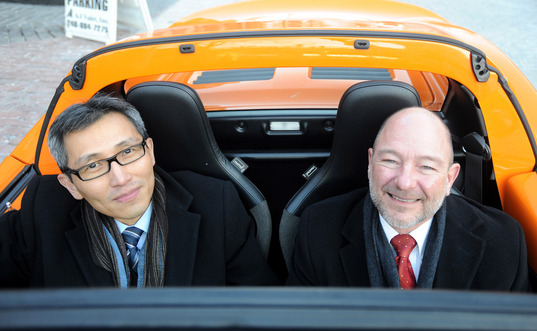
Detroit Electric executives Albert Lam (left) and Don Graunstadt sit inside an electric car outside of the Gandy Dancer restaurant in Ann Arbor.
Angela J. Cesere | AnnArbor.com
Detroit Electric Holdings, a startup electric car company with close ties to Asian vehicle manufacturers, is searching the Ann Arbor region for office space with plans to hire more than 500 engineers.
The firm plans to establish a technical center to serve as the engineering headquarters for its global electric vehicle operation, executives told AnnArbor.com in an exclusive interview. The company has dual headquarters in Hong Kong and the Netherlands.
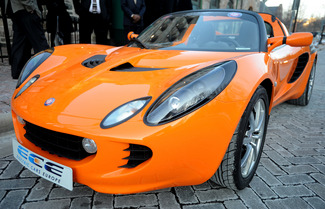
Executives showed off a Detroit Electric prototype for local executives on Monday.
Angela J. Cesere | AnnArbor.com
“We’re now looking at which is the best office location for us,” said Detroit Electric Holdings Chairman and CEO Albert Lam, a former managing director of Apple Computer in Asia and former CEO of Lotus Engineering Group.
Detroit Electric is one of several startup electric car companies
that have surfaced over the last few years with hopes of grabbing a
share of the emerging market for alternative propulsion vehicles.
The global lithium-ion battery-powered car market is expected to balloon from $878 million in 2010 to $8 billion by 2015, according to a December report by Boulder, Colo.-based Pike Research.
But startup electric car companies face enormous challenges due to the sheer complexity of auto manufacturing and the massive amount of capital typically required to make cars of any kind. In 2009, for example, high-profile Silicon Valley startup Tesla Motors had to recall half of its 2008 Roadster electric vehicle due to a parts problem.
|
Detroit Electric
|
Detroit Electric executives rejected skepticism that startup electric vehicle companies can’t compete with giants like General Motors, Ford, Toyota and Nissan.
“We’re not like a lot of startups that we think we’re going to teach Detroit how to do it all,” said Don Graunstadt, CEO of Detroit Electric Automobile Inc., the Detroit Electric Holdings subsidiary that is seeking engineering space. “We’re going to learn the best from Detroit. But at the same point, we’re different. We don’t have any legacy costs. We’re going to do things that make sense.”
Lam, Graunstadt and Detroit Electric Automobile Vice President for Strategic Programs Doug Moore are former executives from Lotus Engineering Group.
Detroit Electric believes its proprietary electric drive technology
-- developed in the Netherlands -- will allow it to mass-produce low-cost
electric cars using lithium-polymer technology. The firm this week
showed off a prototype to local executives, but the flashy orange
sports car was not representative of the more typical
family-sedan-style vehicles the company expects to produce.
Detroit Electric is in discussions with economic development group Ann Arbor SPARK about its plans. Ann Arbor real estate agent Bill Milliken of Milliken Realty confirmed he is representing Detroit Electric in its search for space.
SPARK CEO Michael Finney, who test-drove a Detroit Electric prototype this week, said the company would be a good fit in the Ann Arbor region.
The Ann Arbor area has about 30 automotive engineering and technology centers, including Toyota’s 1,100-person technical center in York Township and Hyundai-Kia’s 170-person technical center in Superior Township. Michigan is also steadily assembling a base of battery companies -- including A123Systems, which has an operation in Ann Arbor, as well as Troy-based LG Chem subsidiary Compact Power and Dow Chemical-backed Dow Kokam.
Detroit Electric is a century-old brand that graced electric cars in the early 1900s.
Angela J. Cesere | AnnArbor.com
Detroit Electric’s new operation would conduct engineering and design for the firm’s electric vehicles.
“What they’re doing is clearly the next mode of automotive transportation,” Finney said. “We think this is an ideal location for them to move our product forward.”
Detroit Electric has revived a century-old brand that graced battery-electric cars in the early 1900s.
“We believe in the vision of this name. Detroit is always a place for innovation, great engineering, skill, great quality,” Lam said.
Detroit Electric’s business model relies on a complex network of contract manufacturing, licensing and distribution deals.
The firm in 2009 signed a manufacturing contract with Malaysian car manufacturer Proton, which agreed to produce Detroit Electric’s vehicles. The cars will incorporate vehicle bodies from Proton and electric drivetrain technology from Detroit Electric.
“Our mission is practical, affordable electric cars for everyone,” Lam said.
The firm plans to market the vehicles under the Detroit Electric brand in the U.S., Europe and Asia. The company says it will produce pure electric cars with a range of 111 miles to 200 miles. The company says it aims to start pricing at $23,000 for its cheapest models.
In addition, Detroit Electric struck an agreement in 2009 with Chinese automaker Dongfeng Motor Corp., which plans to incorporate Detroit Electric’s drivetrain into its own cars for distribution in China.
Lam said the contractual manufacturing relationships are critical to the company’s business model. Detroit Electric won’t need as much capital as startups like Tesla Motors or Fisker Automotive because it won’t be manufacturing cars itself.
Detroit Electric is seeking about $150 million in capital, Lam said.
The firm has about $30 million right now from private investors, he
said.
Erich Merkle, an auto analyst and president of Grand Rapids-based Autoconomy.com, said skepticism about Detroit Electric’s ambition is prudent.
“The cost of capital is so high, and the development costs are so high,” Merkle said. “Electric vehicles themselves have a lot of risk. And when you start applying that to electric vehicles and startup automaker, you start multiplying that risk even more so.”
Lam said the company hopes to launch its first vehicles in Europe by the end of 2010. The firm is aiming to hit the Asian market six months later and, soon after that, the U.S. market.
Lam said the firm is targeting volume in the range of 30,000 to 40,000 vehicles in 2011 and 2012 and 200,000 in 2013.
Bruce Belzowski, an assistant research scientist at University of Michigan's Transportation Research Institute, said startup car companies face major hurdles.
"The idea of a startup (car) company is daunting because of the R&D expense, the product development expense, the manufacturing expense and the sales and marketing expense," Belzowski said. "It’s such a capital-intensive business. You have to have all this money up front."
Detroit Electric is in discussions with prospective dealerships in the U.S. that would sell vehicles, Graunstadt said.
Detroit Electric faces intense competition from a variety of global giants and ambitious startups.
For example, GM’s Chevrolet Volt, an extended-range electric vehicle with 40 miles of battery-only range, will go on sale in November. Nissan’s pure electric Leaf will have a range of 100 miles and go on sale later this year.
“There’s going to be plenty of competition from a well-entrenched, very established automotive establishment,” Merkle said. “You’ve got a lot of automakers that are venturing into the electric car segment.”
Contact AnnArbor.com’s Nathan Bomey at (734) 623-2587 or nathanbomey@annarbor.com. You can also follow him on Twitter.
Sign up here for the weekly Business Review newsletter, published every Thursday by AnnArbor.com.
Comments
Steve
Fri, Jan 14, 2011 : 4:55 p.m.
Did I miss something. It looks like the Tesla http://zautos.com/carvideo/2011-tesla-roadster-sport-roadster-2dr-hr/
kevin
Tue, Jul 20, 2010 : 5:22 a.m.
Its good that electric vehicles are coming in demand in market of automobile, as we all know that the fossil fuel is getting exhausted and the CO2 emissions are really have toll on the planet which is why we are having unconditional climate change and many lives are lost due to it, by using an electric vehicle the climate change will minimize this and will be in little control so that we are safe :) Used trucks
SmokeAndMirrors
Sun, Feb 14, 2010 : 12:24 p.m.
Knowing these three gentlemen, I am very skeptical about their claims. Mr Graunstadt made the very same claims about staffing while at Lotus that were never met. Don't get your hopes up with this one people. From what I know, Mssrs Graunstadt and Moore make big claims but have not delivered anything to date.
Lokalisierung
Fri, Feb 12, 2010 : 2:13 p.m.
"hey loka, $20 or $40 in a persons pocket will do more for the economy of a2 and mich than it will in the hands of the a2 gov't." So you say, I disagree.
bunnyabbot
Thu, Feb 11, 2010 : 11 p.m.
hey loka, $20 or $40 in a persons pocket will do more for the economy of a2 and mich than it will in the hands of the a2 gov't.
skz468
Thu, Feb 11, 2010 : 7:19 p.m.
If Don Graunstadt does as "good" as a job here as he did at Lotus Engineering, this company will never get off the ground. Almost half of all hourly employees are Lotus in Ann Arbor were laid off before he quit.
Lokalisierung
Thu, Feb 11, 2010 : 5:02 p.m.
"Venezuelan oil comprises about 11 percent of U.S. crude oil imports, which amounts to 60 percent of Venezuelas total exports."
Atticus F.
Thu, Feb 11, 2010 : 5:01 p.m.
TDW, it goes into a pool, and is pumped to the nearest destination for use. so Technically we dont get it from Iran, but by useing up oil reserves from the global pool, we force european countries to purchase from Iran. And as far as I know, all Citco gas comes from Venezualan oil.
tdw
Thu, Feb 11, 2010 : 4:52 p.m.
Atticus we don't get oil from Iran and I don't think (could be wrong)we get it from Venezuala either
Atticus F.
Thu, Feb 11, 2010 : 4:34 p.m.
Topcat, do you aposse all governent subsidies? becuase alot of them go towards good things like cancer research, and things like that. I would say that government subsidies that go towards reaserch, are a investment in the future of our country... But I'm sure you would rather continue to enrich Iran and Venezuala.
Top Cat
Thu, Feb 11, 2010 : 4:15 p.m.
I'm no expert on this. But are we sure that electric cars are really going to be practical and affordable? Or is this only happening because of wishful thinking and government subsidies? At one time, Bob Lutz was very skeptical about the Volt.
Lokalisierung
Thu, Feb 11, 2010 : 4 p.m.
I know exactly how much $39 a paycheck is...it's the cost of my union dues that I gladly pay to have a job & the security that comes with it. Are these workers going to be in the UAW? If not than there's the money saved right there...a wash. If i was locating the business here i guess that would make me the boss...and I'd simply add in 5K more to my salary. "I'm not quite sure where the Elise roadster "pumpkin" pictured here fits into Detroit-Electric's plans" Seems that Proton owns majority of lotus so they might go hand in hand. I mean if you serious about cracking the Michigan car market you MUST have performance brands. You can't come in with just mom&pop mobiles and make an instant splash. You coulkd over time...but i don't thinik we have that much time. Somehting like the Tesla that is quicker than almost anything on the road today for only 100K could really fly. Of course i thin they have such a small production number it hasn't made much of a splash.
jdh2550
Thu, Feb 11, 2010 : 3:27 p.m.
AFAIK, the models that Detroit-Electric are referring to when they talk about "practical and affordable" are based off of the Proton models (http://en.wikipedia.org/wiki/Proton_%28carmaker%29). Which are a lot more "run of the mill". I'm not quite sure where the Elise roadster "pumpkin" pictured here fits into Detroit-Electric's plans. Other than to make a nice PR splash. I bet Mr. Finney had more fun driving the electric Elise than the electric Proton! (Mr. Finney, when it gets warmer, come ride one of our bikes) If Detroit-Electric can really deliver an all-electric Proton based 4-door small sedan for $23K, that can do 80mph and 100 mile range then this will be a real game changer. Those sorts of numbers were what they were shooting for when they launched their brand about a year ago. I also happen to think those numbers are almost achievable. Or you could buy a $5,499 electric motor scooter from a local company called Current Motor Company. Just a suggestion;-) We do live in exciting times with regards to EVs. Will 2010 be a breakout year for EVs? 2011? 2012? It's going to happen... John Harding, Founder, Current Motor Company www.currentmotor.com (and in case anyone is wondering - unfortunately we're not ready to create 500 jobs yet - maybe one day though!)
tdw
Thu, Feb 11, 2010 : 3:06 p.m.
When I first saw it it reminded me of an old Opel
Nathan Bomey
Thu, Feb 11, 2010 : 2:31 p.m.
C6, Yes, Hyundai-Kia originally promised 600 jobs for its technical center expansion in Superior Township. http://www.themedc.org/News-Media/Press-Releases/Archives/Detail.aspx?ContentId=8e4784a7-f3c1-43ce-be19-cb05baf40cd0 Those plans were delayed or scrapped when the global auto crisis struck -- but Hyundai managed to avoid layoffs due to its global sales successes. (See story below.) The company has hinted that further personnel expansion is possible as the global auto market stabilizes. http://www.annarbor.com/business-review/ann-arbor-areas-hyundai-kia-america-technical-center-emerges-strong-from-auto-crisis/ Toyota, meanwhile, promised 400 new jobs for a consolidated total of about 1,100 in York Township. http://www.themedc.org/News-Media/Press-Releases/Archives/Detail.aspx?ContentId=E0C74BE1-62BD-4EE2-A6E0-8B05F38C7ADE That's the approximate personnel total at the technical center in York Township -- which heretofore has avoided layoffs. http://www.annarbor.com/business-review/ann-arbor-regions-toyota-technical-center-has-avoided-cuts-executive-says/
Lokalisierung
Thu, Feb 11, 2010 : 2:20 p.m.
Well 3k a year assumes a renter in Ann Arbor working here making $300,000 a year. Or a commuter coming to work making $600,000 a year. I don't want to assume, but I would think somone making that kind of cash would probably buy a house but true you never know it' a start up business, new employess may be weary of a quick going under. I would however think there might be a somewhat healthy level of auto engineers in this state who would like a job? Maybe that's too much assuming also. Not to mention this town pumps out a large number of Engineers every year. But yes you need seasoned ones. I really don't know what this "computer engineers" do on a daily basis having never working in the autro industry myself. If they are not really specialized for the auto industry i would say there are tons of Engineers around and they will have no problem. If they are specialized for auto industry i would completely disagree with your statement that they are in "high demand."
C6
Thu, Feb 11, 2010 : 2:07 p.m.
If I recall correctly Hyundai - Kia was talking about 300 to 400 jobs here eventually, when they opened their new technical center on Geddes Road. This story says that's really developed into 170 jobs, indicating those initial estimates may have been overly optimistic. Weren't Toyota's plans for way more than the current 1,100 jobs too? So maybe we're really talking about some figure considerably below 500 here, but of course even just 5 or 50 new jobs in the area is a good thing. More power (pun intended) to them.
Atticus F.
Thu, Feb 11, 2010 : 2 p.m.
Loka, the problem is that well educated people who's skills are in high demand will simply choose to work in other areas where they dont have to pay $3,000/yr for the privalige of working in A2. This not only include engeneers, but also doctors and nurses.
Atticus F.
Thu, Feb 11, 2010 : 1:56 p.m.
Great news on several fronts. Hopefully, the electric vehicle industry takes off and they are really succesful.
Lokalisierung
Thu, Feb 11, 2010 : 1:45 p.m.
"well hopefully they will be in Ann Arbor. But of course, talking about a city income tax won't help." Haha. So in the state with the highest unemployment, people are going to refuse to take a job with Detroit Electric becasue they may lose $39 a paycheck(based on a 100,000 salery for a renter living inside Ann Arbor $19.50 if living outside of town)? Sure...that makes sense right there.
Lokalisierung
Thu, Feb 11, 2010 : 1:27 p.m.
"They picture a very sexy looking sports car." Yeah that's the Lotus Elise body...which is what the Tesla car is based off of also. I have driven a lotus Elise and I can tell you it's anything but a normal car. of course they make it this way to save on weight. I'm always interested to see REAL stats on these cars becasuye I know the Tesla claims 250 miles charge, but they had it on the Top Gear show and it routinely got around 50...and that's in Britain not sub freezing Detroit. Of course i hope them all the best and bring back the auto business.
dading dont delete me bro
Thu, Feb 11, 2010 : 12:56 p.m.
i just saw that pumpkin on the road. east bound liberty around the i-94 bridge.
Ethics Advocate
Thu, Feb 11, 2010 : 12:47 p.m.
As for Dave66's logo prohibiting U-M: He doesn't seem to understand that this opportunity for him would not have arisen in the Ann Arbor area if it weren't for U-M being here with the College of Engineering and science departments, not just currently, but for the past 150 years. (I not a U-M alum.)
bunnyabbot
Thu, Feb 11, 2010 : 12:39 p.m.
well hopefully they will be in Ann Arbor. But of course, talking about a city income tax won't help.
SemperFi
Thu, Feb 11, 2010 : 12:38 p.m.
Our mission is practical, affordable electric cars for everyone, Lam said. They picture a very sexy looking sports car. I believe that a more practical car is one that could carry a couple kids, some groceries and a couple sets of golf clubs. That said, they couldn't pick a better place to grow their business. Michigan's future is in jobs that require a higher education.
Ethics Advocate
Thu, Feb 11, 2010 : 12:26 p.m.
This is wonderful news! It is exactly the sort of thing we need to have happen in this area, as well as the state in general, to help us overcome what could be a dire-looking future. Thank you Mssrs. Lam and Graunstadt!
Dave66
Thu, Feb 11, 2010 : 7:30 a.m.
As an unemployed software engineer (most recently from an auto supplier), this is great news! Maybe one of those 500 jobs will be mine. :)