

How will free trade agreements affect Michigan? John Dingell, Rick Snyder disagree
Ann Arbor area political officials quickly sought to paint the United States' new free trade agreements with South Korea, Colombia and Panama as job creators or job killers as businesses prepare to compete in markets with lower tariffs and fewer trade barriers.
The free trade agreements, which were passed by Congress on Thursday and are supported by President Barack Obama, will instantly reduce Korean tariffs on U.S. goods by $10 billion to $12 billion, according to the Office of the U.S. Trade Representative.
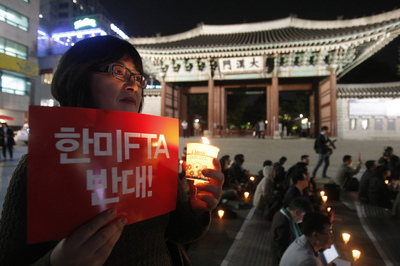
A South Korean protester rallies against the U.S.-Korea free trade agreement on Thursday.
Associated Press
Supporters say the agreements will position the U.S. to boost its exports to those three countries, with exports to Korea rising by about $10 billion.
“Michigan is a clear winner with the free-trade agreements approved by Congress," Michigan Gov. Rick Snyder, a Republican, said in a statement. "As one of North America’s top producer states, Michigan will benefit greatly by opening new doors to global markets. Michigan’s congressional delegation deserves our appreciation for working effectively to ensure the agreements’ passage."
Snyder described the free trade agreements as opening up opportunities for Michigan's agricultural industry, too.
"This is our chance to show the world what we already know: Michigan’s farmers and workers are the best in the world," he said. "As more foreign consumers see what Michigan has to offer, demand for our products will continue to climb. That means a more prosperous Michigan with exciting opportunities for the next generation. I commend Congress and the president for doing what’s best for Michigan and America.”
U.S. Rep. John Dingell, D-Dearborn, split with the president to oppose the agreements. Dingell also disagreed with the United Auto Workers union, which supported the Korean pact and opposed the Colombian agreement, while some other union groups opposed the deals.
“My experience with FTAs has been one of nearly two decades of broken promises and widespread domestic economic dislocation, particularly in my home state of Michigan," Dingell said in a statement. "With our economy teetering on the edge of recession and the painful memory of millions of lost jobs, I cannot vote in good conscience for more free trade agreements."
Dingell cited concerns that Colombia would be hostile to organized labor — and that the free trade agreement won't force the South American country to improve its treatment of workers.
He also said he's skeptical about claims that the Korean agreement will boost the U.S. economy, citing a study by the International Trade Commission projecting that the American auto trade deficit with Korea will rise by more than $700 million over the next 10 years.
“Although I recognize that significant improvements in terms of tariff and non-tariff barriers to trade have been made in the Korean trade agreement, I rather unhappily believe that promises will not translate into reality. In short, I believe the United States is giving up far too much for mediocre market share gains in the short term," Dingell said. "This agreement may well boost our exports to Korea over the next few years, but I am firmly convinced that the benefits Korea will reap in the long run — especially in the auto sector — will eclipse any that the U.S. may achieve."
His comments come as Obama is preparing to visit metro Detroit on Friday with the South Korean president to celebrate the news.
In Washtenaw County, auto suppliers are likely to be the most affected by the free trade agreements.
The county is home to few companies based in Korea, Colombia or Panama, although the Hyundai-Kia America Technical Center Inc. in Superior Township employs more than 170 workers. Hyundai released a statement today praising the passage of the agreement. “It is too early to determine what impact there might be of the Korean-U.S. Free Trade Agreement on the HATCI Ann Arbor facility," Hyundai said. "However, we do not foresee any significant changes at this time.”
In an interview in July, Hyundai Motor America CEO John Krafcik told AnnArbor.com that the U.S.-Korea free trade agreement would have only a minimal impact on Hyundai’s U.S. business, since the automaker is making more of its cars in the U.S.
"Honestly, from our point of view, it doesn’t matter that much. The cost benefits, the tariffs, are relatively low — and we have more and more U.S. production anyway," Krafcik said. "We’re going to build about 400,000 cars in the U.S. this year and sell about 600,000. So when you look at it, it’s a pretty small base of cars, pretty small tariffs we’re talking about anyway."
For more on the national impact of the free trade agreements, read these stories:
Washington Post: Obama gets win as Congress passes free-trade agreements
Korea Times: Trade pact gets mixed reactions
USA Today: Trade deals with S. Korea, Colombia, Panama, who wins?
Bloomberg: Biggest U.S. Free-Trade Accord Since ’94 Passed
Associated Press: Provisions of bill providing aid to trade-displaced workers as part of free trade package
Contact AnnArbor.com's Nathan Bomey at (734) 623-2587 or nathanbomey@annarbor.com. You can also follow him on Twitter or subscribe to AnnArbor.com's newsletters.
Comments
Mike K
Sun, Oct 16, 2011 : 4:28 p.m.
"because it makes it easier for the American car companies to sell their vehicles in Korea." I'll believe it when I see it. My experience has been that Koreans like Korean cars, Japanese like Japanese cars and so on. Nationalism runs high in about every country except ours.
Mike
Fri, Oct 14, 2011 : 9:32 p.m.
Is this negotiated by the same people who have brought us all of the other great trade agreements that have sunk this country and cost us millions of manufacturing jobs?
shepard145
Fri, Oct 14, 2011 : 4:35 p.m.
Dingell was quoted as saying "...where's that draft coming from......shut the dammed door!.." ....and "WHO LET THE CAT IN!!". ...his behind the scenes handlers lurking in the shadows disagree with Rick Snyder on the free trade agreement after union bosses told them what to say. Dinglell later demanded soup.
Gordon
Fri, Oct 14, 2011 : 2:21 p.m.
One could turn TopCat remarks around and come up with the same affect. RayA2 the USA benefitted mightly during the 1950's, 60's & 70's with playing the tariff game. Hows the A2 rally working for you? I didn't even count the 1910's. 20's, and 30's. Enforcement eventually comes down to the value (percieved) of the countries currency. That does become the enforcement. Down grade our debt rating has shown up sooner in the drop in our currency versus other currencies & gold. The recent uptick in dollar based comes from the fears of Europe values. Can't live in a shell. It is & has been a global economy for sometime. Korea comes up with a car company that is a world compeitor in a very short period of time., So much so it can afford to build plants here just liked we did in other countries and hire the locals. The bill trying to punish China is the stupid bill. Guess what country ownes our debt?
snapshot
Fri, Oct 14, 2011 : 4:08 a.m.
Dingell is heavily tied to the auto industry and unions. Trade agreements allow Americans to be free to purchase more affordable products rather than being forced to purchase many American products with inflated prices due to union demands. Whether a particular group agrees or opposes a particular trade agreement is usally dependent upon whether they will benefit from it, or not. What about the "average American consumer" and how they would benefit?
shepard145
Fri, Oct 14, 2011 : 3:03 a.m.
John Dingell Disagrees with Rick Snyder? John Dingell is wondering why everyone is driving so fast, how to keep kids off his lawn and who took is damned bowl of soup, which he could have sworn was right in front of him a minute ago! How tough can that job be when guys in their 100's can show up and every 4 years insist they will run for yet another term.
snapshot
Fri, Oct 14, 2011 : 4:10 a.m.
He's only 90 years old, and you're right, the job can't be that demanding or stressful for him to want to keep working. Staff members are carrying him probably.
Edward R Murrow's Ghost
Fri, Oct 14, 2011 : 3:33 a.m.
His term of office is two years. Another fact-filled post, Shep. Good Night and Good Luck
tim
Thu, Oct 13, 2011 : 9:43 p.m.
As long as the Koreans buy our stuff then it's ok, but it sure hasn't worked that way with China. Free Trade agreements = cheap labor and more profits for the rich.
FredMax
Thu, Oct 13, 2011 : 8:25 p.m.
"This is our chance to show the world what we already know: Michigan's farmers and workers are the best in the world," Probably we nevertheless can't compete with labor in the 3rd world that works for 25 cents an hour.
tommy_t
Thu, Oct 13, 2011 : 5:27 p.m.
Hasn't worked in the last 30 years and millions of jobs shipped out. Same thing again.
jim
Thu, Oct 13, 2011 : 7:28 p.m.
It turns out Ross Perot was right. Talking about NAFTA in the 90's, he said "That giant sucking sound you hear is millions of jobs leaving the country" if NAFTA was passed.
Enso
Thu, Oct 13, 2011 : 4:54 p.m.
Capitalist is what got us into this mess. Capitalism is not going to get us out.
jim
Thu, Oct 13, 2011 : 7:27 p.m.
Welcome to the era of the corporation. Many corporations have more power than many governments now, and it's only going to get worse.
G. Orwell
Thu, Oct 13, 2011 : 6:02 p.m.
Capitalism is not the problem. It is crony/monopoly capitalism that distorts true capitalism. Capitalism is what helped make this country the wealthiest in the world. It's the policies put in place by corporate owned politicians that have cause the distraction of our economic and manufacturing base.
RayA2
Thu, Oct 13, 2011 : 4:24 p.m.
There is no such thing as free trade, never has been and never will be. Free trade agreements have an Orwellian name like the conservative ant-environment groups. Workers get screwed every single time on these free trade agreements because the U.S. government is looking to line the pockets of the top 0.01% and the partner government works to protect its countries' workers. There is also never any enforcement budget in the U.S. for these agreements and there is even less political will to enforce them. With no enforcement it is business as usual in the partner country while corporations here find it easier to pursue cheap products, components, and labor elsewhere. Slick would love such a deal.
Mike K
Mon, Oct 17, 2011 : 1:51 p.m.
And there is no Earth Ray. It's a corporate scheme to rake in money at the expense of the little guy. Get with it.
xmo
Thu, Oct 13, 2011 : 4:14 p.m.
Is Rep. Dingell a Racist since he does not agree with our President? "U.S. Rep. John Dingell, D-Dearborn, split with the president to oppose the agreements."
jim
Thu, Oct 13, 2011 : 7:25 p.m.
I'm sorry, but I don't listen to failed actress/comediennes for political advice. Most of them don't even realize how stupid they sound without a script.
Charlie Brown's Ghost
Thu, Oct 13, 2011 : 4:49 p.m.
Obviously. There's not much one can do, though, because according to Janeane Garofalo people who support Herman Cain for President are also racist.
Top Cat
Thu, Oct 13, 2011 : 2:46 p.m.
When was the last time we entered into one of these trade agreements and saw our trade deficit decline ? When was the last time we entered into one of these trade agreements and saw manufacturing jobs move from elsewhere to here ? We seems so stuck in our mantras of old and never learn from our mistakes.