

Hyundai CEO says expanded U.S. presence, including in Ann Arbor area, is strong possibility
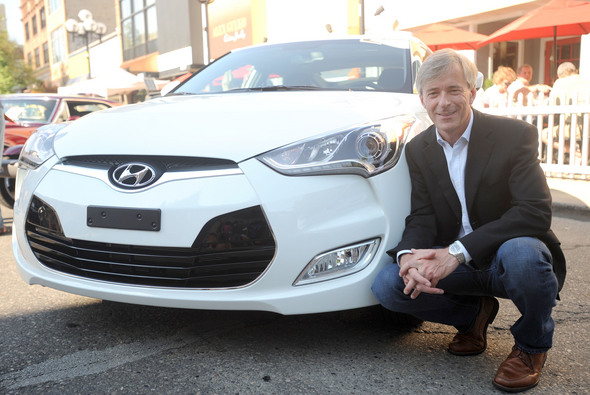
Hyundai Motor America CEO John Krafcik said the company's fuel-efficient vehicles would help the automaker meet increased fuel economy requirements. He's pictured here with the new 40-mpg Veloster hatchback at the Rolling Sculpture Car Show in downtown Ann Arbor on July 8.
Angela Cesere | AnnArbor.com
That could also mean more jobs for the Korean automaker’s technical center in the Ann Arbor area, where 170 workers conduct the testing, calibration and some engineering for the latest Hyundai vehicles.
In an interview on the rooftop patio of the Palio restaurant in downtown Ann Arbor during the Rolling Sculpture Car Show on July 8, Krafcik, sipping a beer and intermittently chatting with old friends, spoke with AnnArbor.com. The former Scio Township resident said he:
--Supports President Barack Obama’s administration’s decision to consider requiring that carmakers achieve corporate average fuel economy of 56.2 miles-per-gallon by 2025.
--Believes Hyundai should continue focusing on quality instead of purely ramping up production.
--Thinks a U.S.-Korea free trade agreement, which is stalled in Washington, would have only a minimal impact on Hyundai’s U.S. business.
Krafcik’s comments come as Hyundai is deep into a sustained period of sales successes, bolstered by huge improvements in quality, fuel-efficient vehicles and comparatively low prices.
The company recently raised its goal for U.S. sales in 2011 to 624,000, a 16 percent increase from 2010. Hyundai has sold more cars in the U.S. in the first half of 2011 than it has at this stage at any point in its history.
Still, when Krafcik strolls down to Main Street to check out the vehicles at the car show, he walks right down the center of the street, totally unnoticed by the crowd.
But the vehicles Hyundai brought to the show — including the new Veloster, a 40-mpg hatchback that was tested and calibrated at the Hyundai-Kia America Technical Center in Superior Township — drew plenty of attention.
Here are excerpts from the conversation with Krafcik:
AnnArbor.com: How would you define the technical center’s contributions to Hyundai’s recent success?
John Krafcik: That technical center is just a godsend for us. At Hyundai, our big idea is that we want to design and engineer and build the cars in the markets that we sell them.
It’s a very smart thing to do because then you can respond more quickly to changes in the local market conditions.
AnnArbor.com: The tech center was particularly stable during the auto crisis when everybody else was shedding jobs. How do you see the presence here evolving over the next several years as Hyundai’s market share continues to grow?
Krafcik: There’s no question that we’re going to be growing our capability. That’s the trajectory we’re on.
We want to do more and more work here in engineering, product development, calibration, certification, development as well as manufacturing.
AnnArbor.com: Do you see that equaling more jobs?
Krafcik: It should, over time. And I can’t give you any commitments because it’s really not my part of the business, but I think there’s a great possibility. We’ve certainly got some incremental capacity there.
AnnArbor.com: I asked Bob Lutz a few weeks ago how quickly he believes battery costs will drop and how fast electric vehicles will become affordable. What’s your assessment?
Krafick: It’s a great question because there’s so much uncertainty around it. We have a great battery partnership with some of the best battery-makers on the planet - LG Chem, for example. And we’ve got third-generation lithium-polymer batteries already on the road in our Hyundai Sonata hybrid.
That said, (lithium batteries) are really expensive. And when you look at the cost of a battery pack in a vehicle like a Leaf or a Volt, you’re talking $10,000 or more. It’s very, very considerable. If you just look at the apparent cost of the chemicals in the materials structure, it’s hard to imagine that much cost being taken out. Some — but I don’t know what that cost curve is going to look like.
So our approach at Hyundai to optimize fuel efficiency has been different. We haven’t put a big marketing focus on those so-called ‘green’ technologies. Instead, we’ve focused on optimizing the internal combustion engine solution — the gasoline engine.
We’ve got four vehicles that get the 40-mpg standard. Three of them are conventional, internal-combustion engines — the new Accent, the new Elantra, the Veloster.
Look, if we want to reduce this country’s dependence on foreign oil, the best way to do it is, ironically, not a wholesale movement to alternative powertrains or hybrids. But rather, let’s just invest in the technologies we have right now — we all have these things — and make them standard on everything.
The prices go up a little, instead of a lot, and we make massive improvements in overall corporate fuel economy. We’re (averaging) 35.7 miles per gallon right now at Hyundai, so we’re already hitting the 2016 standard.
AnnArbor.com: And how do feel about President Obama’s administration’s consideration of the 56-mpg standard?
Krafcik: I think it’s a very, very good approach.
AnnArbor.com: Some of the domestic carmakers are talking about how much money this is going to add to each vehicle. Do you have an estimate as to how much it might add to the average Hyundai car?
Krafcik: Last year we committed to hit 50-mpg by 2025 just because we think it’s the right thing to do. Part of our corporate strategy is to be a leader in environmental responsibility and fuel efficiency, so we haven’t really thought about it in terms of incremental cost.
We have to do this whether or not the standard is there. We’re going to hit 50 by 2025. That’s our corporate commitment. So we haven’t really put a number on it.
AnnArbor.com: The recent Wall Street Journal piece on Hyundai was interesting. How does the Hyundai culture need to change for you to continue your success? There was some talk of it in that story.
Krafcik: Yeah, this tension that’s in the company right now is really interesting and very creative. The tension is: Do we continue to grow our production capacity in sales to meet the demand that’s there, globally, not just in the U.S., but in other markets? Or do we give up some of that growth to focus more on quality and ensuring that the craftsmanship is there and our brand image strengthens?
What’s fascinating is five years ago, we would have picked more production. But we have already made the decision: No, we’re not going to do that. We’re going to grow in a more evolutionary matter, we’re going to focus and ensure we deliver the quality our customers demand.
And we think over the long term, that’s going to be better for the company. Now who knows where we’ll end up in 20 years? But I am absolutely convinced that it’s better to take this slower trajectory now as opposed to growing too fast.
AnnArbor.com: Are you frustrated at the status of the U.S.-Korea trade agreement situation at this point?
Krafcik: We’ve all been very realistic about the timing. These things take a lot of time.
Honestly, from our point of view, it doesn’t matter that much. The cost benefits, the tariffs, are relatively low — and we have more and more U.S. production anyway.
We’re going to build about 400,000 cars in the U.S. this year and sell about 600,000. So when you look at it, it’s a pretty small base of cars, pretty small tariffs we’re talking about anyway.
AnnArbor.com: What do you think about Ann Arbor?
Krafcik: I love this town. For 14 years I lived in southwest Ann Arbor in the Uplands subdivision and (it’s great) being back here on a day like today and seeing Rolling Sculpture. I bought my Caterham (car) here in 2002.
It’s a great town. I live in southern California now. I live in Orange County. And there is nothing like this. The oldest thing where I live is 1980.
It’s fabulous to be back here and walk down Main Street and feel the Ann Arbor vibe.
Contact AnnArbor.com's Nathan Bomey at (734) 623-2587 or nathanbomey@annarbor.com. You can also follow him on Twitter or subscribe to AnnArbor.com's newsletters.
Comments
Frains
Mon, Jul 18, 2011 : 9:21 a.m.
Funny how the domestic 3 companies are spending their cash on running ads against the higher fuel economy legislation and doubling up that spending with lobbyists to fight it... instead of plowing resources into R&D. Hyundai doesn't make trucks so achieving the standard isn't quite as tough. The Detroit 3 need to figure out a better game plan for large vehicles and trucks instead of whining and in GM's case, spending taxpayer money on lobbying and ads, instead of paying back the treasury. Good thing the Detroit 3 weren't NASA during Kennedy's moonshot challenge - they'd have replied, "Mr. President, we need 4 decades, not one, and even then we can't promise anything... trust us, Mr. President - we're the experts."
ethelculp
Mon, Jul 18, 2011 : 9:15 a.m.
Unemployment in construction is 21.2%, I wish these guys would tell the truth. We all need to education ourself in this tough market only way is a degree or change your career.. search online for "High Speed University" for career advice
wereintroubl
Mon, Jul 18, 2011 : 6:26 a.m.
Another carpetbagger. If he loves California so much he should go back there. Regarding Hyundai, and their little engineering center, GM, Ford, and Chrysler employ about 30 times (each) more employees in their salaried/technical ranks. Talk about Hyundai when they actually build something in this state.
Sparty
Mon, Jul 18, 2011 : 3:17 a.m.
Why don't reply vote counts get included in the "most popular" category? It changes the rankings in many articles!
Ron Granger
Sun, Jul 17, 2011 : 11:44 p.m.
My impression is that a lot of the jobs at those plants are filled by overseas, rather than US, workers. They get visas for foreign workers as part of the agreement to open/expand the plants. But the really good news about this is more great asian food in the area!
Michigan Man
Sun, Jul 17, 2011 : 2:37 p.m.
Ouimet and Snyder, both Ann Arbor men, getting it done and bringing new, professional, high paying jobs to Washtenaw County and Ann Arbor. Given the U of M Health System expansion which apparently will create 500+ news jobs and now this message from Hyundai - Ouimet and Snyder really on a roll in a very positive manner. Mark and Rick = keep up the good work - Washtenaw County and Ann Arbor voters were quite wise in electing these two leaders!
wereintroubl
Mon, Jul 18, 2011 : 6:23 a.m.
Whopee! Most of the U of M jobs are of the $8-$10 hour variety, and Hyundai will hire a handful of testers at its little engineering office. If Hyunday wants to do something that will really add some value, why don't they build a plant in this state. Until Snyder can land a project like that, nobody is going to take his "economic development" programs seriously.
a2miguy
Mon, Jul 18, 2011 : 1:36 a.m.
Check your facts, Stephen. Snyder did NOT win Washtenaw County. <a href="http://electionresults.ewashtenaw.org/nov2010/cumulativereport.html" rel='nofollow'>http://electionresults.ewashtenaw.org/nov2010/cumulativereport.html</a>
Sparty
Sun, Jul 17, 2011 : 5:59 p.m.
Ah, actually, both the Hyundai Technical Center and UMHS expansions were started under the Granholm Administration. Ouimet and Snyder will probably take the credit though - typical Republican approach.
Roger Roth
Sun, Jul 17, 2011 : 3:26 p.m.
I'll believe it when I see it. All auto cos. now are increasing profits by effectively taking from workers, whether in the US or abroad. What makes it good for workers abroad, especially Asia, is that an Asian worker needs less to support, for him/her, a higher standard of living. American workers are being forced by their Asian counterparts to accept far less than is needed in America to support an American middle class lifestyle. This is the reason that politicians "jobs" mantra is absurd, unless they're talking about minimum wage-type jobs, which I realize are included in the Bureau of Labor statistics. As for UM Health, did this have its inception within the last year, after Rick and Mark were elected? I'll have to look that one up.
Roger Roth
Sun, Jul 17, 2011 : 1:44 p.m.
Another thought perhaps a scientist could respond to: We need to avoid a false sense of pride, arrogance and security about driving a higher mileage auto. What difference to Mother Earth does it make it 500 Million people drive cars that get 25MPG or 1 Billion drive cars that get 50 MPG? The goal of makers is to saturate the world market.
Roger Roth
Sun, Jul 17, 2011 : 1:34 p.m.
Drill Baby Drill. Burn Baby Burn. Notwithstanding, Koreans are fast learners, given the wretched Kia Sportage of about 10 year ago.
Chip Reed
Sun, Jul 17, 2011 : 11:33 a.m.
Pretty good article, Nathan.
A2comments
Sun, Jul 17, 2011 : 11 a.m.
"The oldest thing where I live in 1980."?
John B.
Sun, Jul 17, 2011 : 4:27 p.m.
'is 1980' still doesn't sound correct. 'is from 1980' or 'was built in 1980' perhaps?
Roger Roth
Sun, Jul 17, 2011 : 3:14 p.m.
Everyone makes mistakes. Focus on content, not typos, et al.
Jean Schiller
Sun, Jul 17, 2011 : 3:08 p.m.
They obviously don't proofread these articles. It *is* So irritating.
Nathan Bomey
Sun, Jul 17, 2011 : 2:07 p.m.
Thanks for catching the typo, I fixed it. Should read "is 1980." He was saying that Orange County doesn't have much history, so to speak.