

Ypsilanti business stalled as fermented tea regulation battle wages over alcohol content
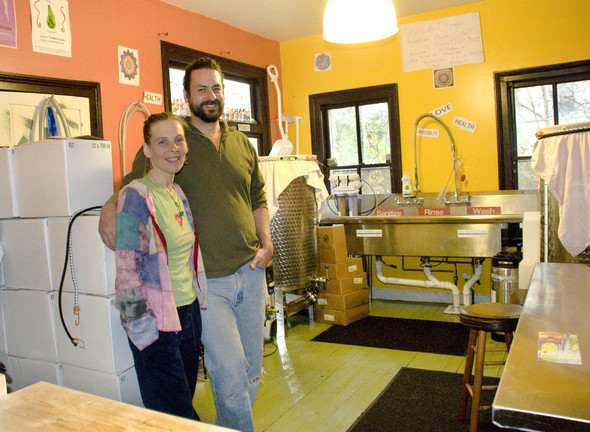
Rachel and Tarek Kanaan pictured in their home's kitchen which they had renovated to meet Michigan Department of Agriculture standards.
Tom Perkins | For AnnArbor.com
Filling up a pantry converted into a walk-in cooler at Rachel and Tarek Kanaan’s Ypsilanti home are 100 cases of ready-to-sell Unity Vibration Living Kombucha Tea. But when those cases will move to store shelves remains in question.
The Kanaan’s Unity Vibration is one of the small businesses many believe will play a significant role in turning around Michigan’s economy, but since July the once rapidly expanding operation has been shut down by a lengthy regulation process.
Over the summer, agencies at all levels began determining how to classify and regulate the relatively new but increasingly popular fermented tea. It contains 0.5 to 2 percent alcohol, and its status has been changed from “non-alcoholic” to “alcoholic.”
While that slow process takes place, the Kanaans are on financially shaky grounds and unsure how much longer they can sustain the business without any revenue.
In August 2009, $20,000 in retirement savings went toward renovating the Kanaans kitchen to meet Michigan Department of Agriculture standards and purchase the necessary stock and equipment. It also helped the parents of four, who brew from home, support their family as business picked up.
Their tea swiftly moved off shelves at over 20 different mom and pop grocers, Whole Foods and was a favorite at the Ann Arbor Farmer’s Market.
But it was brought to the Food and Drug Administration's attention that kombucha tea contains more than the 0.5 percent cap that is the limit on beverages labeled non-alcoholic. All kombucha tea brands nationally were pulled from store shelves, production halted and the regulatory journey began.
The succession of hurdles the Kanaans have cleared in recent months has depleted their savings, just as they were on the cusp of making solid profits.
“The last month of sales - we were just about to do it,” Tarek Kannan said.
“Financially, we’re living at the end of our retirement savings, so we’re ready to start making money. We’ve had to make so many phone calls, we told our story and we keep calling and reminding people that we’re fighting for our lives and fighting for our business.”
Kombucha tea is a fermented raw health drink that has a longer history in Russia and China, but was only relatively recently imported the United States. Its popularity increased significantly in recent years, and Unity Vibration is one of the new companies benefiting.
The organic tea is made from a living yeast and bacteria culture placed in water with sugar and different types of tea. The yeast produces the alcoholic content on which the bacteria feeds. Unity Vibration then adds fresh fruit juice from local farms.
After a fermentation period of 22 days, the process yields a unique, tart tea not too unlike sparkling apple cider, and it's known for being stocked with probiotics, beneficial acids, vitamins and minerals.
But kombucha tea also has very low levels of caffeine, which also presented an unforeseen regulatory problem in Michigan.
Tarek Kanaan said the effects of the caffeine and alcohol are negligible. He first tried kombucha tea around five years ago and immediately felt the positive effects. He described it not as an alcohol buzz or caffeine high, but “like your body is getting something healthy that it needs.”
Rachel Kanaan said she noticed it aided in digestion, and the vitamins, minerals and enzymes contribute to her overall health.
“I feel stronger, I feel like it helps build my immune system and helps me not get sick as much,” she said. “I start feeling more vibrant.”
In 2007 Rachel Kanaan brought home a culture and the husband and wife team started brewing their own teas. The name in part is derived from them coming together and creating the tea. Rachel Kanaan, who is Buddhist, said the name and the larger 25 ounce bottles also speaks for their desire for people to share the experience of drinking one. Friends and family loved the drink, requested more, and the business naturally evolved.
Tarek Kanaan worked for 10 years as an engineer at GM and Ford, then as a social worker for several years. Rachel Kanaan still occasionally works as a massage therapist, but their focus lies entirely on Unity Vibration. Less than a year into seriously starting a business, all indications pointed toward success.
By July 2010, the Kannans were selling around 80 cases of 12 bottles monthly. They didn’t use a distributor, and one 25 ounce bottle sold for between $8 and $10. A case went for $66, meaning they were grossing $5,200 monthly.
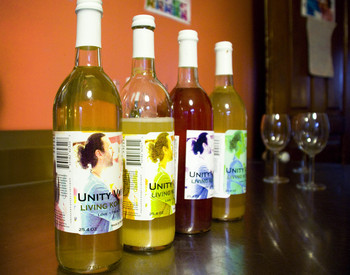
Unity Vibration offers five flavors of Kombucha Tea year-round and four seasonal drinks.
Tom Perkins | For AnnArbor.com
Then the FDA stepped in. Whole Foods was the first to pull all brands from the shelves and others quickly followed.
The first agency that needed to consider Unity Vibration was the United States Alcohol Tax Tobacco and Trade Bureau. The Kanaans quickly got their samples to the agency, but it was the first the TTB had encountered the tea, and no one knew whether to classify it as a beer or wine.
The days turned into weeks, so the Kanaans contacted Representative John Dingell’s office and explained the situation. Dingell’s office began making calls along with the Kanaan’s regular pleas for a swifter decision. Now, the tea is - in regulatory terms - a beer.
That took Unity Vibration to the next stop in their regulatory journey, the Michigan Liquor Control Commission. The LCC informed the Kanaans they would first need an alcohol distributor, which is required by law in Michigan.
Although their new status as a “beer” exempted them from selling at farmer’s markets and certain stores, it does provide them with access to a distributor with thousands of clients statewide and partnerships nationally. That could be the one blessing out of the ordeal, Kanaan said.
The LCC then informed the Kanaans the City of Ypsilanti would need to okay a home microbrewer’s license. Again, it added another several weeks onto the process, but Tarek Kanaan said the city officials he contacted - Mayor Paul Schreiber, Council Member Pete Murdock and Council Member Brian Robb - helped move the process along quickly.
On Nov. 8, City Council unanimously approved the license. But that celebration was short lived. The following morning, the LCC told the Kanaans that the drink contained alcohol and caffeine, and Michigan had just passed a ban on drinks like Four Loko that contained high levels of liquor, taurine and caffeine.
“This is the antithesis of those drinks,” Tarek Kanaan said.
Now the Kanaans are waiting to hear back from the LCC on how they will classify Unity Vibration Living Kombucha Tea so that it is not placed in the same category as Four Loko.
The waiting grows harder and harder, and Rachel Kanaan says she and Tarek spend a lot of time meditating these days.
“We are feeling stressed out, of course, because we really have run out of money,” she said.
“We are waiting and hoping people understand our situation and that they have compassion and will help us. We know that if it’s meant to be, it will happen. It’s been a long road for us but we know that its supposed to be that way for whatever reasons.”
Other companies have sidestepped the regulation process by "de-alcoholizing" the drinks. But the Kanaans say it changes the taste and texture of the drink as well as eliminates many of the beneficial nutrients from the drink. They say they want their tea to remain authentic.
Once business resumes, Unity Vibration is ready to officially hire help, though a number of friends and family members pitched in their services just to help out in the past.
The ultimate goal, the Kannans say, is growing their own food and ingredients on their own farm and keep the company at home in Ypsilanti.
Comments
Oscar Milde
Thu, Nov 18, 2010 : 11:36 a.m.
The amount of alcohol is so minimal, you'd have to drink bottles of this to feel any effects. And kids (or anyone else for that matter) are not going to shell out $8-$10 a bottle to get a buzz. By the way, their kombucha is delicious.
Soothslayer
Wed, Nov 17, 2010 : 11:39 p.m.
So if kids can purchase it because it wasn't flagged as an alcoholic beverage I'm not so sure that would ever be a good thing. Isn't there a way to somehow alter the pre/during/post process to reduce the alcohol without modifying the flavor/benefits?
John of Saline
Wed, Nov 17, 2010 : 4:41 p.m.
The federal government and agribusiness work hand in glove to push unhealthy food, as if they're trying to gin up business for the medical industry, yet finds time to protect we the sheeple from fermented tea that has a minuscule bit of alcohol? I hear tinfoil hats effectively block the government-industrial complex's mind-control rays. FYI.
Technojunkie
Wed, Nov 17, 2010 : 4:25 p.m.
Hooray! The reign of terror from roving bands of hooligans drunk on kombucha is over! All hail Big Brother! Ditto what JenM said. The federal government and agribusiness work hand in glove to push unhealthy food, as if they're trying to gin up business for the medical industry, yet finds time to protect we the sheeple from fermented tea that has a minuscule bit of alcohol? Petrochemical food additives are OK but kombucha is the devil's drink? Seriously?
leaguebus
Wed, Nov 17, 2010 : 3:58 p.m.
All the State needs to do is restrict its sale to those 21 and up and make sure its labeled that it contains some alcohol. How hard is that? How long would that take?
John of Saline
Wed, Nov 17, 2010 : 3:24 p.m.
I hope this is labeled as alcoholic, and not sold right next to normal iced tea. A fair number of people--including me--wouldn't be happy to accidentally buy an alcoholic drink because it wasn't in the beer-liquor section as it should be.
David
Wed, Nov 17, 2010 : 3:12 p.m.
I made Kombucha tea for myself a number of years ago, but quit because it was too much effort. However, I do remember enjoying the taste of it. Does seem a stretch, to consider it to be a beer. I wish the Kannans well and hope they get the necessary licenses soon. I would like to try it again.
emu2009
Wed, Nov 17, 2010 : 2:40 p.m.
So with being classified as a beer, I suppose they will have to stop marketing their Grapefruit Flavor as a kid favorite?
Jay Thomas
Wed, Nov 17, 2010 : 1:59 p.m.
Now I'm interested in trying Kombucha. The idea that because some people misuse alcohol (college students) we should all be treated like children has to stop. Prohibition was a failure, folks.;)
A24eva
Wed, Nov 17, 2010 : 12:59 p.m.
Doe the new Michigan law prohibiting alcohol and caffeine mean that bars will no longer be able to sell mixed drinks such a rum and coke?
frozenhotchocolate
Wed, Nov 17, 2010 : 12:52 p.m.
Really, open a business selling a product heavily taxed and regulated by the government and then get suprised when the government has something to say about something. They obviously opened their own store because there likes of kroger and such would not carry their product for obvious reasons. Duh.
Some Guy in 734
Wed, Nov 17, 2010 : 11:51 a.m.
Huh. Not sure why mine was cut off. Anyway, it seems that this indeed is dangerous stuff. Even with less than two percent alcohol, it looks to be potent enough to make a writer forget the basics of apostrophe use.
d_a2
Wed, Nov 17, 2010 : 11:45 a.m.
take a multi-vitamin
Ryan
Wed, Nov 17, 2010 : 11:35 a.m.
I drink Kombucha every once in a while. As an attorney, I personally find it head scratching funny (in the pathetic kind of way) that our laws consider it a "beer" legally. It goes to show that the post-prohibition laws just are not set up to deal with things like this. Maybe the new administration will take on an overhaul to Michigan's liquor laws. I hope it gets cleared up for you.
Some Guy in 734
Wed, Nov 17, 2010 : 11:34 a.m.
It would seem that
bedrog
Wed, Nov 17, 2010 : 10:20 a.m.
clownfish...agree with you 98% ( 100% on regs for drugs)...but i'll leave a 2% window of opportunity for artisinal and creative foodstuffs/producers, in the spirit of anthony bourdain /andrew zimmern and their 'if it looks good eat it!' adenturesome philosophy.
mkm17
Wed, Nov 17, 2010 : 9:39 a.m.
I feel bad that the Kanaans are caught in the middle of this regulatory mess. I feel especially bad that things are proceeding slowly, and sympathize that the Kanaans are fighting for their business. But I disagree that they are "fighting for their lives". I also question the implied causative relationship between the tea and "feeling more vibrant".
clownfish
Wed, Nov 17, 2010 : 9:37 a.m.
Darn straight Jen! i want my kids to be able to buy Four Loko out of vending machines at school! And Thalidomide should be an option for nausea during pregnancy! Really, do you "desperately need" caffeine and alcohol? I do sympathize with the Kaanans, but..if they are going to sell a food product, they have to go through the process like everybody else. Their product DOES contain alcohol, which society has determined should be regulated. Some recent history of products imported from China, filled with toxics, should make us appreciate our system, as imperfect as it is. The same argument that is made in favor of the Kanaans is in favor of Big Corp, they ALL have the "right" to produce product, and the govt has the duty (right?, power?) to regulate all of them. Kind of off topic, but too far...regulation of the food industry, why do we need it? From the CDC- We estimate that foodborne diseases cause approximately 76 million illnesses, 325,000 hospitalizations, and 5,000 deaths in the United States each year. Known pathogens account for an estimated 14 million illnesses, 60,000 hospitalizations, and 1,800 deaths.
clownfish
Wed, Nov 17, 2010 : 9:28 a.m.
Darn straight Jen! i want my kids to be able to buy Four Loko out of vending machines at school! And Thalidomide should be an option for nausea during pregnancy! Really, do you "desperately need" caffeine and alcohol? I do sympathize with the Kaanans, but..if they are going to sell a food product, they have to go through the process like everybody else. Their product DOES contain alcohol, which society has determined should be regulated. Some recent history of products imported from China, filled with toxics, should make us appreciate our system, as imperfect as it is. Kind of off topic, but too far...regulation of the food industrial, why do we need it? From the CDC- We estimate that foodborne diseases cause approximately 76 million illnesses, 325,000 hospitalizations, and 5,000 deaths in the United States each year. Known pathogens account for an estimated 14 million illnesses, 60,000 hospitalizations, and 1,800 deaths.
Plubius
Wed, Nov 17, 2010 : 9:18 a.m.
JenM - your statement is too limiting. You should have written: 'I am so, so tired of the public being "protected" from getting our hands on the comestibles we want'. Your analysis, however, is probably correct. The big corporations own the government and use it to shut down nascent competition.
JenM
Wed, Nov 17, 2010 : 9:05 a.m.
I am so, so tired of the public being "protected" from getting our hands on the nutrients we desparately need, yet being fed all manner of chemical un-foods from huge food corporations. (You want to talk about the disease called obesity?) Corporate CEO's want big, big profits. The Kanaan's just want to make some kind of honest living. Please. Our food supply is going to heck in the name of corporate profit. Wake up public citizens. The government has proven not to be on your side in this battle. And if you didn't realize there was a battle, reference your quickly declining health.